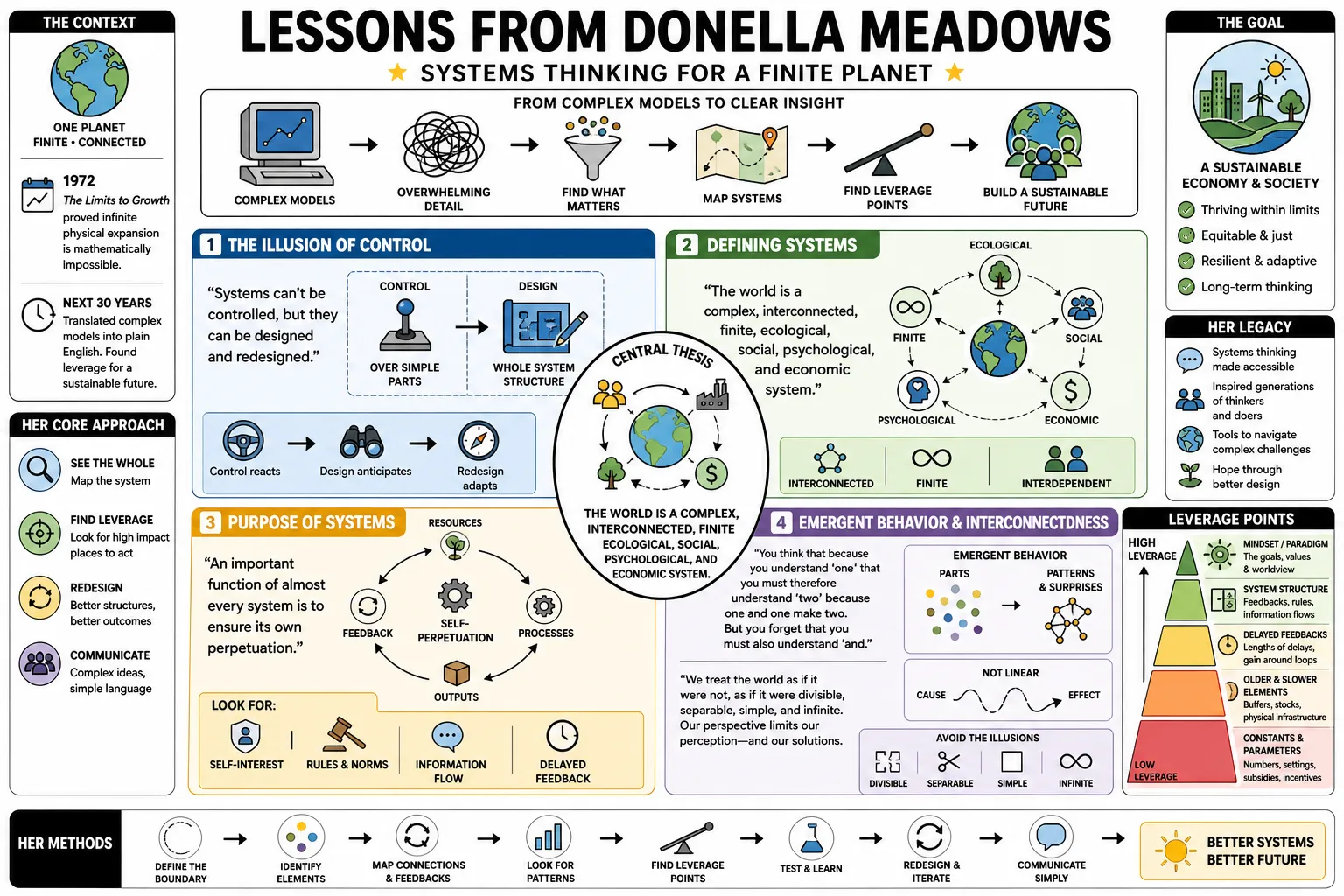
Donella Meadows led the team behind the 1972 Limits to Growth report, which used a global systems model to examine the consequences of continuing population and economic growth on a finite planet. She later wrote and taught about systems, feedback and leverage points. This profile revisits those ideas in her own essays and books. — The Limits to Growth — Club of Rome.
Part 1: The Basics of Systems
- On the Illusion of Control: Meadows argues that nonlinear feedback systems cannot be completely predicted or controlled, but can be redesigned while learning from surprises. — Dancing With Systems.
- On Defining Systems: A system is an interconnected set of elements organized around a function or purpose; examining the relationships and purpose matters as much as listing its parts. — Thinking in Systems.
- On Purpose: A system’s purpose is best inferred from what it actually does; preserving itself is an important function of many systems. — Thinking in Systems.
- On Emergent Behavior: Knowing the individual parts does not explain a system by itself; their interconnections help produce behavior that none of the parts can produce alone. — Thinking in Systems.
- On Interconnectedness: Environmental and social problems cross the boundaries of our usual categories; Meadows argues that treating an interconnected, finite world as separable obscures their system-level causes. — Harvesting One Hundredfold.
- On Respecting Systems: Before intervening, listen to what the system is doing and consider how its existing properties might work with human values. — Dancing With Systems.
- On Structural Failures: Look for mechanisms within a system that generate its behavior, not only the external events that trigger it. — Dancing With Systems.
- On Addiction: A quick fix to a symptom can become addictive when it delays the harder work of changing the conditions that produce the problem. — Thinking in Systems.
- On Complexity: Meadows advises respecting genuine complexity rather than forcing a simple explanation onto an interconnected system. — Dancing With Systems.
Part 2: The Limits to Growth
- On Denial: Meadows and her coauthors argued that cultural expectations of continuing material expansion make physical limits difficult to discuss, even though a finite planet cannot sustain exponential growth indefinitely. — Limits to Growth: The 30-Year Update — Synopsis.
- On Misplaced Faith: Technology and markets are useful tools, but Meadows and her coauthors warned that neither can offset unlimited growth if society leaves its underlying goals unchanged. — Limits to Growth: The 30-Year Update — Synopsis.
- On Inaction: In the 1972 model study, Meadows and her coauthors argued that delaying action is itself a consequential choice because system delays can make later corrections harder. — The Limits to Growth — Dartmouth Edition.
- On Exponential Math: Continued exponential growth in a finite system narrows the room for an orderly transition; the 1972 authors warned that delays matter before limits become obvious. — The Limits to Growth — Dartmouth Edition.
- On Default Outcomes: The 1972 scenarios did not treat business as usual as neutral: failing to respond to observed pressures increased the modelled risk of overshoot and collapse. — The Limits to Growth — Dartmouth Edition.
- On Blind Progress: Meadows and her coauthors endorsed a Sierra Club motto against blind progress, urging assessment of a technology’s side effects and of the next limit it might expose. — The Limits to Growth — Dartmouth Edition.
- On Technological Distractions: A technical fix can relieve a visible symptom while leaving the growth pressures that produced it intact; the original study urged combining useful technologies with deliberate attention to those pressures. — The Limits to Growth — Dartmouth Edition.
- On Final Boundaries: Meadows asked whether human expansion should be moderated before the resulting loss of habitat and species diversity, rather than after irreversible losses become obvious. — How Many Species Are Endangered?.
- On Earth’s Commandment: Meadows contrasted an economy organized around endless growth with the Earth’s finite stocks and regenerative rhythms: “enough” was her shorthand for living within them. — The Laws of the Earth and the Laws of Economics.
- On Non-Material Limits: Material throughput has physical limits; Meadows argued that compassion and love are capacities a sustainable society can draw upon rather than scarce commodities to hoard. — There Are Limits to Growth, But No Limits to Love.
Part 3: Leverage Points and Interventions
- On the Promise of Leverage: A small change at a leverage point can have large effects throughout a complex system, though finding the right point and direction takes careful study. — Leverage Points: Places to Intervene in a System.
- On Intuition Versus Action: Meadows recounts Jay Forrester’s observation that organizations often recognize a leverage point yet push it in the wrong direction; she warns that effective interventions can be counterintuitive. — Leverage Points: Places to Intervene in a System.
- On Rules: Changing a system’s rules—its incentives, constraints and degrees of freedom—can change behavior more deeply than adjusting its numerical parameters. — Leverage Points: Places to Intervene in a System.
- On Constant Parameters: Taxes, subsidies and other numerical parameters rank low on Meadows’s leverage-point list, but she explicitly allows exceptions when a parameter crosses a threshold or changes a stronger feedback loop. — Leverage Points: Places to Intervene in a System.
- On Self-Organization: A system’s capacity to diversify, experiment and evolve its own structure is a more powerful intervention point than changing physical stocks and flows alone. — Leverage Points: Places to Intervene in a System.
- On System Goals: Changing the overall goal of a system can redirect its rules, information flows and even its self-organizing behavior toward a different outcome. — Leverage Points: Places to Intervene in a System.
- On Information Flows: Changing who receives information can create a new feedback loop and alter behavior without changing prices or rebuilding physical infrastructure. — Leverage Points: Places to Intervene in a System.
- On Missing Feedback: Missing feedback can make a system malfunction; restoring information is most useful when it reaches the decision-maker in a compelling form. — Leverage Points: Places to Intervene in a System.
- On the Power of Paradigms: Shared assumptions about how the world works shape a system’s goals, rules, information flows and feedback loops. — Leverage Points: Places to Intervene in a System.
Part 4: Information and Feedback
- On Measurement: When GNP becomes society’s goal, the system works to raise GNP—even if that measure misses the outcomes people actually want. — Thinking in Systems.
- On Missing Values: A GNP target alone does not produce welfare, equity or justice; Meadows argues that desired outcomes must be stated as goals and measured or reported in their own right. — Thinking in Systems.
- On Muddy Data: Distorted, late or withheld information can prevent decision-makers from responding well and can destabilize the system they govern. — Dancing With Systems.
- On Clarity: Timelier, more accurate and more complete information can make a system work better by giving its decision-makers feedback they can use. — Dancing With Systems.
- On Unquantifiable Truths: Justice, freedom and love cannot be precisely measured, but that is no reason to exclude them from decisions about what a system should produce. — Dancing With Systems.
- On Defending Intangibles: If people do not speak up for hard-to-measure values, and systems are not designed to produce them, those values may disappear from practice. — Dancing With Systems.
- On Adapting Policies: For changing systems, Meadows recommends policies that adjust to feedback—and, under uncertainty, can even revise their own feedback rules as managers learn. — Dancing With Systems.
- On Truth to Power: Meadows urges people seeking a sustainable world to speak uncomfortable truths persistently to those with power, alongside taking action from love. — There Are Limits to Growth, But No Limits to Love.
- On Political Math: In a 2000 climate-policy column, Meadows warned that forest and farm carbon credits require both gains and losses to be counted; selective accounting could make an apparent reduction illusory. — No Point In Waiting Around For Leadership.
Part 5: Mental Models and Paradigms
- On Models: What we think we know about a system is a model of the world, not the world itself; useful models still leave out details that can surprise us. — Thinking in Systems.
- On Openness: Expose your mental model to challenge: invite alternative explanations and revise assumptions when evidence rules them out. — Dancing With Systems.
- On Ignorance: When you do not know how a system will respond, neither bluff certainty nor freeze; treat the gap as a reason to learn. — Dancing With Systems.
- On Learning: Learn through small experiments, close monitoring and a willingness to change course when a complex system responds unexpectedly. — Dancing With Systems.
- On Paradigms: A society’s paradigm consists of shared, often unstated assumptions about how the world works; these assumptions shape what its systems treat as normal or valuable. — Leverage Points: Places to Intervene in a System.
- On Paradigm Transcendence: Meadows ranks the capacity to stand outside any one paradigm above changing a paradigm: it permits continued learning when one worldview proves limited. — Leverage Points: Places to Intervene in a System.
- On Epistemic Humility: Every paradigm, including one’s own, is a limited account of a larger reality; Meadows treats this recognition as a safeguard against false certainty. — Leverage Points: Places to Intervene in a System.
- On Intellectual Flexibility: Remaining unattached to a single worldview lets a thinker select or revise a model for the purpose at hand, rather than defending it as complete truth. — Leverage Points: Places to Intervene in a System.
- On Staying a Learner: Trust experience and intuition, but expect surprises: incomplete mental models require monitoring results and correcting mistakes. — Dancing With Systems.
Part 6: Economics and Human Needs
- On Infinite Growth: Meadows described conventional economics as demanding that firms, national economies and consumption keep expanding; she contrasted that demand with finite earthly stocks. — The Laws of the Earth and the Laws of Economics.
- On Growth as a Goal: Growth is not an end in itself: Meadows urged readers to ask what is growing, who benefits, what it costs and when enough has been reached. — What Does Sustainability Mean?.
- On Defining Progress: Meadows argued that human progress should be judged by quality rather than sheer quantity, and that consumption alone is an inadequate measure of a good life. — There Are Limits to Growth, But No Limits to Love.
- On False Desires: A larger car can be marketed as a route to status, but Meadows argued that the deeper needs are self-respect, identity and belonging. — What Does Sustainability Mean?.
- On True Needs: Meadows named variety, beauty, challenge and a sense of purpose among needs that more clothing and other purchases cannot reliably satisfy. — What Does Sustainability Mean?.
- On the Trap of Materialism: When advertising promises that purchases will satisfy nonmaterial needs, the purchase can fail to deliver and stimulate another round of wanting; Meadows saw this as a self-reinforcing trap. — What Does Sustainability Mean?.
- On Inequality: In their 30-year update, Meadows and her coauthors described growth flowing disproportionately toward already wealthy countries and people rather than automatically closing the rich–poor gap. — Limits to Growth: The 30-Year Update — Synopsis.
- On Structural Poverty: Meadows and her coauthors treated persistent inequality as a structural feedback problem: simply running the same growth system faster would not by itself change who receives its gains. — Limits to Growth: The 30-Year Update — Synopsis.
- On Efficiency’s Cost: Meadows warned that judging farms only by cheap food or a narrow efficiency measure can conceal losses in stewardship, community, ecological health and farmers’ livelihoods. — There’s Farming and Then There’s Farming.
- On Redefining Ends: Meadows wrote that material accumulation is not the purpose of human existence; she treated quality of life and care for one another as more meaningful measures of progress. — There Are Limits to Growth, But No Limits to Love.
Part 7: Environmental Sustainability
- On the Meaning of Sustainable: Sustainability does not mean freezing society as it is: Meadows envisioned meeting human needs while preserving ecological capacity and allowing a richer, evolving social life. — Definition of Sustainability.
- On Quality Over Quantity: A sustainable society could pursue sufficiency and quality of life instead of treating ever-greater material consumption as the goal. — What Does Sustainability Mean?.
- On Soft Landings: The authors of the 30-year update describe a planned reduction in humanity’s ecological footprint as a possible alternative to collapse, while explicitly saying the better scenario is uncertain. — Tools for the Transition to Sustainability.
- On Farming’s Real Goal: Meadows’s sustainable-agriculture vision follows an organic farmer’s principle that farming should cultivate health—not just maximize food output. — Two Mindsets, Two Visions of Sustainable Agriculture.
- On Land Connection: Meadows described her farm as an enduring personal anchor, despite the work it demanded and her periodic thoughts of leaving it. — Though I Didn’t Grow Up on a Farm.
- On Ecological Pest Control: Instead of treating pesticides and genetic engineering as the only choices, Meadows advocates crop diversity, rotation and healthy soils that support pests’ natural enemies. — Two Mindsets, Two Visions of Sustainable Agriculture.
- On an Organic Transition: The coauthors argue that a sustainability transition cannot be ordered by a single authority; it would grow from many people’s visions, experiments and actions. — Tools for the Transition to Sustainability.
- On Shared Burden: No single person or group carries the entire transition; the coauthors say everyone can contribute without any one actor claiming the credit. — Tools for the Transition to Sustainability.
- On Community and Sustainability: Meadows’s proposed farm community joined sustainable land management with sharing, responsibility and conflict-resolution skills; she saw both ecological and social practice as necessary. — Dear Folks: March 24, 1996.
Part 8: Vision and Dancing with Systems
- On the Necessity of Vision: Before arguing over models or implementation, name the destination: Meadows treats a shared vision as a necessary guide for policy and a source of motivation. — Envisioning a Sustainable World.
- On Admitting Dreams: People often share complaints more readily than their hopes; Meadows argues that voicing the world we actually want can broaden what we try to achieve. — Envisioning a Sustainable World.
- On Vision as a Skill: Envisioning can be practiced: Meadows describes deliberately forming a vision, inviting others to refine it and returning to it when she loses direction. — Envisioning a Sustainable World.
- On Logic and Values: For Meadows, a responsible vision begins with values rather than technical analysis, while rational tools still help test whether that vision respects physical constraints. — Envisioning a Sustainable World.
- On Inventing the Future: A complex system’s exact future cannot be predicted, but Meadows argues that people can envision and help bring about a preferred future while learning from surprises. — Dancing With Systems.
- On Observing the Beat: Before trying to change a system, watch its behavior and history so an intervention responds to its actual dynamics rather than to a favored theory. — Dancing With Systems.
- On Full Humanity: Systems thinking needs more than calculation: Meadows also calls for intuition, compassion, vision and moral judgment when acting amid uncertainty. — Dancing With Systems.
- On Mastery: Meadows closes her leverage-point essay by warning that mastery does not come from force alone; it also takes hard analysis, humility and a willingness to let go of a fixed paradigm. — Leverage Points: Places to Intervene in a System.
- On Human Potential: Meadows rejected the idea that people are fatally flawed or helpless; she warned that believing change is impossible can itself paralyze action. — If We Believe That It’s Effectively Over.