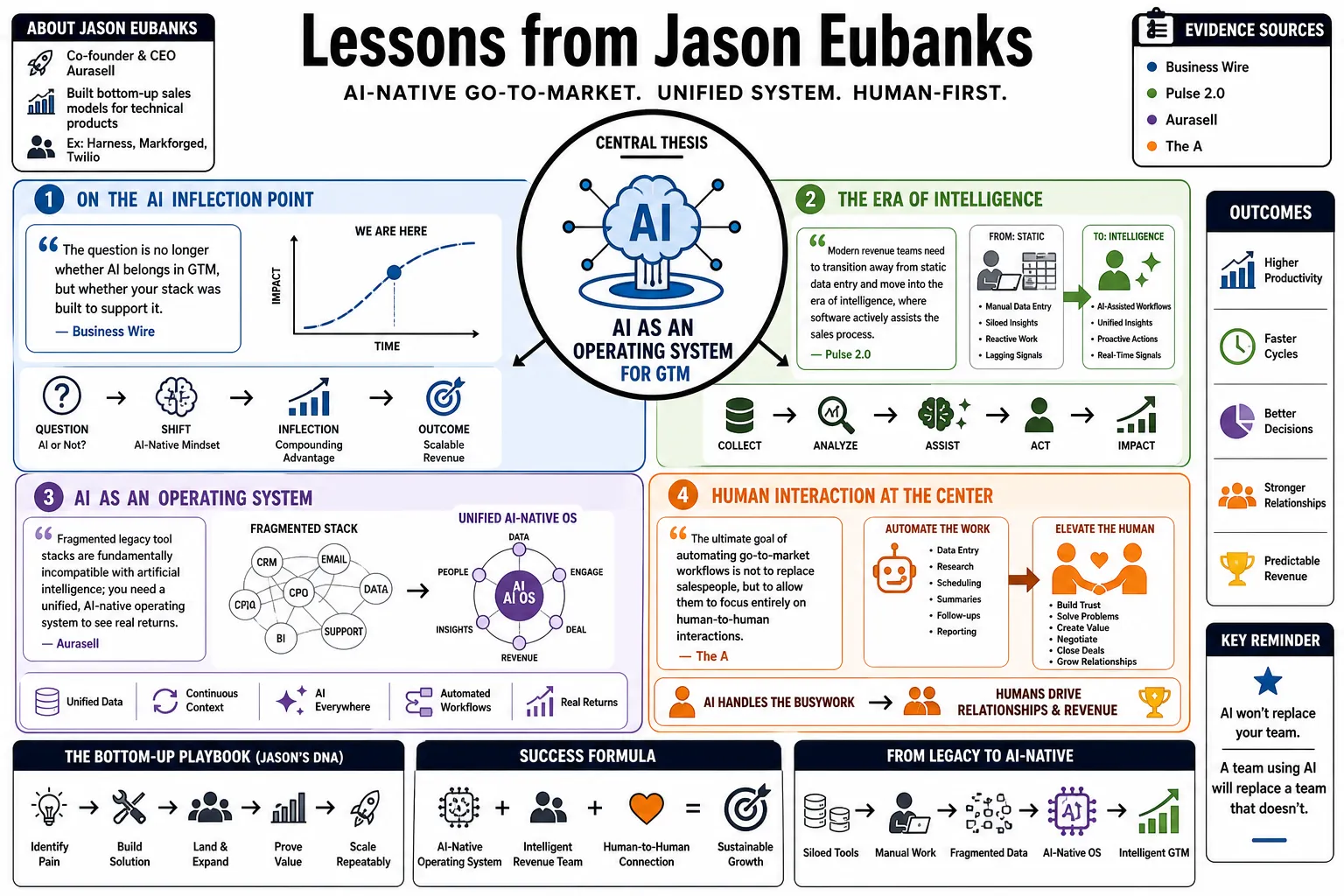
Lessons from Jason Eubanks
Jason Eubanks is the co-founder and CEO of Aurasell, an AI go-to-market platform. He previously ran sales at Harness, Markforged, and Twilio, where he specialized in building bottom-up sales models for technical products. This profile gathers his thoughts on selling to developers, scaling revenue teams, and modernizing sales software.
Part 1: The AI-Native Go-to-Market
- On the AI Inflection Point: "We're at an inflection point where the question is no longer whether AI belongs in GTM, but whether your stack was built to support it." — Source: Business Wire
- On the Era of Intelligence: "Modern revenue teams need to transition away from static data entry and move into the era of intelligence, where software actively assists the sales process." — Source: Pulse 2.0
- On AI as an Operating System: "Fragmented legacy tool stacks are fundamentally incompatible with artificial intelligence; you need a unified, AI-native operating system to see real returns." — Source: Aurasell
- On Human Interaction: "The ultimate goal of automating go-to-market workflows is not to replace salespeople, but to allow them to focus entirely on human-to-human interactions." — Source: The Agile Brand Guide
- On Legacy Constraints: "Tools built a decade ago were not designed for autonomous action, limiting how much value modern AI can actually extract from them." — Source: SalesTechStar
- On Defining AI-Native: Eubanks frames Aurasell as an AI-native GTM system built around unified data, contextual awareness, and agentic automation rather than AI added onto legacy CRM architecture. — Reference: Pulse 2.0 interview with Jason Eubanks
- On Go-to-Market Evolution: "The way companies go to market is fundamentally shifting; relying on brute-force outbound strategies is becoming less effective than precision AI targeting." — Source: Demand Gen Report
- On Agentic Workflows: "We are moving toward a reality where GTM operators can design and deploy agentic workflows using natural language instead of complex coding." — Source: Business Wire
- On Data Unification: "AI cannot function effectively if your customer data is scattered across five different platforms that barely talk to one another." — Source: RevOps Coop
- On the Role of the Rep: Eubanks says AI should remove cross-system work so sellers can spend more time on relationship building, nuance, trust, and human-to-human selling. — Reference: Pulse 2.0 interview with Jason Eubanks
Part 2: Eliminating Tool Sprawl and Tech Debt
- On Tool Sprawl: "Revenue teams are overwhelmed by the sheer number of applications they are required to update daily, leading to massive inefficiencies." — Source: Pulse 2.0
- On Legacy Fragmentation: "Replacing fragmented legacy stacks is essential because cobbling together a dozen point solutions creates friction rather than speed." — Source: Aurasell
- On Tech Debt in Sales: "Sales organizations accumulate technical debt just like engineering teams do, often in the form of abandoned Salesforce plugins and unused enablement tools." — Source: RevOps Coop
- On Context Switching: "Forcing account executives to switch between six different tabs just to send a follow-up email destroys their momentum and focus." — Source: The Agile Brand Guide
- On Consolidation: "The market is exhausted by point solutions; the next wave of enterprise software is about consolidation around intelligent systems." — Source: Demand Gen Report
- On Integration Costs: "The hidden cost of a fragmented GTM stack is the immense engineering and RevOps hours required just to keep the integrations from breaking." — Source: SaaStr
- On Data Silos: "When marketing, sales, and customer success operate out of different databases, the customer experience inevitably suffers." — Source: Medium
- On Simplifying the Stack: Eubanks argues that GTM stacks have become fragmented and tool-heavy, and that Aurasell aims to collapse many disconnected tools into one automated platform. — Reference: Pulse 2.0 interview with Jason Eubanks
- On ROI of Sales Tech: "If a tool requires more time to manage than it saves in execution, it is a liability, not an asset." — Source: SalesTechStar
- On System Architecture: Aurasell is described as using a unified data model and agentic logic engine so revenue workflows are connected across the full contact-to-contract lifecycle. — Reference: Pulse 2.0 interview with Jason Eubanks
Part 3: Selling to Technical Audiences
- On the Developer Persona: "You cannot market to developers the way you market to traditional executives; they want to see the documentation and the API, not a slide deck." — Source: Medium
- On Bottom-Up Adoption: "The most powerful enterprise sales motions often start with a single engineer finding value in a free tier and championing it internally." — Source: SaaStr
- On Technical Credibility: "Sales teams selling to DevOps or engineering must have technical credibility; if you can't speak their language, you've already lost the deal." — Source: Medium
- On Product-Led Evidence: "Technical buyers trust product telemetry over sales promises. Show them how their team is already using the tool." — Source: Pulse 2.0
- On Frictionless Trials: "When selling to developers, any friction between them and a working sandbox environment is a reason for them to abandon the process." — Source: The Agile Brand Guide
- On Navigating Open Source: "Competing with or complementing open-source tools requires understanding why engineers chose the open-source route in the first place." — Source: SaaStr
- On the Role of Sales Engineers: Eubanks's own background spans systems engineering, solutions architecture, pre-sales, services, and sales leadership, which helps explain his bias toward technical credibility in enterprise GTM. — Reference: Stackforce profile of Jason Eubanks
- On Value Realization: "Technical audiences do not care about hypothetical ROI; they care about how quickly they can deploy and see a functional result." — Source: Demand Gen Report
- On Overcoming Skepticism: Eubanks treats legacy-CRM skepticism as understandable, then redirects the question to whether current architecture improves productivity, predictability, SaaS cost, and revenue execution. — Reference: Pulse 2.0 interview with Jason Eubanks
- On Transitioning to the Enterprise: "Moving from a developer-focused tool to an enterprise-wide deployment requires shifting the conversation from features to security, compliance, and governance." — Source: Medium
Part 4: Scaling Revenue from $1M to $100M+
- On Early Stage Growth: "Getting from zero to one requires a completely different mindset than getting from one to ten; early on, it is about survival and product-market fit." — Source: SaaStr
- On Predictable Revenue: Eubanks says customers value stronger forecasting, better pipeline visibility, faster sales velocity, and more predictable revenue operations when manual GTM work is automated. — Reference: Pulse 2.0 interview with Jason Eubanks
- On Hiring Profiles: "The type of account executive you hire at $5 million in ARR is rarely the same profile you need at $50 million." — Source: Medium
- On Managing Churn: "Growth is impossible if you have a leaky bucket; scaling revenue requires as much focus on retention as it does on net new logos." — Source: Demand Gen Report
- On Sales Process Evolution: "A sales process that works perfectly at 20 employees will completely break down at 200 if it is not constantly refined." — Source: SaaStr
- On Territory Design: "Effective territory management is critical for scale; if reps are fighting over accounts, they aren't fighting competitors." — Source: RevOps Coop
- On Forecasting Accuracy: "As you scale, the tolerance for missed forecasts drops to zero. Rigor in pipeline management becomes the most important metric for a CRO." — Source: Pulse 2.0
- On Leadership Transitions: Eubanks's operating story is built around scaling revenue organizations from early stages through IPO and large-company growth, with lessons drawn from Harness, Markforged, Twilio, and Meraki. — Reference: Pulse 2.0 interview with Jason Eubanks
- On Pricing Power: "As the product matures, you must develop the confidence to capture the value you are creating, which often means restructuring pricing mid-flight." — Source: Medium
Part 5: Sales-Led vs. Product-Led Growth
- On the PLG Mirage: "Many companies think product-led growth means they don't need a sales team, but true enterprise PLG eventually requires a sophisticated sales motion to capture the upper market." — Source: SaaStr
- On Combining Motions: "The most resilient revenue engines combine a frictionless product-led entry point with a highly targeted sales-led expansion strategy." — Source: Medium
- On Identifying Triggers: "In a PLG model, sales should only engage when specific product usage triggers indicate the account is ready for an enterprise conversation." — Source: Demand Gen Report
- On Compensating Hybrid Teams: Eubanks presents Aurasell as flexible enough to run as a full AI-native CRM or coexist with legacy CRM systems through bidirectional integration and use-case-based automation. — Reference: Pulse 2.0 interview with Jason Eubanks
- On Customer Success in PLG: "In product-led environments, the customer success function often morphs into a revenue-generating role focused on driving utilization and expansion." — Source: RevOps Coop
- On Top-Down Resistance: The Agile Brand frames Aurasell around simplifying how teams prospect, sell, manage, and operate with one AI-driven GTM engine, making adoption about operational relief rather than another point tool. — Reference: One Amazing Thing episode with Jason Eubanks
- On Data-Driven Selling: "Sales-led growth in a PLG company relies entirely on product telemetry; if the sales team cannot see how the customer is using the app, they are flying blind." — Source: Pulse 2.0
- On Enterprise Requirements: "Eventually, PLG hits a ceiling where enterprise features like single sign-on and compliance require traditional sales engagement to navigate procurement." — Source: SaaStr
- On Alignment: "The tension between product teams optimizing for signups and sales teams optimizing for deal size must be managed through shared revenue goals." — Source: Medium
Part 6: Autonomous Agents and the Future of Sales Workflows
- On Agent Builder: "Allowing operators to build agents with natural language lowers the barrier to entry and fundamentally democratizes workflow automation in sales." — Source: Business Wire
- On Replacing Routine: "Autonomous agents are best utilized not for complex negotiations, but for eliminating the mundane, repetitive tasks that drain a seller's energy." — Source: SalesTechStar
- On Workflow Fragility: Eubanks says Aurasell has evolved from CRM automation into an agentic GTM platform that observes, coordinates, and executes work across teams and the customer lifecycle. — Reference: Pulse 2.0 interview with Jason Eubanks
- On Prompting vs. Coding: "The future of revenue operations is less about writing Python scripts and more about engineering precise prompts for AI agents." — Source: The Agile Brand Guide
- On Contextual Action: "An autonomous sales agent is only valuable if it understands the context of the deal; otherwise, it is just generating noise." — Source: Aurasell
- On Scaling Outreach: "AI agents allow companies to execute personalized, high-touch outbound strategies at a scale that was previously physically impossible." — Source: Demand Gen Report
- On Real-Time Coaching: "The next frontier of sales AI is agents that act in the background during calls, providing real-time data and suggestions to the representative." — Source: Pulse 2.0
- On Data Hygiene: "Autonomous agents can finally solve the CRM data hygiene problem by updating records automatically based on email and call interactions." — Source: RevOps Coop
- On Trusting AI: Eubanks emphasizes keeping people in the loop: AI should automate manual systems work while leaving judgment, relationships, trust, and value exchange to humans. — Reference: Pulse 2.0 interview with Jason Eubanks
Part 7: Building and Leading High-Performance Revenue Teams
- On Culture and Execution: "You can have the best product in the world, but if your sales culture lacks accountability and execution, you will lose to inferior competitors." — Source: SaaStr
- On Continuous Enablement: "Sales training cannot be a once-a-year event; it must be embedded in the daily workflow and directly tied to pipeline generation." — Source: Medium
- On Hiring the Right Traits: The Agile Brand bio highlights Eubanks as a multi-time CRO and GTM leader with more than two decades of experience building high-performance revenue teams. — Reference: One Amazing Thing episode with Jason Eubanks
- On Managing Through Change: "Leading a team through hyper-growth requires transparent communication about what is breaking and how leadership plans to fix it." — Source: The Agile Brand Guide
- On Cross-Functional Trust: "A successful CRO must build deep trust with the CMO and the Head of Product, as revenue is a team sport." — Source: Demand Gen Report
- On Recognizing Burnout: "Sales is a grueling profession. Leaders must actively monitor their top performers for burnout before it impacts retention and morale." — Source: Pulse 2.0
- On the Importance of Frontline Managers: "Frontline sales managers are the most critical layer in the organization; they translate strategy into daily execution." — Source: SaaStr
- On Promoting from Within: "Building a farm system where SDRs can reliably become AEs is essential for maintaining culture and scaling efficiently." — Source: RevOps Coop
- On Feedback Loops: Eubanks says the best signal comes when early customers replace multiple tools quickly after seeing the platform solve real GTM workflow problems. — Reference: Pulse 2.0 interview with Jason Eubanks
Part 8: Evolution of the Modern GTM Stack
- On End of an Era: "The days of buying software just to store passive customer data are over; systems of record must become systems of action." — Source: Business Wire
- On Platform Shifts: "Just as we moved from on-premise to cloud, we are now moving from static cloud applications to intelligent, predictive platforms." — Source: SalesTechStar
- On Data Centralization: "The modern stack requires a single source of truth; if revenue operations cannot trust the data, they cannot optimize the process." — Source: Medium
- On Buyer Expectations: "Buyers today expect a consumer-grade experience in B2B sales. If your GTM stack creates friction for the buyer, they will go elsewhere." — Source: Demand Gen Report
- On Measuring Velocity: "The most important metric the modern stack must measure is deal velocity: where are deals stalling, and why?" — Source: Pulse 2.0
- On Vendor Consolidation: "CFOs are demanding that CROs justify every license. The trend is moving rapidly toward platforms that can replace multiple point solutions." — Source: SaaStr
- On Interoperability: "If a new tool cannot seamlessly write data back to the core system of record, it should not be introduced into the stack." — Source: RevOps Coop
- On Agile RevOps: "Revenue Operations must transition from a reactive support function to a proactive, strategic driver of go-to-market architecture." — Source: The Agile Brand Guide
- On Future Proofing: Eubanks's future roadmap points toward agents that observe and automate manual tasks outside the platform, with shared standards for agentic marketplaces and cross-platform interoperability. — Reference: Pulse 2.0 interview with Jason Eubanks