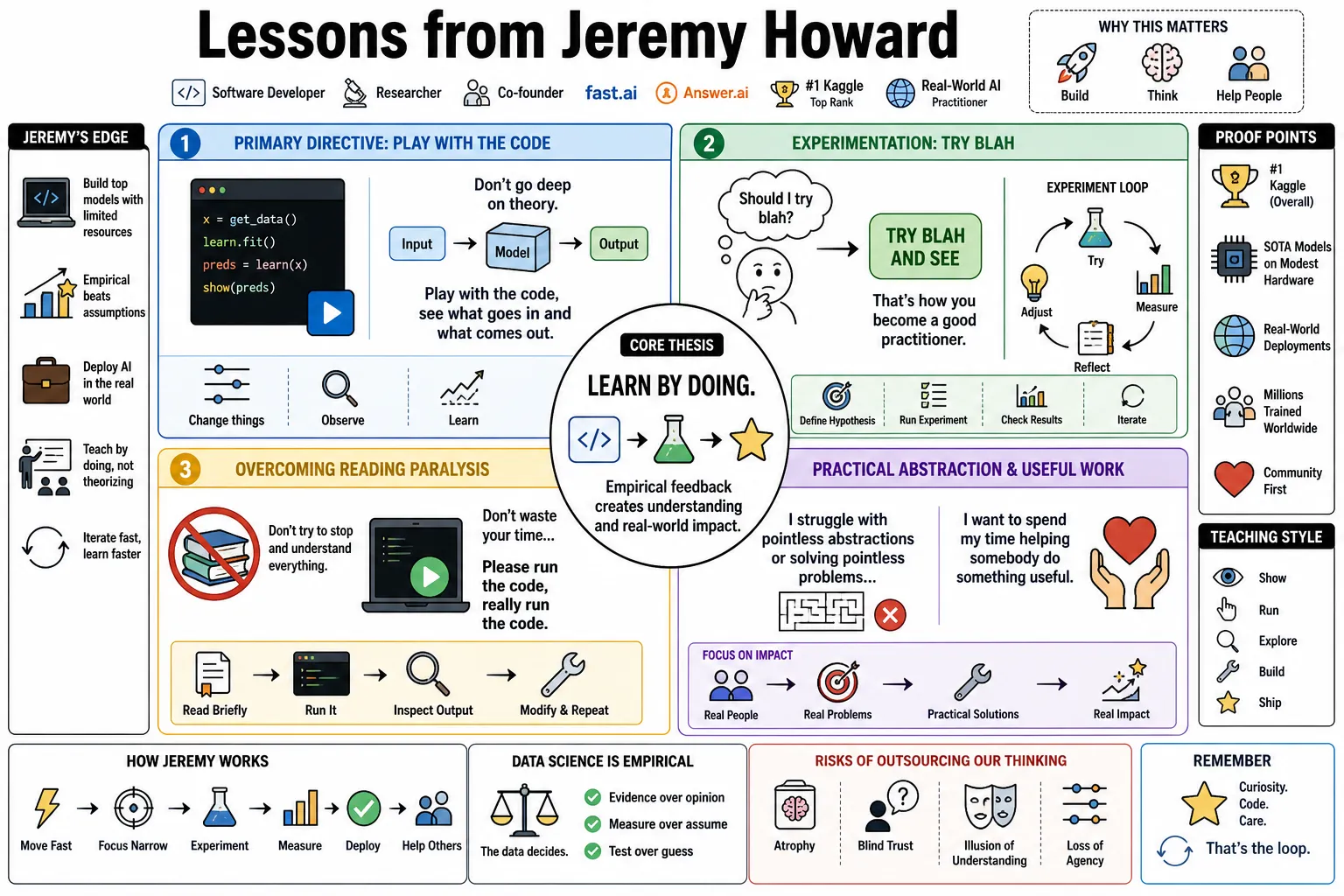
Jeremy Howard is a software developer, researcher, and the co-founder of fast.ai and Answer.ai. He is known for building top-performing deep learning models with limited resources, reaching the #1 rank globally on Kaggle, and teaching practitioners how to deploy AI in the real world. This collection compiles his most specific insights on how adults actually learn complex subjects, why data science is inherently empirical, and the overlooked risks of outsourcing our thinking to machines.
Part 1: The Practice of Deep Learning
- On the primary directive of practice: "Don't go deep on theory. Play with the code, see what goes in and what comes out." — Source: fast.ai Course
- On experimentation: "The answer to the question ‘Should I try blah?’ is to try blah and see. That’s how you become a good practitioner." — Source: fast.ai Lesson 5
- On overcoming reading paralysis: "Don't try to stop and understand everything. Don't waste your time... Please run the code, really run the code." — Source: fast.ai Tutorials
- On practical abstraction: "I struggle with pointless abstractions or solving pointless problems... I want to spend my time helping somebody do something useful." — Source: Chai Time Data Science
- On questioning defaults: "When you see something in a library, don't assume that it's right or that it makes sense. When it comes to deep learning, none of us know what we're doing." — Source: fast.ai Forums
- On resource myths: "To become effective researchers, they are not really limited by compute or data the vast majority of the time... that impression is an accident of how things are reported." — Source: Lavanya Shukla Interview
- On removing prestige: "We want to make neural nets uncool again." — Source: fast.ai Mission Statement
- On the accessibility of impact: "The vast majority of the world is like us [arts graduates]... that doesn't mean that people like us have nothing to contribute." — Source: PyTorch Conference 2025
- On empirical reality: "The world of machine learning has become very empirical... the difference between theory and practice is so huge." — Source: Kaggle Interviews
- On the core goal of machine learning: "The whole point of machine learning is to identify which variables actually matter the most, and how do they relate to each other and your dependent variable together." — Source: Kaggle Masterclasses
Part 2: Data Science and Kaggle Strategy
- On winning through combination: "I'm slightly embarrassed too, because all I really did was to combine the clever techniques that others had already developed — I didn't really invent anything new, I'm afraid." — Source: Kaggle Chess Competition Reflection
- On daily incrementalism: "I just spent a bit of time on it each day. And just came up with simple, more simple common sense things to try. And each time... some of them did put me a bit higher and a bit higher." — Source: Kaggle Journey Interview
- On early prototyping: "My approach to this competition was to first analyze the data in Excel pivottables. I looked for groups which had high or low application success rates." — Source: Kaggle Forum Posts
- On where the value lives: "If you've ever seen a top model you'd know the key is the data. The top people on Kaggle are great at data wrangling and data cleansing." — Source: Quora ML discussions
- On distinguishing disciplines: "Data science is not software engineering. There's a lot of overlap… but what we're doing right now is prototyping models." — Source: Chai Time Data Science
- On public accountability: "I entered with my real name to kind of maximize the pressure on myself to like do my best I could." — Source: Lex Fridman Podcast
- On studying competitors: "When I looked at the people that were in the top 10 they were all like PhDs and professors... I thought okay well at the very least I'll learn from them at the end of the competition to see what they do." — Source: Data Science Interviews
- On community platforms: "I treat it [Kaggle] as a platform for communicating to people rather than a compute environment for sure." — Source: fast.ai Forums
- On valuing the journey: "I suspect in many ways the process is more interesting than the result, since the lessons I learnt will perhaps be useful to others in future competitions." — Source: Kaggle Blog
- On the nature of rapid iteration: "The ability to continuously analyze, prototype, and refine data models in real-time is a priority." — Source: fast.ai Methodology
Part 3: Learning How to Learn
- On meta-learning: "If you're not spending a significant portion of your early learning, learning how to learn, then you're going to be at a disadvantage." — Source: Sources and Methods Podcast
- On the failure of formal education: "Spending 12 years at school learning things, but nobody ever taught you how to learn, is the dumbest thing I've ever heard." — Source: Sources and Methods Podcast
- On pedagogical sequencing: "We use the 'top-down' approach... we start by showing how to use a complete, working, very usable, state-of-the-art deep learning network to solve real-world problems... and then we gradually dig deeper." — Source: fast.ai Philosophy
- On repetition: "You should generally plan to go through the lessons 2-3 times, going a bit deeper each time, since stuff you learn later will help clarify things earlier." — Source: fast.ai Course Documentation
- On memory and exceptionalism: "Exceptional people take a lot of notes. Less exceptional people assume they're going to remember." — Source: fast.ai Lectures
- On the utility of AI tutors: "AI is actually great at helping you learn... you can ask it to find good resources for you to help you with misunderstandings." — Source: Answer.ai Announcements
- On the difference between consumption and production: "It is easy to just consume outputs. But building the intuition of how systems actually behave requires actively querying them until they break." — Source: Weights & Biases Interview
- On dialogue engineering: "If you're in constant dialogue with AI, you can recalibrate what would be a hallucination." — Source: GTC Conference 2026
- On maintaining a human core: "We just use this really different approach where the human is considered a vitally important part of the process." — Source: fast.ai Blog
- On community support: "I try to pick a software platform that's as easy to use and flexible and nice as possible... and then tried to like really genuinely answer every question that people asked." — Source: fast.ai Forum Origins
Part 4: Medical AI and Real-World Applications
- On shifting physician roles: "The theory is that we can take the middle part of the medical process and turn that into data analysis as much as possible, leaving doctors to do what they're best at." — Source: 2014 TED Talk
- On solving global bottlenecks: "The number of doctors in the developing world is 10–20 times less than what is needed... If computers can learn to fill these roles, lives will be saved." — Source: Enlitic Founding Vision
- On diagnostic superiority: "Enlitic's systems putatively can judge the malignancy of nodules up to 50 percent more accurately than a panel of radiologists." — Source: Enlitic Press Release
- On finding novel biological markers: "In cancer diagnosis, a computer analyzed tumors and discovered some features unknown to human doctors that can help predict survival rate and treatment." — Source: 2014 TED Talk
- On freeing up human bandwidth: "This leaves doctors more time to gather input data and apply treatments." — Source: Enlitic Founding Vision
- On the expert paradox in tech: "So myself as somebody with no previous background in medicine, I seem to be entirely well-qualified to start a new medical company... doing very useful medicine using just data analytic techniques." — Source: TEDx Presentations
- On the distraction of philosophy: "I think that people get distracted by whether computers can 'really think' or 'really feel'... whilst interesting philosophical questions, they are of little impact to the important issues impacting our economy today." — Source: AI in Medicine Conferences
- On the nature of algorithmic perception: "Computers are being presented with pictures, and being told what they are pictures of. And they are learning to recognize them on their own. This is what humans do too." — Source: 2014 TED Talk
- On the scale of deep learning: "Deep learning is an algorithm... which has no theoretical limitations on what it can do. The more data you give it and the more computation time you give it, the better it gets." — Source: 2014 TED Talk
Part 5: Open Source and the AI Balance of Power
- On the necessity of open source: "Open source is the backbone of all leading artificial intelligence software. With open source, the entire community comes together to collaborate on solving the toughest problems." — Source: IBM Open Source Panel
- On open vs. closed models: "Open-source models like DeepSeek and Qwen are quietly outpacing closed-source giants... the best new AI is coming out of China." — Source: Answer.ai Blog
- On collaboration outperforming isolation: "If you create something that you allow more people to use to build on top of to cooperate... obviously that's going to be better than ivory towers." — Source: PyTorch Conference 2025
- On regulatory targets: "Instead of regulating the development of AI models, the focus should be on regulating their applications, particularly those that pose high risks to public safety." — Source: Marginal Revolution Discussions
- On the general purpose tool fallacy: "The creator of a model can not ensure that a model is never used to do something harmful – any more so that the developer of a web browser, calculator, or word processor could." — Source: fast.ai Forums
- On liability and big tech: "Placing liability on the creators of general purpose tools like these mean that, in practice, such tools can not be created at all, except by big businesses with well funded legal teams." — Source: AI Safety Hearings
- On societal defense: "The balance between defending society and empowering society to defend itself is delicate... Proposals for stringent AI model licensing and surveillance will likely be ineffective or counterproductive." — Source: AI Policy Essays
- On the future of corporate scale: "The future belongs to small, nimble teams who build for societal benefit, not just profit." — Source: Answer.ai Manifesto
- On democratizing defense: "When you put technology into the hands of society as a whole, then people learn from it, they defend with it, they become engaged with it." — Source: PyTorch Conference 2025
Part 6: Artificial General Intelligence and True Risks
- On the UI illusion: "I don't think we have any more evidence that ASI might be close now than we did 15 years ago... our brains think we're dealing with a different kind of thing because of natural language interfaces." — Source: The MAD Podcast 2025
- On shifting goalposts of AGI: "Basically we had all these definitions of AGI that we have surpassed... Now we are finding more edge cases where we go 'ahh... it can't do this so therefore it isn't intelligent.' But lots of humans can't do them either." — Source: Hacker News Interviews
- On the actual threat of AI: "The real risk of AI is how it concentrates power." — Source: fast.ai Blog
- On the dystopia of restricted access: "If only rich and powerful people can use it... it's going to be like killer drones and global surveillance." — Source: PyTorch Conference 2025
- On autonomous recursion: "The first red line: No fully automated self-improvement where AI designs and trains its own successor without human oversight." — Source: Machine Learning Street Talk
- On dangerous capabilities: "The second red line: No expert-level virology or offensive cyber capabilities made accessible without safeguards." — Source: Machine Learning Street Talk
- On weight security: "The third red line: Ensuring that model weights for highly capable systems have rigorous security to prevent theft or misuse." — Source: Machine Learning Street Talk
- On the AI pause movement: "Calling for a pause on AI development only benefits incumbents... avoiding extinction is often used as a vague justification for policies that limit open-source competition." — Source: fast.ai Policy Posts
- On pragmatic optimism: "Being paranoid, being anxious, being afraid of living your life and of building a better world seems like a very silly and not very pragmatic thing to do." — Source: Lex Fridman Podcast #380
Part 7: Productivity, Tools, and the Cost of Vibe Coding
- On the speed of feedback: "My rule of thumb is that if something takes more than 10 seconds to run, it's too long for me to do interactive analysis with it." — Source: Kaggle Workflows
- On reducing friction: "The idea of preparing your workspace to do a task is becoming like inconceivable... it's like the architect sharpening his pencils... you're putting in all the pieces to say 'Okay, I'm ready to work.'" — Source: fast.ai Setup Guides
- On keyboard mastery: "Don't waste your time, learn Jupyter keyboard shortcuts. Learn 4 to 5 each day." — Source: fast.ai Lesson 1
- On the virtue of laziness: "My interest in improving ML workflows comes from my extreme laziness... So I want to write as little code as possible." — Source: fast.ai Library Design
- On the hazard of vibe coding: "Vibe coding is a slot machine... you have an illusion of control... but anytime I've made any attempt at getting an LLM to design a solution to something that hasn't been designed lots of times before, it's horrible." — Source: GTC Conference 2026
- On human enfeeblement: "If you've outsourced all of your thinking to computers for the last few years, you've stopped becoming a more competent human being." — Source: PyTorch Conference 2025
- On obsolescence: "You've stopped upskilling, you've stopped learning... and you're going to be in a group of people that is of no use to anybody." — Source: PyTorch Conference 2025
- On the fork in developer evolution: "The AI agent revolution promises to make everyone more productive, yet developers are abandoning the very practices that lead to understanding, mastery, and software that lasts." — Source: fast.ai Blog
- On the rise of super-learners: "People who use AI the wrong way are going to get worse and worse. And the people who use it to learn more and learn faster are going to outpace the speed of growth of AI capabilities." — Source: PyTorch Conference 2025
Part 8: The Reality of Academic Research and The Future
- On academic incentives: "Most of the research in the deep learning world is a total waste of time... The academic world just has no reason to care about practical learning." — Source: Lex Fridman Podcast #35
- On the power of transfer learning: "I only want to teach people practical stuff and I think the only practical stuff is transfer learning... It’s understudied in academia." — Source: Lex Fridman Podcast #35
- On ignoring boundaries: "I couldn't find any examples of transfer learning in NLP. So I just did it... and it smashed the state-of-the-art on one of the most important data sets in a field that I knew nothing about." — Source: Lex Fridman Podcast #35
- On active learning: "Active learning is the study of how do we get more out of the human beings in the loop... it's almost nobody working on it because it's just not a trendy thing right now." — Source: Lex Fridman Podcast #35
- On practical reinvention: "Everybody kind of reinvents active learning when they actually have to work in practice because they start labeling things and they think, 'Gosh, this is taking a long time and it's very expensive.'" — Source: Lex Fridman Podcast #35
- On the nature of generative inference: "No matter how good your generative model is, you can always make it better if you can find a way to run it multiple times during inference." — Source: Lex Fridman Podcast #380
- On continuous improvement: "Each year, we try to get to a point where the course covers twice as much as the previous year, with half as much code, with twice the accuracy at twice the speed." — Source: fast.ai Course Milestones
- On future baselines: "I always assume that the best thing out there right now is far short of what the best thing could be. That in five to ten years' time, there'll be something better." — Source: Lex Fridman Podcast #380
- On the unending shift: "The machine learning revolution is going to be very different to the industrial revolution because... it never settles down. The better computers get at intellectual activities, the more they can build better computers to be better at intellectual capabilities." — Source: 2014 TED Talk