Ana Andjelic is one of the most influential brand strategists of the modern era, known for her work with brands like Esprit, Mansur Gavriel, and Banana Republic. Her work focuses on the intersection of sociology, luxury, and technology.
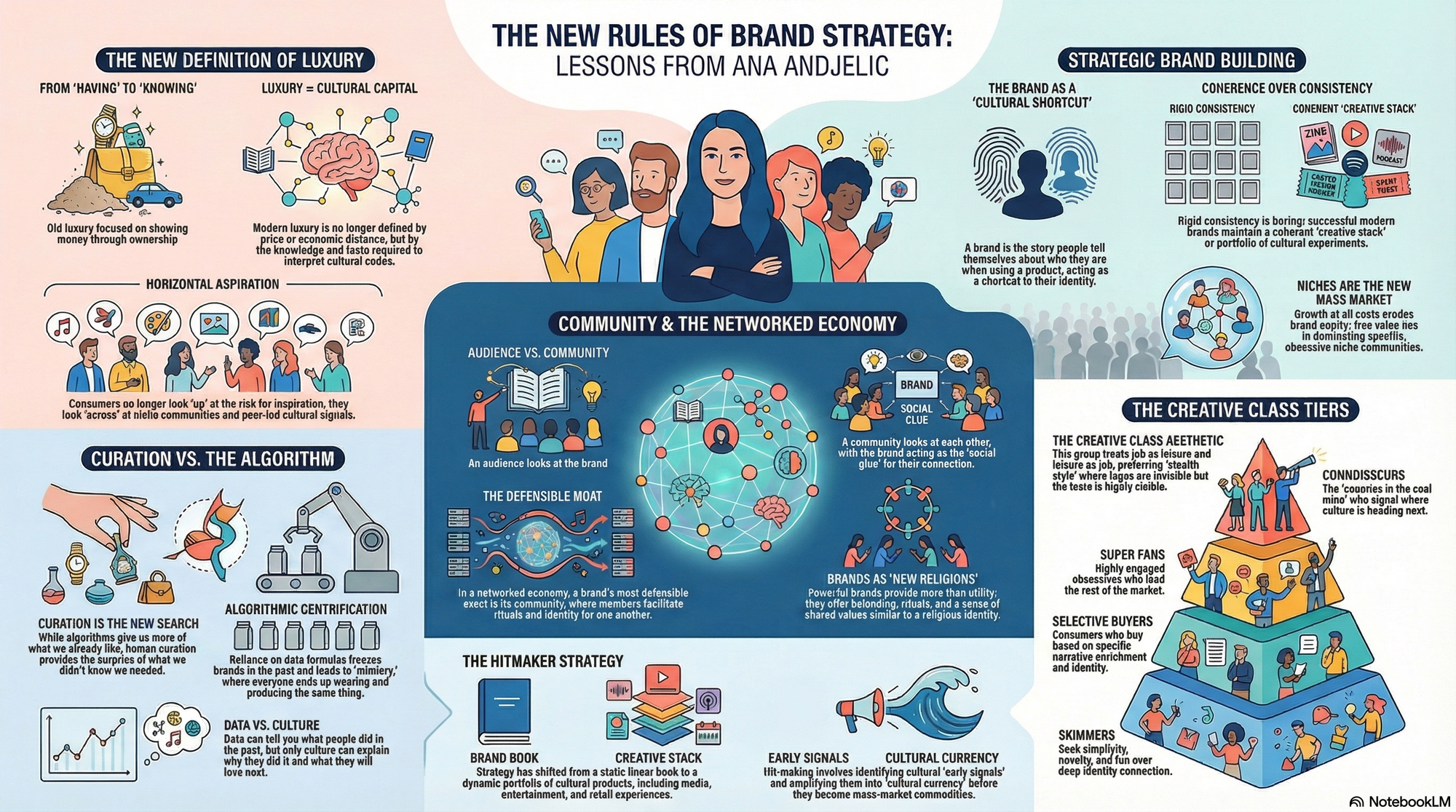
I. On the New Definition of Luxury
- "Luxury is no longer about price. It is about cultural capital." (Knowledge is the new status symbol).
- "In the old luxury, we bought things to show we had money. In the new luxury, we buy things to show we have taste."
- "Modern luxury is about access, not ownership."
- "The ultimate luxury today is the luxury of time and the luxury of being off the grid."
- "Luxury has shifted from 'having' to 'being' and now to 'knowing'."
- "Cultural distance has replaced economic distance as the primary barrier to entry for luxury brands."
- "The most successful brands don't sell products; they sell a worldview."
- "Aspiration used to be vertical (looking up at the rich). Today, it is horizontal (looking at our peers and niche communities)."
- "Exclusivity is now defined by 'who knows,' not 'who can afford'."
- "Luxury is a social signal that allows us to find 'our people'."
II. On Brand Strategy & "The Sociology of Business"
- "A brand is a story that people tell themselves about who they are when they use your product."
- "Strategy is the art of making choices that create a unique and valuable position."
- "Growth at all costs is the enemy of brand equity."
- "Marketing is no longer about the top of the funnel; it’s about the entire ecosystem of the brand."
- "The goal of a brand is to become a cultural shortcut."
- "Brands must move from being 'efficient' to being 'effective'."
- "A brand’s value is the sum of all the stories told about it."
- "The most valuable brands act like media companies, curators, and community leaders."
- "Niches are the new mass market."
- "Brand consistency is boring; brand coherence is essential."
III. On Cultural Capital & Taste
- "Taste is the ability to recognize quality and cultural relevance."
- "Cultural capital is the knowledge that allows a person to interpret and understand cultural codes."
- "The internet has democratized access to products, but it has stratified access to taste."
- "Curation is the new search."
- "Algorithms give us more of what we already like; taste gives us what we didn't know we needed."
- "The curator is the new creator."
- "Cultural relevance is the only way to stay competitive in a world of infinite choice."
- "Brands should stop trying to be 'relatable' and start trying to be 'relevant'."
- "Taste cannot be automated."
- "Aesthetic is the visual language of a brand's values."
IV. On Community and the "Networked Economy"
- "Community is a brand’s most defensible moat."
- "An audience is a group of people who look at the brand. A community is a group of people who look at each other."
- "In a networked economy, the value of a brand is determined by the strength of its community."
- "Brands should provide the 'social glue' for their customers."
- "The most powerful brands are those that foster a sense of belonging."
- "Don't build for everyone; build for the 'obsessives' who will lead the rest."
- "Social commerce is not about shopping on social media; it’s about shopping because of social influence."
- "User-generated content is the modern word-of-mouth."
- "Brands are the new religions; they provide rituals, identity, and community."
- "The role of the brand is to facilitate connections between its fans."
V. On Retail, Technology, and Future Trends
- "The future of retail is not 'bricks vs. clicks,' but the seamless integration of both into a lifestyle."
- "Physical stores are no longer distribution points; they are media channels."
- "DTC (Direct-to-Consumer) is a channel, not a business model."
- "The metaverse is not a place; it is a time when our digital lives become more important than our physical ones."
- "Sustainability is no longer a 'nice to have'; it is a prerequisite for modern aspiration."
- "Resale and rental are the new pillars of the circular luxury economy."
- "Data tells you what happened; culture tells you why it happened."
- "The biggest risk for a brand is being 'middle of the road'."
- "Personalization is not just using a customer’s name; it’s understanding their context."
- "The business of aspiration is about helping people become the best version of themselves."
VI. The Hitmaker Strategy & Cultural Programming[1][2]
- "A cultural hit is an idea that a large number of consumers pay attention to; a market hit is when that attention turns into financial return." (Hitmakers, 2024)[3]
- "Modern brands are hitmakers. They produce as many cultural hits as possible to stay relevant."
- "Cultural products are the new advertising: entertainment, product celebrity, aesthetics, and retail experiences."
- "Strategy is moving from a linear brand book to a 'Creative Stack'—a portfolio of cultural experiments."
- "The job of a brand is to move from being a 'service' to being a 'story'."
- "Hit-making is about identifying cultural 'early signals' and amplifying them before they go mass."[3]
- "Don't just buy media; create 'cultural currency' that media wants to talk about."
- "A brand is no longer a promise; it is a strategy of cultural influence."[4]
- "Cultural hits avoid the 'middle-of-the-road' death trap of commodification."
- "The goal of cultural programming is to make the brand a 'main character' in the zeitgeist."
VII. The Creative Class & "Creative Money"[2][5][6][7]
- "The Creative Class treats job as leisure and leisure as job." (The Creative Class Aesthetics, 2024)[6]
- "The Creative Class aesthetic is 'cool, nonchalant, and versatile'—designed for a life without boundaries."
- "In the Creative Class, clothing is a uniform of expertise, not just a signal of wealth."
- "There are four tiers of the Creative Class: Connoisseurs, Super Fans, Selective Buyers, and Skimmers."[8]
- "Connoisseurs are the 'canaries in the coal mine'; they show brands where culture is going next."
- "Skimmers seek simplicity and novelty; they don't buy for identity, they buy for fun."[8]
- "Creative money aesthetics is about 'stealth style'—logos are invisible, but the taste is loud."
- "To sell to the Creative Class, a brand must offer 'narrative enrichment,' not just a product."
- "Belonging to the Creative Class is aspirational because it implies freedom from corporate structures."
- "A member of the Creative Class is both the merchant and the merchandise."[1]
VIII. Algorithms vs. Human Taste[9][10][11]
- "Algorithms give you more of what you liked before; they freeze you in the past." (Cannes in Cairns Talk, 2025)
- "To stand out in an algorithmic world is to be its opposite: human, surprising, and wildly creative."
- "The algorithm is killing the 'monoculture' and replacing it with 'algorithmic gentrification'."
- "Passive taste is shaped by formulas; active taste is shaped by curiosity and experimentation."
- "When the algorithm takes over, everyone ends up wearing the same thing (the 'Panda' sneaker effect)."
- "Data tells you what people did; it cannot tell you what they will love next."
- "Curation is the antidote to the algorithm. It requires a human 'point of view'."
- "Mimicry is the decentralized mechanism of modern cultural influence."
- "The most successful brands today are those that successfully 'defy' the algorithm."
- "Social influence now rests on 'algorithmic personalization' rather than social connection."
IX. Product-Led Branding & The New ROI
- "Product-led branding starts with an iconic product and builds 'wear stories' around it." (Case Study: ON, 2025)[7]
- "Stop trying to build demand with Facebook ads; build demand by making the product culturally desirable."
- "The 'Volume/Value Matrix' defines whether a brand is mass, aspirational, or luxury based on context."
- "Growth should be slow and organic; quick growth often leads to brand dilution."
- "Merchandising is a form of storytelling."
- "The CMO and the CFO must become 'best friends' to unite cultural impact with revenue growth."
- "Comparing engagement metrics to sales is like comparing 'apples and oranges'."
- "Everything is merch.[1] Every touchpoint is an opportunity to sell the brand’s aesthetic."
- "The best brands act as 'fractal' organizations—acting small even when they are big."
- "ROI should be measured by 'Cultural Capital' alongside financial capital."
X. Future Trends & The Sociology of Now
- "Nobody knows anything.[1][12] Trend forecasting is mostly just 'educated guessing'." (Sociology of Business, 2024)
- "The future of aspiration is 'K-shaped': one side is hyper-niche, the other is hyper-mass."
- "We are entering an era of 'Functional Maximalism'—practical styles with bold statements."[12]
- "The resale market is the 'stock market' for brand value."[13]
- "Sustainability is moving from 'compliance' to 'creativity' (the circular economy)."
- "Pop culture is dead; it has been replaced by thousands of niche subcultures."
- "To understand the zeitgeist, look for 'contradictions, inversions, and oddities'."[11]
- "Modern creativity is a 'group sport,' not the work of a solo genius."[12]
- "The 'Creative Economy' exploits time, while the old economy exploited physical resources."
100.[5] "A brand’s ultimate goal is to become an 'Imagined Community' for its followers."
Sources & Further Reading (2024–2025)
- "Hitmakers: How Brands Influence Culture" (2024 Book): Ana's newest major work focusing on how brands create cultural hits.[1]
- "The Creative Class Aesthetics" (Substack/Medium, Jan 2024): A deep dive into the new social hierarchy and their consumption habits.
- "Cannes in Cairns Keynote" (June 2025): Her talk on why "Pop Culture is Dead" and how algorithms are killing creativity.[9]
- "The Volume/Value Matrix" (Sociology of Business, Sept 2025): A strategic framework for brand positioning in crowded markets.[14]
- "Nobody Knows Anything" (Dec 2024): Her year-end reflection on the unpredictability of cultural markets.[12]
Key Sources & Links
To explore these learnings in depth, I recommend the following primary sources:
- The Sociology of Business (Substack): This is Ana’s primary platform where she publishes weekly deep dives into brand strategy.
- "The Business of Aspiration" (Book): Her seminal book on how social and cultural capital have replaced money as the driver of consumption.
- Harvard Business Review Articles: Ana frequently contributes pieces on luxury and brand building.
- Vogue Business / Highsnobiety / Lean Luxe: She is a frequent commentator and guest contributor to these trade publications.
- Podcast Interviews: For verbal breakdowns of these quotes, listen to her episodes on the Business of Fashion (BoF) Podcast or Monocle on Design.
Sources