Sir David MacKay was a brilliant physicist, a pioneering researcher in machine learning and information theory, and the Chief Scientific Advisor to the UK Department of Energy and Climate Change. Best known for his uncompromising dedication to data, he forced the world to evaluate complex systems—from neural networks to global climate policy—through the lens of rigorous arithmetic rather than emotion. The following insights capture his enduring legacy across energy, mathematics, and rational thought.
Part 1: The Importance of Numbers and Arithmetic
- On the Energy Debate: "This heated debate is fundamentally about numbers. It’s not sufficient to know that something is huge: we need to know how the one 'huge' compares with another 'huge', namely our huge energy consumption." — Source: [Sustainable Energy — Without the Hot Air]
- On Adjectives: "To make this comparison, we need numbers, not adjectives." — Source: [Goodreads]
- On Twaddle: "I'm concerned about cutting UK emissions of twaddle – twaddle about sustainable energy." — Source: [Cambridge University Lectures]
- On Emotional Arguments: "Numbers are chosen to impress, to score points in arguments, rather than to inform." — Source: [Climate Home News]
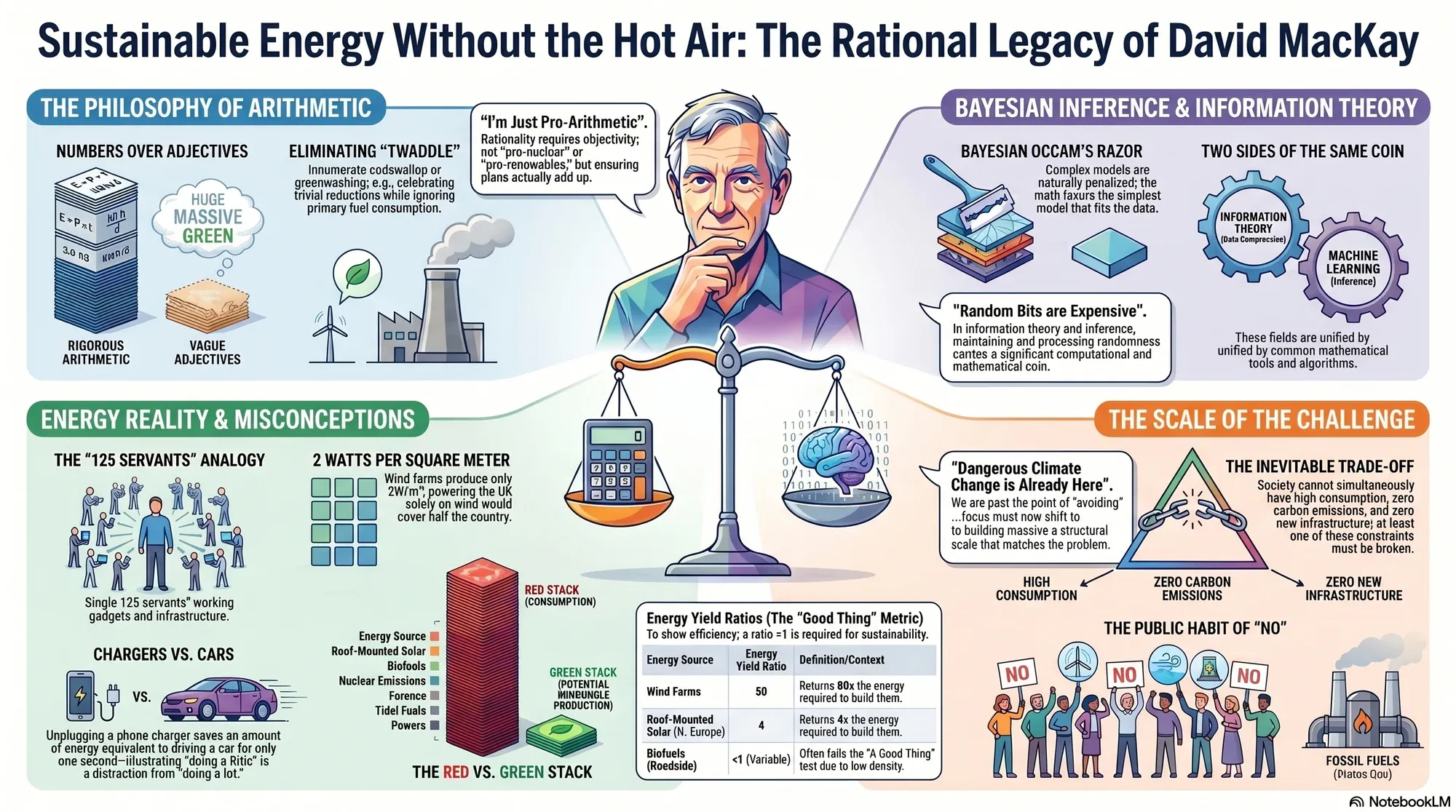
- On Objectivity: "Please don't get me wrong: I'm not trying to be pro-nuclear. I'm just pro-arithmetic." — Source: [Sustainable Energy — Without the Hot Air]
- On the Flood of Innumeracy: "We are inundated with a flood of crazy innumerate codswallop." — Source: [Goodreads]
- On Corporate Greenwashing: "Companies contribute to the daily codswallop by celebrating trivial reductions in pollution, like changing the paint on ships, when it is the fuel inside the tanker that deserves attention." — Source: [Sustainable Energy — Without the Hot Air]
- On Adding Up: "We can't be anti-everything – we need an energy plan that adds up." — Source: [AZ Quotes]
- On Public Consultation: "The calculator takes the poison out of the debate. The key thing is that any scenario you choose has to add up." — Source: [DECC 2050 Energy Calculator]
- On Quantitative Literacy: "It is dangerous for humanity when people are willing to debate climate change without thinking carefully about the numbers, the laws of physics, and the realities of engineering." — Source: [Final Interview with Mark Lynas]
Part 2: Energy Reality and Misconceptions
- On Small Gestures: "Don't be distracted by the myth that 'every little helps.' If everyone does a little, we'll only achieve a little. We must do a lot." — Source: [Atomic Insights]
- On the Scale of Modern Living: "A measure of modern society in Europe is that it is as if we all have 125 servants working for us—that's how much energy we use through our gadgets and devices." — Source: [TED Talk: A reality check on renewables]
- On Gadget Unplugging: "The energy saved by switching off a mobile phone charger is exactly the same as the energy used by driving an average car for one second." — Source: [Sustainable Energy — Without the Hot Air]
- On Thermostats: "If you turn down your thermostat in Britain by one degree Celsius in the winter, you'll reduce your energy consumption by 10%. Some people call it a lifestyle change. It works." — Source: [TED Talk: A reality check on renewables]
- On the "Appalling Delusion": "There is a 'pro-renewables' lobby that is 'anti-arithmetic,' laboring under the appalling delusion that the UK can be powered solely by domestic renewables without massive infrastructure changes." — Source: [The Guardian]
- On Energy Density: "Renewables fundamentally have low power density; for example, wind farms produce roughly 2 watts per square meter, meaning vast land areas are required." — Source: [Harvard Lectures]
- On the Red and Green Stacks: "In energy accounting, the red stack of consumption is currently much bigger than the green stack of potential renewable production." — Source: [Sustainable Energy — Without the Hot Air]
- On Solar Panel Myths: "Manufacturing a solar panel consumes more energy than it will ever deliver. False. The energy yield ratio of a roof-mounted solar system in Central Northern Europe is 4." — Source: [Sustainable Energy — Without the Hot Air]
- On "Embedded" Energy: "Every object has an energy cost... the energy cost of 'stuff' is often overlooked because it's 'embedded' in the things we buy." — Source: [Sustainable Energy — Without the Hot Air]
- On Efficiency vs. Delivery: "Efficiency should not be confused with delivered power." — Source: [Academia.edu]
Part 3: Renewables, Physics, and Limits
- On Land Use: "If we don't want to industrialise the whole countryside with renewables, then we have a big building project to build the alternative... which is nuclear and so-called clean coal." — Source: [UKCCSRC]
- On Wind Farms: "Wind farms have an incredibly high energy yield ratio of 80, meaning they return 80 times the energy it takes to build them, making them a fantastic investment energy-wise." — Source: [Goodreads]
- On Wind Power Constraints: "To power the UK entirely on wind, you would need to cover roughly half the country in wind farms." — Source: [TED Talk: A reality check on renewables]
- On Back-of-the-Envelope Physics: "I love back-of-the-envelope calculations, as many physicists do... If you grew the biofuels to power transport on the edge of the road, how wide would the strip have to be?" — Source: [Cambridge Lectures]
- On the Standard Unit: "Converting all energy use into a single unit—kilowatt-hours per day per person (kWh/d/p)—is the only way to make national energy usage intuitively understandable." — Source: [Sustainable Energy — Without the Hot Air]
- On Electric Vehicles: "The switch to electric vehicles is technologically inevitable and highly efficient; it is comparable to the transition from cassette tapes to iPods." — Source: [Final Interview with Mark Lynas]
- On the Laws of Physics: "Politicians can and should reshape economics to deliver renewable energy, but they cannot change the fundamental laws of physics." — Source: [Inference Group Cambridge]
- On "A Good Thing": "An energy yield ratio bigger than one means that a system is A Good Thing, energy-wise." — Source: [Sustainable Energy — Without the Hot Air]
- On Infinite Growth: "We have an addiction to fossil fuels, and it’s not sustainable... easily-accessible fossil fuels will at some point run out." — Source: [Cambridge University]
- On Fluctuations: "Renewable energy inherently fluctuates; managing this requires massive grid-level storage, international interconnectors, or flexible demand, none of which come for free." — Source: [Sustainable Energy — Without the Hot Air]
Part 4: Nuclear Power and Real-World Trade-offs
- On Nuclear Danger: "Nuclear power is not infinitely dangerous. It's just dangerous, much as coal mines, petrol repositories, fossil-fuel burning and wind turbines are dangerous." — Source: [AZ Quotes]
- On Irrational Fear: "We must not let ourselves be swept off our feet in horror at the danger of nuclear power." — Source: [AZ Quotes]
- On Nuclear as a Backbone: "Nuclear power is a low-carbon energy source that can serve as a reliable backbone in the transition period towards a fully renewable system." — Source: [Bookey]
- On the Public Habit of "No": "I am worried that we won't actually get off fossil fuels when we need to... given the general tendency of the public to say 'no' to wind farms, 'no' to nuclear power, 'no' to tidal barrages—'no' to anything other than fossil fuel power systems." — Source: [Final Interview with Mark Lynas]
- On False Choices: "The debate shouldn't be renewables versus nuclear; it must be about finding any combination of low-carbon sources that scales to meet the red stack of consumption." — Source: [TED Talk: A reality check on renewables]
- On Carbon Capture: "If society rejects the massive land-use requirements of renewables, Carbon Capture and Storage (CCS) must be accepted and scaled rapidly alongside nuclear." — Source: [Final Interview with Mark Lynas]
- On "Clean Coal": "So-called clean coal is only viable if carbon capture and storage is implemented on an industrial scale, effectively burying the waste problem." — Source: [UKCCSRC]
- On Evaluating Risk: "Every energy system has a body count and environmental impact; refusing to build low-carbon infrastructure because it isn't perfect implicitly accepts the higher body count of fossil fuels." — Source: [Sustainable Energy — Without the Hot Air]
- On the Reality of Trade-offs: "The primary aim should be to create an energy system that harmoniously integrates various renewable energy sources while addressing the practical constraints and societal needs." — Source: [ResearchGate]
Part 5: Information Theory and Machine Learning
- On Unification: "Why unify information theory and machine learning? Because they are two sides of the same coin." — Source: [Cambridge University Press]
- On the Brain: "Brains are the ultimate compression and communication systems." — Source: [Information Theory, Inference, and Learning Algorithms]
- On Shared Tools: "The state-of-the-art algorithms for both data compression and error-correcting codes use the same tools as machine learning." — Source: [Information Theory, Inference, and Learning Algorithms]
- On the Cost of Randomness: "Random bits are expensive." — Source: [Inference Group Lectures]
- On Shannon's Theorem: "The 'asymptotic equipartition' principle is equivalent to Shannon's source coding theorem." — Source: [Uni-Muenchen]
- On Bayesian Thinking: "Bayesian methods are not just a set of tools; they are a way of thinking about the world." — Source: [Wikipedia]
- On Learning as Inference: "The process of a machine or brain learning from data is fundamentally an exercise in Bayesian inference and updating probabilities." — Source: [Information Theory, Inference, and Learning Algorithms]
- On High-Dimensional Spaces: "In high-dimensional spaces, almost all the probability mass of a distribution lies in a 'typical set,' a concept central to understanding data compression." — Source: [Information Theory, Inference, and Learning Algorithms]
- On Error Correction: "Good error-correcting codes, like Low-Density Parity-Check (LDPC) codes, can be built efficiently using very sparse matrices and Bayesian message-passing." — Source: [Inference Group Cambridge]
Part 6: Bayesian Inference and Occam's Razor
- On Occam's Razor: "A model that is more complex is not necessarily better. Bayesian inference naturally embodies Occam's Razor: it prefers the simplest model that is consistent with the data." — Source: [Wikipedia]
- On Explicit Probabilities: "Always write down the probability of everything." — Source: [ArXiv]
- On the Bayesian Method: "The Bayesian method is not a 'new' way of doing statistics; it is the only way of doing statistics that is consistent with the laws of probability." — Source: [Wikipedia]
- On Model Comparison: "Learning is not just about finding the best parameters; it is about finding the best model." — Source: [Information Theory, Inference, and Learning Algorithms]
- On Prior Distributions: "If a larger model performs worse than a simple model, then the larger model needs a better prior distribution." — Source: [Columbia University]
- On the "Occam Factor": "Complex models are penalized in Bayesian inference because their prior probability must be spread thin across a vast space of possible datasets, reducing the evidence for any specific observation." — Source: [Inference Group Cambridge]
- On Prior Bias: "You do not need to hard-code a bias toward simplicity into a Bayesian system; the mathematics of marginal likelihood automatically favor simpler hypotheses that explain the data." — Source: [Medium]
- On Over-Precision: "0.234 seems a ridiculously precise number for such a vague science. Why not call it 0.2 or 0.25?" — Source: [Columbia University]
- On Model Penalties: "While parameter estimation can easily overfit data, Bayesian model comparison fundamentally resists overfitting by evaluating the 'evidence' rather than just the maximum likelihood." — Source: [Inference Group Cambridge]
Part 7: Education, Teaching, and Clear Thinking
- On Teaching Method: "I don't want to feed you my own conclusions. Convictions are stronger if they are self-generated, rather than taught." — Source: [Climate Home News]
- On True Understanding: "Understanding is a creative process." — Source: [Climate Home News]
- On Paradoxes: "When evaluating logical puzzles like the Two Envelopes paradox, if your calculation allows you to swap back and forth ad-infinitum to gain an advantage, the calculation is absurd, not the universe." — Source: [University of Amsterdam]
- On Open Access: "Knowledge should be free; MacKay deliberately released his seminal textbooks online for free to maximize their impact and accessibility." — Source: [Information Theory, Inference, and Learning Algorithms]
- On the Role of Textbooks: "In this book it will from time to time be taken for granted that a Bayesian approach makes sense, but the reader is warned that this is not yet a globally held view." — Source: [Medium]
- On Student Engagement: "He believed that education must provide quantitative tools, allowing readers and students to build their own 'balance sheet' rather than preaching a specific agenda." — Source: [ResearchGate]
- On Skipping Ahead: "The details are left to the diligent reader... All chapters of Part III are optional on a first reading." — Source: [Information Theory, Inference, and Learning Algorithms]
- On Visualizing Data: "Complex policies and models must be visualized simply—whether through stacks of red and green blocks or intuitive web calculators—so that anyone can verify the math." — Source: [DECC 2050 Energy Calculator]
- On the Value of Interdisciplinary Study: "In the 1960s, cybernetics united computer scientists, physicists, and neuroscientists around common problems; we must maintain that unified approach to solve modern challenges." — Source: [Information Theory, Inference, and Learning Algorithms]
Part 8: The Scale of the Challenge
- On the Danger of Climate Change: "'Avoiding dangerous climate change' is impossible – dangerous climate change is already here." — Source: [Inference Group Cambridge]
- On Focusing the Debate: "Never mind when fossil fuels are going to run out; never mind whether climate change is happening; burning fossil fuels is not sustainable; let's imagine living sustainably, and think how much sustainable energy is available." — Source: [Inference Group Cambridge]
- On the Cost of Fixing It: "If the true cost of fixing climate change were £40 per person then the government could fix it with the loose change in the Chancellor's pocket!" — Source: [Goodreads]
- On "Doing Our Bit": "Companies and individuals telling us how they can help us 'do our bit' are often a distraction from the massive structural changes required." — Source: [Sustainable Energy — Without the Hot Air]
- On Protest and Reality: "When citizens protest and burn effigies of wind farms, it highlights the immense gap between our desire for clean energy and our willingness to host the physical infrastructure it demands." — Source: [Cambridge Lectures]
- On the Inevitability of Trade-offs: "We cannot have high consumption, zero carbon emissions, and zero new infrastructure; one of those constraints must break." — Source: [TED Talk: A reality check on renewables]
- On Future Generations: "The energy choices we make today are not merely political preferences; they are physical commitments that will dictate the geography and economy of the next century." — Source: [Final Interview with Mark Lynas]
- On Optimism: "Despite the grim arithmetic, a sustainable future is physically possible if we build an energy plan that relies on mature technologies and actual scale rather than hope." — Source: [Sustainable Energy — Without the Hot Air]
- On His Legacy: "His ultimate contribution was taking the poison out of the energy debate, replacing ideological shouting with a shared, mathematical reality where every proposed solution simply has to add up." — Source: [DECC 2050 Energy Calculator]