Dr. John Vervaeke is a cognitive scientist, psychologist, and philosopher at the University of Toronto, best known for his 50-part YouTube series, "Awakening from the Meaning Crisis."
His work synthesizes cognitive science, history, and ancient wisdom to address the modern sense of nihilism and disconnection.
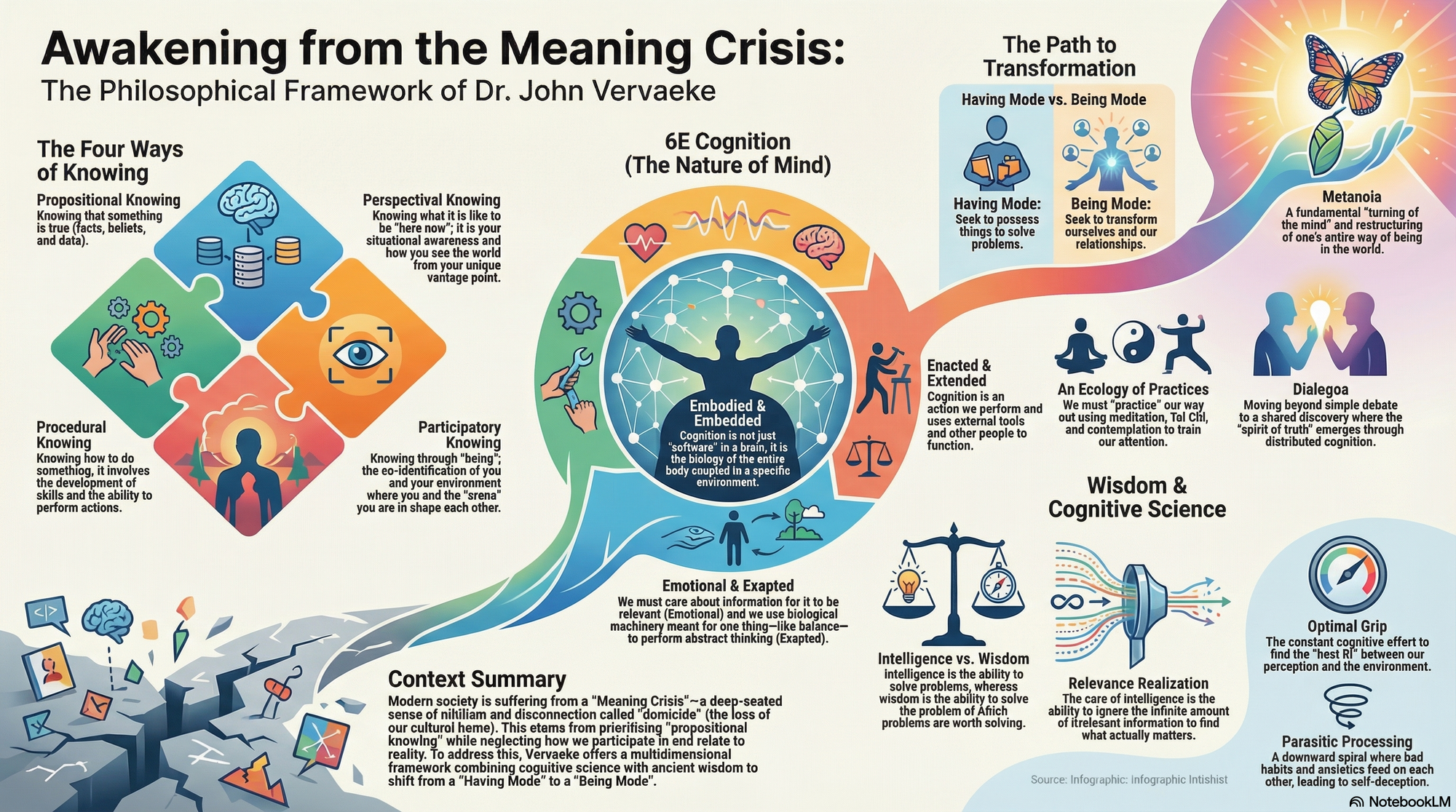
Part 1: The Four Ways of Knowing
Vervaeke argues that our crisis stems from over-prioritizing facts (propositional) while ignoring how we actually live and relate to the world.
- Propositional Knowing: Knowing that something is true (facts/beliefs).
- Procedural Knowing: Knowing how to do something (skills).
- Perspectival Knowing: Knowing what it is like to be here now (your situational awareness).
- Participatory Knowing: Knowing through being (the co-identification of you and your environment).
- Learning: "Wisdom is not about having more facts; it is about the coordination of all four ways of knowing."
- Learning: "You don't just have a worldview; you inhabit it."
Part 2: On The Meaning Crisis & Nihilism
- Quote: "The meaning crisis is the sense that we are no longer at home in the world." — Meaning Crisis Ep. 1
- Quote: "Meaning is not a 'feeling'; it is a structural relationship of connectedness."
- Learning: Meaning is "Transjective"—it is neither just in your head (subjective) nor just in the object (objective). It is the bridge between them.
- Quote: "Nihilism is the spirit of the age because we have disconnected our knowledge from our being."
- Quote: "We are suffering from 'domicide'—the loss of our cultural and spiritual home."
- Learning: The "Zombie" is the modern symbol of the meaning crisis: a being that consumes without purpose, moving without agency.
Part 3: Wisdom & Self-Deception
- Quote: "Intelligence is the ability to solve problems. Wisdom is the ability to solve the problem of which problems to solve." — The Nature of Wisdom
- Quote: "Wisdom is the optimization of cognition to minimize self-deception."
- Learning: Parasitic Processing: This is Vervaeke’s term for how bad habits and anxieties feed on each other in a downward spiral.
- Quote: "We are the only creatures who can simultaneously be the deceiver and the deceived."
- Learning: To find truth, we must undergo Aporia—the state of "not knowing" that forces us to re-examine our foundations.
- Quote: "Socrates didn't want to give people information; he wanted to give them transformation."
Part 4: Relevance Realization (Cognitive Science)
- Quote: "The core of your intelligence is 'Relevance Realization'—the ability to ignore the infinite amount of irrelevant information." — RR Theory
- Learning: We don't see the world as it is; we see it in terms of what is relevant to our survival and goals.
- Quote: "Your brain is a 'Meaning Maker' before it is a 'Fact Finder'."
- Learning: Optimal Grip: Like a photographer focusing a lens, we are constantly trying to find the "optimal grip" on reality—not too close, not too far.
- Quote: "The world is 'affordance-rich.' It offers us ways to act, but only if we have the skills to see them."
Part 5: Flow States & Sacredness
- Quote: "Flow is the state where your skills perfectly match the challenges of the environment."
- Learning: Flow is the "universal signifier" of meaning. It feels good because it tells us we are deeply "fitted" to reality. — Flow and the Meaning Crisis
- Quote: "The sacred is that which is 'inexhaustibly' relevant."
- Learning: Sacredness isn't necessarily religious; it’s the sense that something is a "fountain" of insight that never runs dry.
- Quote: "To find something sacred is to find it worthy of your ultimate concern."
Part 6: An Ecology of Practices
- Learning: You cannot think your way out of the meaning crisis; you must practice your way out.
- Quote: "We need an 'Ecology of Practices'—meditation, tai chi, circling, and contemplation—to train our attention."
- Learning: Lectio Divina: A way of reading text not for information, but to allow the text to "read" you.
- Quote: "Silence is not the absence of noise; it is the presence of attention."
- Learning: Circling/Dialogos: Moving from "debate" (winning) to "dialogue" (shared discovery) to "Logos" (the spirit of truth-seeking).
Part 7: The "Having" vs. "Being" Mode
Drawing from Erich Fromm, Vervaeke emphasizes how we relate to life.
34. Quote: "In the 'Having Mode,' we seek to possess things to solve our problems. In the 'Being Mode,' we seek to transform ourselves."
35. Learning: You cannot 'have' a relationship; you can only 'be' in one.
36. Quote: "Love is the act of 'Agapic' opening—where you create a space for the other person to become who they truly are."
37. Learning: The "Identity Crisis" occurs when we try to solve "Being" problems with "Having" tools.
Part 8: Higher States of Consciousness
- Quote: "A 'Great Awakening' is a profound shift in perspectival and participatory knowing."
- Learning: Scaling Up: Wisdom involves moving from a narrow, ego-centric view to a "God’s eye" or "Universal" view.
- Quote: "Wonder is the act of being overwhelmed by the beauty of reality, whereas curiosity is just wanting to know a fact."
- Learning: Real transformation requires Metanoia—a fundamental "turning of the mind."
Part 9: Modern Philosophy & Society
- Quote: "We have the most powerful 'Knowing' machinery in history (science), but we have forgotten how to 'Be'."
- Quote: "The death of God was not the death of a person, but the death of a shared map of meaning."
- Learning: We are currently in a "Global Meta-Crisis" where our problems (climate, nukes, AI) are caused by our lack of collective wisdom.
- Quote: "To be a philosopher is not to have a PhD; it is to be a lover of wisdom."
Part 10: Final Wisdoms
- Quote: "Real life is lived in the gaps between our theories."
- Quote: "You are not a machine. You are a self-organizing process in constant dialogue with the universe."
- Quote: "The most important thing to know is what is worth caring about."
- Learning: Internalization: We become the people we admire by "internalizing" their perspective (e.g., "What would Socrates do?").
- Quote: "Awakening from the meaning crisis is the great work of our time." — The Conclusion of the Series
Part 11: The "After Socrates" Insights
This series (2023–2024) focuses on the "Socratic Way of Life" as a response to the meaning crisis.
- Quote: "Socrates doesn’t have a method; he has a spirituality centered on the love of wisdom." — After Socrates Ep. 1
- Learning: Internalization: The goal is to internalize Socrates—not as a historical figure, but as an "internal owner's manual" for how to function well and avoid self-deception.
- Quote: "The meaning crisis is a tsunami of bullshit in a famine of wisdom." — After Socrates Intro
- Learning: Imaginary vs. Imaginal: The imaginary is just fantasy; the imaginal is a way of using the mind to perceive real possibilities for transformation (e.g., using a mentor’s voice in your head to stay calm).
- Quote: "Stop looking for the part of you that will never lead you astray. It does not exist." — After Socrates Ep. 8
- Learning: Aspiration vs. Ambition: Ambition is wanting more of what you already value. Aspiration is trying to become a person who values something entirely new.
- Quote: "Irony is the tool we use to realize that what we think is ultimate is actually just a representation."
- Learning: Ontonormativity: The deep human drive to be "in touch with the real." We don't just want to feel good; we want our feelings to be right about reality.
Part 12: The Expanded "6E" Cognition
Vervaeke expanded the standard "4E" cognitive science (Embodied, Embedded, Enacted, Extended) to include two more essential pillars.
- Embodied: Cognition is not software in a brain; it is the biology of your entire body.
- Embedded: You are not a brain in a vat; your mind is coupled to your specific environment.
- Enacted: Cognition is something you do (action-oriented), not just something you have.
- Extended: We think with tools—calculators, notebooks, and most importantly, other people.
- Emotional (The 5th E): Cognition is never "cold." You must care about information for it to become relevant to you. — 6E Cognition Summary
- Exapted (The 6th E): Evolution takes machinery meant for one thing (like balance) and "exapts" it for another (like abstract thinking).
- Quote: "You are basically taking the same machinery you use for moving around physical space and exapting it to move through conceptual space."
- Learning: Your body is a Bioeconomy: It manages resources of energy and attention to "fit" you to the world.
Part 13: Dialogos & Collective Intelligence
Vervaeke’s work on "Dialogos" explores how truth emerges between people.
- Quote: "Dialogos is not about two people talking; it is about the Logos—the spirit of truth—coming through the conversation." — Dialogos Explained
- Learning: Distributed Cognition: A group of people can solve problems that no single individual in the group could solve alone.
- Quote: "In true Dialogos, you move from 'I-Thou' intimacy to a 'triangulation' with the truth."
- Learning: Collective Wisdom: The goal is to move from collective intelligence (solving tasks) to collective wisdom (getting into right relationship with reality).
- Quote: "We are an 'eusocial' species. We don't reason monologically; we reason together."
- Learning: Internalizing the Other: By listening deeply, you internalize the perspectives of others, which gives you the "meta-cognitive" ability to see your own biases.
Part 14: Relevance Realization (Advanced)
- Learning: Combinatorial Explosion: There are infinite ways to combine thoughts. Logic alone can't save you; your brain must "realize relevance" to keep you from freezing.
- Quote: "Intelligence is not about being logical; it is about being relevant."
- Learning: Optimal Grip: Like a cat preparing to pounce, we are always trying to find the "best fit" between our perception and the environment.
- Quote: "Mattering is Relevance Realization. If nothing is relevant, nothing matters."
- Learning: Salience Landscape: Your brain creates a "map" of what stands out as important. Self-deception occurs when your salience landscape becomes distorted.
- Quote: "The core of general intelligence is the ability to ignore the infinite."
Part 15: Transformation & Ontological Shock
- Quote: "Ontological Shock is the feeling of the old world not working anymore and no solid ground for the new world appearing yet."
- Learning: Metanoia: This is not just "changing your mind," but a fundamental restructuring of your entire way of being.
- Quote: "You cannot see what it’s like after a transformation until you go through it. You have to trust a mentor who says, 'The water is fine.'"
- Learning: The Solomon Effect: We are wiser at solving other people’s problems than our own. Wisdom involves "distancing" yourself to see your own life from a third-person perspective.
- Quote: "A life awash in bullshit is a life that lacks both truth and transformation."
Part 16: Philosophy as a Way of Life
- Quote: "Ignorance is a lack of knowledge. Foolishness is a lack of wisdom."
- Learning: Philosophical Fellowship: We need "communities of practice"—places to practice wisdom together, similar to how athletes practice in a gym.
- Quote: "Worship is the practice of cultivating reverence that prevents idolatry." — Goodreads Source
- Learning: Learned Ignorance (Docta Ignorantia): The wisdom of knowing exactly what you don't know.
- Quote: "Humor is a clash of perspectives resolved by play; absurdity is a clash we can't resolve."
- Quote: "Real life situations do not come labeled with the virtues you need to solve them."
Part 17: Practical Daily Wisdom
- Learning: Vervaeke’s own Ecology of Practices includes: Tai Chi, Mindfulness Meditation, Contemplation, and Lectio Divina. — Vervaeke's Routine
- Quote: "Silence is the presence of attention, not just the absence of noise."
- Learning: The Agent-Arena Relationship: You are an 'agent' (someone with goals) acting in an 'arena' (a place that makes sense for those goals). Meaning is the fit between the two.
- Quote: "You don't solve the meaning crisis by thinking; you solve it by inhabiting a new way of being."
- Learning: Overfitting: Just like AI, our brains "overfit" to patterns. Dreams and "noise" (like meditation) help "reset" the brain so it doesn't get stuck in wrong patterns. — Vervaeke on Dreams
Part 18: On AI and Humanity (Recent 2024-2025)
- Quote: "AI can out-think us, but it cannot 'out-care' us. Caring is the foundation of meaning." — Recent Interview 2024
- Learning: Meaning-making is a biological process (autopoiesis). Machines process symbols; humans realize relevance because we have to stay alive.
- Quote: "A machine doesn't care if it's wrong. You do."
Part 19: The Nature of Love (Agape)
- Quote: "Agape is to love the process of meaning-making for its own sake."
- Learning: To love someone "Agapically" is to participate in their growth as a person, even if it doesn't benefit you directly.
- Quote: "The most real thing is that which is most transformative."
Primary Resources
- Series: After Socrates (2023-2024)
- Theory: Relevance Realization Summary
- Discussion: Voices with Vervaeke
- Practice: Circling and Dialogos Workshop
Key Sources & Links
- YouTube Series: Awakening From The Meaning Crisis (The primary source for all quotes).
- Podcast: Voices with Vervaeke (Deep dives into Dialogos and philosophy).
- After Socrates: New Series (2023-2024) - Focuses on the Socratic method and virtue signaling.
- Book: Zombies in Western Culture: A 21st Century Crisis (Co-authored by Vervaeke).