Dr. Michael Breus, widely known as "The Sleep Doctor," is a clinical psychologist and board-certified sleep specialist who has spent over two decades helping people optimize their lives through the science of circadian rhythms. His pioneering work on chronotypes—moving beyond the simple "early bird" and "night owl" labels—provides a biological blueprint for when to perform daily activities for maximum health and productivity. By aligning our schedules with our internal clocks, Dr. Breus demonstrates that sleep is not just a passive state but the foundational pillar for cognitive performance, metabolic health, and emotional well-being.
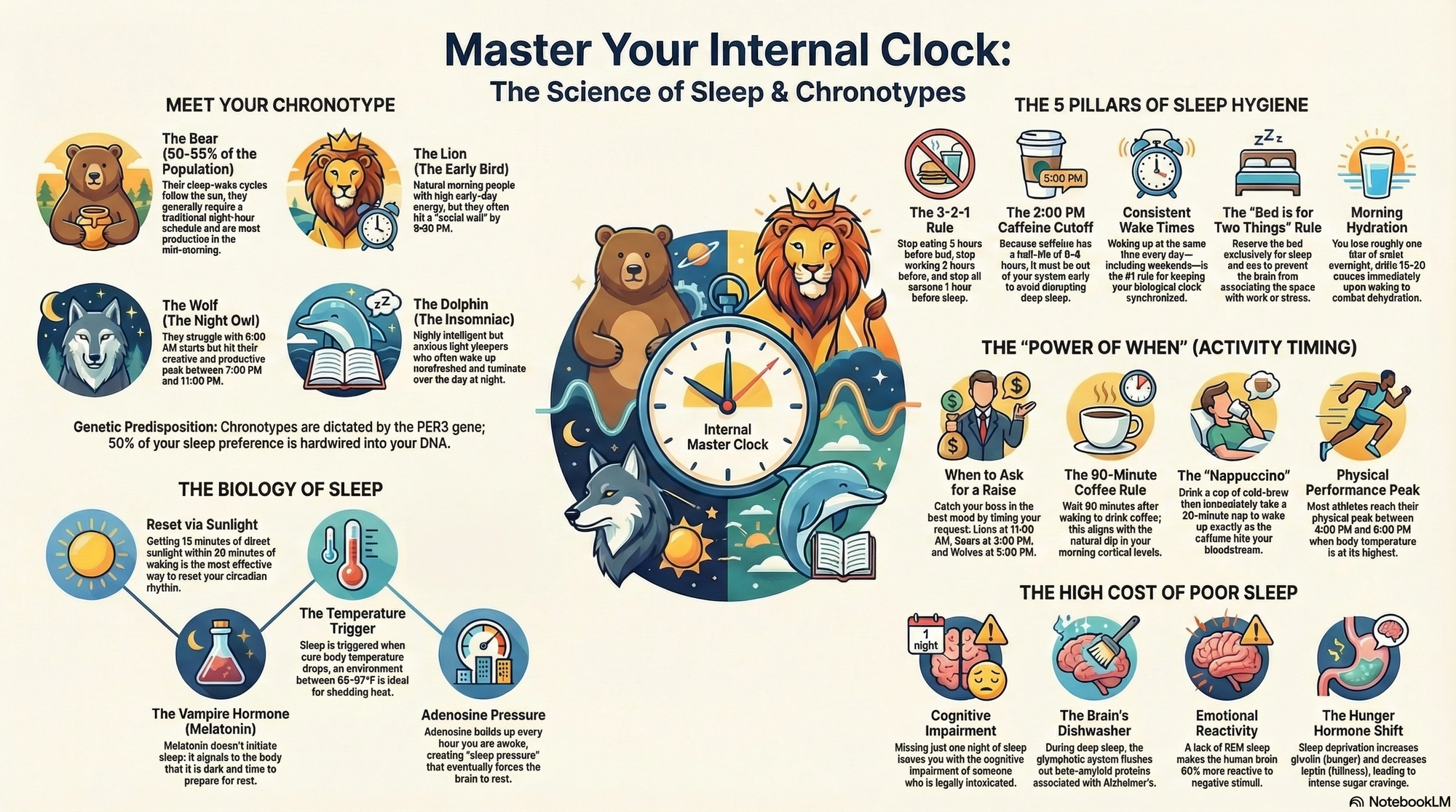
Part 1: The Four Chronotypes
- On the Bear Chronotype: "Bears make up about 50 to 55 percent of the population; their sleep-wake cycles follow the sun, and they generally do best with a traditional eight-hour sleep schedule." — Source: Sleep Foundation
- On the Lion Chronotype: "Lions are the classic morning people, waking up early with high energy, but they often hit a wall by 9:00 PM and struggle with social events late at night." — Source: Business Insider
- On the Wolf Chronotype: "Wolves are night owls who have a hard time waking up before 9:00 AM; they are most creative and energetic in the late afternoon and evening." — Source: The Sleep Doctor
- On the Dolphin Chronotype: "Dolphins are often light sleepers or insomniacs who are highly intelligent but prone to anxiety; they tend to wake up feeling unrefreshed." — Source: PsychCentral
- On Chronotype Stability: "Your chronotype is largely determined by your genetics, specifically the PER3 gene, which dictates the length of your circadian cycle." — Source: Medium
- On Social Jetlag: "When your work schedule forces you to wake up at a time that contradicts your biological chronotype, you suffer from a permanent state of social jetlag." — Source: The Art of Charm
- On the Wolf's Peak: "For a Wolf, the peak time for productivity is actually between 7:00 PM and 11:00 PM, which is why they often struggle in traditional corporate environments." — Source: Qualia Life
- On Chronotypes and Age: "Most children start as Lions, transition into Wolves during their teenage years, and then settle into their permanent genetic chronotype in their twenties." — Source: YouTube - Mindvalley
- On the Lion's Strategy: "Lions should tackle their most difficult, analytical tasks first thing in the morning when their cognitive clarity is at its absolute peak." — Source: Fast Company
- On Recognizing a Dolphin: "If you find yourself ruminating over the day's events as soon as your head hits the pillow, you likely fall into the Dolphin category." — Source: MindBodyGreen
Part 2: Circadian Science & Biology
- On the Master Clock: "The Suprachiasmatic Nucleus (SCN) in your brain acts as a master clock, regulating every biological process from hormone release to body temperature." — Source: National Institutes of Health
- On Melatonin's Role: "Melatonin is not a sleep initiator but a 'vampire hormone' that signals to the body that it is dark and time to prepare for rest." — Source: The Sleep Doctor
- On Core Body Temperature: "Sleep is triggered when your core body temperature begins to drop; if your body stays too warm, your brain will struggle to enter deep sleep cycles." — Source: Psychology Today
- On Sunlight Exposure: "Getting 15 minutes of direct sunlight within 20 minutes of waking up is the single most effective way to reset your circadian rhythm." — Source: Jim Kwik Podcast
- On Adenosine Pressure: "Adenosine builds up in the brain every hour you are awake, creating 'sleep pressure' that eventually forces the brain into rest." — Source: YouTube - School of Greatness
- On Blue Light: "Short-wavelength blue light suppresses melatonin production more than any other light source, effectively telling your brain it's noon when it's midnight." — Source: Humnutrition
- On the Circadian Dip: "Almost everyone experiences a natural energy dip between 1:00 PM and 3:00 PM when core body temperature takes a slight dive." — Source: The Power of When (Book)
- On Genetic Predisposition: "Roughly 50% of your sleep preference—whether you are an early bird or night owl—is hardwired into your DNA." — Source: TEDx Talks
- On Cortisol Timing: "Waking up at the same time every day allows your body to predict when to release a 'cortisol spike' to give you natural morning energy." — Source: Rich Roll Podcast
- On Seasonal Shifts: "While your chronotype is fixed, your circadian rhythm can slightly shift with the seasons based on available daylight hours." — Source: Sleep.com
Part 3: The Five Pillars of Sleep Hygiene
- On Consistent Wake Times: "The most important rule in sleep is to wake up at the same time every day, including weekends, to keep your biological clock synchronized." — Source: WebMD
- On the Caffeine Cutoff: "Because caffeine has a half-life of 6 to 8 hours, you should stop all consumption by 2:00 PM to ensure it’s out of your system by bedtime." — Source: Medium
- On Alcohol and Sleep Quality: "While alcohol helps you fall asleep faster, it prevents you from reaching REM sleep and leads to fragmented, low-quality rest." — Source: Express UK
- On Late-Night Exercise: "Finish high-intensity exercise at least three hours before bed to allow your core body temperature and heart rate to return to baseline." — Source: The Sleep Doctor
- On Morning Hydration: "You lose about a liter of water through breath and sweat during the night; drink 15-20 ounces of water immediately upon waking." — Source: Wales Online
- On the 'Bed is for Two Things' Rule: "The bed should be reserved exclusively for sleep and sex; doing work or watching TV in bed confuses the brain's association with the space." — Source: ABC News
- On Nap Duration: "If you must nap, keep it to 25 minutes to avoid entering deep sleep and waking up with 'sleep inertia,' or grogginess." — Source: YouTube - Dr. Breus
- On Darkness: "Your sleep environment should be as dark as possible; even a small amount of light can be detected through your eyelids and disrupt sleep." — Source: Purple
- On Smoking: "Nicotine is a stimulant; smokers often take longer to fall asleep and experience more light sleep than non-smokers." — Source: The Sleep Doctor
- On Routine Consistency: "A consistent pre-sleep routine tells your brain that it is safe to down-regulate and prepare for the 90-minute sleep cycles ahead." — Source: One Commune
Part 4: Nutrition & Supplements
- On Magnesium for Sleep: "Magnesium is the 'relaxation mineral' because it helps regulate GABA, a neurotransmitter that calms the nervous system." — Source: Psychology Today
- On the Banana Tea Hack: "Boiling a whole organic banana (peel included) creates a tea rich in magnesium and potassium that acts as a natural muscle relaxant." — Source: Chalene Johnson Podcast
- On the 3-2-1 Rule: "Stop eating 3 hours before bed, stop working 2 hours before bed, and stop screens 1 hour before bed." — Source: Jim Kwik
- On Vitamin D Deficiency: "Low levels of Vitamin D are clinically linked to shorter sleep duration and increased daytime sleepiness." — Source: The Sleep Doctor
- On the Best Bedtime Snack: "If you’re hungry, choose a snack that is roughly 250 calories with a 70/30 carb-to-protein ratio, like an apple with almond butter." — Source: Whole30
- On Tart Cherry Juice: "Tart cherries contain natural melatonin and can slightly improve sleep duration in people with mild insomnia." — Source: Sleep Advisor
- On Heavy Meals: "Eating a large, spicy, or high-fat meal late at night forces the digestive system to work, raising your internal temperature and disrupting sleep." — Source: CBS News
- On Melatonin Dosage: "Most people take far too much melatonin; the body naturally produces only 0.3mg, and higher doses can cause nightmares and grogginess." — Source: Paleovalley
- On Hydration and Waking: "Don't gulp a huge glass of water right before bed; instead, sip small amounts to avoid waking up for bathroom trips in the middle of the night." — Source: The Sleep Doctor
- On Kiwifruit: "Eating two kiwis an hour before bed has been shown in some studies to help people fall asleep faster due to their high serotonin content." — Source: Psychology Today
Part 5: The "Power of When" (Activity Timing)
- On the Best Time for Coffee: "The best time for almost everyone to drink coffee is about 90 minutes after waking, once your natural cortisol levels begin to dip." — Source: YouTube - Dr. Breus
- On Asking for a Raise: "Lions should ask for a raise at 11:00 AM, Bears at 3:00 PM, and Wolves at 5:00 PM to catch their bosses in the best mood." — Source: The Power of When (Book)
- On Timing Sex: "While most people wait until bedtime, the biologically optimal time for intimacy is often in the morning when testosterone levels are highest." — Source: Daily Mail
- On Learning New Things: "Your brain is most receptive to learning new material during the window when your chronotype's alertness is rising, typically late morning for Bears." — Source: Mike Vardy Podcast
- On Creative Thinking: "Wolves are most creative late at night, but for others, the best creative 'Aha!' moments often happen during the 'grogginess' window of early morning." — Source: The Art of Charm
- On Taking Medications: "Certain medications, like those for blood pressure or cholesterol, work significantly better when taken at night to align with the body's repair cycle." — Source: Psychology Today
- On Difficult Conversations: "Never have a serious argument late at night when your prefrontal cortex is exhausted; you’re more likely to say things you regret." — Source: ManTalks Podcast
- On Brainstorming: "Dolphins should brainstorm in the late evening when their naturally high arousal state can be channeled into creative problem-solving." — Source: Integrated Listening
- On Physical Performance: "Most athletes perform at their physical peak in the late afternoon, around 4:00 PM to 6:00 PM, when body temperature is highest." — Source: The Sleep Doctor
- On the 'Nappuccino': "Drink a cup of cold-brew coffee and immediately take a 20-minute nap; you'll wake up just as the caffeine hits your bloodstream." — Source: YouTube - School of Greatness
Part 6: Sleep Disorders & Brain Health
- On Sleep Apnea Signs: "Loud snoring followed by a gasp for air is the primary indicator of obstructive sleep apnea, a condition that starves the brain of oxygen." — Source: Mindvalley
- On the Glymphatic System: "During deep sleep, the glymphatic system opens up to flush out beta-amyloid proteins, which are the plaques associated with Alzheimer's." — Source: YouTube - The Energy Blueprint
- On Insomnia vs. Deprivation: "Insomnia is the inability to sleep despite having the opportunity; sleep deprivation is simply not giving yourself enough time to sleep." — Source: The Sleep Doctor
- On Sleep and Mental Health: "Sleep is not just for the body; it’s emotional first aid. Lack of REM sleep makes us 60% more reactive to negative stimuli." — Source: School of Greatness
- On Restless Leg Syndrome: "RLS is often a sign of iron or magnesium deficiency and can be significantly improved through targeted supplementation." — Source: WebMD
- On Cognitive Decline: "Missing just one night of sleep can leave you with the cognitive impairment of someone who is legally intoxicated." — Source: Get Yourself Optimized
- On CPAP Therapy: "For those with severe apnea, the CPAP machine is not just a comfort device; it is a life-saving tool that prevents heart strain." — Source: The Sleep Doctor
- On Sleep Walking: "Sleepwalking occurs during deep Stage 3 sleep, not during dreams (REM), which is why sleepwalkers have no memory of their actions." — Source: Psychology Today
- On Narcolepsy Misconceptions: "Narcolepsy isn't just falling asleep mid-sentence; it’s a fundamental breakdown of the boundaries between being awake and asleep." — Source: The Sleep Doctor
- On Sleeping Pills: "Most prescription sleep aids are sedatives that knock you out but do not provide the restorative architecture of natural sleep." — Source: Paleovalley
Part 7: Morning & Evening Routines
- On the Power Down Hour: "Divide the hour before bed into 20 minutes for tasks, 20 minutes for hygiene, and 20 minutes for meditation or reading." — Source: Medium
- On 4-7-8 Breathing: "Inhale for 4 seconds, hold for 7, and exhale for 8; this technique physically forces your heart rate to slow down and lowers cortisol." — Source: First for Women
- On Not Checking the Clock: "If you wake up at 3:00 AM, do not look at the clock; doing so triggers 'math anxiety' that keeps you awake for the rest of the night." — Source: YouTube - School of Greatness
- On Morning Movement: "A simple 5-minute stretch or walk in the morning tells your brain that the day has officially begun and helps dissipate sleep inertia." — Source: Humnutrition
- On Reading in Bed: "If you must read in bed, use a physical book and a warm-toned book light rather than an e-reader that emits blue light." — Source: Psychology Today
- On the 'Brain Dump' Journal: "Write down everything you're worried about two hours before bed so your brain doesn't feel the need to 'hold' those thoughts while you sleep." — Source: The Sleep Doctor
- On Cold Showers: "A cold shower in the morning can provide a massive boost in dopamine and alertness that lasts for several hours." — Source: Energize! (Book)
- On Bedtime Consistency: "While the wake-up time is most important, having a consistent 'lights out' time helps your body predict the onset of melatonin." — Source: WebMD
- On Morning Protein: "Lions and Bears should prioritize protein in the morning to stabilize blood sugar and maintain energy throughout their early peak." — Source: YouTube - Dr. Breus
- On the 90-Minute Rule: "Sleep happens in 90-minute cycles; try to time your wake-up so you aren't being pulled out of the middle of a deep sleep stage." — Source: The Sleep Doctor
Part 8: Technology & Sleep Environment
- On Optimal Temperature: "The ideal temperature for sleep is between 65 and 67 degrees Fahrenheit; any warmer and your body will struggle to shed core heat." — Source: Purple
- On Mattress Materials: "Hot sleepers should avoid traditional memory foam and look for latex or hybrid mattresses that allow for better airflow and heat dissipation." — Source: The Mattress Factory
- On White Noise: "White noise is effective not because it’s soothing, but because it masks the 'peak' sounds that would otherwise startle you awake." — Source: The Sleep Doctor
- On Blue Light Blockers: "If you must use screens at night, wear blue light blocking glasses with amber lenses to protect your melatonin production." — Source: Humnutrition
- On Smart Alarms: "Alarms that track your movement and wake you up during your lightest phase of sleep can significantly reduce morning grogginess." — Source: The Sleep Doctor
- On Humidity: "Maintaining 40% to 50% humidity in the bedroom prevents dry nasal passages, which can lead to snoring and mouth breathing." — Source: Sleep Advisor
- On Pillow Placement: "Side sleepers should place a pillow between their knees to keep their hips aligned and prevent lower back pain during the night." — Source: The Sleep Doctor
- On Weighted Blankets: "Weighted blankets can help people with anxiety or ADHD by providing deep pressure stimulation that encourages serotonin release." — Source: Psychology Today
- On Bed Size: "If you share a bed, a King-sized mattress is often the best investment for sleep quality because it minimizes 'motion transfer' from your partner." — Source: The Mattress Factory
- On Smart Lighting: "Use 'circadian lighting' that shifts from bright blue-white in the morning to soft amber-red in the evening to mimic the natural sun." — Source: The Sleep Doctor
Part 9: Social & Relationship Dynamics
- On the 'Sleep Divorce': "Sleeping in separate rooms is not a sign of a failing relationship; it is often a practical solution for couples with different chronotypes." — Source: Psychology Today
- On Chronotype Compatibility: "A Lion and a Wolf in a relationship will have very little overlap in energy; they must intentionally schedule 'quality time' when both are awake." — Source: Focus DE
- On Office Productivity: "Companies should allow Wolves to start work later and Lions to start earlier to maximize the collective cognitive output of the team." — Source: Fast Company
- On Parenting: "Parents must recognize that their children's 'difficult' behavior in the morning is often just a mismatch between school schedules and their biology." — Source: YouTube - Mindvalley
- On Snoring and Intimacy: "Chronic snoring is a major cause of relationship friction; treating the snorer often fixes the partner's sleep deprivation as well." — Source: The Sleep Doctor
- On Communication Timing: "Wait until a Wolf has been awake for at least two hours before asking them to make complex decisions or have deep conversations." — Source: ManTalks Podcast
- On Social Events: "If you’re a Lion, don't feel guilty for leaving a party at 10:00 PM; your brain is literally shutting down for the night." — Source: Business Insider
- On Shared Bedding: "Use the 'Scandinavian Sleep Method'—two separate duvets on one bed—to prevent tug-of-war and keep each partner at their ideal temperature." — Source: The Sleep Doctor
- On Working from Home: "The flexibility of remote work is a massive benefit for Wolves, who can finally align their work hours with their late-night peak." — Source: Mike Vardy Podcast
- On Leadership: "The best leaders are those who understand their own energy cycles and don't force their chronotype on their entire staff." — Source: School of Greatness
Part 10: Metabolism, Fitness & Longevity
- On Sleep and Weight Loss: "If you are sleep deprived, your ghrelin (hunger hormone) goes up and your leptin (fullness hormone) goes down, making you crave sugar." — Source: YouTube - Dr. Breus
- On Growth Hormone: "The majority of your human growth hormone (HGH) is released during deep sleep; if you skip sleep, you skip your body's repair phase." — Source: Psychology Today
- On Immune Function: "During sleep, your immune system produces cytokines, which are proteins that help the body fight off infections and inflammation." — Source: The Sleep Doctor
- On Beauty Sleep: "Sleep deprivation increases cortisol, which breaks down skin collagen; 'beauty sleep' is a biological reality for skin elasticity." — Source: Psychology Today
- On Muscle Recovery: "Muscles are not built in the gym; they are built in the bed while you sleep and your body synthesizes protein." — Source: The Sleep Doctor
- On Inflammation: "Chronic lack of sleep is a systemic stressor that leads to high levels of C-reactive protein, a marker for chronic inflammation." — Source: Simple Roots Wellness
- On Longevity and Sleep: "The sweet spot for longevity is between 7 and 9 hours of sleep; consistently sleeping less than 6 hours is linked to a higher risk of early death." — Source: Medium
- On Metabolism Speed: "A single night of poor sleep can slow your resting metabolic rate the following morning, making it harder to burn calories." — Source: Heal Your Hunger
- On Heart Health: "Deep sleep acts as a natural blood pressure medication, allowing your heart rate to slow and your vascular system to relax." — Source: The Sleep Doctor
- On the 'Energize!' Philosophy: "Good sleep is not just about the night; it's the engine that powers your movement, your nutrition, and your purpose during the day." — Source: Energize! (Book)