Harvey Firestone (1868–1938), founder of the Firestone Tire and Rubber Company and one of the "Vagabonds" alongside Henry Ford and Thomas Edison, was a pioneer in American industry. His wisdom—captured primarily in his 1926 autobiography, Men and Rubber: The Story of Business—revolves around the "labor of thinking," the development of people, and the necessity of maintaining a surplus.
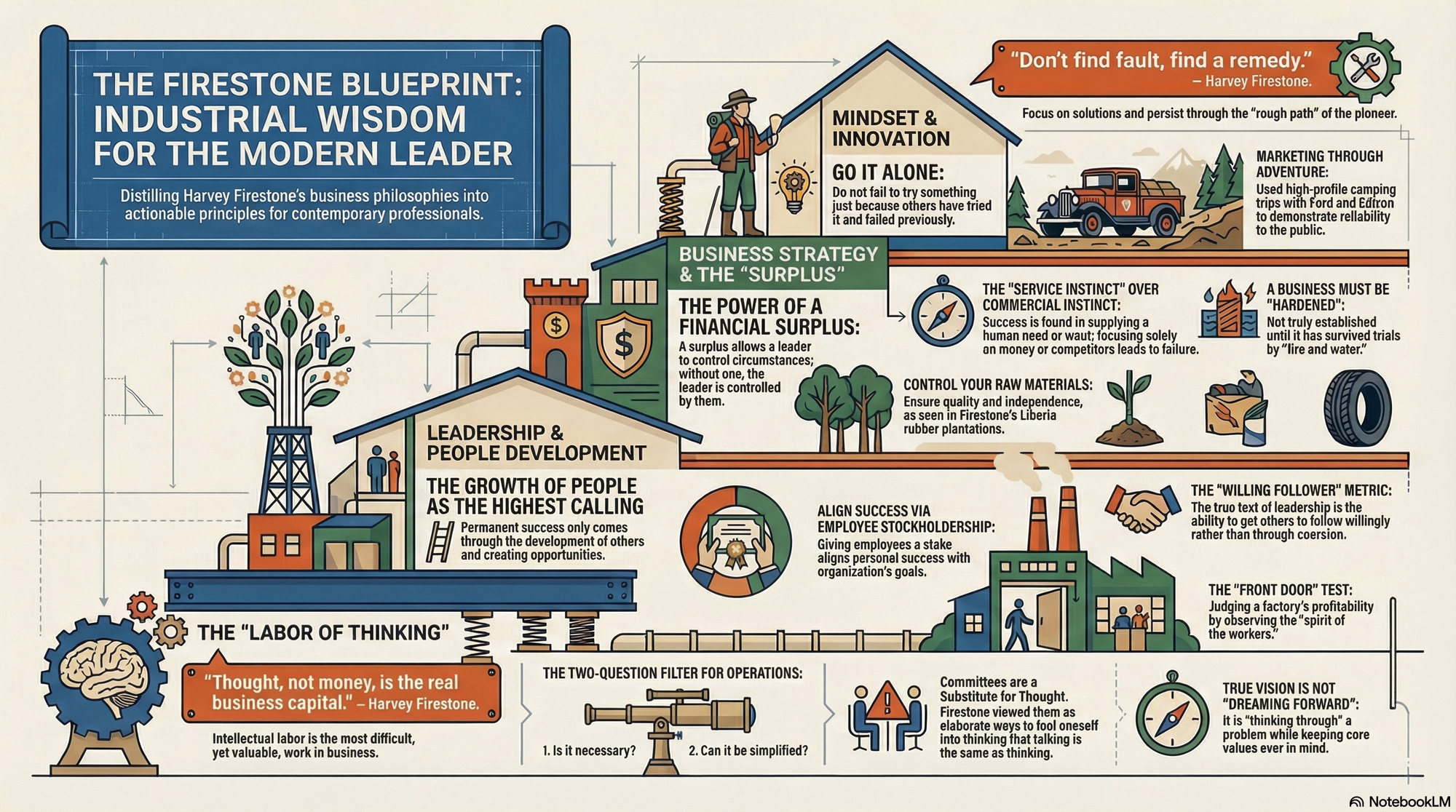
I. On Leadership & People
- The Highest Calling: "The growth and development of people is the highest calling of leadership."[1][2][3]
- Developing Others: "It is only as we develop others that we permanently succeed."[3][4][5]
- Leading by Example: "You get the best out of others when you get the best out of yourself."
- Knowledge of People: "The secret of my success is a two-word answer: Know people."
- Human Assets: "Our company is built on people—those who work for us, and those we do business with."
- Willing Followers: "The most difficult thing in leadership is getting others to follow you willingly."
- Empowerment: "True greatness in business is not solely measured by the wealth or power one accumulates, but by the number of opportunities created for others."[6]
- Employee Stockholders: Firestone believed in giving every employee stockholdership to align their success with the company's.
- The Spirit of Work: "I can walk through the front door of any factory and out the back and tell you if it's making money or not... by the spirit of the workers."
- The Valuable Man: "The really valuable man is the one who is willing to take the chance of eventually making himself worth a large salary."
II. On the "Labor of Thinking"
- Avoiding Thought: "There is no expedient to which a man will not go to avoid the real labor of thinking." (Often credited to Edison, but adopted as Firestone’s core management mantra).
- The Hardest Work: "The most difficult thing in business is first getting yourself to thinking and then getting others to thinking."[7]
- Distraction of Detail: "It is very easy indeed to keep so busy with details that no time is left over for hard, quiet thought."[7]
- Substitute for Thought: "We try to substitute discussion for thought by organizing committees... a committee organization is just an elaborate means of fooling oneself."[2][8][9][10]
- Real Capital: "Thought, not money, is the real business capital."[3][9]
- Dangerous Speed: "Quick decisions that have not behind them a long train of thought are exceedingly dangerous."[9]
- No Guessing: "Personally, I do not want to have around me the kind of man who can give me an instant decision... if he has not had the opportunity to give the question serious thought, then he is only guessing."
- The First Question: "The FIRST question I always ask myself when looking at any operation is this: Is it necessary?"
- Simplicity: "If I do find a process necessary, then I ask: Can it be simplified?"
- Vision vs. Dreaming: "Vision, as I see it, is not dreaming forward. It is a thinking through with the values ever in mind."
III. On Business Strategy & Management
- The Power of Surplus: "Having a surplus is the greatest aid to business judgment that I know. A man with a surplus can control circumstances, but a man without a surplus is controlled by them."[2][9][10]
- Business Hardening: "A business is not a business until it has been hardened by fire and water."[10]
- The Importance of Ideas: "Capital isn't that important in business. Experience isn't that important. You can get both of these things. What is important is ideas."
- Service First: "You will fail if you think more of matching competitors than of giving service."
- The Service Instinct: "The commercial instinct has been over-rated.[7] The service instinct is more important."
- Purpose of Business: "If you ask yourself why you are in business and can find no answer other than 'I want to make money,' you will save money by getting out of business."[10][11]
- Supply a Need: "The single reason for the existence of any business must be that it supplies a human need or want."[10][11][12]
- One Thing at a Time: "The only firm rule I have is to take up one thing at a time and to take up nothing else until my mind is free."
- Managing Oneself: "The management of one's self... comes only from experience. Every man has to work out his own rules."
- Success in Details: "Success is the sum of details."
- Executive Detail: "An executive cannot gradually dismiss details. The chief executive who dismisses them is quite likely to dismiss his business."[2]
- Comparison with Opportunity: "To do a better business than we did last year really is not much of a credit... we must compare what we are doing today with our opportunities of today."[8]
- Flexible Planning: "The only danger in mapping the future lies in making the plans inflexible."[12]
- Honesty as Keystone: "I believe fundamental honesty is the keystone of business."
IV. On Sales, Marketing & Competition
- Public Education: "Educating the public to new ways is a difficult task."
- Market Creation: When told the market for rubber tires was too small, he replied: "To me the market was without limit, because every man who owned a carriage was a possible prospect."[13]
- Price Motivation: "Find a way to put them out at a price low enough so people cannot afford not to buy them."
- Sales Reputations: "No end of sales reputations are established by salesmen taking the credit for the public resolutely refusing to be deterred from buying."[2]
- Advertising Purpose: "Advertising copy was never intended to serve as literature."
- Facing Trouble: "I think the best way to settle trouble is face to face."
- Pioneer’s Path: "The way of the pioneer is always rough."
- Supply Chain Control: Firestone believed a business must control its raw materials to ensure quality and independence (leading to his Liberia plantations).
V. General Life Lessons & Mindset[13]
- Self-Definition: "Accept no one's definition of your life, but define yourself."
- Finding a Remedy: "Don't find fault, find a remedy."
- Courage in Adversity: "Success is not final, failure is not fatal: It is the courage to continue that counts."
- Satisfaction in Giving: "Success is finding satisfaction in giving a little more than you take."
- Go It Alone: "One precept stands out above all others... It is this: Go it alone. Do not fail to try because someone has already tried and failed."
- Perspective: "A man has to get a perspective, and he can get it from books or from people—preferably from both."[9]
- Patience and Conviction: "If you know absolutely that what you are doing is right, then you are bound to accomplish it in due season."
- Persistence: "You are capable of more than you know... Persist! The world needs all you can give."
VI. On Thinking & Decision-Making (The Deep Work)
- The Trap of Committees: "A committee may function very well indeed as a clearinghouse for thoughts, but more commonly a committee organization is just an elaborate means of fooling oneself into believing that a spell spent in talking is the same as a spell spent in thinking."
- Avoiding "Ready-Made" Ideas: "We try to buy thoughts ready-made and guaranteed to fit, in the shape of systems installed by experts."
- The Executive's Burden: "The most difficult thing in business is first getting yourself to thinking and then getting others to thinking."
- Don't Be a "Tenderfoot": Edison once teased Firestone for seeking a hotel during a camping trip: "You're a tenderfoot. Soon you'll be dressing up like a dude." Firestone learned that physical discomfort often clears the mind for better business grit.
- The Thinking Routine: Firestone believed in "hard, quiet thought—for thinking through from the beginning to the end." He often practiced this away from the office to avoid the "distraction of detail."
- Measuring Value: "The financial crisis of 1920... forced the company to re-appraise values, cut unnecessary expenses, and return to fundamental thinking."
- Observation over Data: "I can just tell by the way [a factory] is being run and by the spirit of the workers whether it is making money."
- On Intuition: While he valued thought, he believed intuition was simply "the result of many years of deep thinking surfacing at the right moment."
VII. On Financial Discipline & The "Surplus"
- Borrowing Rule: "Bank credit should be reserved for busy seasons, with the goal of liquidating all loans annually."
- The Danger of Debt: "The man who pushes his credit to the limit is taking too many chances. He should always take a little less than is offered to him."
- Self-Financing: Firestone advocated for accumulating a surplus from profits rather than using expansion funds to cover operating costs.
- The "Surplus" as Courage: He noted that a man with a cash reserve has the "courage to say no" to bad deals that a desperate man would accept.
- Investment in Equipment: "I looked around until I found some fairly good second-hand equipment, for I had not forgotten what it meant to try to run a business without a surplus."
- Hardening the Business: "A business is not a business until it has been hardened by fire and water."
- Capital Lacks Importance: "I attribute much of my advancement and progress to the fact that I lacked capital. Because of this I had to watch every expenditure."
- Cost vs. Return: "If we make a change in manufacturing or selling methods, will the added return pay the cost?"
VIII. On Leadership & Developing Men
- The Employer’s Duty: "The biggest thing an employer can do is to help his men to help themselves."
- Anti-Human Machine: Firestone rejected the notion of treating laborers as "mere human machines."
- On Motivation: "I believe most men will make good if they find the work they are happy in doing."
- Asset Requirements: "The man who is to be an asset to the business must have energy and persistence."
- Management Fault: "If anything in the business is wrong, the fault is squarely with management."
- The Interest of Growth: "As I employed men, I found an absorbing interest in their development."
- Leading the "Willing": He believed the hallmark of a great leader was getting others to follow "willingly," not through coercion.
- Mutual Prosperity: He sought a relationship between capital and labor resting on "mutual dependence, growth, and prosperity."
IX. On Innovation & The Pioneer Spirit
- The Power of Ideas: "Ideas are any man's greatest asset. There isn't any limit to what you can do with your business and your life if you have them."
- Pioneer’s Rough Road: "The way of the pioneer is always rough... do not fail to try because someone has already tried and failed."
- Public Resistance: "Educating the public to new ways is a difficult task." (Referring to the transition from carriage tires to pneumatic auto tires).
- Technological Vision: Firestone promoted the building of the American highway system and motor-driven trucks long before they were standard.
- First Principles: He famously asked of every operation: "Is it necessary? Can it be simplified?"
- Standardization: He worked with Henry Ford to standardize tire sizes, which drastically reduced manufacturing costs for the entire industry.
- Learning from Others: "A man has to get perspective, and he can get it from books or from people—preferably from both."
X. Lessons from the "Vagabonds" (Ford & Edison)
- Henry Ford’s Energy: "Mr. Ford, when he is out of doors, is just like a boy... He wants to have running races, climb trees, or do anything which a boy might do."
- Edison’s Economy of Thought: Firestone observed that Edison never wasted a thought on something that did not have a practical, service-oriented application.
- The "Greatest Good": From Ford, he learned: "Always think in terms of the greatest good to the greatest number."
- Marketing through Adventure: The Vagabonds' trips were "shrewd marketing strategies" to show the reliability of cars and tires to the American public.
- Single-Man Leadership: Both Ford and Firestone believed that "companies could be efficiently run by only one man, whose orders must be carried out by efficient subordinates."
- The Middleman Problem: During a campfire discussion, Firestone suggested that the high cost of living was caused by "too many middlemen between the producer and the consumer."
- The Value of Nature: He believed that retreating to nature was essential for high-level executives to "unplug and rethink their foundations."
XI. General Success & Philosophy
- Goal Setting: "Why many men fail is because they have
Sources & Recommended Reading
- Primary Source: Men and Rubber: The Story of Business by Harvey S. Firestone (1926).[11]
- Analytical Takeaways: Farnam Street - Lessons from Men and Rubber
- Business Philosophy: Novel Investor - Firestone Book Notes
- Quote Collections: BrainyQuote | AZQuotes
Sources help