Katie Burke is a widely recognized HR leader and executive, best known for her transformative tenure as the Chief People Officer at HubSpot and her current role as COO at Harvey. She pioneered the concept of treating company culture as a continuously iterated product, championing radical transparency and empathetic leadership. Her insights offer a masterclass in building resilient, high-performing teams while navigating the complexities of the modern workplace.
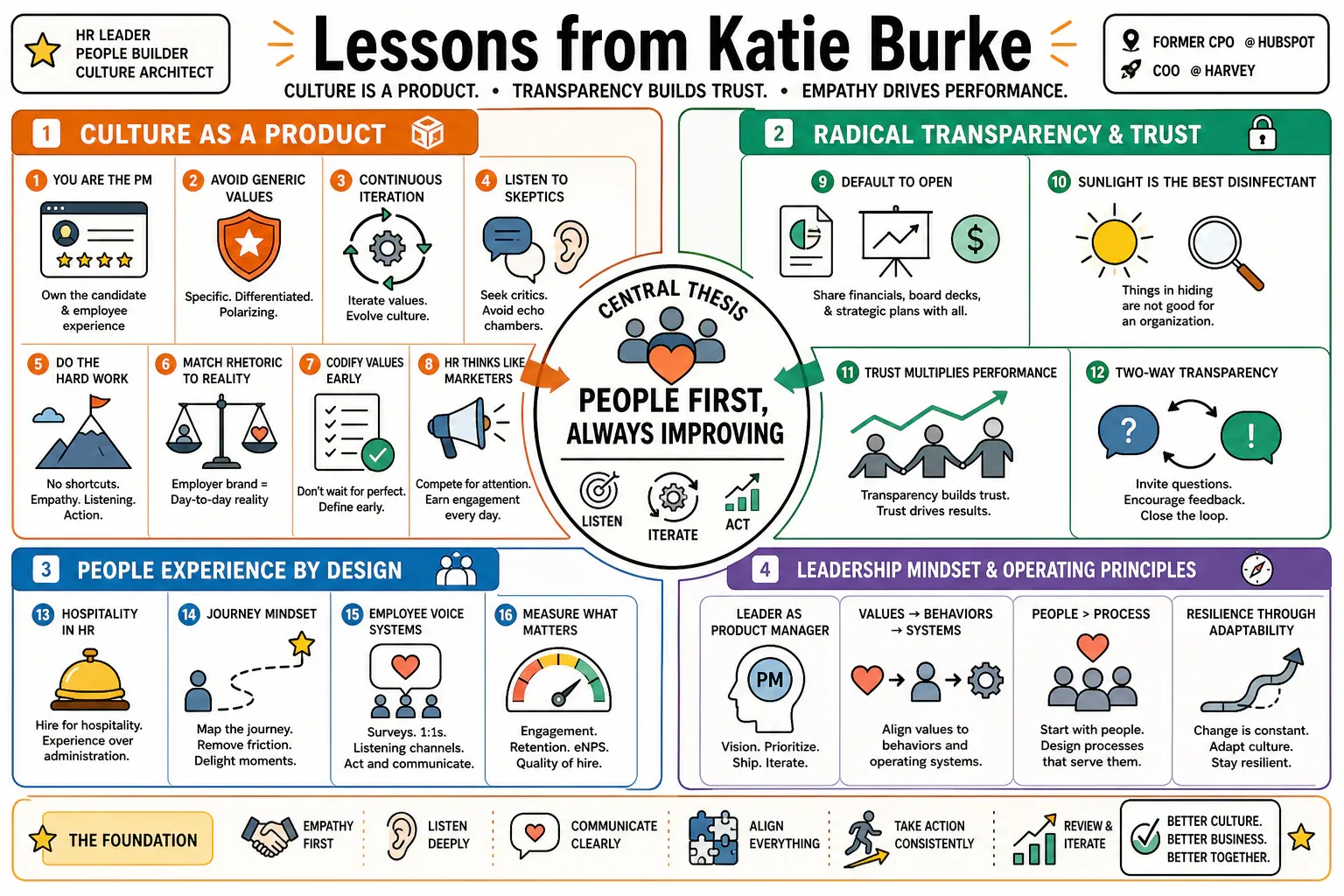
Part 1: Culture as a Product
- On Treating Culture Like Software: "Our culture is one of the products we offer at HubSpot... you are the ultimate PM for the candidate and employee experience." — Source: [Lattice]
- On the Danger of Generic Values: "Mission statements shouldn't be so generic that they could fit a yoga studio; they must be specific, differentiated, and even polarizing." — Source: [First Round Review]
- On Continuous Iteration: "Just like a software product, culture must evolve. HubSpot iterated its core values multiple times after earlier versions failed to resonate." — Source: [HubSpot]
- On Listening to Critics: "Rather than dismissing critics, leaders should actively listen to 'culture skeptics' to avoid becoming an echo chamber." — Source: [Paddle]
- On the CHRO Mindset: "A CPO or a CHRO role is often viewed as compliance. It’s all defense. Keep us out of trouble... [Instead], you are the ultimate PM." — Source: [Lattice]
- On Doing the Hard Work: "A lot of the work we do is really complex and for good reason. So there are no shortcuts. There's only continued empathy, continued listening, and continued action on that listening." — Source: [Lattice]
- On Matching Rhetoric to Reality: "A company's external employer brand on platforms like Glassdoor must match the actual day-to-day experience of employees." — Source: [Future Talent Learning]
- On Codifying Values Early: "In startup environments like Harvey AI, leaders shouldn't wait for perfection to define what the company stands for; codify values early." — Source: [Medium]
- On HR as Marketers: "The best people leaders think like marketers, recognizing that leaders must compete for their employees' attention and engagement every day." — Source: [YouTube]
- On Hospitality in HR: "Hiring people from hospitality backgrounds rather than traditional HR prioritizes the candidate and employee experience above administrative compliance." — Source: [HubSpot]
Part 2: Radical Transparency & Trust
- On Defaulting to Open: "HubSpot famously shares its financial data, board decks, and strategic plans with all employees because transparency builds trust." — Source: [YouTube]
- On the Power of Transparency: "Sunlight is the best disinfectant... things in hiding are not good for an organization. They're not good for growth, they're not good for innovation." — Source: [Lattice]
- On Taking Ownership: "I always say that if there's a jump ball at the leadership team level, the CHRO will come down with the ball. So rather than waiting for someone else to take it, it's better to just assume it's yours." — Source: [Inc.]
- On the Calm Lifeguard Mentality: "In times of crisis or uncertainty, leaders must act as calm lifeguards. People don't want to be rescued by someone who is panicking." — Source: [ExCo Leadership]
- On Embracing Failure: "Better to try and sometimes fail than to sit tight… and fail for sure." — Source: [Inc.]
- On Destigmatizing Mistakes: "Implementing Failure Forums where leaders share their biggest mistakes helps destigmatize failure and turns it into a collective learning opportunity." — Source: [Inc.]
- On the Risk of Playing it Safe: "The problem with avoiding failure is that’s how great companies become mediocre." — Source: [Inc.]
- On Psychological Safety: "Employees are more likely to try something bold, innovative, and new when they aren’t afraid it’ll cost them their job." — Source: [Inc.]
- On the Speed of Recovery: "What matters is that you can learn, iterate, and try again. Failure is a data point, not an end point." — Source: [Inc.]
Part 3: The "Protein vs. Sugar" of Feedback
- On "Sugar" Feedback: "Sugar feedback consists of high-level praise, perks, and unicorns and rainbows culture that feels good in the moment but doesn't sustain long-term growth." — Source: [Apple Podcasts]
- On the Necessity of "Protein": "Protein feedback is the substantive, often difficult, but necessary feedback that helps an employee grow and improves the business." — Source: [Apple Podcasts]
- On the "Unicorns and Rainbows" Myth: "Our job is not to make you happy every day; our job is to create an environment where you can do the best work of your career." — Source: [First Round Review]
- On Over-Indexing on Sugar: "There were certainly days when we over-indexed too high to the unicorns and rainbows, and I think disappointed people when reality required more protein." — Source: [Apple Podcasts]
- On Avoiding the Cultural Hangover: "Organizations often face a cultural hangover after layoffs if they haven't balanced their culture with enough protein to sustain them through lean times." — Source: [Apple Podcasts]
- On Simple Incentives: "Compensation and incentive programs should be kept simple to avoid manipulation and ensure that the protein—actual performance goals—remains the focus." — Source: [Apple Podcasts]
- On Continuous Feedback: "Feedback should be continuous so that formal reviews contain no surprises or new information." — Source: [Essex Partners]
- On the Breakfast of Champions: "Employees should view feedback as data rather than a personal attack, embracing the idea that feedback is the breakfast of champions." — Source: [Inc.]
- On the Goal of Growth: "A leader's ultimate responsibility is providing the nutritional management that builds long-term strength and professional development." — Source: [Listen Notes]
Part 4: Hiring for "Culture Add"
- On the Flaw of "Culture Fit": "Culture fit is often a lazy shorthand for people I’d like to have a beer with, which inadvertently excludes people from different backgrounds." — Source: [Fast Company]
- On Defining "Culture Add": "Seek candidates who share the company's core values but bring new perspectives, skills, or experiences that the organization currently lacks." — Source: [Medium]
- On Challenging Conventions: "We need people who are good at challenging conventional assumptions. We want people with experience of growing at scale, but they're also committed to doing things a different way." — Source: [ExCo Leadership]
- On Behavioral Interviewing: "Standardized templates and behavioral questions for all candidates help mitigate gut feeling biases during the hiring process." — Source: [Fast Company]
- On Values-Based Questions: "Ask behavioral questions that reveal a candidate's alignment with core values, such as asking about a time they helped a colleague succeed without direct benefit." — Source: [Medium]
- On the Teaching Hospital Analogy: "A healthy company is like a teaching hospital where everyone is both a student and a teacher, requiring hires to have a growth mindset." — Source: [Medium]
- On Hiring Autonomous Talent: "Look for autonomous individuals who don't need micromanagement and who thrive in a radically transparent environment." — Source: [UPenn]
- On Building the Table: "Leaders—especially those from underrepresented backgrounds—should stop asking for permission and instead take the lead in creating the environments they want to see." — Source: [YouTube]
- On Diversity as a Default: "Leaders must think about building diverse and inclusive teams by default, rather than treating it as a separate HR compliance initiative." — Source: [HubSpot]
Part 5: Rethinking Onboarding & Employee Experience
- On the First Culture Feature: "Onboarding is not just administrative tasks; it is the first feature of the company's culture product." — Source: [YouTube]
- On the Beginner's Mindset: "New hires should join with a beginner’s hat, as trying to copy-paste playbooks from previous jobs often leads to failure." — Source: [YouTube]
- On Unlearning Old Habits: "Effective onboarding is designed to help employees unlearn old habits and adopt the specific operating system of their new company." — Source: [YouTube]
- On Manager Multipliers: "While HR sets the stage for onboarding, the direct manager is the most critical factor in a new hire's success." — Source: [YouTube]
- On Psychological Safety in Onboarding: "Managers must exhibit humility during onboarding, creating a space where new hires feel safe saying, 'I don't know how to do this yet.'" — Source: [Lattice]
- On Scaling the Nuts and Bolts: "Rapid growth requires scaling the un-glamorous parts of onboarding, like building out global HR tech stacks that can handle multiple countries simultaneously." — Source: [YouTube]
- On Establishing Operating Cadence: "A clear operating system ensures new employees immediately understand the cadence of internal communications and how decisions are made." — Source: [YouTube]
- On Where Culture Lives: "Culture doesn't live in our hallways, it lives in our hearts and in the shared documentation that connects distributed teams." — Source: [YouTube]
- On Return on Invested Time (ROIT): "Any request made of an employee, including onboarding tasks, should have a clear financial or developmental return on the time they invest." — Source: [Apple Podcasts]
Part 6: Leading in a Hybrid World
- On Hybrid Equity: "Our commitment to hybrid means that people won't feel their success or access to careers in tech is tied to their zip code." — Source: [Owl Labs]
- On Empathy in Strategy: "In order to deliver on a great hybrid strategy, empathy is the key ingredient." — Source: [Owl Labs]
- On Guardrails vs. Autonomy: "Our goal at HubSpot is to provide high-level guardrails as a company on hybrid inclusion and still provide a lot of autonomy to leaders to do what works for their teams." — Source: [Owl Labs]
- On Removing Opinions from Decisions: "To decide on the future of work, organizations should use data panels and employee surveys rather than relying on executive intuition." — Source: [Owl Labs]
- On Asynchronous Resources: "Successful hybrid work relies heavily on shared internal documentation and recorded meetings to ensure no one is left out of the loop." — Source: [YouTube]
- On Hybrid-Friendly Infrastructure: "Remote work requires highly organized meeting processes, including written agendas and dedicated facilitators for remote inclusion." — Source: [Lattice]
- On Manager Enableement in Hybrid: "Developing specific communities or training programs for managers is essential to handle the nuances of leading distributed teams and avoiding proximity bias." — Source: [YouTube]
- On Work-Life Integration: "Employees are saying two things at once: they don't want work to be their lives, but they also want their work to reflect the values of their lives." — Source: [ExCo Leadership]
- On Letting Go of Guilt: "No one is winning quarantine... Your company will survive without you for the day. In fact, you'll likely have even more of an impact once you've taken time to recharge." — Source: [Medium]
- On Mental Health Stamina: "We all need to prepare for a marathon, not a sprint... now's not the time to push mental health down on our to-do lists." — Source: [Medium]
Part 7: Redefining Performance Reviews
- On Ditching the Annual Review: "Performance reviews should be a regular part of a company's operating system rather than a once-or-twice-a-year event where employees wait months for feedback." — Source: [Essex Partners]
- On Matching the Resort to the Brochure: "If a company claims to be high-performance, it must be willing to have difficult conversations and make hard calls; the experience must match the pitch." — Source: [First Round Review]
- On Blinded Reviews: "Removing names from performance reviews during leadership calibrations helps ensure fairness and standardizes what remarkable talent looks like across the organization." — Source: [First Round Review]
- On Empathy in Reviews: "Especially during stressful periods, managers should reframe reviews as check-ins on personal well-being and email key themes a few days in advance." — Source: [Inc.]
- On the Danger of "7s": "Employees who are consistently rated a 7—good enough but not scaling—can create a culture of mediocrity; managers must give direct feedback to improve or evaluate their future." — Source: [Inc.]
- On Future-Proofing Talent: "Instead of just looking at past performance, managers should ask: How would you handle performance reviews differently if you were building a team for the future?" — Source: [Inc.]
- On Sharing Personal Reviews: "Leaders should share their own performance reviews with their teams to model vulnerability and demonstrate a genuine growth mindset." — Source: [First Round Review]
- On Skipping the Transactional Nature: "Companies must move away from compliance-heavy, check-the-box HR exercises toward strategic, ongoing talent development." — Source: [Essex Partners]
- On the Michael Jordan Standard: "Executives should strive to be the hardest-working person on the team, fostering a culture where others are willing to follow them to battle." — Source: [YouTube]
Part 8: Women in Leadership & The Non-Linear Career
- On the Non-Linear Path: "You don't become a director, a VP, or a CEO without striving to try new things, doing them remarkably, and even sometimes failing and learning from that failure." — Source: [HubSpot]
- On Embracing the Unknown: "In business, new opportunities will be thrown at you every day. It's okay to be afraid of what you don't know—but take that fear, and do it anyway." — Source: [HubSpot]
- On Continuous Growth: "Tackle the lateral opportunities and take on brand new challenges. Learn something new and master that skill. Always be growing and learning as you move up the career ladder." — Source: [HubSpot]
- On the Aspiration Gap: "Studies show that when women enter the workforce, their aspiration to become C-level executives is roughly the same as their male counterparts and just five years into the workforce, that drops precipitously." — Source: [Silicon Republic]
- On Collective Responsibility: "Spoiler alert: both men and women need to be part of the solution to gender inequity." — Source: [Silicon Republic]
- On a Personal Board of Advisors: "Instead of relying on a single mentor, build a personal board of advisors to provide diverse perspectives on your career and life." — Source: [Ali on the Run Blog]
- On Values-Led Careers: "Rather than picking a specific role and working backward, lead with your values and let them guide you to your next career step." — Source: [Apple Podcasts]
- On Being an Accidental HR Professional: "Career fulfillment often comes from being open-minded about your destination rather than rigidly sticking to an initial plan." — Source: [YouTube]
- On Chameleon Leadership: "Successful leaders must be chameleons, adjusting their management style to bring out the best in each individual rather than expecting the team to mirror the leader." — Source: [YouTube]
- On the Bossy Oldest Sister Mentality: "I am the very definition of a bossy oldest sister... You love big, but you also make big decisions, and you have a strong presence and opinion about things." — Source: [YouTube]