Luke Nosek co-founded PayPal, later co-founded Founders Fund, and is a co-founder and partner at Gigafund. At Founders Fund, he led the first venture investment in SpaceX in 2008 and has served on its board since then. Gigafund ↗
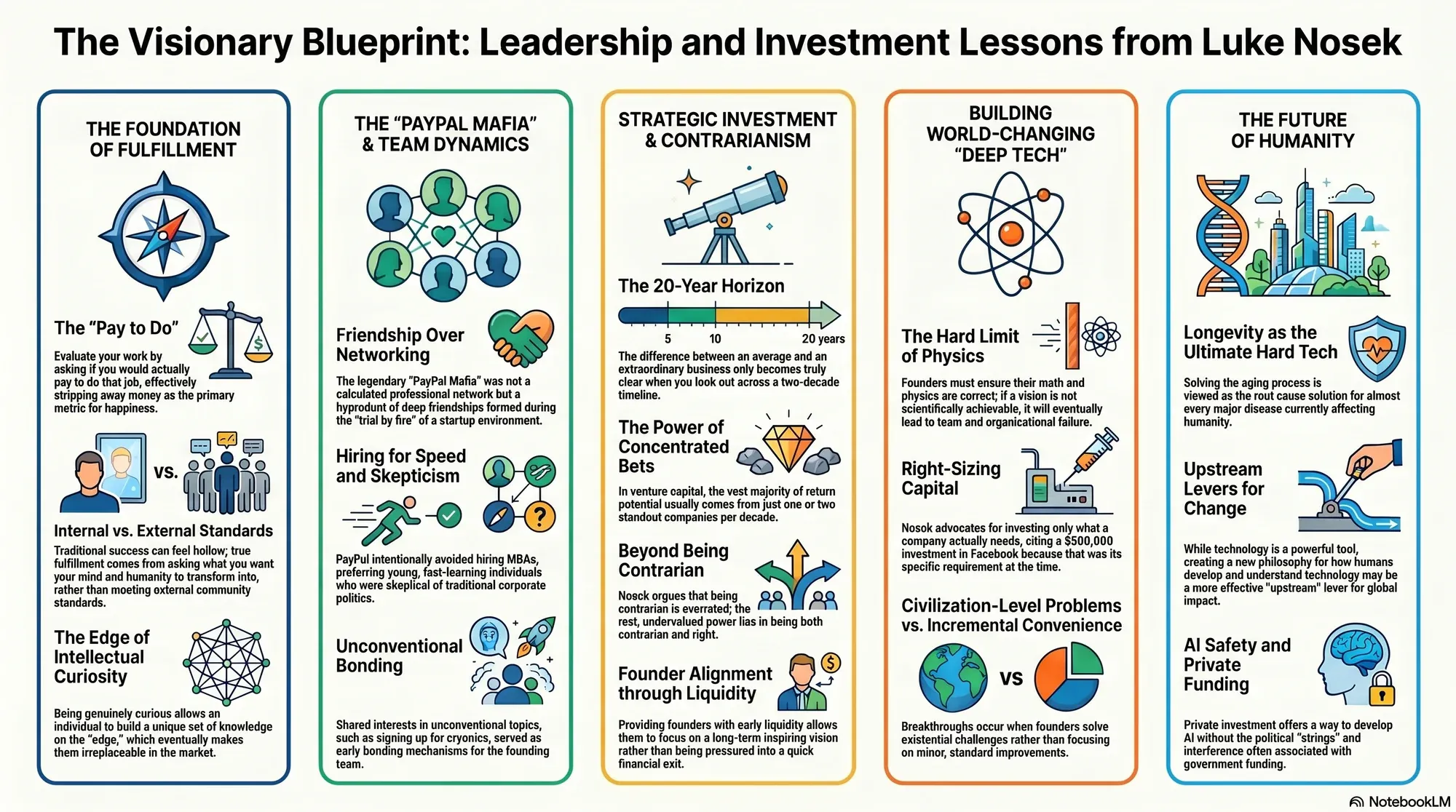
Part 1: Philosophy of Success and Fulfillment
- On Rethinking Success: After PayPal’s success, Nosek questioned why conventional achievement had not made him feel fulfilled and began reconsidering the standard by which he judged success. — EA Global talk ↗.
- On the Pay-to-Do Test: To identify intrinsically meaningful work, Nosek asks which activities he would be willing to pay to do rather than merely expecting payment for them. — EA Global talk ↗.
- On Choosing Your Standard: Nosek repeatedly asks whose standard of success he is following instead of assuming that external measures are the right ones. — EA Global talk ↗.
- On Examining the Intended Transformation: Builders of transformative technology should ask what they want humanity, the mind, and society to become. — Transformative Technology talk ↗.
- On Doing the Inner Work: Nosek urges creators to examine and continue their own inner development because personal motivations can become entangled with the systems they build. — Transformative Technology talk ↗.
- On the Founder Formula: Nosek’s investment framework combines the founder, the mission, the technology, and the stamina required to pursue the work over a long period. — Capstones interview ↗.
- On Social Pressure: Nosek identifies community pressure as one force that can keep people from pursuing unusual paths. — EA Global talk ↗.
- On Founder Motivation: For technologies capable of changing minds or society, a founder’s motivations and models of the world can shape the project’s long-term trajectory. — Transformative Technology talk ↗.
- On Companies Built for Long-Term Purpose: Nosek argues that companies founded around a durable purpose—such as Google, Facebook, or SpaceX—may do more good than many other available vehicles. — Capstones interview ↗.
Part 2: The "PayPal Mafia" and Team Dynamics
- On PayPal’s Original Mission: Nosek says PayPal originally sought to create a global currency independent of interference from banks and governments. — Davos interview ↗.
- On Compromising the Mission: PayPal became economically powerful but remained centralized and dependent on major financial institutions; Nosek says the company learned to accommodate those institutions and did not complete its original mission. — Davos interview ↗.
- On the Outsider’s Advantage: Entering an unfamiliar industry can help a founder question practices that insiders have stopped noticing because they are treated as simply how things are done. — Capstones interview ↗.
- On Meeting the Founder: Nosek says he cannot decide on a company before meeting its founder; evaluating the person is central to evaluating the investment. — Capstones interview ↗.
Part 3: Investment Strategy and Contrarianism
- On Investing as a Long-Term Partnership: Nosek compares backing a founder to getting married: spend time understanding the person, then commit for the long term. — Capstones interview ↗.
- On the 20-Year Test: Gigafund asks whether a company can become one of the world’s most significant businesses over 20 years and whether its founder will stay long enough to realize that potential. — Gigafund thesis ↗.
- On Concentrated Investing: Gigafund argues that most venture-return potential comes from one or two companies per decade, so it concentrates most of its capital in a handful of candidates for long-term significance. — Gigafund thesis ↗.
- On Preserving Founder Control: Nosek points to Founders Fund’s Facebook investment as an effort to let founders retain board control and resist pressure for an early sale. — EA Global talk ↗.
- On Aligning Founders for the Long Term: Providing some early liquidity can reduce pressure for a quick exit and help founders stay focused on a larger long-term mission. — EA Global talk ↗.
- On Binary Technical Risk: In discussing SpaceX, Nosek framed the core technical question plainly: the rocket would either reach orbit or it would not, and he believed the team was capable of making it work. — Venture Capital Journal interview ↗.
- On Due Diligence without Precedent: Nosek noted that investors could not interview living backers of prior successful new-rocket ventures; the absence of precedent was part of the investment problem. — Venture Capital Journal interview ↗.
- On Patient Capital for Transformative Companies: Gigafund makes long-term concentrated investments in founders building companies intended to create or transform industries over decades. — Gigafund thesis ↗.
- On Escaping Conventional Paths: Nosek argues that social pressure makes it difficult to break from the pack, which is one reason unusual approaches demand conviction. — EA Global talk ↗.
- On Choosing the Right Problem: Nosek recommends problems that are strategically important, inspiring enough to attract exceptional people, and achievable under real technical constraints. — BIL 2013 talk ↗.
Part 4: Building World-Changing Companies
- On Right-Sizing Capital: Nosek describes matching the investment to what the company actually needs, contrasting SpaceX’s capital requirements with Facebook’s much smaller early round. — Venture Capital Journal interview ↗.
- On Physics as a Hard Constraint: For technically ambitious plans, the mathematics and physics must work; rhetoric cannot compensate for a future that is physically impossible. — EA Global talk ↗.
- On Achievable Ambition: An inspiring future still has to be achievable in the near term and consistent with the laws of physics. — BIL 2013 talk ↗.
- On Avoiding the Fundability Trap: Nosek warns that an institutionalized startup ecosystem can lead people to ask what will get funded instead of asking what company they should start. — Capstones interview ↗.
- On Preparing for Failure Modes: Nosek values founders who have thought through difficult scenarios and are prepared to act when products or technical systems fail. — EA Global talk ↗.
- On Designing Distribution into the Product: David Sacks credits Nosek with devising PayPal’s signup and referral bonuses; once PayPal focused on eBay sellers, that incentive helped the product spread rapidly through the community. — David Sacks’s PayPal account ↗.
- On Rigorous Reasoning and Team Quality: Weak reasoning can compound through hiring because leaders may attract teammates who fail to notice the same flaws. — EA Global talk ↗.
- On First-Principles Founders: Gigafund seeks founders who look past short-term trends and existing industry structures to attack large problems from first principles. — Gigafund thesis ↗.
- On Building Transformative Businesses: Significant companies that create or transform industries require unusual stamina, independent thought, vision, and long-term backing. — Gigafund thesis ↗.
Part 5: The Future of Humanity
- On Looking for Upstream Levers: Nosek broadened his view of impact beyond building or funding companies to include philosophy, political systems, psychology, sociology, and nonprofit work. — EA Global talk ↗.
- On Philosophy as an Upstream Force: A new philosophy or understanding of humanity can change how entrepreneurs decide which technologies to build. — EA Global talk ↗.
- On Private Funding as an Alternative: Nosek argues that private capital can give technical projects an alternative to government funding and the political constraints that may accompany it. — EA Global talk ↗.
- On Effective Altruism: Nosek says effective altruism expanded his view of the different levers available for producing positive impact. — EA Global talk ↗.
- On Long-Term Technological Optimism: Gigafund’s thesis is that founders using first principles to solve major problems can build transformative companies whose impact and value compound over decades. — Gigafund thesis ↗.