Malte Ubl is the Chief Technology Officer at Vercel and a pioneer in web infrastructure, having previously served as an Engineering Director at Google where he co-created Core Web Vitals and the AMP Project. Across two decades of leadership, Ubl has focused on the intersection of developer productivity, web performance, and the transformative potential of AI-driven interfaces.
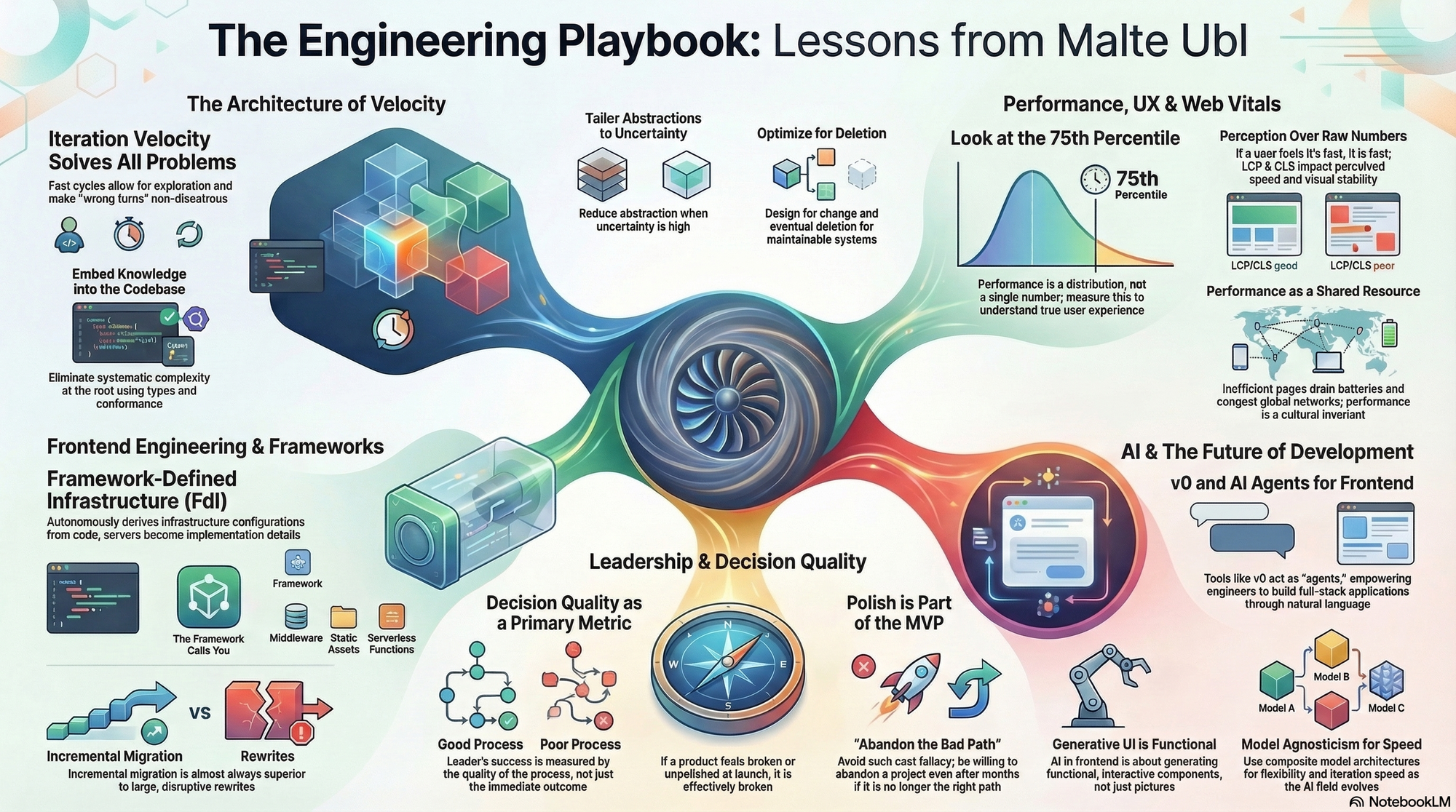
Part 1: The Architecture of Velocity
- On Iteration Velocity: "Iteration velocity solves all known software problems." — Source:
- On Feedback Loops: "Everything we do is basically about literally physically reducing iteration cycles; if you can react quickly, a wrong turn isn't a disaster." — Source:
- On Uncertainty: "Understand the degree of uncertainty and then tailor the degree of abstraction respectively; if uncertainty is high, reduce the abstraction." — Source:
- On Systematic Complexity: "Identify and catalog the difficulties encountered by the team and develop tools or processes to eliminate that systematic complexity at the root." — Source:
- On Systematic Knowledge: "Embed knowledge into the codebase via types, conformance, or linting rules so that teammates with less context can still work effectively." — Source:
- On Deleting Code: "Optimizing for change and deletion leads to better, more maintainable designs than optimizing for permanence." — Source:
- On The Cost of Failure: "If the cost of failure is low because iteration is fast, you can allow for more exploration in your API design rather than trying to make it foolproof." — Source:
- On Abstraction Limits: "You only really know how to build a perfect abstraction after you have fallen on your face at least five times building that specific type of application." — Source:
- On Local Environments: "The end of the local development environment is near; the cloud is where the compute, the data, and the preview should live for maximum speed." — Source:
- On Measuring Speed: "Focus on the time it takes for a developer to see the results of their changes; this is the fundamental unit of engineering success." — Source:
Part 2: Frontend Engineering & Frameworks
- On Framework-Defined Infrastructure (FdI): "FdI autonomously derives infrastructure configurations directly from the application's framework and code, turning servers into implementation details." — Source:
- On The Role of Frameworks: "The framework calls you; the framework should control the life cycle of the system, not the other way around." — Source:
- On Code Analysis: "We should look at your application, analyze it, and then deploy it to edge middleware or static assets based on its actual needs." — Source:
- On Predictability: "Immutable deployments where each commit creates a dedicated infrastructure lead to enhanced predictability and security in DevOps." — Source:
- On The Wiz Framework: "Wiz was built to be an invariant-focused framework that eliminated the trade-offs between ease of writing and excellent user experience at Google." — Source:
- On Open Sourcing: "One regret is not open-sourcing Wiz earlier; it had unique power but would now require a massive update to match modern developer experiences." — Source:
- On Modern Frameworks: "The case for modern frameworks isn't just about syntax; it's about the deep integration with infrastructure that allows for automation not possible with black boxes." — Source:
- On Technical Debt: "Incremental migration is almost always superior to large, disruptive rewrites that halt product progress." — Source:
- On API User Empathy: "Build empathy with your API users by practically building apps with your own tools; dogfooding is the only way to validate abstractions." — Source:
- On Static vs. Dynamic: "The goal is to blur the line between static and dynamic, where the infrastructure intelligently decides based on the framework's intent." — Source:
Part 3: Performance, UX & Web Vitals
- On Real-World Measurement: "Core Web Vitals were designed to measure the real-world user experience of loading, interactivity, and visual stability, not just synthetic lab tests." — Source:
- On Performance Distribution: "Web performance is a distribution, not a single number; you have to look at the 75th percentile to understand the true user experience." — Source:
- On Performance Ranking: "Core Web Vitals are widely used because they are a ranking factor; this alignment between user experience and business goals is critical." — Source:
- On AMP's Goal: "AMP was designed to be 'portable content' that could be served instantly from any cache while maintaining strict performance guarantees." — Source:
- On User Perception: "Performance is ultimately about human perception; if a user feels a page is fast, it is fast, regardless of the raw numbers." — Source:
- On Cumulative Layout Shift (CLS): "CLS is one of the most important metrics because visual stability directly impacts user trust and task completion." — Source:
- On Performance Culture: "Performance isn't a checklist; it's a culture of identifying invariants that prevent regressions automatically." — Source:
- On The Web as a Shared Resource: "The web is a shared resource; inefficient pages don't just hurt one user, they drain device batteries and congest networks globally." — Source:
- On LCP Priority: "Largest Contentful Paint (LCP) is the most critical metric for perceived loading speed; it tells the user 'this page is ready for you'." — Source:
- On The Baseline: "Over half of the pages on the web have bad Core Web Vitals scores; the gap between the best and the average is still too large." — Source:
Part 4: AI & The Future of Development
- On v0 and AI DX: "v0 is an 'agent' for the frontend that empowers even backend engineers to build full-stack applications through natural language." — Source:
- On Coding Agents: "Coding agent architectures work surprisingly well for non-coding tasks; we are entering an era of software that can make decisions." — Source:
- On The d0 Agent: "We built d0 to democratize data; it uses basic Unix commands like grep and cat to navigate our data warehouse and answer questions in Slack." — Source:
- On Generative UI: "Generative UI is not just about making pictures; it's about generating functional, interactive components that solve a user's immediate intent." — Source:
- On Model Agnosticism: "Don't train your own foundation models if you want to iterate fast; use a composite model architecture to stay flexible as the field evolves." — Source:
- On AI Costs: "Continuous algorithmic and hardware improvements will keep AI costs reasonable; the competition among labs is a win for developers." — Source:
- On Agentic Infrastructure: "The future of the cloud is infrastructure that understands agents, supporting long-running workflows and non-deterministic actions." — Source:
- On High-Value Software: "Agents enable the creation of valuable software that was previously economically unfeasible due to the cost of manual development." — Source:
- On Error-Free Generation: "The goal for AI tools is not just generation, but achieving error-free, 'hallucination-minimized' output that passes type checks." — Source:
- On AI and Human Agency: "AI tools should expand human agency, not replace it; v0 is about getting you to a 1.0 version faster so you can do the real creative work." — Source:
Part 5: Leadership, Culture & Decisions
- On Decision Quality: "Decision quality is the primary metric for a leader; it's about the process used to reach a conclusion, not just the immediate outcome." — Source:
- On Sunk Cost Fallacy: "The sunk cost fallacy is the most dangerous trap for senior engineers; you must be willing to abandon a bad path even after months of work." — Source:
- On Polish as MVP: "Polish is not a post-launch luxury; polish is part of the MVP. If it feels broken, it is broken." — Source:
- On Credit: "Credit is not a zero-sum game; the more credit you give away to your team, the more successful you become as a leader." — Source:
- On Hiring Experts: "Working on Google Search was humbling because of the density of experts; always hire people who are better than you in their specific domains." — Source:
- On Open Source Sustainability: "The best way to sustain open source is to grow the pie through unencumbered licenses that foster an ecosystem rather than a wall." — Source:
- On The Opportunity Cost of Inaction: "Always weigh the worst-case outcome of a decision against the opportunity cost of not acting at all." — Source:
- On "Can't be bad": "Prefer systems that 'can't be bad' over those that 'can be amazing but are typically bad'. Consistency is a feature." — Source:
- On Team Adoption: "When introducing new frameworks, work closely with early adopters to ensure the solution is actually liked before forcing wide adoption." — Source:
- On The Role of the CTO: "The CTO's job is to ensure the technology strategy enables the iteration velocity required for the business to survive and thrive." — Source: