Matt Slotnick, the CEO of Poggio Labs and author of the Substack "cloud rants, predominantly," has become a leading voice in the transition from traditional SaaS to the "Agentic Era." His insights bridge the gap between high-level market strategy and the granular mechanics of software building.
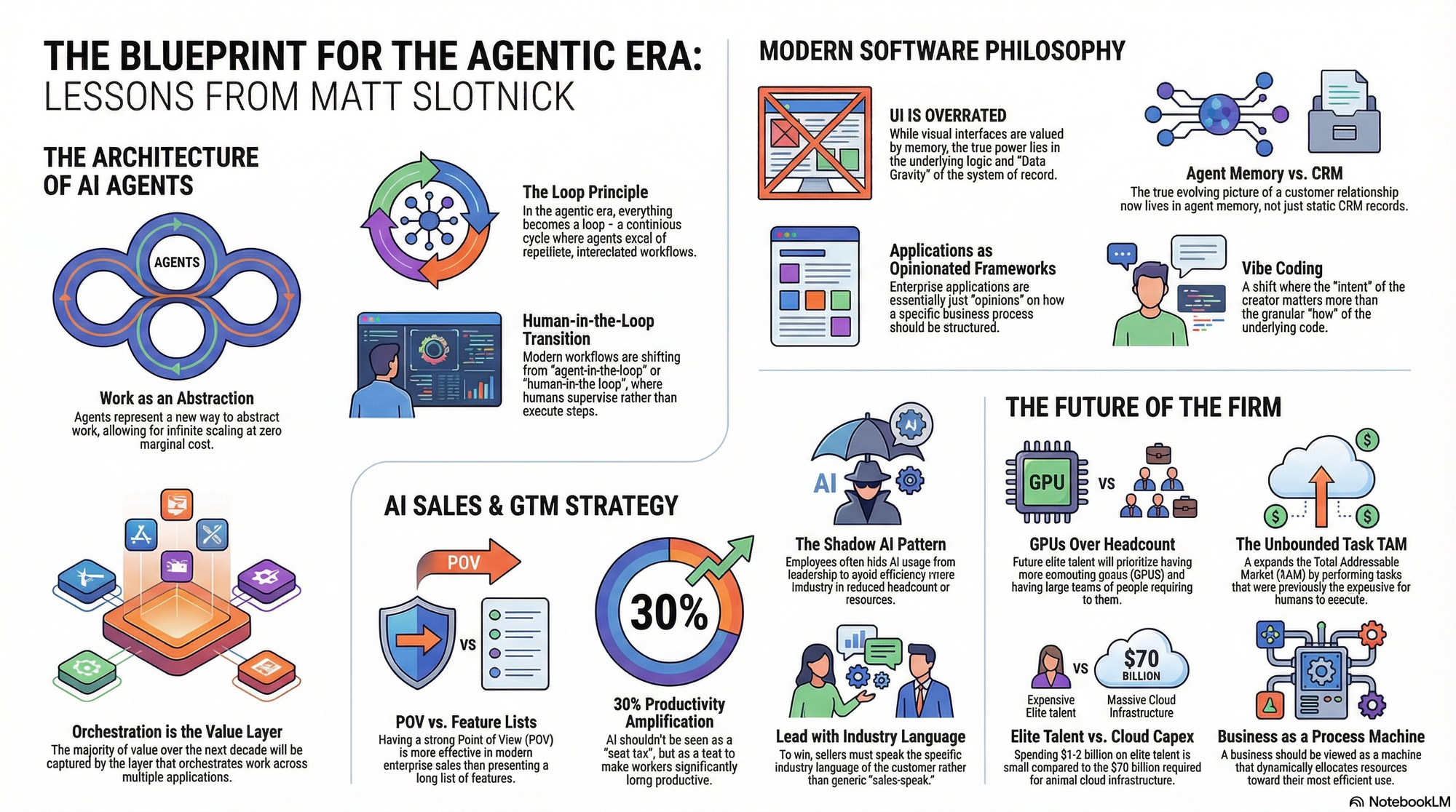
The Architecture of AI & Agents
- Work as an Abstraction: "There’s a new abstraction for work, and that abstraction is agents." (Source)
- The Loop Principle: "Everything becomes a loop.[1] And agents are great at loops." (Source)
- Decoupling Growth: "The total amount of work done within an organization will dramatically increase, but decoupled from cost and headcount."[1] (Source)
- Atomic Units of Work: "Don't try to 'solve sales' with a button. Identify the atomic units of work, make those units better, and stitch them together." (Source)
- Human-in-the-Loop Transition: "We are moving from 'agent in the loop' to 'human in the loop,' where humans supervise the work rather than executing every step." (Source)
- Infinite Scaling: "With AI, agents can act on data at infinite scale and zero marginal cost."[1] (Source)
- The UI as a Guardrail: "The UI is the way an organization sets the guardrails for thousands of interrelated workflows that make a business run."[2] (Source)
- Nouns and Verbs: "The nouns and the verbs for how you use AI don't even exist yet. We are in the market development phase." (Source)
- Agent Memory: "The real evolving picture of a customer relationship lives in agent memory, not just the CRM." (Source)
- Orchestration Value: The lion’s share of value in the next decade will go to the layer that orchestrates work acrossapplications.
Modern Software Philosophy
- UI is Overrated: "Application UI is overrated. As visual creatures, we value what we see, but what lies underneath is what actually matters."[1][2] (Source)
- Systems of Record Gravity: "Data has gravity.[3] The system of record commands immense value because it creates influence on all other systems."[3] (Source)
- Application as Opinion: "Enterprise applications are just opinionated frameworks for how a business process should be structured." (Source)
- The Best Business Model: "Shrink-wrapped software [SaaS] is the best business model on earth." (Source)
- Consumer-Grade Expectations: "If IT doesn’t provide modern tools, users will find them. IT will eventually find themselves in a forced procurement cycle for what their users already use." (Source)
- Low-Code is a Paradigm, Not a Category: "Saying 'we are a low-code company' tells you almost nothing about the value you provide." (Source)
- The End of 'Cheap' Growth: "When the unit economics of software growth shift, your balance sheet cannot save you." (Source)
- Platform Definition: "A platform is an application that provides interfaces for other applications to be built upon." (Source)
- Vibe Coding: The shift where the "how" of code matters less than the intent of the creator. (Source)
- The CRM Battleground: "The CRM isn't the battleground... at least not in the way you’re thinking. The battle is for the work that happens outside of it." (Source)
AI Sales & GTM Strategy
- Winning POVs: "A Point of View (POV) is more powerful than a feature list in modern enterprise sales."
- Research is a Waste: "Sellers waste too much time on manual research that AI can execute in 60 seconds." (Source)
- Amplifying People: "AI isn't a 'seat tax'; it's about amplifying the ability for people to do their jobs 30% more productively." (Source)
- Leading with Language: "To win, a seller must speak in the specific industry language of their customer, not generic sales-speak."
- Selling to Winners: "Focus on the market-leading Winners who will actually buy AI. Companies squeezing cash are often afraid of new tech." (Source)
- The Shadow AI Pattern: "In some companies, reps hide AI usage because they're afraid the CIO will take it away once they realize how much more efficient it makes them." (Source)
- AI for Sales Context: The value of AI in sales is "discovering, synthesizing, and contextualizing data" from thousands of unstructured sources. (Source)
- Relationship Data: AI allows you to capture the "rich and dynamic context" of a lead that manual logging misses.
- Outcome Centricity: In subscription software, the power rests with the customer’s ongoing success, not the initial sale. (Source)
- Winning the Future: "We won the last game [SaaS]; now AI helps us win the future." (Source)
Product & Team Execution
- Iterative Innovation: "Product innovation in AI comes from an iterative approach, not a rigid 12-month roadmap." (Source)
- Workflow First, Tech Second: "Team construction should be influenced by deep understanding of end-user workflows, not just technical ability." (Source)
- Managing Infinite Expectations: One of the hardest parts of AI is managing the "infinite expectation" users have for the technology. (Source)
- Data vs. Context: "Data without contextual action is just a liability."
- The maestros of Excel: "Today, people are the engine of business, the maestros of Excel macros... AI is the new engine." (Source)
- Infrastructure Costs: "Spending $1-2bn on elite talent is 'nothing' compared to $70bn on annual cloud capex." (Source)
- GPU over Headcount: Elite talent in the future will ask for the "fewest people reporting to me, and the most GPUs." (Source)
- The Logic of Applications: An application is essentially a set of "nouns and verbs" for a business. (Source)
- Building in Public: Building in public and engaging on social platforms is a critical modern distribution channel for founders. (Source)
- Open Core Risks: "Open source core is often a misaligned incentive for venture-backed SaaS." (Source)
Business Logic & Personal Philosophies
- Business as a Machine: "A business is just a process machine, dynamically allocating resources toward their most efficient use." (Source)
- Cycling & Business: Entrepreneurship is like cycling: success is about consistency, endurance, and knowing exactly when to push. (Source)
- Vibe Organizations: "Running an organization will start to feel like 'vibe coding'—setting the intent and letting agents execute." (Source)
- The Unbounded Task TAM: AI expands the TAM (Total Addressable Market) because it addresses tasks that were previously too expensive for humans to do. (Source)
- Cloud Rush Backlash: Hasty cloud migrations without workflow redesign often stall transformations. (Source)
- Data Sovereignty: In the agentic era, data control and compliance are the primary friction points for enterprise adoption.
- Hybrid Software: Pragmatism usually wins; hybrid models that mix local security with cloud scale are the future.
- Scale or Die: "In verticalized markets, you either scale and own the customer relationship or you die." (Source)
- Cloud Platform Incentives: Cloud incentives often drive behavior that is contrary to what the end-user actually needs. (Source)
- The Messy Reality: The transition from SaaS to AI is "far messier" than the marketing tropes suggest, but the destination is revolutionary. (Source)
Sources