Nic Carter is a prominent philosopher of the cryptocurrency space, renowned for his rigorous defense of Bitcoin's energy consumption, his advocacy for proof of reserves, and his early identification of "Operation Choke Point 2.0." As a founding partner of Castle Island Ventures and co-founder of Coin Metrics, his work bridges cypherpunk ideals with institutional financial infrastructure.
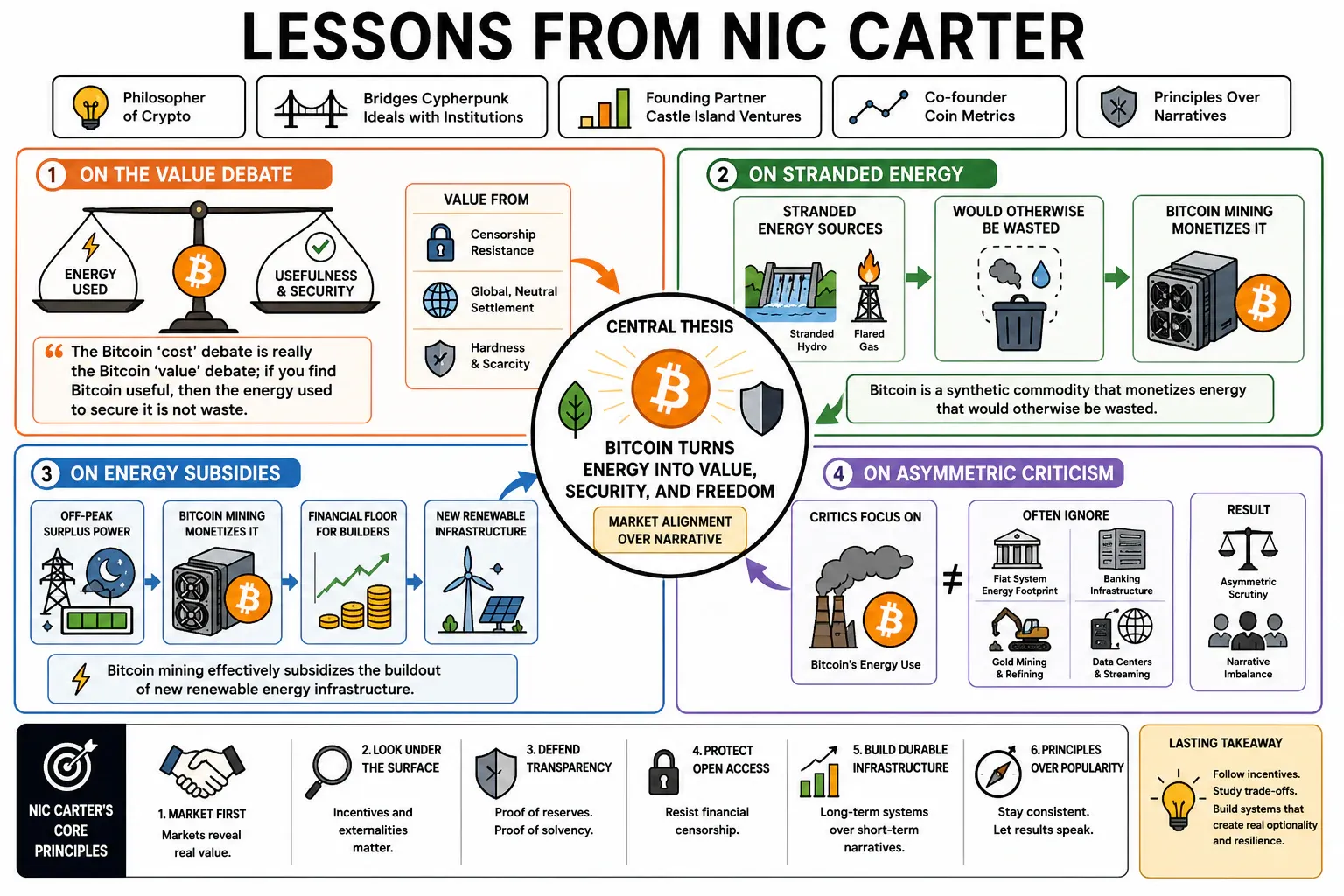
Part 1: Bitcoin's Energy Usage and ESG Debates
- On the Value Debate: "The Bitcoin 'cost' debate is really the Bitcoin 'value' debate; if you find Bitcoin useful, then the energy used to secure it is not waste." — Source: [Noahpinion Interview]
- On Stranded Energy: "Bitcoin is a synthetic commodity that monetizes energy that would otherwise be wasted, such as stranded hydro and flared gas." — Source: [Bitcoin Mining and the ESG Imperative]
- On the Buyer of Last Resort: "Miners act as a unique buyer of last resort for renewable energy, providing a financial floor for energy producers worldwide." — Source: [Castle Island Ventures Blog]
- On Energy Subsidies: "Bitcoin mining effectively subsidizes the buildout of new renewable energy infrastructure by monetizing off-peak power." — Source: [On the Brink Podcast]
- On Asymmetric Criticism: "Critics often target Bitcoin's energy use without acknowledging the immense hidden energy costs of the fiat financial system." — Source: [Nic Carter's Substack]
- On Grid Stabilization: "Flexible data centers, like those used for Bitcoin mining, can stabilize power grids by turning off during peak demand." — Source: [CoinDesk Opinion]
- On the Physics of Money: "Proof of Work anchors digital scarcity to the physical world, making it the only genuinely unforgeable digital commodity." — Source: [Visions of Bitcoin]
- On Flared Gas Mitigation: "By routing flared methane through generators to mine Bitcoin, the industry is actively reducing greenhouse gas emissions." — Source: [Bitcoin Net Zero Report]
- On ESG Hypocrisy: "Much of the ESG criticism against Bitcoin is intellectually lazy and ignores the nuances of how electrical grids actually operate." — Source: [On the Brink Podcast]
- On Resource Allocation: "Whether you feel Bitcoin has a valid claim on society's resources boils down to how much value you think it creates for society." — Source: [Nic Carter's Substack]
Part 2: Stablecoins and Crypto Dollars
- On Digital Cash: "Stablecoins restore the properties of cash in a digital format, bringing privacy and autonomy back to transactions." — Source: [Substack: Stablecoins are the real DeFi]
- On Dollarization: "Crypto dollars are quietly dollarizing the global south, providing an escape valve for citizens living under hyperinflation." — Source: [On the Brink Podcast]
- On Free Banking: "The current stablecoin landscape closely resembles the historical 'Free Banking' era, where private entities issued their own asset-backed currency." — Source: [CoinDesk Opinion]
- On Shadow Banking: "Stablecoins are a form of digital shadow banking, but one that is inherently more transparent due to public blockchains." — Source: [Bankless Interview]
- On Geopolitical Strategy: "The US government should embrace dollar-backed stablecoins as they extend the hegemony of the US dollar globally." — Source: [Castle Island Ventures Blog]
- On Remittances: "Crypto dollars bypass the extractive fees of legacy remittance networks, empowering workers to send more money home." — Source: [Nic Carter's Substack]
- On Yield Bearing Coins: "The next evolution of stablecoins involves passing the yield from the underlying Treasury bills back to the token holders." — Source: [On the Brink Podcast]
- On Offshore Dollars: "Stablecoins represent the creation of a massive offshore Eurodollar market that operates 24/7 without banking holidays." — Source: [Macro Voices Interview]
- On Regulatory Arbitrage: "Stablecoin issuers seek jurisdictions that provide regulatory clarity, highlighting the failure of onshore regimes to adapt." — Source: [Coin Metrics State of the Network]
- On Algorithmic Stablecoins: "Under-collateralized algorithmic stablecoins are structurally fragile and prone to spectacular death spirals." — Source: [Nic Carter's Substack]
Part 3: Proof of Reserves and Exchange Transparency
- On Exchange Solvency: "Trusting an exchange without cryptographic proof of its reserves is fundamentally antithetical to the ethos of cryptocurrency." — Source: [The Case for Proof of Reserves]
- On the FTX Collapse: "The collapse of offshore exchanges could have been mitigated if the industry had standardized around routine Proof of Reserves." — Source: [On the Brink Podcast]
- On Cryptographic Audits: "Proof of Reserves allows depositors to cryptographically verify that their assets are held 1:1 by the custodian." — Source: [Castle Island Ventures Blog]
- On Fractional Reserve Risks: "Crypto exchanges should not operate as fractional reserve banks; they are custodians, not credit creators." — Source: [Nic Carter's Substack]
- On Liability Proofs: "A complete Proof of Reserves must include a Proof of Liabilities, ensuring the exchange isn't hiding outstanding debts." — Source: [CoinDesk Opinion]
- On Self-Regulation: "The industry must proactively adopt cryptographic solvency standards before heavy-handed regulators force incompatible rules upon it." — Source: [On the Brink Podcast]
- On Transparency: "Blockchains make perfect transparency possible; choosing not to utilize it as a custodian is a massive red flag." — Source: [Bankless Interview]
- On Auditor Reluctance: "Traditional accounting firms are hesitant to audit crypto exchanges, making native cryptographic proofs even more critical." — Source: [Nic Carter's Substack]
- On User Vigilance: "Users must demand Proof of Reserves and withdraw their funds from institutions that refuse to provide it." — Source: [Visions of Bitcoin]
- On the Future of Custody: "The future of digital asset custody will be defined by continuous, real-time, on-chain auditing." — Source: [Castle Island Ventures Blog]
Part 4: Operation Choke Point 2.0 and Crypto Regulation
- On Coordinated Debanking: "Operation Choke Point 2.0 is a coordinated effort by regulators to marginalize the crypto industry by cutting off its banking access." — Source: [Operation Choke Point 2.0 Essay]
- On Regulatory Overreach: "Using bank regulators to backdoor policy decisions bypasses the legislative process and harms legitimate businesses." — Source: [On the Brink Podcast]
- On Systemic Risk FUD: "Regulators often falsely cite crypto as a systemic risk to banking, when in reality, the banks themselves failed due to poor duration management." — Source: [CoinDesk Opinion]
- On Signature and Silvergate: "The targeted closures of crypto-friendly banks demonstrated a clear political agenda rather than purely financial concerns." — Source: [Nic Carter's Substack]
- On the Need for Alternatives: "The industry must build its own censorship-resistant on-ramps and off-ramps that are immune to political pressure." — Source: [Bankless Interview]
- On SEC Strategy: "Regulation by enforcement stifles innovation and forces legitimate projects offshore to more welcoming jurisdictions." — Source: [On the Brink Podcast]
- On the Innovation Exodus: "Hostile regulatory environments in the US are causing a massive brain drain of crypto talent to Europe and the Middle East." — Source: [Castle Island Ventures Blog]
- On Financial Deplatforming: "Financial censorship is the ultimate tool of control; crypto was built specifically to route around this exact vulnerability." — Source: [Nic Carter's Substack]
- On the First Amendment: "Writing and deploying open-source code is a form of free speech that should be protected under the First Amendment." — Source: [CoinDesk Opinion]
- On Political Advocacy: "The crypto industry must mature into a powerful lobbying force to protect its right to exist in western democracies." — Source: [On the Brink Podcast]
Part 5: Bitcoin as a Monetary Network and Settlement Layer
- On Final Settlement: "Bitcoin is optimized not for buying coffee, but for the final, trustless settlement of large-value international transactions." — Source: [Visions of Bitcoin]
- On Block Space: "Bitcoin block space is a scarce commodity; high fees are necessary to ensure the network's security budget long-term." — Source: [Coin Metrics State of the Network]
- On the Lightning Network: "Layer 2 solutions like Lightning are the appropriate venue for small, rapid payments, preserving the base layer for settlement." — Source: [On the Brink Podcast]
- On Monetary Policy: "Bitcoin's completely inelastic issuance schedule is its defining monetary feature, contrasting sharply with fiat currency." — Source: [Nic Carter's Substack]
- On Central Banking: "Bitcoin acts as a structural hedge against the systemic mismanagement of central bank monetary policy." — Source: [Macro Voices Interview]
- On Censorship Resistance: "A settlement layer must be completely neutral; the moment it discriminates based on the user, it loses its fundamental value proposition." — Source: [Castle Island Ventures Blog]
- On Node Operation: "The ability for average users to run a full node and verify the rules is what keeps the Bitcoin network honest and decentralized." — Source: [Visions of Bitcoin]
- On Hard Forks: "Contentious hard forks are a mechanism for resolving deep philosophical disagreements, effectively splitting the community and the asset." — Source: [CoinDesk Opinion]
- On Digital Gold: "Bitcoin has successfully captured the 'digital gold' narrative because it replicates the physical properties of gold in the digital realm." — Source: [Nic Carter's Substack]
- On Institutional Adoption: "Institutions don't buy Bitcoin for payments; they buy it as a pristine, non-sovereign reserve asset." — Source: [On the Brink Podcast]
Part 6: The Visions and Narratives of Bitcoin
- On Competing Visions: "Bitcoin isn't just one thing; it has been viewed as a cheap P2P payments network, censorship-resistant digital gold, and a reserve asset." — Source: [Visions of Bitcoin]
- On Narrative Evolution: "The dominant narrative of Bitcoin shifts over time based on market conditions, scaling debates, and technological realities." — Source: [Nic Carter's Substack]
- On Governance Inertia: "Changing Bitcoin is like steering an aircraft carrier; governance inertia is not a bug, it is the feature that prevents capture." — Source: [CoinDesk Opinion]
- On the Block Size War: "The block size war was a battle over the soul of Bitcoin: whether it should be a corporate-friendly payment rail or a decentralized settlement network." — Source: [On the Brink Podcast]
- On Cypherpunk Roots: "We must never lose sight of Bitcoin's cypherpunk origins, which prioritize privacy, cryptography, and individual sovereignty." — Source: [Castle Island Ventures Blog]
- On the Fiat Interregnum: "Bitcoin is a revanchist movement aimed at reclaiming property rights lost during the post-1971 fiat interregnum." — Source: [Nic Carter's Substack]
- On Monetary Premium: "Bitcoin's value is derived almost entirely from its monetary premium, not from any utilitarian industrial use case." — Source: [Macro Voices Interview]
- On Social Contracts: "The soul of bitcoin is not the blockchain; it is the social contract among its users to defend the protocol's core rules." — Source: [Visions of Bitcoin]
- On Ossification: "Protocol ossification is necessary for Bitcoin to serve as a reliable foundation for global finance." — Source: [On the Brink Podcast]
- On the Quantum Reckoning: "Bitcoin culture treats 'not imminent' as 'not urgent'; we are sleepwalking toward a quantum crisis that requires procedural preparation." — Source: [Nic Carter's Substack]
Part 7: On-chain Data and Network Analytics
- On Truth in Crypto: "On-chain data is the only source of ground truth in an industry plagued by wash trading and falsified volume." — Source: [Coin Metrics State of the Network]
- On Realized Cap: "Realized Capitalization provides a much more accurate picture of a network's economic weight than traditional market cap." — Source: [Coin Metrics Research]
- On Velocity: "Measuring the on-chain velocity of tokens helps differentiate between networks used for holding versus those used for speculative churn." — Source: [Nic Carter's Substack]
- On UTXO Age: "Tracking the age of unspent transaction outputs (UTXOs) gives profound insights into the behavior of long-term holders during market cycles." — Source: [On the Brink Podcast]
- On Active Addresses: "Active addresses are a solid proxy for network health, but they must be adjusted for entity-clustering to avoid double-counting." — Source: [Castle Island Ventures Blog]
- On Supply Audits: "Public blockchains allow anyone to audit the exact total supply of an asset at any moment, a feature impossible in fiat systems." — Source: [CoinDesk Opinion]
- On Miner Revenue: "Analyzing the ratio of fees to block subsidies is crucial for understanding the long-term security trajectory of a blockchain." — Source: [Coin Metrics State of the Network]
- On Stablecoin Metrics: "On-chain stablecoin transfer volume frequently eclipses major legacy payment networks, highlighting deep product-market fit." — Source: [Nic Carter's Substack]
- On Economic Density: "Evaluating the economic density of blocks reveals how efficiently a network is monetizing its limited block space." — Source: [On the Brink Podcast]
- On Wash Trading Elimination: "Sophisticated on-chain heuristics are necessary to filter out bot activity and reveal the true economic utility of a network." — Source: [Coin Metrics Research]
Part 8: Public Blockchains vs. Private/Enterprise Blockchains
- On Enterprise Fallacies: "Enterprise blockchains without a native token are essentially just highly inefficient, glorified databases." — Source: [Visions of Bitcoin]
- On Permissionless Innovation: "The true power of crypto lies in permissionless innovation; permissioned chains reintroduce the very gatekeepers the technology was built to bypass." — Source: [Castle Island Ventures Blog]
- On Intranet vs. Internet: "Private blockchains are the intranets of the 1990s; public blockchains are the open internet." — Source: [Nic Carter's Substack]
- On Consortium Coordination: "Bank consortium chains frequently fail because competing institutions fundamentally do not want to share infrastructure." — Source: [On the Brink Podcast]
- On the Purpose of Tokens: "Tokens are not a bug to be stripped out for enterprise use; they are the essential economic incentive that secures the network." — Source: [CoinDesk Opinion]
- On Centralized Control: "If an administrator can roll back a transaction or freeze an account, you aren't using a blockchain, you're using a centralized server." — Source: [Nic Carter's Substack]
- On the 'Blockchain Not Bitcoin' Era: "The 'blockchain not bitcoin' narrative was a fundamental misunderstanding of what makes decentralized systems valuable." — Source: [Macro Voices Interview]
- On Interoperability: "Public blockchains naturally foster open, interoperable financial protocols, unlike siloed enterprise solutions." — Source: [On the Brink Podcast]
- On Security Budgets: "Public chains leverage global, competitive markets to secure their networks; private chains rely on legal contracts." — Source: [Castle Island Ventures Blog]
- On True Decentralization: "True decentralization is incredibly expensive and slow; you should only use a public blockchain if censorship resistance is an absolute necessity." — Source: [Visions of Bitcoin]
Part 9: Venture Capital and Investing in Crypto Infrastructure
- On Infrastructure Plumbing: "As an investor, the highest probability returns come from funding the unglamorous 'plumbing' of the crypto world—custody, data, and compliance." — Source: [Castle Island Ventures Blog]
- On Speculative Mania: "Venture capital should focus on backing teams building foundational infrastructure, not participating in retail-driven token mania." — Source: [On the Brink Podcast]
- On Token Economics: "A token must have a clear mechanism for value capture; printing a token simply to fundraise is an unsustainable model." — Source: [Nic Carter's Substack]
- On the Fat Protocol Thesis: "The idea that all value accrues to the base layer protocol is flawed; significant value will be captured by the application and infrastructure layers." — Source: [CoinDesk Opinion]
- On Founder Resilience: "Crypto cycles are brutal; we look for founders who possess the ideological conviction to keep building through deep bear markets." — Source: [On the Brink Podcast]
- On Regulatory Risk: "Investors must deeply underwrite the regulatory risk of a project; ignoring the SEC is no longer a viable business strategy." — Source: [Castle Island Ventures Blog]
- On Equity vs. Tokens: "Investing in the equity of picks-and-shovels companies provides a safer, more predictable return profile than buying pure governance tokens." — Source: [Nic Carter's Substack]
- On Institutional Bridges: "The greatest venture opportunities lie in building the bridges that allow traditional financial institutions to safely interact with DeFi." — Source: [Bankless Interview]
- On Security Audits: "We will not back protocols that launch without rigorous, multi-party security audits; the cost of failure is too high." — Source: [On the Brink Podcast]
- On Long-term Value: "Avoid projects that rely entirely on yield farming and mercenary capital; true value requires organic product-market fit." — Source: [Castle Island Ventures Blog]
Part 10: Macroeconomics and the History of Money
- On the Fiat Experiment: "The post-1971 completely unbacked fiat system is a historical anomaly, an experiment that is showing deep structural cracks." — Source: [Nic Carter's Substack]
- On Inflation as Theft: "Inflation is not a force of nature; it is a regressive tax engineered by policymakers that disproportionately harms the working class." — Source: [Macro Voices Interview]
- On the Gold Standard: "Studying the operational mechanics of the classical gold standard is essential for understanding how a global Bitcoin standard might function." — Source: [On the Brink Podcast]
- On Sovereign Debt: "The mathematical realities of sovereign debt levels mean central banks will eventually be forced to monetize the debt, debasing the currency." — Source: [Castle Island Ventures Blog]
- On Financial Repression: "Governments use financial repression—keeping interest rates artificially below inflation—to quietly liquidate their massive debt burdens." — Source: [Nic Carter's Substack]
- On the Cantillon Effect: "The money printer does not distribute wealth evenly; those closest to the spigot benefit immensely at the expense of those furthest away." — Source: [CoinDesk Opinion]
- On Non-Sovereign Money: "History shows that non-sovereign money always emerges as a lifeboat when state-managed currencies inevitably fail." — Source: [Visions of Bitcoin]
- On Geoeconomic Fragmentation: "As global trust breaks down, nations will increasingly seek a neutral reserve asset that cannot be seized or sanctioned by a rival superpower." — Source: [On the Brink Podcast]
- On Austrian Economics: "The frameworks of Austrian economics provide the most accurate lens for understanding the booms and busts of the modern fiat credit cycle." — Source: [Nic Carter's Substack]
- On the Separation of Money and State: "Just as the separation of church and state was necessary for intellectual freedom, the separation of money and state is necessary for economic freedom." — Source: [Macro Voices Interview]