Rohit Krishnan is a venture capitalist, technologist, and polymathic essayist whose work explores the intersection of complexity, artificial intelligence, and the mechanics of human progress. Through his influential newsletter, Strange Loop Canon, he provides a radically interdisciplinary lens on how combinatorial innovation and systemic shifts shape the modern world.
Part 1: Innovation and the Combinatorial Nature of Progress
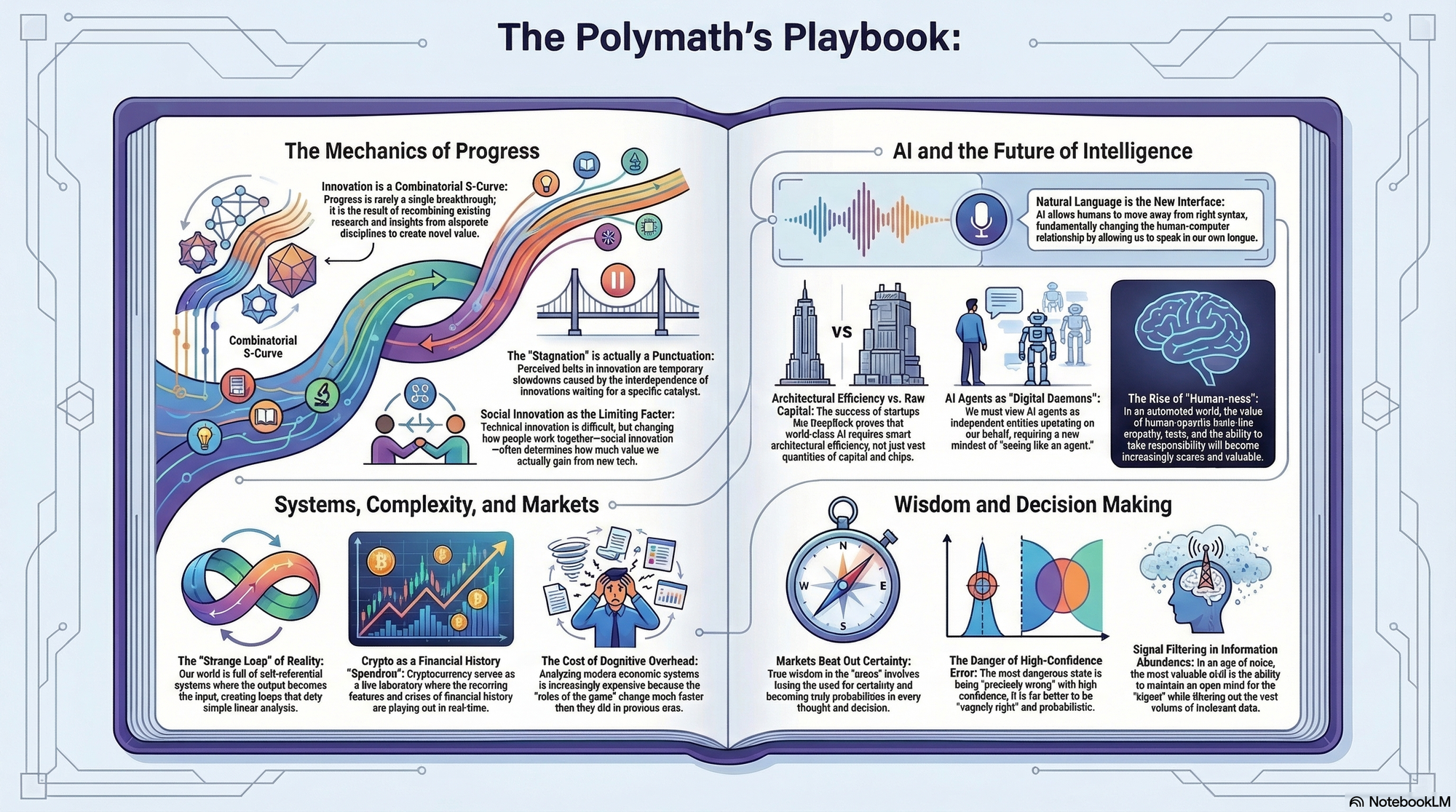
- On the Engine of Progress: "Technological progress primarily follows a combinatorial S-curves model, where advancement is the result of recombining existing research and disparate insights from various disciplines." — Source: Strange Loop Canon
- On the Great Stagnation: "The perceived halt in innovation is less of a permanent ceiling and more of a 'punctuation'—a temporary slowdown caused by the interdependence of innovations waiting for the next catalyst." — Source: Strange Loop Canon
- On Curiosity as a Force: "Curiosity is not just a personality trait; it is a potent, driving force that powers problem-solving and fuels the technological advancements necessary for societal growth." — Source: Clearer Thinking
- On Combinatorial Innovation: "Innovation is rarely about a single 'Eureka' moment but rather about finding the right way to stitch together existing technologies in a way that creates novel value." — Source: Strange Loop Canon
- On Augmenting Intelligence: "To effectively manage the increasing complexity of the world, we must develop tools that specifically augment human intelligence rather than just replacing it." — Source: Humans+ AI
- On Progress Studies: "Understanding the mechanisms of progress requires a deep dive into the history of how ideas spread and how incentives align to reward risk-taking." — Source: Strange Loop Canon
- On Systemic Shifts: "Small changes in the cost of a foundational technology can lead to massive, unpredictable shifts in how entire societies organize themselves." — Source: Strange Loop Canon
- On Scientific Discovery: "The bottleneck in science today is often not a lack of data, but a lack of new conceptual frameworks to make sense of the data we already have." — Source: Strange Loop Canon
- On Technical vs. Social Innovation: "Technical innovation is hard, but social innovation—changing how people work together—is often the limiting factor for how much we can actually gain from new tech." — Source: Strange Loop Canon
Part 2: Artificial Intelligence and the Future of Work
- On Interfacing with Machines: "AI allows us to move away from rigid syntax and finally talk to machines in our own natural language, fundamentally changing the human-computer relationship." — Source: Infinite Loops Podcast
- On AGI Disruption: "The impact of Artificial General Intelligence on the economy will be massive, it will happen far faster than most realize, and its disruptive power cannot be overstated." — Source: Freethink
- On Resource Efficiency: "The success of Chinese startup DeepSeek proves that vast quantities of capital and cutting-edge chips are not the only prerequisites for world-class AI; architectural efficiency matters." — Source: Freethink
- On AI Agents as Daemons: "We should view AI agents as 'digital daemons'—independent entities that operate on our behalf, necessitating a new way of 'seeing like an agent'." — Source: Strange Loop Canon
- On the Tragedy of the Agentic Commons: "Everyone having their own AI agent will necessitate new market structures; otherwise, we face a digital version of the tragedy of the commons." — Source: Strange Loop Canon
- On Corporate Survival: "The future corporate landscape will likely be split between 'big model' companies and 'big services' companies, with the middle ground being competed away by AI efficiency." — Source: Substack
- On Creative Outlets: "AI doesn't just automate creativity; it unlocks entirely new outlets for expression that were previously gated by technical skill or high production costs." — Source: Infinite Loops Podcast
- On Military Advantage: "In the future, a decisive military advantage will belong to whichever force most effectively leverages the low-cost, scalable capabilities of AI." — Source: Freethink
- On AI Safety: "I am not a 'doomer'; AI is extraordinarily powerful and disruptive, but it is ultimately a tool that we have the agency to shape and direct." — Source: YouTube - Rohit Krishnan Interview
- On LLM Limitations: "While Large Language Models are impressive, they are just one branch of AI; the path to true AGI likely requires integrating more symbolic or world-model approaches." — Source: YouTube - Rohit Krishnan Interview
Part 3: Complexity, Systems, and Radical Interdisciplinarity
- On Interdisciplinary Thinking: "The most profound insights occur at the intersection of science, technology, complexity, and the humanities—a practice of 'radical interdisciplinarity'." — Source: Strange Loop Canon
- On Actions as Prediction: "Actions act as a form of compression that predict future states; they hold the information needed to unroll dynamics until a new action updates the environment." — Source: Substack
- On Learning Complexity: "Explicitly structuring your learning process is highly useful and dramatically underused when trying to wrap your head around a new, complex topic." — Source: Humans+ AI
- On Systemic Feedback: "In complex systems, the feedback loops are often delayed and non-linear, making it difficult for humans to intuit the long-term consequences of local actions." — Source: Strange Loop Canon
- On the 'Strange Loop': "The world is full of self-referential systems where the output becomes the input, creating a 'strange loop' that defies simple linear analysis." — Source: Infinite Loops Podcast
- On Cognitive Burden: "The shift from a few life-long rules to many malleable, short-term rules has increased the cognitive burden of analysis, even if the expected value remains the same." — Source: Substack
- On the Outsider Perspective: "A 23-year-old consultant with zero industry knowledge can often improve a company simply by asking the fundamental questions that insiders have stopped seeing." — Source: YouTube
- On Interconnected Knowledge: "Formative works like Gödel, Escher, Bach show that disparate streams of human knowledge are actually part of the same underlying systemic structure." — Source: Humans+ AI
- On Mapping the World: "The goal of inquiry should be to understand the ever-increasing complexity of our world without being paralyzed by the sheer volume of information." — Source: Infinite Loops Podcast
Part 4: Economic Dynamics and Market Realities
- On Financial History: "Cryptocurrency is effectively speedrunning financial history; it is a live laboratory where we can see the recurring features of financial crises play out in real-time." — Source: Strange Loop Canon
- On Growth Distribution: "The real worry for the future is not that overall economic growth will fall negative, but that its distribution will dramatically shift, leading to great polarization." — Source: Substack
- On the Workweek Paradox: "We don't work 15-hour weeks as Keynes predicted because social security and modern standards of living mean we are chasing an abundance of the current year, not 1960." — Source: Substack
- On Probabilistic Thinking: "If you spend enough time in the markets, they beat the certainty out of you until you become truly probabilistic in your thoughts and decisions." — Source: YouTube
- On Path Dependency: "Economic events are often path-dependent; the specific sequence of historical events matters as much as the underlying fundamental drivers." — Source: Strange Loop Canon
- On Incentive Alignment: "Most economic 'problems' are actually features of a system where the incentives are perfectly aligned to produce that specific, albeit undesirable, outcome." — Source: Strange Loop Canon
- On Market Complexity: "Markets are the ultimate decentralized processing unit, but they require constant new inputs and actions to remain efficient predictors of the future." — Source: Substack
- On Cognitive Costs: "Analyzing modern economic systems carries a high cost of cognitive overhead because the rules of the game change much faster than they used to." — Source: Substack
- On Wealth Abundance: "Modern grandparents in the West live a life of abundance, but it is an 'abundance of the year 1960' that requires constant work to maintain relative to today's norms." — Source: Substack
- On Global Competition: "Venture capital's biggest competition today isn't other VC firms; it's the massive liquidity and speed of hedge funds." — Source: Metacast
Part 5: Decision Making and Wisdom
- On the Nature of Advice: "Much of advice is distilled wisdom that you can only truly recognize from the other side, once you have already lived through the experience." — Source: Strange Loop Canon
- On Autonomy in Decisions: "Do not let anyone, regardless of their expertise or status, push you into making a decision that you fundamentally do not want to make." — Source: YouTube
- On Living vs. Mapping: "Life is something you live through experience, not something you can map out and navigate with a set of pre-determined instructions." — Source: Strange Loop Canon
- On Experiential Learning: "True wisdom is the byproduct of being in the markets or the arena long enough to acquire the probabilistic advantages that come only from time." — Source: YouTube
- On Structuring Thought: "The ideal decision-making process involves explicit structuring to help learn how to think about new and unfamiliar topics." — Source: Humans+ AI
- On High-Confidence Error: "The most dangerous state of mind is being highly confident and precisely wrong; it is better to be vaguely right and probabilistic." — Source: Strange Loop Canon
- On the Role of Wonder: "A sense of wonder is a necessary component of high-level inquiry; without it, decision-making becomes a dry, mechanistic exercise." — Source: Strange Loop Canon
- On Information Filtering: "In an age of information abundance, the most valuable skill is the ability to filter out noise while maintaining an open mind for the 'signal'." — Source: Strange Loop Canon
- On Rationality: "Rationality isn't about having all the answers; it's about having a process that allows you to update your beliefs when new evidence arrives." — Source: Strange Loop Canon
Part 6: Venture Capital, Startups, and Value Creation
- On Business Essentials: "Value is often added by everything except the core activity of a company; yet that 'everything else' is essential to actually running a business." — Source: YouTube
- On the Capital Myth: "DeepSeek's success demonstrates that world-class innovation in AI can be achieved without the traditional prerequisite of billions in capital." — Source: Freethink
- On India's AI Potential: "India has a unique opportunity in the AI landscape by leveraging its massive developer base to build application-layer solutions for the world." — Source: YouTube
- On Deep Tech Investing: "Investing in deep tech requires a different risk-return calculus, as the timeline for technical validation is often longer than the standard VC cycle." — Source: Metacast
- On Startup Dynamics: "The biggest hurdle for most startups isn't technology; it's the distribution and the ability to capture value in a crowded, noisy market." — Source: Strange Loop Canon
- On the Role of Bodo.ai: "We are building Bodo to allow Python users to run their code at supercomputing scales without needing to change their workflow, bridging the gap between ease-of-use and power." — Source: Big Think
- On VC Competition: "When hedge funds enter the venture space, they bring a speed and scale of capital that forces traditional VCs to rethink their value proposition." — Source: Metacast
- On the Founder's Edge: "The best founders are those who can navigate the 'strange loops' of their industry, turning systemic constraints into competitive advantages." — Source: Strange Loop Canon
- On Scaling Intelligence: "The ultimate goal for many modern startups is to find ways to scale human intelligence through software, creating a massive multiplier for productivity." — Source: Strange Loop Canon
- On Market Entry: "Entering a market with a slightly better product is a losing game; you must enter with a product that fundamentally changes the economics of the customer's business." — Source: Strange Loop Canon
Part 7: History, Culture, and the Human Element
- On Historical Reality: "History is anchored in documentation and reality; we cannot be gaslit or 'waterboarded' out of historical facts simply because they are currently inconvenient." — Source: Substack
- On Economics in Literature: "Exploring the 'Economics of Jane Austen' reveals that the fundamental drivers of human behavior—status, marriage markets, and asset management—remain remarkably constant." — Source: YouTube
- On Grounding Science: "A larger historical context provides the necessary grounding for scientific understanding, preventing us from repeating the conceptual errors of the past." — Source: YouTube
- On the Epitome of Desire: "Historical documentation in art shows us that societal definitions of desire and beauty are fluid, yet rooted in the cultural context of their time." — Source: Substack
- On Cultural Path Dependency: "Societies are often stuck in sub-optimal states because the path they took to get there makes it too expensive to switch to a better alternative." — Source: Strange Loop Canon
- On Language as Interface: "Language has always been our primary interface for coordinating human activity; AI simply allows us to extend that interface to machines." — Source: Infinite Loops Podcast
- On Human Value: "In an automated world, the value of 'human-ness'—empathy, taste, and the ability to take responsibility—will become more scarce and more valuable." — Source: Strange Loop Canon
- On the Myths of Progress: "We often tell ourselves neat stories about progress after the fact, but history shows that innovation is messy, chaotic, and largely accidental." — Source: Strange Loop Canon
- On Historical Documentation: "The sheer volume of documentation we leave behind today means that future historians will struggle with too much context rather than too little." — Source: Substack
Part 8: The Future of Knowledge and Scientific Discovery
- On Problem Solving: "Curiosity-driven inquiry is the most efficient way to solve complex problems, as it leads us to explore adjacent possibilities we might otherwise ignore." — Source: Clearer Thinking
- On Future Technology: "By 2050, the combination of advanced robotics, AI, and new material science will likely make the physical world as malleable as the digital world is today." — Source: Strange Loop Canon
- On Conceptual Breakthroughs: "The next great leap in human knowledge won't come from more computing power alone, but from a new way of conceptually framing the relationship between information and matter." — Source: Strange Loop Canon
- On the Science of Progress: "We need a formal 'science of progress' that studies how to optimize for discovery and the rapid deployment of new ideas." — Source: Strange Loop Canon
- On Scientific Interdependence: "No scientific field is an island; the biggest breakthroughs often come from importing a mental model from a completely unrelated discipline." — Source: Strange Loop Canon
- On the Limits of Data: "Data can tell you what happened, but it takes a well-constructed theory to tell you why it happened and what will happen next." — Source: Substack
- On AI as a Research Partner: "AI should be viewed as a high-powered research partner that can scan the combinatorial space of ideas much faster than any human could alone." — Source: Strange Loop Canon
- On the Quest for Truth: "The pursuit of truth requires a willingness to be uncomfortable and a commitment to following the evidence, no matter where it leads." — Source: Strange Loop Canon
- On the Future of Discovery: "We are entering a golden age of discovery where the tools of AI and the philosophy of progress studies will allow us to tackle the most complex challenges of our time." — Source: Strange Loop Canon