Simon Lejeune is a distinguished growth leader currently serving as the Chief Growth Officer at Wealthsimple, where he has helped scale the platform to over $100 billion in assets. Known for his "productive laziness" philosophy and his focus on global maxima over incremental gains, his strategies have redefined modern growth marketing in the fintech and travel sectors.
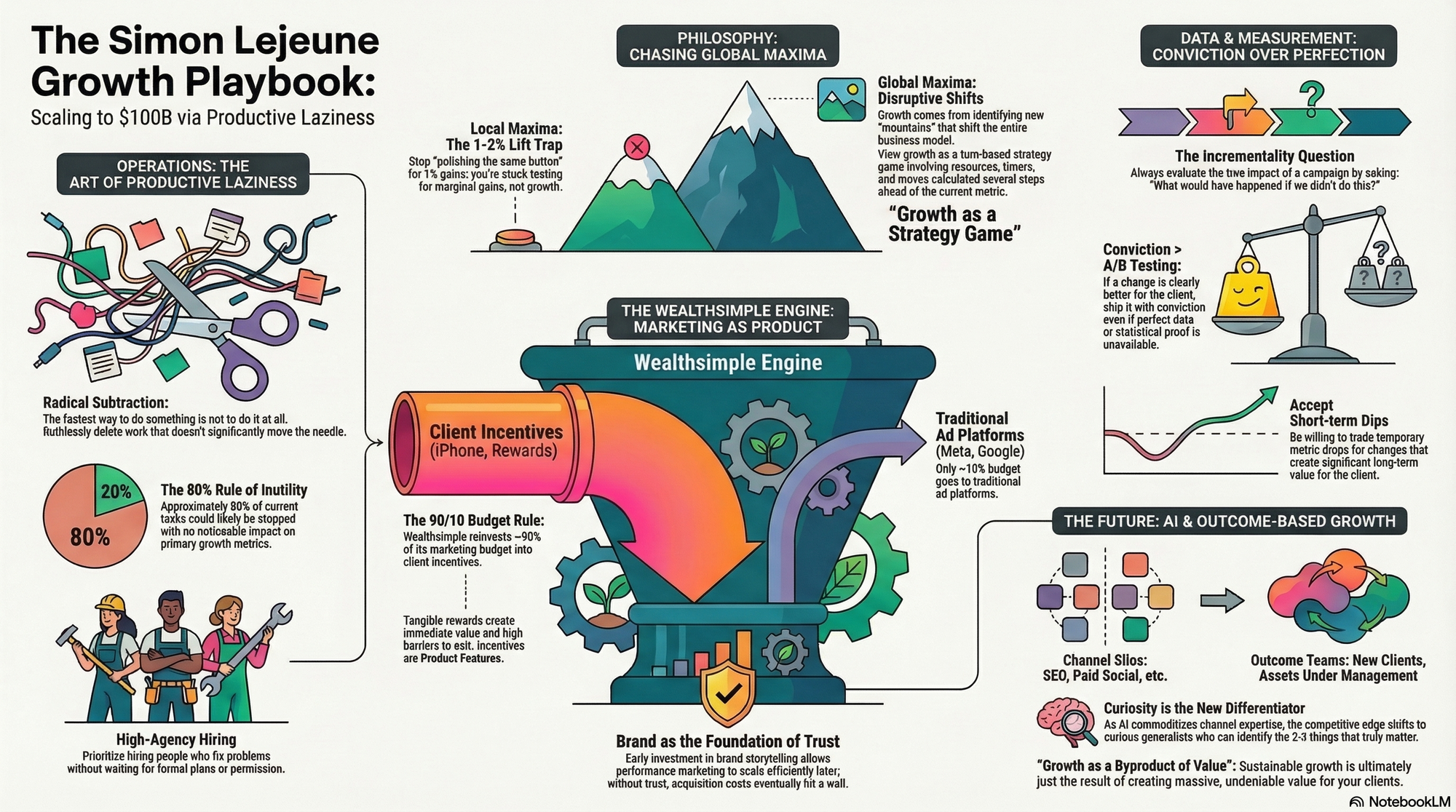
Part 1: The Philosophy of Global Maxima
- On the Local Maximum Trap: "Chasing small wins through A/B testing often keeps growth teams stuck on a single hill, preventing them from seeing the much larger mountains in the distance." — Source: Humans of Martech
- On Disruptive Ideas: "Real growth comes from pursuing ideas big enough to shift the entire business model, rather than just polishing the same button over and over." — Source: Simon Lejeune Official Site
- On the Price Test Lesson: "At Hopper, I proposed a price-point test that was dismissed because it only optimized the current state; it was a 'local maximum' that didn't change the trajectory of the company." — Source: Humans of Martech
- On Abandoning Comfort: "Growth teams must be willing to abandon the comfort of optimization and pursue experiments that are high-risk but high-reward." — Source: LinkedIn Profile
- On Identifying the Maximum: "If your experiments are consistently yielding 1-2% lifts, you aren't testing for growth; you are stuck in a local maximum." — Source: Humans of Martech
- On Finding New Mountains: "To achieve breakthrough growth, you must stop polishing the same hill and start climbing new mountains by deleting work that doesn't matter." — Source: Simon Lejeune Official Site
- On Beyond Participation Metrics: "Move beyond vanity metrics like 'participation' or 'clicks' and focus on the structural changes that drive lifetime value." — Source: Fintech Growth Insider
- On the Strategic Game Mindset: "I view growth as a massive, turn-based strategy game where resources, timers, and opponents force you to think several steps ahead of the current metric." — Source: Humans of Martech
- On Incrementalism vs. Innovation: "Incrementalism is for maintenance; innovation is for growth. Most companies spend 90% of their time on the former when they should be doing the opposite." — Source: Simon Lejeune Official Site
- On Strategic Signal: "Look for signals that suggest a complete shift in user behavior, not just a temporary spike in activity." — Source: Mobile Growth Nightmares
Part 2: The Wealthsimple Growth Engine
- On the 90/10 Budget Rule: "Wealthsimple reinvests approximately 90% of its marketing budget directly into client incentives rather than traditional advertising platforms like Meta or Google." — Source: Reddit - Fintech Analysis
- On Marketing as a Product Feature: "We view our marketing incentives—like giving away houses or iPhones—as product features that create immediate value for the client." — Source: Fintech Growth Insider
- On Wallet Share Strategy: "Significant growth doesn't always come from acquiring new users; it comes from convincing existing clients to transfer larger portions of their wealth from traditional banks." — Source: Fintech Growth Insider
- On Brand as Trust: "Brand marketing is the foundation of trust that makes performance marketing effective; without it, your acquisition costs will eventually hit a wall." — Source: Simon Lejeune Official Site
- On Investing Early in Brand: "Wealthsimple invested in brand storytelling from day one, which allowed us to scale performance marketing much more efficiently years later." — Source: Reddit - Fintech Analysis
- On Client Incentives: "If you have $10 to spend, it's often better to give $9 to your customer and $1 to an ad platform than the other way around." — Source: Fintech Growth Insider
- On the 'iPhone for Assets' Strategy: "Promotions like giving an iPhone for transferring assets are powerful because they are tangible, understandable, and create a high barrier to exit." — Source: Wealthsimple News
- On Premium Experience: "Creating a premium brand in fintech allows you to compete on trust and experience rather than just interest rates." — Source: Simon Lejeune Official Site
- On Speed of Execution: "In a competitive market, being the first to ship a feature or a marketing campaign is often more important than being perfect." — Source: Humans of Martech
- On Scaling to $100B: "Reaching $100B in assets required a shift from high-volume user acquisition to high-value asset retention and expansion." — Source: Fintech Growth Insider
Part 3: Operations & Productive Laziness
- On Productive Laziness: "The secret to high impact is being productively lazy: ruthlessly deleting any work that doesn't significantly move the needle." — Source: Humans of Martech
- On Deleting Work: "The fastest way to do something is simply not to do it at all. We should always be looking for what we can stop doing." — Source: Humans of Martech
- On the 80% Rule: "Probably 80 percent of what you're doing right now could be stopped with no noticeable impact on your primary growth metrics." — Source: Humans of Martech
- On Questioning Tasks: "Every time a task is assigned, the first question should be: 'Why does this even exist?'" — Source: Simon Lejeune Official Site
- On High Agency: "I hire for high agency—people who will see a problem and fix it without waiting for a formal project plan or approval." — Source: Humans of Martech
- On Permission vs. Forgiveness: "In a high-growth environment, it is almost always better to ask for forgiveness than to wait for permission to innovate." — Source: LinkedIn Profile
- On Cutting Negligible Lift: "If the projected lift of a project is negligible, cut it immediately. Don't waste talent on marginal gains." — Source: Humans of Martech
- On Focus through Subtraction: "True prioritization isn't deciding what to do; it's deciding what not to do and sticking to it." — Source: Simon Lejeune Official Site
- On Efficiency: "Efficiency is often a trap; it's better to be effective on three things than efficient on thirty." — Source: Humans of Martech
- On Team Velocity: "Velocity is the ultimate competitive advantage; the faster you can test and discard ideas, the sooner you find the winners." — Source: Mobile Growth Nightmares
Part 4: Data, Measurement & Conviction
- On Measuring Incrementality: "To understand the true impact of a campaign, always ask: 'What would have happened if we didn't do this?'" — Source: Humans of Martech
- On Conviction over Testing: "If a change is clearly better for the client, I have the conviction to ship it even if we can't perfectly A/B test it." — Source: Humans of Martech
- On Data as a Barrier: "Don't let the quest for perfect data become a barrier to shipping bold ideas that you know are right for the business." — Source: Simon Lejeune Official Site
- On Skepticism of Metrics: "Be skeptical of 'perfect' A/B test results; if they look too good to be true, they usually are." — Source: Mobile Growth Nightmares
- On Signal vs. Noise: "In growth, you need enough signal to make a decision, not a statistically perfect proof of every minor change." — Source: Humans of Martech
- On Short-term Dips: "I am willing to accept a short-term dip in metrics if I am convinced the change creates more long-term value for the client." — Source: Humans of Martech
- On Shipping for the Client: "If I hear 'we shipped it to the client without a full measurement plan because it was the right thing to do,' that’s a success in my book." — Source: Humans of Martech
- On Irrelevant Tests: "Probably 80 percent of the A/B tests out there make me wonder why anyone is even spending time on them." — Source: Humans of Martech
- On Impact over Activity: "A busy team is not necessarily a high-impact team. Measure the outcome, not the hours spent testing." — Source: Simon Lejeune Official Site
- On Qualitative Signal: "Quantitative data tells you what is happening; qualitative insights and conviction tell you why and what to do next." — Source: Humans of Martech
Part 5: Leadership & The Future of Growth
- On Founder-led Growth: "The real head of growth at any successful startup is the founder; they are the ones who set the pace and the appetite for risk." — Source: Humans of Martech
- On Outcome-based Teams: "I reorganized my growth teams away from channel silos like 'SEO' or 'Paid Social' to focus on outcomes like 'New Clients' or 'Assets Under Management.'" — Source: Humans of Martech
- On AI making Channels a Commodity: "AI is making deep channel expertise a commodity. The real differentiator now is curiosity and the ability to prioritize." — Source: Humans of Martech
- On the Curiosity Edge: "In the age of AI, curious generalists who can navigate multiple functions will outperform narrow specialists every time." — Source: Simon Lejeune Official Site
- On AI as a Lever: "AI allows us to turn a nascent idea into a polished, investor-ready execution plan in minutes, accelerating our overall speed of growth." — Source: Humans of Martech
- On Plain Language Tools: "The future of marketing is being able to describe exactly what you want in plain language and having the tool build it for you instantly." — Source: Humans of Martech
- On Originality of Ideas: "As distribution becomes commoditized through AI, the value of having a truly original and disruptive idea sky-rockets." — Source: Simon Lejeune Official Site
- On Cross-functional Growth: "Growth isn't a department; it's a philosophy that must permeate product, engineering, and marketing simultaneously." — Source: LinkedIn Profile
- On Ruthless Prioritization: "In a world of infinite tools and data, the only thing that matters is who can identify the 2-3 things that actually move the needle." — Source: Humans of Martech
- On Client Value above All: "At the end of the day, growth is simply the byproduct of creating massive, undeniable value for your clients." — Source: Fintech Growth Insider