Soleio Cuervo is a highly influential software designer and investor, best known as the second design hire at Facebook and the former Head of Design at Dropbox. Having designed the iconic Facebook "Like" button and later backed defining design-led companies like Figma and Vercel, his career bridges the gap between raw product execution and venture capital strategy. His insights consistently emphasize the primacy of shipping speed, the strategic nature of design, and the necessity of understanding the "mental ergonomics" of software.
Part 1: Design Strategy & Philosophy
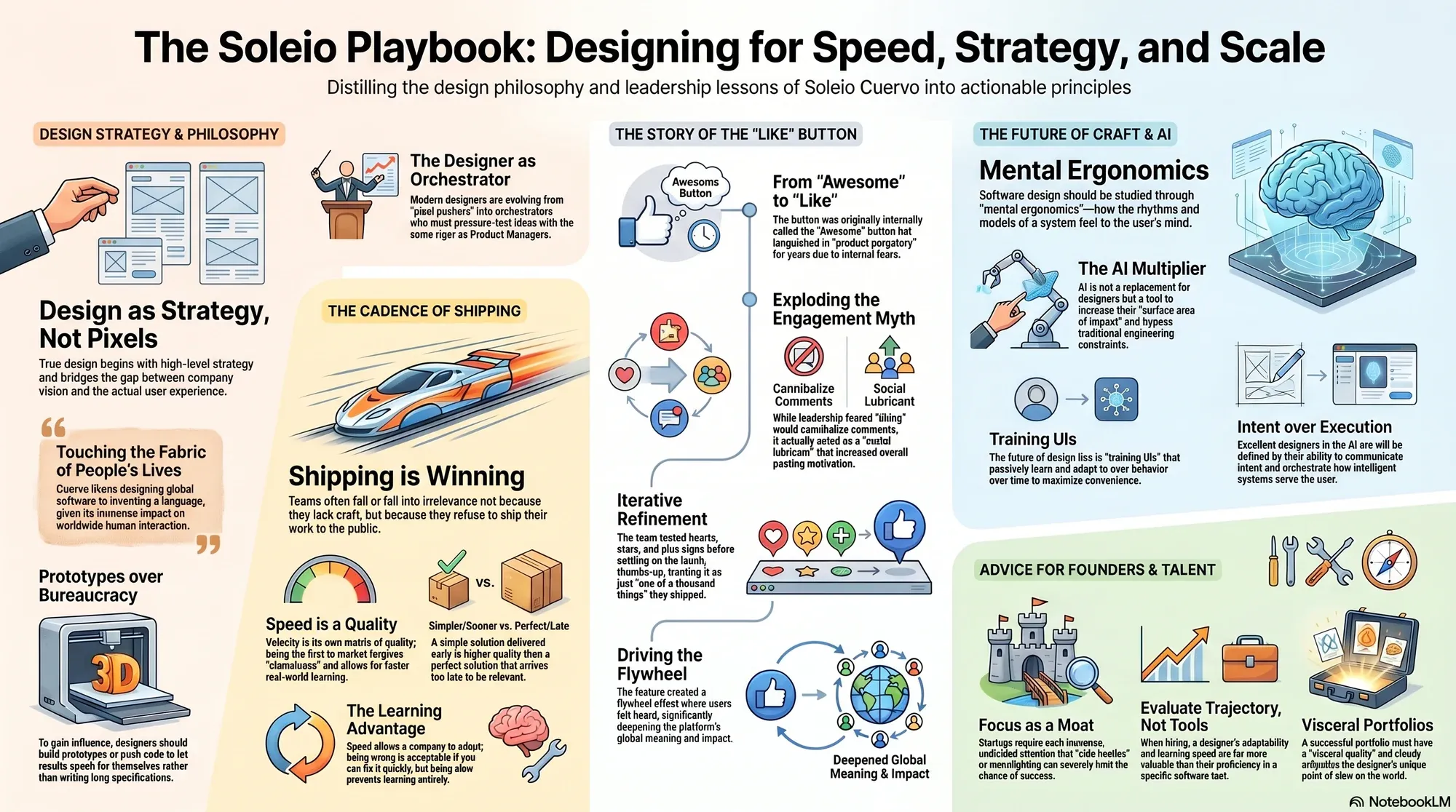
- On Strategy: "Design starts with strategy, not pixels." — Source: [Dive Club Podcast]
- On Bridging the Gap: "Design bridges what the company wants to become with what users experience." — Source: [Dive Club Podcast]
- On Empathy: Designers should pressure-test ideas by asking the same questions a Product Manager would about core metrics and user goals. — Source: [Substack]
- On Evolution: "Designers are becoming orchestrators, not just pixel pushers." — Source: [Dive Club Podcast]
- On the Designer's Role: "You are going to be touching the fabric of people's lives worldwide; this is like inventing the English language." — Source: [YouTube]
- On Influence: Instead of writing long specifications to "vouch" for an idea, designers should build a prototype or push code to let the results speak for themselves. — Source: [Dive Club Podcast]
- On Building Muscle: "All mental activities are like a muscle that needs to be trained, and design is no exception." — Source: [Visualist]
- On Persuasion: The most impactful designers let their work prove the viability of a concept rather than relying on bureaucracy. — Source: [Dive Club Podcast]
- On Moving Fast: Iconic features aren't magical moments; they are the result of constant experimentation and iteration. — Source: [Dive Club Podcast]
Part 2: The Cadence of Shipping
- On Winning: "The teams that win are the teams that ship. And so, first and foremost, if you're not shipping, you're not winning." — Source: [Dive Club Podcast]
- On Survival: "I’ve never felt that teams have died because they lacked craft. I think that the opposite has been true where teams have really kind of flailed around in irrelevance because they just refuse to ship." — Source: [Dive Club Podcast]
- On Relevance: "If your work is not out there, everything else falls flat." — Source: [Dive Club Podcast]
- On Speed: "Speed is a quality all its own." — Source: [Substack]
- On Iteration: "Sometimes something simpler and sooner is higher quality than something perfect but late." — Source: [Substack]
- On Timing: "Sometimes the best way to capture lightning in a bottle is to be faster than lightning." — Source: [Dive Club Podcast]
- On First Mover Advantage: "Being the first forgives a lot of clumsiness and lack of craft, but rewards speed and urgency and the ability to learn quickly." — Source: [Dive Club Podcast]
- On Learning: Being wrong is acceptable if you can fix it quickly, but being slow prevents a company from learning and adapting. — Source: [Dive Club Podcast]
- On Action: "The problem is that designers are still updating design files instead of production." — Source: [Dive Club Podcast]
Part 3: Facebook's Insurgent Era
- On Early Culture: "Facebook as a culture naturally attracted people who had this mix of competition, ambition, speed, and a real desire to show the world an alternative to MySpace." — Source: [PBS FRONTLINE]
- On The Underdog Mindset: "We were the insurgents. We were the ones that had everything to lose." — Source: [PBS FRONTLINE]
- On Domination: "The notion of domination was guided by this idea of rallying the troops towards making steady continuous progress." — Source: [PBS FRONTLINE]
- On Project Motion: At a time when uploading video was cumbersome, the team unauthorizedly "stapled together" a Flash-based video recorder by ignoring directives to stop. — Source: [Dive Club Podcast]
- On Rebellion: Project Motion succeeded because the team ignored engineering leadership's directive to stop working on it and pulled all-nighters to prove its value. — Source: [Dive Club Podcast]
- On Agency: At early Facebook, designers were expected to push to production on their first day, fostering a "shoot first, ask questions later" mentality. — Source: [YouTube]
- On The Original Mission: The team was heavily focused on building a "college network" and did not initially anticipate the massive global political consequences the platform would face. — Source: [New York Magazine]
- On Media Narratives: Following the Cambridge Analytica scandal, Cuervo defended the company, suggesting the media was unfairly targeting Facebook and sensationalizing its early choices. — Source: [New York Magazine]
- On Regulation: Government regulation is unlikely to solve the problems facing tech companies; the solution requires better internal discipline and design foresight. — Source: [New York Magazine]
Part 4: The Story of the Like Button
- On Naming: Before it became the iconic thumbs-up, the Like button was originally conceived and internally known as the "Awesome" button. — Source: [Marketplace]
- On The Curse: "We used to call it the curse of the Awesome button because the project felt a little bit cursed... It just always seemed to get stuck in review." — Source: [Marketplace]
- On Product Purgatory: "The Like button was a feature that we had in what I like to call product purgatory for, I think, multiple years." — Source: [Marketplace]
- On Internal Fear: "There was a lot of concern internally that 'liking' was going to cannibalize engagement" and discourage people from writing actual comments. — Source: [Marketplace]
- On Reality vs Expectations: "Rather than cannibalizing comments, it did the opposite... It created an environment in which people were more motivated to leave posts." — Source: [Marketplace]
- On Social Function: "The Like button acted as a social lubricant." — Source: [Project Avalon]
- On Iteration: Before settling on the thumbs-up, the team experimented with a green thumbs up, hearts, stars, and plus signs, but found them too generic. — Source: [Bustle]
- On Momentum: "It was driving this flywheel of engagement that people felt like they were heard on the platform whenever they shared something." — Source: [PBS FRONTLINE]
- On Surprise: "It was one of a thousand things we shipped... We just iterated like crazy." — Source: [Marketplace]
- On Global Impact: "We struck a chord of meaning that I don't think any of us really had fully internalized would be the case." — Source: [PBS FRONTLINE]
Part 5: Personalization & The Future
- On Personalized Products: Startups can build deeply engaging experiences by establishing a clear sense of who the user is beyond just a username. — Source: [First Round Review]
- On The Social Graph: True personalization leverages the communal asset of a user's relationships to provide outsized value. — Source: [First Round Review]
- On The Interest Graph: Great products surface relevant content by deeply understanding what a user cares about at a granular level. — Source: [First Round Review]
- On Context: Anticipating user needs requires using real-time data, such as location and time, to deliver the right experience at the right moment. — Source: [First Round Review]
- On Taking a Stand: "Dare to be opinionated about what’s important to your users at every moment." — Source: [First Round Review]
- On User Behavior: Startups should not be afraid to have a strong viewpoint on how their users should behave within the product ecosystem. — Source: [First Round Review]
- On Training UIs: Products like Nest represent the future of "training UIs" that passively learn and adapt to user behavior over time. — Source: [First Round Review]
- On Multi-Device Consistency: "Soon it’s not going to be enough to have one service that looks the same across multiple devices... People want it to be easy to use your product at all times." — Source: [First Round Review]
- On Convenience: Users increasingly expect products to "maximize for their convenience" dynamically, depending on their physical and digital context. — Source: [First Round Review]
Part 6: Investing & the Creator Economy
- On Figma's Origin: "When Dylan [Field] pitched me on Figma, it was speaking to the problems that I was seeing as the head of design at Dropbox. And that whole setup was a dumpster fire." — Source: [YouTube]
- On Single-Player Tools: Legacy design tools failed because they were "fundamentally single-player tools in a multiplayer discipline." — Source: [YouTube]
- On Early Conviction: Experiencing the pain of collaborative design directly led Cuervo to work with the Figma founders "before the product even existed." — Source: [YouTube]
- On Combine's Mission: "Combine is a natural evolution of a mutual recognition of both these challenges [recruiting top designers and embedding design culture]." — Source: [Medium]
- On Institutionalizing Design: Combine was created to merge capital and design advisory into an institutional early-stage venture capital firm. — Source: [Medium]
- On Designer-Led VC: Having partners who spent most of their careers as designers allows investors to bring a unique operational expertise that traditional VCs lack. — Source: [Medium]
- On Backing Creators: Tools like Vercel, Figma, Framer, and Replit are part of a massive movement "redefining how we live, work, learn and create." — Source: [Visualist]
- On Hybrid Models: The complexity of managing a fund while providing intensive design services (the "Happy Meal" approach) creates role confusion. — Source: [YouTube]
- On Founder DNA: When evaluating startups, investors should look for "ferocity" in founders and a deep commitment to treating culture as their deepest moat. — Source: [Medium]
- On Biological Technology: He frequently recommends What Technology Wants by Kevin Kelly, praising its exploration of technology as an extension of biological life. — Source: [First Round Review]
Part 7: Craft & Mental Ergonomics
- On Mental Ergonomics: "Software has both physical ergonomics... but I actually feel as though one can study video game design along this dimension... there’s like a mental ergonomic to it." — Source: [YouTube]
- On Tactile Quality: "There’s a tactile quality to it that I always trace back to how really great video games felt. It was more than just the ergonomics of the game; it was almost like the mental models." — Source: [YouTube]
- On Finding the Path: Success often comes from finding the "shortest path to water," ignoring the technically "right way" to do things to deliver a great experience directly. — Source: [YouTube]
- On Utility vs Social: Different business models require vastly different design philosophies; while a social app thrives on fast iteration, a utility like Dropbox requires "space shuttle quality software." — Source: [YouTube]
- On Whimsy: At a highly technical company like Dropbox, design is utilized to inject "whimsy and delight" (like colored pencil illustrations) to humanize the product. — Source: [YouTube]
- On Cadence: Great software design is not just about visual aesthetics, but about mastering the rhythm and cadence of how the user interacts with the system. — Source: [YouTube]
- On the AI Multiplier: "AI isn’t here to replace you, it’s here to multiply you... Think of it as increasing your surface area of impact." — Source: [Substack]
- On Orchestrating AI: The modern designer must act as a guide for intelligent systems, orchestrating how the machine’s output serves the user's intent. — Source: [Substack]
- On Early Adoption: "It’s easy to be the best when you’re among the first," encouraging designers to embrace frontiers like spatial computing and AI aggressively. — Source: [Substack]
- On Expanding Horizons: AI gives designers the unprecedented ability to bypass engineering constraints and go from a raw idea directly to a functional prototype. — Source: [Substack]
Part 8: Advice for Founders & Designers
- On Communication: "Okay designers show work. Excellent designers communicate intent." — Source: [Substack]
- On Portfolios: A designer's portfolio should have a "visceral quality" and explicitly frame the designer's unique point of view on the world. — Source: [Substack]
- On Trajectory: When evaluating design talent, trajectory and adaptability matter far more than static proficiency in a specific tool. — Source: [Design MBA Podcast]
- On Time to Proficiency: The most valuable skill a modern designer can possess is how quickly they can learn and adapt to a completely new environment or technology stack. — Source: [Design MBA Podcast]
- On Commitment: "It astonishes me to this day that there are people who work at startups and also have side hustles and moonlight." — Source: [Visualist]
- On Focus: Startups require such immense, undivided attention that attempting to build one while distracted by secondary projects severely limits the chance of success. — Source: [Visualist]
- On Moving the Needle: Designers must deeply understand how their aesthetic and interactive choices directly influence the core business metrics of the company. — Source: [Substack]
- On Building Culture: Founders must embed a "design culture" into their organizations from day one if they want to attract and retain top-tier creative talent. — Source: [Medium]
- On Vantage Points: Leveraging the lessons from the early days of social networking and cloud storage is essential for the next generation of founders building design-forward companies. — Source: [First Round Review]