Tal Raviv is a seasoned product leader (Riverside, ex-Patreon, AppsFlyer) and a prominent voice in the "Super IC" (Individual Contributor) movement. His insights often challenge standard "best practices" in favor of "street smarts" and AI-driven productivity.[1]
I. On Product Management Philosophy
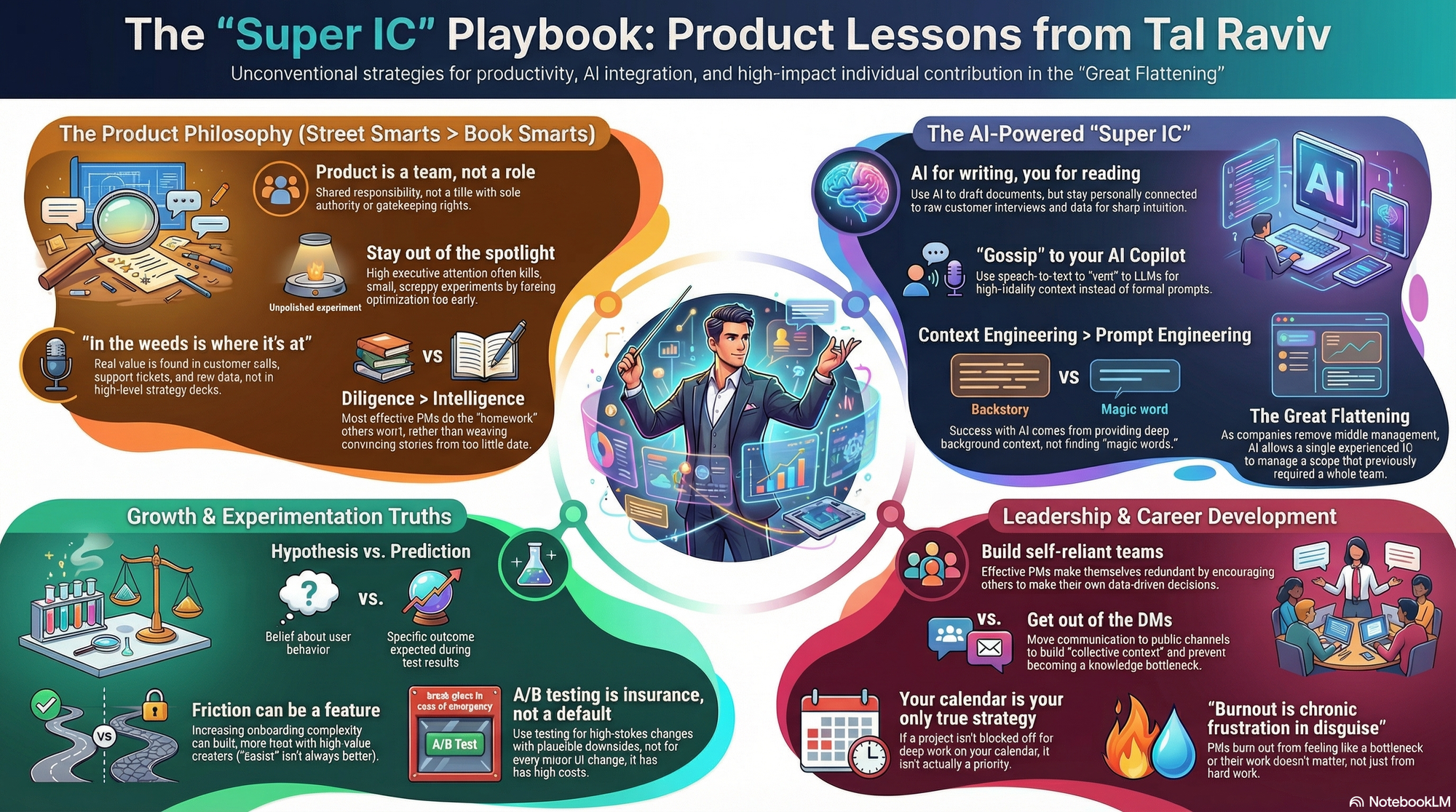
- "Product is not a role, it’s a team." Product management is a shared responsibility, not a title that grants solo authority. Source
- "The worst thing a PM can be is intelligent." Smart PMs often paint convincing narratives from too little data.[2] Instead, be "diligent"—do the homework others won't. Source
- "Stay out of the spotlight." Executive attention often kills small, scrappy experiments by forcing them to optimize for high expectations too early.[2] Source
- "I still don't know what epics and stories are." Formal Jira terminology matters far less than whether the team understands the problem they are solving. Source
- "Metrics suck." Key Results are usually poor proxies for the actual Objective. Don't mistake the metric for the truth. Source
- "There is no 'one way' to do product." Frameworks are tools, not laws. The best PMs adapt their process to the specific needs of the team and company. Source
- "In the weeds is where it’s at." Value is found in the details of customer calls, support tickets, and raw data, not in high-level strategy decks. Source
- "Doing your homework is the ultimate influence card." In a world of opinions, the person who has listened to the most customer calls wins the argument. Source
- "I want to live happily in a world I don’t understand." (Referencing Nassim Taleb) PMs must navigate massive uncertainty without the illusion that they can predict the future. Source
- "Street smarts over book smarts." Logic and data (book smarts) are important, but understanding the emotional/perceptual impact on a user (street smarts) is what prevents PR disasters. Source
II. On AI & The "Super IC" Productivity
- "Don't let AI read for you, let AI write for you." Use AI to draft docs, but stay "connected to the raw training data" (customer interviews/data) yourself to keep your intuition sharp. Source
- "Gossip to your AI copilot." Instead of formal prompts, "vent" to the LLM about a meeting or a stakeholder change using speech-to-text to give it high-fidelity context. Source
- "AI won't replace PMs, but PMs using AI will replace those who don't." Source
- "Treat AI like a highly talented intern." It needs context, feedback, and clear boundaries, but it can handle massive amounts of "grunt work." Source
- "Your gut is the world’s most sophisticated machine learning model." (Quoting David Lieb) Use AI to process info, but use your "taste" and "craft" to make the final call. Source
- "Use the smartest model available, even if it's slow." When using AI for thought partnership, intelligence matters more than speed. Source
- "Speech-to-text is a superpower for unblocking thoughts." Talking through a problem often reveals details that get lost when trying to write "professionally." Source
- "Ask: 'What context does the AI need to succeed here?'" If the output is bad, the context is usually the missing link. Source
- "Product scrapbooking." Maintain a "scrapbook" of insights, screenshots, and evidence to fuel your AI copilot and your own strategy. Source
- "The 'Great Flattening' creates the Super IC." AI allows experienced individual contributors to handle a scope that previously required a whole team. Source
III. On Growth & Experimentation
- "That’s not a hypothesis, that’s a prediction." A hypothesis is a belief about your users; a prediction is what you think will happen in the test. Source
- "Clear learnings come only from clear hypotheses." If you don't state what you believe before you test, you aren't doing science; you're just "growth hacking."[3] Source
- "Friction can be a feature." At Patreon, they found that making onboarding harder (more complex) actually built more trust with high-value creators. Source
- "Please, please don't A/B test that." Testing has a high cost in complexity and time. If you’re confident and the risk is low, just ship it. Source
- "A/B testing is for when you have a plausible downside." Use tests as insurance for high-stakes changes, not for every button color. Source
- "Reverse causality in growth." Users often see a successful person using a tool and think the tool created the success. This "aspirational" pull is a powerful growth lever.[4] Source
- "Qualitative research is the 'Why' behind the 'What'." Data tells you what happened; talking to users tells you why, which is the only way to generate new hypotheses. Source
- "The 'North Star' should be a life-changing outcome." At Patreon, they focused on "Financially Successful Creators"—people earning a living—rather than just total signups.[5] Source
- "Broaden the funnel vs. deepen activation." It’s often better to make current users more successful than to just throw more people into a leaky bucket. Source
- "Test in the cheapest way that can conclusively reject your thinking." Source
IV. On Team Culture & Leadership
- "Build self-reliant teams by making yourself redundant." The best PM is one the team doesn't "need" for every small decision. Source
- "Get out of the DMs." Encourage all communication to happen in public channels. This builds "collective context" and stops the PM from being a bottleneck. Source
- "Every company has just two departments that matter." In every org, there are usually two specific functions (e.g., Design + Support) that actually drive the 10x wins.[6] Find them. Source
- "Praise the behavior of independence." When an engineer finds a data insight themselves, celebrate it publicly to reinforce a culture of self-reliance. Source
- "The 'Corner Office' vs. the 'Assembly Line'." To understand how things really work, talk to the people doing the work, not just the managers. Source
- "Failure is still yours." You share the wins with the team, but as a PM, you "own" the risks and the responsibility when things go wrong. Source
- "Don't put pressure on teammates—speed comes from structure." Cracking the whip doesn't work; removing blockers and providing clear context does. Source
- "Sustainable hours are a marathon, not a sprint." Burnout is the enemy of good product thinking. Source
- "Give away your Legos." (Quoting Molly Graham) Giving away responsibility for the parts of the product you built is the only way to move on to bigger things.[7] Source
- "Transparency is a snowball effect." Working in public channels encourages others to do the same, eventually creating a high-context team. Source
V. On Career & Personal Development
- "Stay an IC because you love the work, not because you fear management." Tal chose the IC path because it allowed him to stay "hands-on" with the product, influenced by his father’s fulfilling career as a researcher. Source
- "Believe your worth as an IC." Compensation for expert individual contributors can and should rival management as their impact grows. Source
- "My strategy is to not have a strategy." Career paths are often non-linear. Focus on doing great work that excites you, and the opportunities will follow. Source
- "Burnout is often 'chronic frustration' in disguise." If you feel like your work doesn't matter or you're a bottleneck, you'll burn out even if you're not "working hard." Source
- "Learn to navigate challenges rather than control them." (His life motto from a surf shop). Source
- "Don't read blog posts—write them instead." Writing forces you to crystallize your thoughts and find your own "uncommon opinions." Source
- "Design your days: Deep work vs. Reactive work." Separate your time fiercely. Deep work requires "no Slack, no meetings." Source
- "If money is your only motivation, you will crack." Source
- "Self-care tasks first." Knock out "life admin" (banking, forms) before diving into work, or they will never happen. Source
- "Surprises are good; they lead to 'Nobel Prizes'." Being proven wrong by data is the fastest way to learn and improve your mental model. Source
- "The goal isn't to be a founder; the goal is to be 'founding' every day." True ownership means constantly looking for ways to improve the environment around you. Source
VI. On AI & "Working Unfairly"
- "Product management is an unfair role.[1][2] So work unfairly." Expectations for PMs are often infinite and unrealistic. Use AI to gain an "unfair" advantage in productivity to survive the burnout. Source
- "Don’t learn the tool, learn how to think about what software means." Tools like Replit or Cursor will change every three months, but the mental model of how to use AI to generate logic remains constant. Source
- "Context engineering > Prompt engineering." It’s not about finding "magic words"; it’s about giving the AI the same background context you would give a human teammate. Source
- "The moment you say 'build auth,' the whole thing breaks." When prototyping with AI, you have to "sneak up" on complex features rather than asking for them all at once. Source
- "Incredible products have been built without a PM." Acknowledging this humility allows you to focus on where you actually add value rather than gatekeeping. Source
- "The most impactful, money-printing initiatives my teams have ever shipped were never my ideas." A great PM is a curator and unblocker, not necessarily the "idea person." Source
- "Speech-to-text is spellcasting." Dictating your raw thoughts into an LLM is the fastest way to turn "vague vibes" into a structured PRD. Source
- "If it takes 20 minutes to read, it’s not an update, it’s a burden." Use AI to summarize your long-form thinking into "executive TL;DRs" that actually get read. Source[2][3][4]
VII. On The "Great Flattening" & The Super IC
- "The 'Great Flattening' is here." Tech companies are removing middle management and expecting senior ICs to own massive scopes. AI is the only way to meet that expectation. Source
- "An IC PM can have a bigger impact than a VP of Product." If you are at the "fingertips" of the product where the work actually happens, your leverage is immense. Source
- "Believe your worth as a domain expert, not just as a manager." Just as engineers have Staff and Principal tracks, PMs must recognize their value in deep craftsmanship. Source
- "I want to be at the 'fingertips' of the work." Management moves you away from the customer and the code; the IC path keeps you where the "magic" happens. Source
- "Hierarchy is a proxy for context." When everyone has high context (via AI and shared docs), you need less hierarchy to keep people aligned. Source
- "Work in a way that makes you feel powerful, not depleted." Productivity systems aren't just for the company; they are for your own mental health. Source[2][3][4]
VIII. On Street Smarts vs. Book Smarts
- "If I could summarize product in three words, it’d be: Good people talking." High-fidelity conversation usually solves what complex processes cannot. Source
- "Logic is a tool, but perception is the reality." A feature can be logically perfect but fail because it feelsuntrustworthy to the user. Source
- "Don’t be the 'intelligent' PM who explains why the customer is wrong." If the customer is confused, the product is wrong—no matter how "smart" the logic behind it was. Source
- "Street smarts is knowing which internal stakeholders will kill your project." It's not just about the user; it's about navigating the "human maze" inside your company. Source
- "A/B testing is often a substitute for having an opinion." Don't use data to hide from the responsibility of making a choice. Source
- "Every company has two departments that are the 'secret sauce'." Success usually comes from a specific cultural strength (e.g., Apple's Design or Amazon's Ops), not just "good PMing." Source
IX. Tactical Productivity "Nuggets"
- "Product Scrapbooking." Keep a folder of everything that catches your eye—competitor flows, weird bugs, customer praise. It becomes your "creative fuel." Source
- "The 'Venting' Habit." If you're stuck, record yourself venting about the problem for 5 minutes. The AI summary of that rant will often contain the solution. Source
- "Never start with a blank page." Use AI to generate a "strawman" proposal, then tear it apart. It’s 10x faster than writing from scratch. Source[2][3][4]
- "Your calendar is your only true strategy." If you say a project is a priority but it’s not on your calendar for deep work, you’re lying to yourself. Source
- "Make yourself redundant." The more your team can function without you, the more time you have to work on the next high-leverage bet. Source
Key Resources to Follow Tal Raviv:
- Lenny's Newsletter Feature (The Super IC): The Super IC PM
- Lenny's Newsletter Feature (AI Copilot): Build Your Personal AI Copilot
- Maven Course: Build Your Personal PM Productivity System[3][4]
- Medium Blog: Tal Raviv on Medium[5]
- X (Twitter): @talraviv
- YouTube Interview: Riverside PM Insights
Sources