Armand Farrokh and Nick Cegelski are the founders of 30 Minutes to President’s Club (30MPC), the world’s #1 sales podcast.[1][2][3][4] Their philosophy is built on "no-nonsense, hyper-actionable tactics" that move away from fluff and toward repeatable frameworks.[1][4][5]
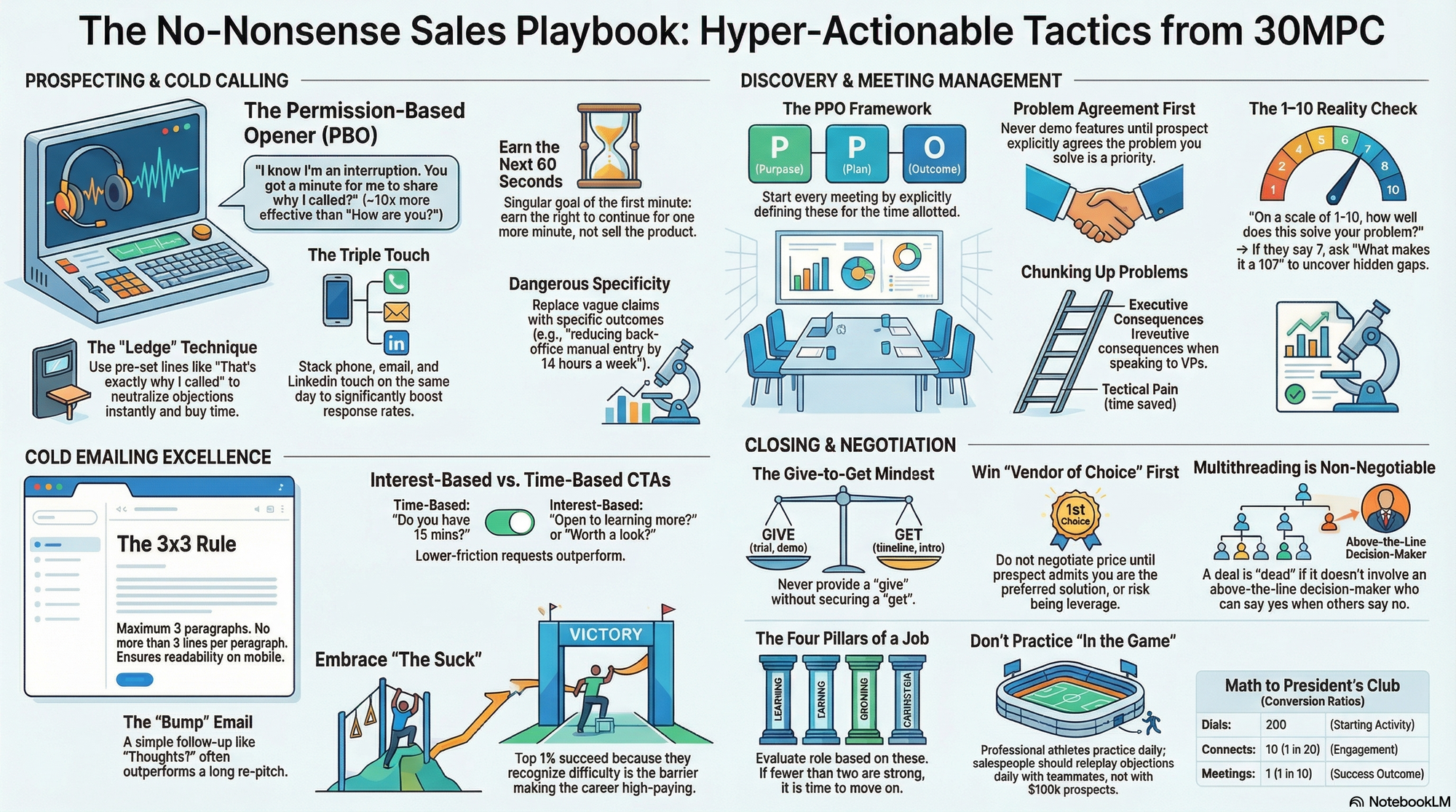
I. Prospecting & Cold Calling
- The Goal of the First 60 Seconds: "The goal of the first 60 seconds is to earn the next 60 seconds."
- The Permission-Based Opener (PBO): "I know I’m an interruption. You got a minute for me to share why I called?" (Gong data shows PBOs are ~10x more effective than "How are you?").[2][3]
- The "Ledge": When hit with an objection, use a pre-set line like "That's exactly why I called" or "This one's totally on me" to buy a second to think.
- "Heard the Name Tossed Around" Opener: Reference a peer or competitor up front: "We work with X and Y; have you heard our name tossed around?"
- Dangerous Specificity: Don't say "we help with efficiency." Say "we help law firms reduce back-office manual entry by 14 hours a week."
- Sell the Test Drive, Not the Car: "My guess is you’re probably not going to buy this, but would you be open to seeing how it works in case budget opens up later?"
- The Triple Touch: Start every sequence by stacking a call, email, and LinkedIn touch on the same day to boost response rates.
- Preparation vs. Research: "Spend 30 seconds to disqualify, 30 seconds to research. Find one trigger, and that's your reason for calling."
- Tone is Everything: "Kill all your uptones and slow the conversation down like an executive."
- The "Suck" is Your Advantage: "The only difference between the top 1% and the rest is that the great ones know the 'suck' is what makes everyone else quit."[2][3]
- Call Your Own Number: Dial yourself first to ensure your number isn't being flagged as "Spam Likely" by carriers.[2][3]
- The 5x5x5 Rule: Spend 5 minutes of research to find 5 insights on 5 key accounts.
- Voicemail as an Ad: Leave voicemails that reference an email you just sent to double the email's open rate.[2][3]
- Be Disarmingly Blunt: If asked how you got their number, say "On the internet" or "In a database." Don't hide it.
- Avoid "Telemarketer" Habits: Never open with "How's your day going?"—strangers don't care, and it triggers immediate defense.
II. Cold Emailing
- The 3x3 Rule: Emails should be no more than 3 paragraphs, with no more than 3 lines per paragraph when viewed on a phone.
- Interest-Based CTAs: Avoid "Do you have 15 mins?" Use "Open to learning more?" or "Worth a look?"
- Subject Lines: They shouldn't read like advertisements; they should look like internal memos (e.g., "Question re: [Trigger]").
- Don't Equate Formality with Professionalism: Write emails that read like text messages to friends.
- Trigger Templates: Use a templatized structure but customize the "Trigger" and "Problem" to stay relevant at scale.
- No Large Images: Avoid attachments or heavy images that trigger spam filters.
- The "Bump" Email: A simple "Thoughts?" or "Any interest in this?" as a follow-up often outperforms a long re-pitch.[2][3]
III. Discovery & Meeting Management
- PPO (Purpose, Plan, Outcome): Start every meeting by defining the Purpose, the Plan for the 30 mins, and the desired Outcome.
- Bucket Questions: "Most COOs I talk to are focused on X, Y, or Z. Which bucket do you fall into?"
- The 1–10 Feedback Question: At the end of a demo, ask: "On a scale of 1-10, how well does this solve your problem?" If they say 7, ask: "What makes it a 10?"
- Problem Agreement First: Don't demo features. Stage 1 of your deal should be "Problem Agreement"—the prospect must agree the problem exists before you show the solution.[2][3]
- "Look for Trouble": Proactively ask, "Why wouldn’t you want to do this?" to uncover hidden objections early.
- Solution Agreement: Stage 2 is getting the prospect to agree that your solution is the best way to solve their specific problem.[2][3]
- Ask Questions They Don't Know the Answer To: This tests if your champion actually has the influence to get the deal done.
- Chunk Up Problems: Translate tactical pain (e.g., "slow software") into executive consequences (e.g., "20% higher turnover").
- Stop Discovering Late: In the final stages, stop asking "What do you think?" and start leading the customer through the buying process.
- The Humbling Disclaimer: Use "I feel a bit crazy asking this, but..." to ask tough questions without appearing aggressive.
IV. Process, Closing & Negotiation
- The Give-to-Get Mindset: "Every time you give something (a demo, a trial), you must ask for something in return (an intro to power, a timeline)."
- Mistaking Activity for Achievement: Just because a prospect took a demo doesn't mean the deal moved forward.[2][3] Only outcomes move stages.[2][3]
- The 3 Whys of Negotiation: Before negotiating price, know: Why buy anything? Why buy us? Why buy now?
- Give Price and Shut Up: "The person who speaks first after the price is revealed loses."
- Win Vendor of Choice First: Don't negotiate price until they admit you are the one they want to buy. Otherwise, you’re just leverage for a competitor's discount.[2][3][6]
- Multithreading is Non-Negotiable: "A deal without an above-the-line decision maker is a dead deal."[2][3]
- Mirror-Matching Outreach: Have your CEO email their CEO to offer executive support while you work the deal below.
- The Golden Path: Map exactly who you need to speak to and in what order before you even start prospecting.[2][3]
- Don't Change Your Process for a Bad Day: If you get hung up on five times, don't change your script. Statistics say you just hit a bad run of luck.[2][3][5]
V. Career & Leadership
- The Four Pillars of a Job: Evaluate your role based on Learning, Earning, Growing, and Connection.[2][7] If only two are strong, it's time to leave.
- Sell Your Way Into a Job: Don't just apply. Cold call the hiring manager and treat the interview process like a sales cycle.
- Over-Index on Work Ethic Early: In your first two years, the results matter less than building the grit required to handle rejection.[2][3]
- Eat the Frog: Start every day with the hardest, most uncomfortable task (usually cold calling) to create momentum.
- Eliminate Context Switching: Group similar tasks (e.g., 1 hour of only LinkedIn, 1 hour of only calls) to maintain focus.
- Invert the Hiring Funnel: When hiring, try to "sell them out" of the job by being brutally honest about the downsides.
- 20/80 Training Rhythms: Spend 20% of your time on theory and 80% on live practice or roleplays.
- Stop Practicing in the Game: Roleplay objections with your team so you don't hear them for the first time when a prospect says them.
- No Platitudes: "Eschew fluffy advice like 'lead with empathy.' If you can't tell someone how to do it, don't say it."
I. Advanced Prospecting Frameworks
- "Marking Your Tracks": Your first dial through a list is your most inefficient. Use it to map the terrain.[1][2] Note which numbers are direct, which are dial trees (e.g., "Press 1 then 3"), and which have gatekeepers.[3] The second time you call, you should be twice as fast because you already have the "map."
- The "Ledge" (Extended): When a prospect says "I'm not interested," use a ledge like, "That’s exactly what the last 30 people I called said, but I'm curious..." This breaks the "telemarketer script" in the prospect's head and buys you time to ask a discovery question.
- The "Mr. Miyagi" Objection Method: Don't fight the objection; flow with it. Acknowledge, ask a clarifying question, and "wax on/wax off" to get back to the pitch.
- The "Never Call Again" Incentive: To handle the "just send me an email" brush-off: "I’ll send that over. Just so I don't ever have to cold call you again, is it that you have no budget this year or is the problem I mentioned just not a priority?"
- The "Heard the Name Tossed Around" Opener: Instead of "How are you?", start with: "Hey [Name], we work with [Competitor A] and [Competitor B]—have you heard our name tossed around?" It establishes instant peer-level credibility.[1]
- 30 Seconds to Disqualify: Don't spend 5 minutes researching. Spend 30 seconds looking for a reason not to call. If you can't find one, spend 30 seconds finding a "trigger" (a hire, a new round of funding, a LinkedIn post) and dial.[1]
II. Discovery & The "Sales Cycle" Evolution
- Stage 1: Problem Agreement: You should not move a deal to "Stage 2" until the prospect explicitly agrees that the problem you solve is a priority for them.[1] If they just "want to see a demo," they are a tourist, not a buyer.
- Stage 2: Solution Agreement: This is the moment they agree that your way of solving the problem is the best way.[1] This happens after the demo but before negotiation.
- Stage 3: Power Agreement: You haven't won the deal until "Power" (the person who can say "yes" when everyone else says "no") agrees to both the Problem and the Solution.[1]
- "Chunking Up" Problems: If you are talking to a Manager, talk about "time saved." If you are talking to a VP, "chunk up" that time into "operational cost" or "revenue leakage."[1] You must translate tactical pain into executive consequences.[1]
- The "Humbling Disclaimer": Before asking a high-friction question (like "Who else needs to sign off on this?"), say: "I feel a bit silly asking this because we’ve had such a great conversation, but..." This lowers their defensive guard.
- The "1-10 Scale" Reality Check: At the end of a demo, ask: "On a scale of 1-10, how close are we to this being exactly what you need?" If they say 8, ask: "What's the gap between 8 and 10?"
III. Leadership & Operations
- "Process makes you great; documentation makes you legendary": Armand’s mantra for leaders. If your best sales tactics aren't documented in a searchable "Battlecard," they will die when your top rep leaves.[1]
- Inverting the Recruitment Funnel: When hiring, don't just screen for skills. Try to "sell them out" of the job by being brutally honest about how hard it is.[1] If they still want in, they’re the right hire.
- The Four Rhythms of Management: Leaders should only run four types of meetings: Deal Reviews (process), Team Meetings (culture/admin), 1-on-1s (personal development), and Skill-Building (group roleplay).
- "Don't practice in the game": Professional athletes don't wait for the game to practice their jump shot.[1] Salespeople shouldn't wait for a $100k prospect to practice their objection handling.[1] Roleplay daily.
- The "Math to President’s Club": Every rep should know their "Conversion Ratios." If you know it takes 200 dials to get 10 connects, and 10 connects to get 1 meeting, you no longer "hope" for success—you calculate it.[1]
IV. Career Mindset
- The "Suck" is the Barrier to Entry: Nick often says that the reason sales pays so well is because most people can't handle the "suck" of cold calling.[1] If it were easy, it wouldn't be a high-paying career.[1]
- Sell Your Way Into the Job: If you’re applying for a sales role, don't just send a resume.[1] Prospect into the VP of Sales. Send them a video, leave a voicemail, and treat the interview like a discovery call.
- The "Golden Path" of Outreach: Identify the 5 most common triggers for your product.[1] Map them to a specific sequence. Don't "spray and pray"; follow the path that has the highest historical conversion.[1]
Sources and Further Learning
- The "Battlecards" and Checklists: Their 30MPC Toolkit is arguably more valuable than the podcast itself, as it provides the actual PDF versions of these scripts.[1]
- YouTube Whiteboard Sessions: Armand and Nick have started doing video breakdowns of real cold calls and deal reviews, which show the "tone" and "timing" that text can't capture.
- The Book: Cold Calling Sucks (And That's Why It Works) (2024) is the definitive manual for the prospecting side of their philosophy.[1]
- The "Reply Method": A specific 30MPC email framework designed to double-digit reply rates by focusing on "interest-based" CTAs.[1]
- Official Website & Toolkit: 30mpc.com[2]
- Book: Cold Calling Sucks (And That's Why It Works)
- Podcast: 30 Minutes to President's Club (Apple/Spotify)[2]
- YouTube Channel: 30MPC on YouTube[2][7][8]
- LinkedIn Profiles: Armand Farrokh and Nick Cegelski[1][2][5]
Sources