Jesse Itzler moved from a music career into entrepreneurship, including co-founding Marquis Jet, and has pursued ultra-distance running. In direct interviews and signed essays, he describes how those experiences shaped his approach to challenge, business and planning a life. — Investor's Podcast Life Resume Interview.
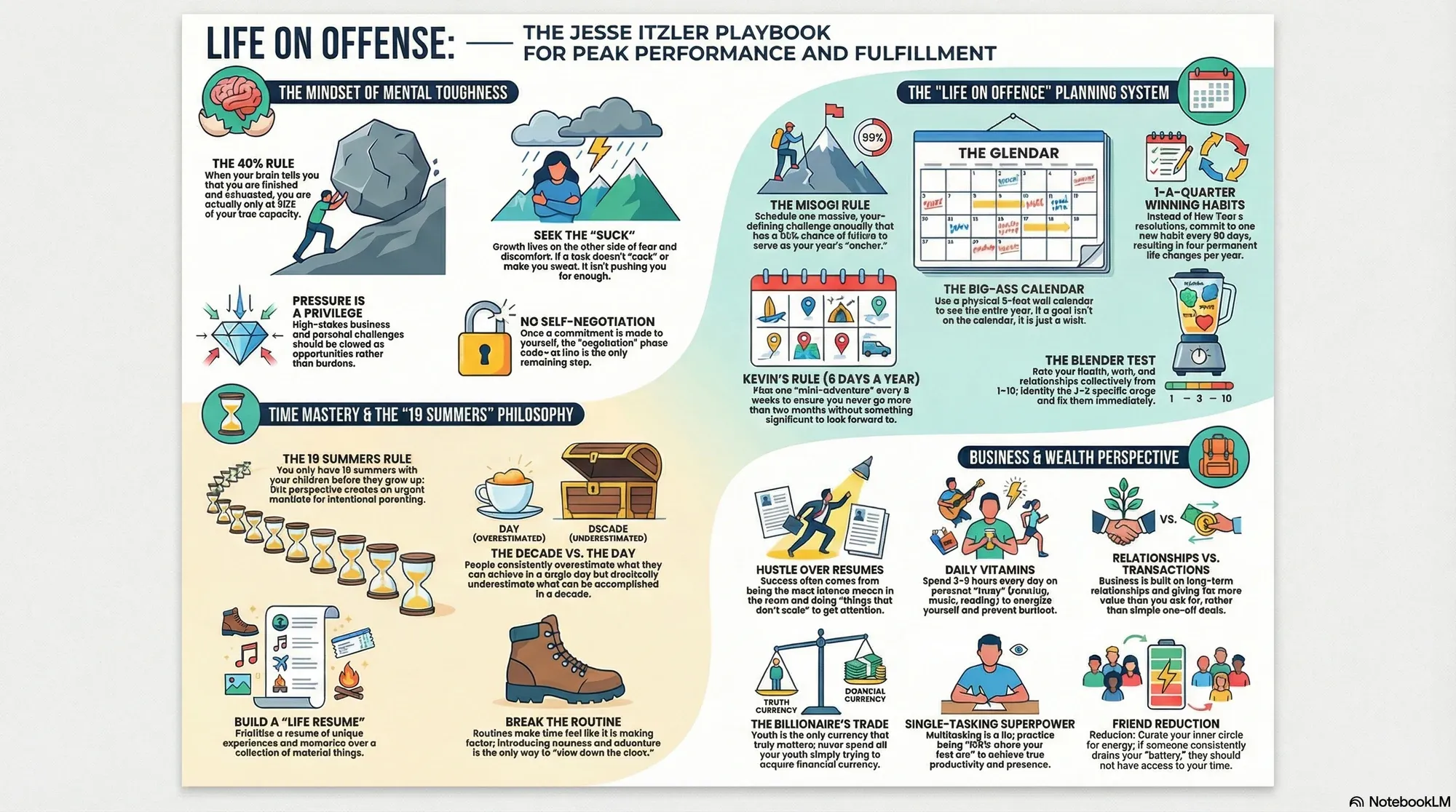
On Mindset and the "40% Rule"
- The 40% rule as a training heuristic: Jesse recounts David Goggins teaching him that the urge to stop during a challenge can arrive before one's actual limit. The percentage was Goggins's motivating rule of thumb, not a measured capacity claim. — Jesse Itzler's SEAL Account.
- Choose deliberate discomfort: Jesse says Goggins's willingness to choose difficult challenges influenced him to seek discomfort as a way to improve. The original saying belongs to Goggins. — Jesse Itzler's SEAL Account.
- Commit before motivation fades: Jesse describes deciding on a goal and not negotiating himself out of it when the work becomes inconvenient. — Intralinks Interview.
- Be willing to look different: Itzler uses Rick Barry’s unconventional underhand free throws to argue that fear of looking odd should not prevent trying an approach that works. This is his interpretation, not a verified success rule. — The 90% Free Throw Nobody Wants To Shoot.
- Chosen pressure, credited to Tim Grover: Jesse says his friend Tim Grover taught him to regard pressure as a privilege; Jesse applies that idea by choosing demanding goals. It is not presented as Jesse’s original saying. — Sean Delaney Interview.
- Take chances while the opportunity exists: In his commencement essay, Jesse urges graduates to take chances even when the outcome is uncertain; the existing fear aphorism is not verified as his quotation. — Dear Graduates.
On Time Management and Family
- Protect time with your children: Jesse says he plans one-on-one time with his children and tries not to spend so much energy elsewhere that he cannot be present when they ask him to play. The popular 18 Summers wording is not needed to convey his documented practice. — Human Upgrade Interview.
- Plan personal priorities before work fills the year: Jesse describes putting family trips and important personal commitments on a physical year calendar before other demands occupy it. — Intralinks Interview.
- Build a life resume of experiences: Jesse says he wants a life resume made of experiences and memories, not only professional achievements or possessions. — Model Health Show Interview.
- Make room by removing low-value time: Jesse describes cutting low-value screen time to make more room for family, health and experiences he values. — Model Health Show Interview.
- See the whole year at once: Jesse uses a large physical calendar to see his trips, time with his children and open gaps across the full year; he says the visual view complements his digital calendar. — Human Upgrade Interview.
- Review each life lap: Itzler calls his years “laps” and reviews how he spent them—the gaps and family moments as well as business wins—before planning the next one. The old claim that every lap must be faster is removed. — Lap 2: A Year in Review.
- Break routine to make time feel fuller: After leaving his usual routine for a monastery stay, Jesse says time seemed to move more slowly to him. He treats unfamiliar experiences as a way to notice more of life, not a universal time-perception law. — Investor's Podcast Monks Interview.
On Business and Success
- Create an unconventional opening: Jesse says he sent many music demos without response, then found a nonstandard way to get a meeting instead of relying on a conventional résumé. — Mixergy Interview.
- Personal outreach can open a door: Jesse recounts tailoring his approach to prospective partners and customers rather than waiting for a standard introduction. — Mixergy Interview.
- Keep relationships after the first transaction: Jesse credits staying in touch, doing favors and building relationships with helping him open business opportunities. — Mixergy Interview.
- Commit to the entrepreneurial journey: Jesse says companies take time and that a founder needs to care about the process, including difficult periods, rather than only an eventual outcome. — Investor's Podcast Life Resume Interview.
On Resilience and Growth
- Act despite self-doubt: Jesse has described self-doubt as an obstacle to success and recounts feeling it himself before taking an early entrepreneurial risk. This is his view, not a measured universal cause of failure. — ASI Fort Worth Keynote Report.
- Start before you have perfect credentials: Jesse says that lacking prior experience need not prevent someone from starting; he used that perspective when entering industries new to him. — Model Health Show Interview.
- Treat happiness as a way of living: Jesse distinguishes happiness from a single future finish line and describes it as a way of living rather than a prize reached after business success. — Model Health Show Interview.
- Choose people who build on ideas: Jesse describes how positive, open-to-ideas company can make collaboration more productive. His point is about the influence of a supportive environment, not a deterministic rule to surround oneself with “winners.” — Yes, and....
Core Life Learnings
- Choose a routine you will repeat: Jesse gives the example of putting a few morning stretches before coffee because a simple health habit one will practice can be more useful than a complex routine one abandons. — Coffee Can Wait.
- Differentiate before you advertise: Jesse recounts pitching Aunt Franny’s brownies in an advertising class and being unable to explain what made the product distinctive. He later applied that lesson to standing out in the music business. — Dear Graduates.
- Make space for quiet: After living at a monastery, Jesse wrote about reducing constant noise and distraction so he could pay attention to his own thinking. He presents silence as a useful practice, not a guaranteed cure for mental clutter. — Living With the Monks.
- Invest in well-rounded capacity: Jesse says the coaches and mentors he sought in business, fitness and other areas helped him become more well-rounded. He views that breadth as useful in life and work; it is not a guarantee of success. — Coaching Matters... A Lot.
The "Life on Offense" Planning System
- Choose one year-defining challenge: Jesse recommends placing one large, personally meaningful challenge on the calendar each year so it gives the year a distinctive aim. His source does not require a quantified 50% chance of failure. — Jesse Itzler's Year-Planning Post.
- Plan six mini-adventures, crediting Kevin: Jesse says he named Kevin’s Rule for a friend and uses it to schedule a mini-adventure about every eight weeks. The aim is to create experiences he would otherwise miss. — Jesse Itzler's Year-Planning Post.
- Add one habit each quarter: Rather than attempt a complete reset on January 1, Jesse suggests introducing a manageable new habit each quarter. His post does not promise that all four will become permanent. — Jesse Itzler's Year-Planning Post.
- Put chosen priorities on the calendar first: Jesse contrasts planning family and personal commitments in advance with letting incoming requests fill the year by default. He calls that playing life on offense. — Intralinks Interview.
- Write a contract with yourself: Itzler wrote a personal list of non-negotiables about gratitude, effort, presence and family, then used it to guide daily choices. Treat it as his practice, not a universal prescription. — Make a Contract With Yourself
- Assess life domains together: Jesse describes an informal 1–10 self-assessment of health, relationships, work and other domains, then identifying the areas that bring the overall score down. It is a reflection exercise, not a validated diagnostic. — Model Health Show Interview.
On Productivity and "Time Richness"
- Take one or two daily vitamins: Jesse calls the activities that energize and fulfill him his daily vitamins. He tries to do at least one or two each day; this is not a fixed two-to-three-hour prescription. — Your Daily Vitamins.
- Make guilt-free personal time: Itzler’s three-hour rule is to reserve cumulative pockets of time for personally restorative activities without guilt; he explicitly allows that even one hour may be more realistic for some people. — The 3-Hour Rule
- Learn through firsthand experience: Jesse says that direct experiences, including spending time with people who practice what he wants to learn, teach him more effectively than reading alone. The old 20-hour-versus-20-books comparison is not verified. — Investor's Podcast Monks Interview.
- Attend to one task at a time: Jesse recounts a monk urging him to focus on the dish he was washing rather than the hundreds still to do. The teaching belongs to the monk; the existing universal anti-multitasking quote is unverified. — Model Health Show Interview.
- Reset the inbox before a new year: Jesse has described clearing unread messages at year-end so he can begin the next year without carrying the old backlog. This is his personal reset practice, not a rule that everyone should delete email. — Human Upgrade Interview.
- Make a place at the table: Jesse used a customer-first pilot and relationships to enter private aviation without conventional industry credentials. In a later keynote he urged people who lacked a place at the table to make one. — ASI Fort Worth Keynote Report.
On Wealth and Perspective
- The value of youth and the process: Jesse recalls an unnamed very wealthy older man who said he would trade his possessions, but not his children, for Jesse’s youth and another chance to build a life. Jesse presents the story as a reason to value time and the process; the man’s billionaire status is unverified. — Investor's Podcast Monks Interview.
- Reduce draining commitments and company: Jesse says that when planning a new year he tries to remove distractions and commitments, and is also considering which friendships energize rather than deplete him. This is his own reflection, not a rule to abandon people in difficulty. — Jesse Itzler's Friend Reduction Post.
- Keep an underdog mindset: Jesse says he continues to see himself as an underdog despite business successes, and values the drive to keep proving himself. The old claims about flying commercial and basic hotels are not verified. — My First Million Interview.
- Do not make money the only driver: Jesse says money can make life easier, but he does not treat it as his main reason for building businesses. He places particular value on experiences and memories. — Mixergy Interview.
- Credit Sara Blakely’s purpose formula: Jesse says his wife Sara Blakely described purpose as an intersection of what one loves, does well and can contribute positively to others. He uses his own breakdancing story as an illustration; this is Sara’s formula as Jesse recounts it. — Investor's Podcast Monks Interview.
Further Lessons
- Be patient in business and urgent about time: Jesse says building a business usually takes time and commitment to the process; separately, awareness of mortality motivates him to make meaningful moments now. The two-part old sentence is a paraphrase, not a verified quotation. — Investor's Podcast Life Resume Interview.
- Get past embarrassment to try new things: Jesse says fear of embarrassment held him back and that getting past it made unusual outreach and experimentation possible. — Mixergy Interview.
Primary Sources and Links
Selected direct interviews and Jesse’s own writings:
- Jesse Itzler’s SEAL account: Signed first-person essay distinguishing Goggins’s teachings from Jesse’s response. — Jesse Itzler's SEAL Account.
- Living With the Monks: Jesse’s signed account of quiet and attention after his monastery stay. — Living With the Monks.
- The Human Upgrade: How to Relentlessly Prioritize Your Life: Speaker-labelled interview on the all-year calendar, adventures and family time. — Human Upgrade Interview.
- Model Health Show: Your Time and Why Experience Is Overrated: Speaker-labelled interview on the life resume, blender exercise and monk’s one-dish teaching. — Model Health Show Interview.
- Investor’s Podcast MI012: Building Your Life Resume: Direct conversation about his music origins, entrepreneurship, time and process. — Investor's Podcast Life Resume Interview.
- Mixergy: Marquis Jet with Jesse Itzler: Direct interview with his business outreach and relationship-building examples. — Mixergy Interview.
- Intralinks: Rules to Live By Featuring Jesse Itzler: Direct webinar on committed goals and priority-first year planning. — Intralinks Interview.
- My First Million: How to Plan an Epic 2025: Original episode on year-end reset, Misogi, mini-adventures and quarterly habits. — My First Million Planning Interview.
- Jesse Itzler’s Three-Part Year-Planning Post: Signed post and embedded transcript on one challenge, six adventures and quarterly habits. — Jesse Itzler's Year-Planning Post.
- Dear Graduates: Jesse’s signed commencement essay on the brownie differentiation lesson and taking chances. — Dear Graduates.
- Your Daily Vitamins: Jesse’s signed description of a flexible one-or-two-activities daily practice. — Your Daily Vitamins.
- Investor’s Podcast TIP192: Living with the Monks: Direct interview on routine, youth and a purpose idea credited to Sara Blakely. — Investor's Podcast Monks Interview.
- Sean Delaney: Mastering the Art of Living Fully with Jesse Itzler: Direct interview on life planning and Tim Grover’s pressure maxim. — Sean Delaney Interview.