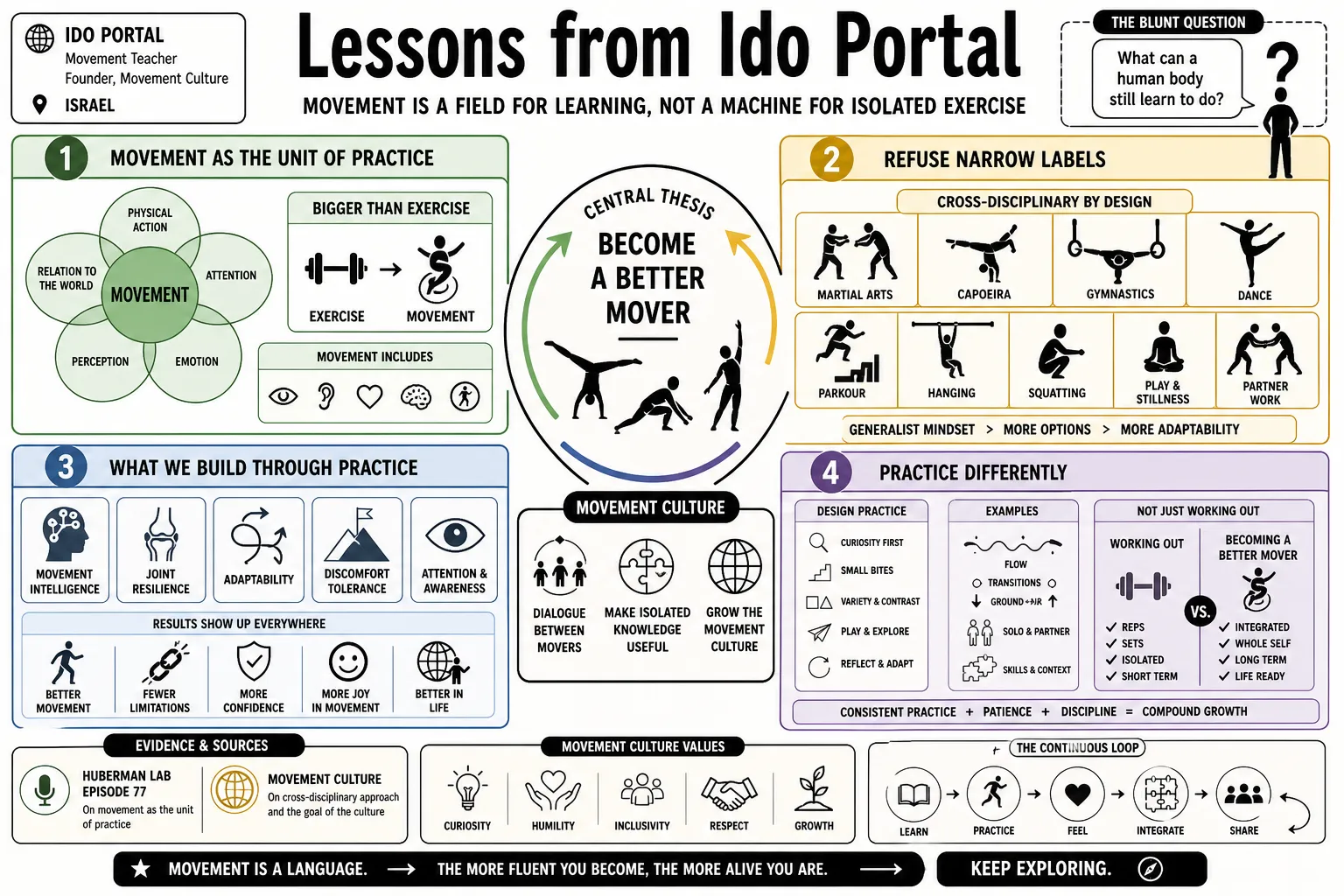
Ido Portal is an Israeli movement teacher and the founder of Movement Culture, a practice that treats the body as a field for learning rather than a machine for isolated exercise. His work pulls from martial arts, capoeira, gymnastics, dance, parkour, hanging, squatting, play, stillness, and partner work, then asks a blunt question: what can a human body still learn to do? This profile draws out his ideas on movement intelligence, generalism, discomfort, joint resilience, attention, practice design, and the difference between working out and becoming a better mover.
Part 1: Movement Culture
- On movement as the unit of practice: Portal frames movement as broader than exercise, because it includes physical action, attention, emotion, perception, and the way a person relates to the world through the body. - Reference: Huberman Lab Episode 77
- On refusing narrow labels: Movement Culture is built around cross-disciplinary exchange, not around becoming a gymnast, yogi, fighter, dancer, or lifter in isolation. - Reference: Movement Culture
- On the goal of the culture: The point is not to crown "masters of movement" but to create dialogue between movers and make isolated knowledge useful across domains. - Reference: Movement Culture
- On what makes a mover: A mover is someone who sees beyond the technicalities of one discipline and becomes interested in body, health, performance, and physical artistic expression together. - Reference: Movement Culture
- On a map rather than a hierarchy: Portal organizes ideas less like a ladder with one correct path and more like a map of practices, constraints, and entry points that can be explored from different directions. - Reference: GQ Interview
- On the limits of definitions: He resists defining movement too tightly because the definition itself can start to restrict the practice before the practitioner has explored it. - Reference: Huberman Lab Episode 77
Part 2: Generalism and Anti-Specialization
- On escaping the fitness silo: Portal's critique of ordinary fitness is that it often separates health, aesthetics, performance, and art into artificial compartments. - Reference: Movement Culture
- On broad physical literacy: He treats capoeira, martial arts, dance, gymnastics, sport, and play as knowledge sources that can cross-pollinate rather than as separate identities to defend. - Reference: Huberman Lab Episode 77
- On the danger of mastery claims: No one can master all movement pursuits, so the more honest path is to keep learning from many practices without pretending to have arrived. - Reference: Movement Culture
- On not becoming addicted to a useful tool: Even hanging and squatting should not become permanent obsessions; once a quality improves, the focus should move to another weakness, skill, position, or discipline. - Reference: Hanging Integration Work
- On becoming good, then moving on: Portal's prescription is to take something you are bad at, practice until you are good enough, maintain it, and then repeat the process with a new limitation. - Reference: Hanging Integration Work
- On specialists needing outside play: In his work with fighters, he argues that high-level specialists benefit from being thrown into unfamiliar environments because reaction ability stagnates inside one technical box. - Reference: McGregor and Gunnar Nelson Learning with Ido
Part 3: Practice Design
- On isolation, integration, improvisation: The mature path moves from isolated capacities, to integrated sequences, to improvisation where the body can respond without a scripted plan. - Reference: Huberman Lab Episode 77
- On isolation as a beginning, not an identity: Portal uses isolated drills to build missing qualities, but the point is to return those qualities to richer movement instead of worshiping the drill. - Reference: Hanging Integration Work
- On practice as examination: A movement practice should reveal what you do not notice about your body, not just repeat the movements you already perform well. - Reference: Huberman Lab Episode 77
- On weak links: He looks for holes in the chain because resolving one weak link can improve the whole system more than polishing an already strong quality. - Reference: GQ Interview
- On discomfort as signal: The practices you resist often expose fear, blind spots, or automatic behavior, which makes them unusually valuable entry points. - Reference: GQ Interview
- On automation and review: Obsession can keep practice moving through weak moments, but it needs periodic checks so the practitioner does not keep chasing an outdated desire. - Reference: GQ Interview
Part 4: Hanging and Shoulder Intelligence
- On hanging as a base pattern: Portal treats hanging as a central beginner-to-advanced movement practice because it underlies pulling, climbing, brachiation, grip, and overhead capacity. - Reference: Hanging
- On passive hanging: Passive hangs target relaxed structural adaptation and are often the starting point for people who need to recover overhead range. - Reference: Hanging
- On active hanging: Active hangs selectively engage the shoulder and scapular pattern, turning hanging into straight-arm scapular strength work. - Reference: Hanging
- On dynamic hanging: Dynamic hanging adds momentum, swing, brachiation, release, and catch, but only after the body has earned enough passive and active capacity. - Reference: Hanging
- On complementary tools: Passive, active, and dynamic hangs are not rivals; they create different adaptations and should be used contextually. - Reference: Hanging
- On daily frequency: Portal prefers spreading hanging across the day because the goal is not one heroic workout but integrating movement back into ordinary life. - Reference: Hanging
- On setting the environment: If a bar, rings, rope, wall, or other anchor point is accessible, you are far more likely to hang; environment design precedes willpower. - Reference: Hanging FAQ
- On choosing rings or a bar: Rings accommodate alignment and can suit strong, stiff shoulders, while a bar is sturdier and can suit mobile but weaker shoulders. - Reference: Hanging FAQ
- On minimum useful exposure: Portal's hanging challenge uses accumulated daily minutes over 30 days because modest but consistent exposure is enough to build a new physical habit. - Reference: Hanging Integration Work
Part 5: Joint Resilience and Tissue Adaptation
- On strain without pain: For shoulder issues without dislocations, Portal suggests carefully using partial or full passive hanging to strain tissues enough to adapt while avoiding pain. - Reference: Hanging
- On unstable shoulders: For people with dislocation history, he favors partial or full active hangs first so the shoulder can learn to stabilize before relaxing into passive or dynamic work. - Reference: Hanging
- On elbow weak links: Hanging can reveal old elbow issues, so he recommends adjusting load, using a slight bend when necessary, and warming pronation and supination before the hang. - Reference: Hanging FAQ
- On spinal position in a hang: A relaxed hang can help spinal issues when shoulders are open enough to maintain alignment; closed shoulders may require bracing to avoid painful arching. - Reference: Hanging FAQ
- On arching active hangs: The arching active hang is a scapular depression and retraction drill, not a front lever pull, and it should be reserved for people with enough active-hang foundation. - Reference: More Hanging Materials
- On posture through strength: Portal uses arching active hangs as a counter-dose to the protracted, elevated, internally rotated posture that many people develop from sitting. - Reference: More Hanging Materials
- On never swinging to failure: Dynamic hanging drills such as front stationary swings should be introduced only after mobility, shoulder stability, and pathway control are in place. - Reference: More Hanging Materials
Part 6: Attention, Nervous System, and Learning
- On movement as nervous-system education: Portal treats movement as a way to study the nervous system because every new posture, gait, touch, and reaction forces perception and motor control to reorganize. - Reference: Huberman Lab Episode 77
- On contents and containers: A useful practice distinguishes the visible movement content from the deeper container: the attention, constraints, awareness, and learning process behind it. - Reference: Huberman Lab Episode 77
- On variability: Movement diversity matters because the nervous system needs changing conditions to build adaptable skill rather than brittle repetition. - Reference: Huberman Lab Episode 77
- On sensory range: Portal explores vision, hearing, touch, proximity, gait, and awareness because movement quality depends on perception, not only on muscle output. - Reference: Huberman Lab Episode 77
- On stillness: Stillness is not the opposite of movement practice; it is another edge where the practitioner can study attention, emotion, and the body. - Reference: The Power of Movement
- On undoing: Sometimes the most valuable intervention is not adding more work but undoing unnecessary tension, automatic patterns, and habits that block movement. - Reference: The Power of Movement
Part 7: Play, Partner Work, and Fighting Lessons
- On child mind: When Portal worked with Conor McGregor and Gunnar Nelson, he used unfamiliar games and stick reactions to bring them into a more adaptive, playful learning state. - Reference: McGregor and Gunnar Nelson Learning with Ido
- On softness in fighters: He argues that fighters need softening protocols because bodies that are only hardened by impact can become slower, more restricted, and easier to break. - Reference: McGregor and Gunnar Nelson Learning with Ido
- On recovery through shaking: Portal uses shaking as a relaxation and regeneration tool, especially for bodies carrying scar tissue, stress, and repeated impact. - Reference: McGregor and Gunnar Nelson Learning with Ido
- On fear as training material: He connects physical fear with broader fear responses, arguing that practiced exposure changes how the body and mind react under pressure. - Reference: GQ Interview
- On partner proximity: Touch, reactivity, personal space, and partner games expose qualities that solitary strength work cannot reveal. - Reference: Huberman Lab Episode 77
- On play as seriousness: Play is not a break from practice; it is one of the main ways a mover tests adaptability, timing, creativity, and emotional regulation. - Reference: Huberman Lab Episode 77
Part 8: Teaching and Transmission
- On walking with the teacher: Portal has resisted static packaging of his work because he wants students to walk with the practice, not stand behind a frozen version of it. - Reference: London Real - Just Move
- On seminars as embodied communication: He treats live workshops and meetings as necessary because the subject cannot be transmitted cleanly as information alone. - Reference: London Real - Just Move
- On community: Movement Culture is partly an educational system and partly a community of people sharing experiments, questions, and support around physical practice. - Reference: Movement Culture
- On being a student: Portal's public interviews repeatedly return to the missing art of being a good student: staying curious, humble, and willing to be changed by practice. - Reference: The Power of Movement
Part 9: Life in a Body
- On physical self-knowledge: Portal argues that people often know surprisingly little about basic physical processes happening inside their own bodies, even when those processes shape emotion and behavior. - Reference: GQ Interview
- On movement and relationships: He sees movement practice as relevant beyond sport because the same body carries emotions, reactions, boundaries, and patterns into relationships. - Reference: GQ Interview
- On aging dynamically: A broad movement practice protects autonomy by continuing to challenge range, attention, balance, coordination, and adaptation instead of narrowing life around comfort. - Reference: Huberman Lab Episode 77
- On reconnecting with the body: London Real's profile of Portal emphasizes that his work speaks to a screen-heavy culture separated from physical movement and its own animal nature. - Reference: London Real - Just Move
- On the simplest command: Underneath the complexity of his method is a plain operating rule: stop outsourcing the body to fitness abstractions and move more often, in more ways, with more awareness. - Reference: Hanging FAQ