Maya Spivak is an independent marketing consultant who has led brand and growth strategies for tech companies like Segment, Wealthfront, and Mux. She is known for her practical frameworks on structuring early marketing teams and her advocacy for high-production creative in B2B campaigns. This profile collects her insights on hiring, technical brand building, and executing ambitious growth operations.
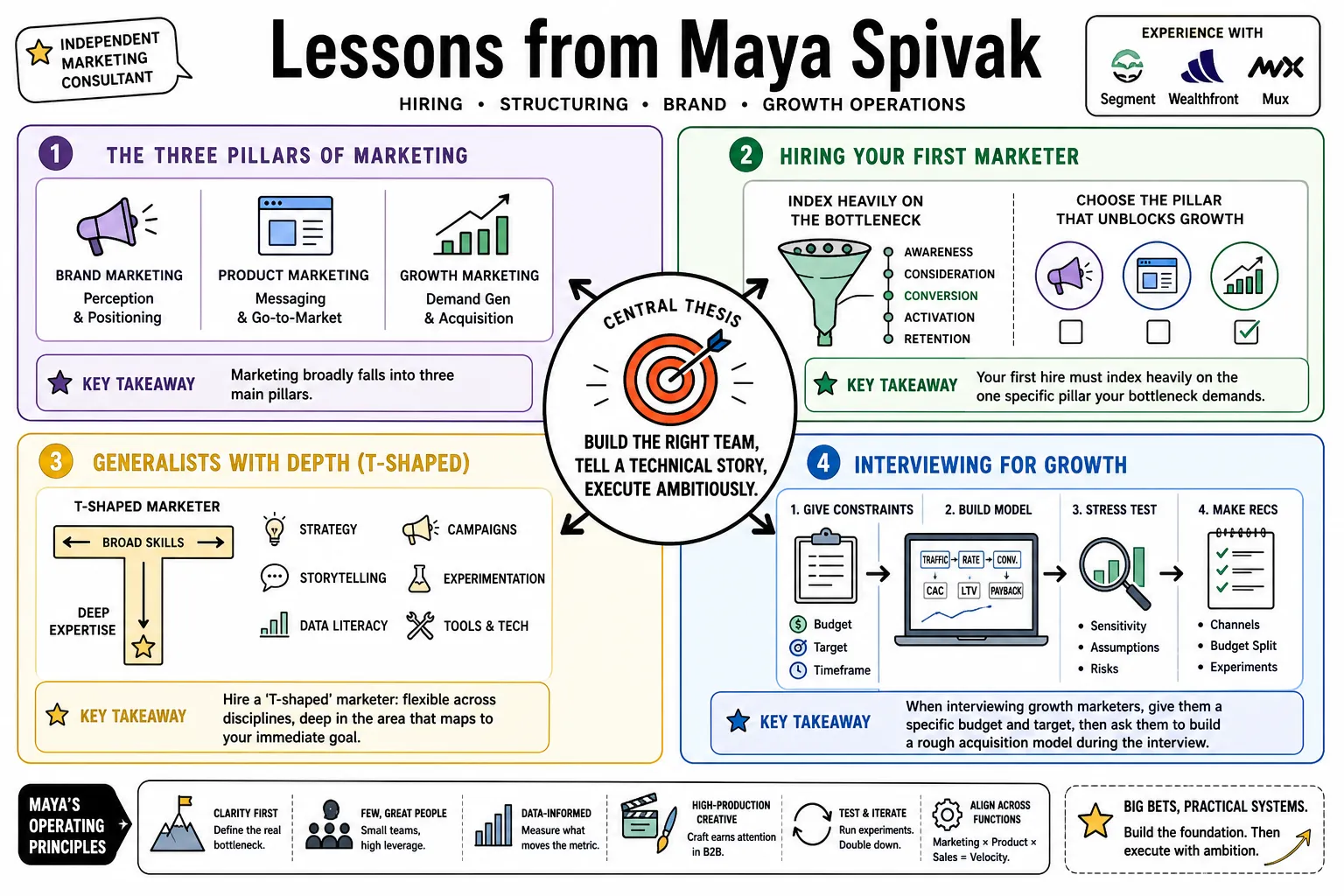
Part 1: Hiring and Structuring Marketing Teams
- On the three pillars: "Marketing broadly falls into three main pillars: product marketing, brand marketing, and growth marketing." — Source: First Round Review
- On the first hire: "Founders often want a unicorn who can do everything, but your first marketing hire must index heavily on the one specific pillar your current growth bottleneck demands." — Source: First Round Review
- On generalists vs. specialists: "Early on, hire a 'T-shaped' marketer who can flex across disciplines but has deep expertise in the one area that maps to your immediate company goal." — Source: First Round Review
- On interviewing for growth: "When interviewing growth marketers, give them a specific budget and target, then ask them to build a rough acquisition model during the interview." — Source: First Round Review
- On evaluating brand marketers: "Look for brand marketers who understand how to connect creative execution directly to company narrative, rather than just chasing aesthetic perfection." — Source: First Round Review
- On product marketing talent: "A great product marketer is fundamentally a translator. They must be able to sit with engineers and then explain the value to a non-technical buyer without losing the core truth." — Source: First Round Review
- On setting expectations: "If you hire a senior leader before you have product-market fit, you run the risk of them building a large team before the company knows what it is actually selling." — Source: First Round Review
- On the danger of titles: "Over-titling early marketing hires creates downstream organizational debt when you eventually need to bring in experienced executives to scale the next phase." — Source: First Round Review
- On founder involvement: "Founders cannot fully outsource marketing early on; the founding team must remain deeply involved in narrative creation because they are the ultimate domain experts." — Source: First Round Review
- On interview assignments: "Keep candidate projects tightly scoped to a real, current problem the company is facing, rather than hypothetical scenarios." — Source: First Round Review
Part 2: Building B2B Tech Brands
- On brand as a moat: "In crowded software markets, your brand eventually becomes the primary differentiator when feature parity is reached." — Source: Beloved Tech Brands
- On defining brand: "Brand is the sum of every interaction a person has with your company, from the website copy to the support ticket resolution." — Source: Beloved Tech Brands
- On B2B emotion: "Enterprise buyers are still human beings; they respond to narratives that reduce anxiety and increase their personal status within their organization." — Source: The Transaction Podcast
- On consistency: "Brand equity is built through relentless repetition of your core message, even after you are entirely sick of hearing yourself say it." — Source: Beloved Tech Brands
- On visual identity: "A strong visual identity signals product quality. If your marketing site looks broken, buyers will assume your software is broken." — Source: Beloved Tech Brands
- On narrative positioning: "Positioning is about choosing an enemy. The strongest tech brands define clearly what they are fighting against in the legacy market." — Source: ExponentialX
- On category creation: "Creating a new category requires you to educate the market on the problem before you can sell them your specific solution." — Source: Beloved Tech Brands
- On authentic voice: "Corporate speak dilutes your message. Speak plainly and treat your buyers with intellectual respect." — Source: Beloved Tech Brands
- On customer stories: "The most effective brand marketing simply amplifies the voices of your most successful customers." — Source: The Transaction Podcast
- On long-term value: "Brand marketing does not always show immediate ROI, but it fundamentally lowers your customer acquisition cost over a multi-year horizon." — Source: The Transaction Podcast
Part 3: The Mechanics of "Edutainment"
- On earning attention: "Before you can educate a B2B buyer, you have to entertain them enough to earn their attention." — Source: GTMshift
- On content format: "Mix heavy technical documentation with lighter, engaging formats to keep your audience interested throughout their entire learning journey." — Source: GTMshift
- On social platforms: "Enterprise buyers often discover vendors through LinkedIn or Twitter before they ever visit a company homepage." — Source: GTMshift
- On humor in B2B: "Using humor in B2B marketing shows confidence and makes your brand memorable in a sea of sterile corporate communication." — Source: GTMshift
- On video content: "Video is highly effective for edutainment because it allows you to convey complex technical concepts with personality." — Source: Grow & Tell Podcast
- On event marketing: "Treat live events as content creation engines, where the physical experience translates into digital assets you can use all year." — Source: Grow & Tell Podcast
- On organic discovery: "When your content is entertaining, buyers will share it internally on Slack, which is the most valuable dark funnel distribution." — Source: GTMshift
- On breaking patterns: "If every competitor is writing dry whitepapers, the highest leverage move is to create something completely counter to that format." — Source: GTMshift
- On audience trust: "Edutainment works because it provides value upfront without immediately demanding a sales meeting in return." — Source: GTMshift
Part 4: Creative Judgment and "Taste"
- On defining taste: "Taste in marketing is the ability to recognize what will resonate emotionally with your audience and what will feel inauthentic." — Source: The Transaction Podcast
- On hiring for taste: "You cannot easily train creative taste. You have to hire people who already possess a high standard for quality output." — Source: The Transaction Podcast
- On reviewing creative: "When reviewing creative work, give directional feedback on the emotion or message, rather than prescribing specific design tweaks." — Source: The Transaction Podcast
- On taking risks: "Safe creative often results in invisible marketing. You have to be willing to take calculated risks to stand out." — Source: Beloved Tech Brands
- On brand guardrails: "Establish clear visual and tonal guidelines early so the team can move fast without sacrificing the brand's core identity." — Source: Beloved Tech Brands
- On avoiding consensus: "Marketing designed by committee almost always results in a watered-down message that appeals to no one." — Source: The Transaction Podcast
- On sweating the details: "The difference between a good campaign and a great one is often the final five percent of polish and execution." — Source: Beloved Tech Brands
- On evaluating agencies: "When hiring external agencies, prioritize those who push back on your ideas and bring distinct perspectives, rather than order-takers." — Source: The Transaction Podcast
- On internal alignment: "The marketing team must be completely aligned on the standard of quality before they can hold the rest of the company to it." — Source: Beloved Tech Brands
Part 5: High-Impact Campaigns on a Budget
- On constraint as an advantage: "A limited budget forces you to be more creative and precise with your message, rather than relying on volume." — Source: Grow & Tell Podcast
- On out-of-home advertising: "Billboards can be highly effective for tech companies if they are placed strategically and feature a singular, provocative message." — Source: The Transaction Podcast
- On TV commercials: "Producing multiple commercials on a shoestring budget requires ruthless prioritization of the core concept over expensive production values." — Source: Grow & Tell Podcast
- On the halo effect: "A highly visible physical campaign often drives an unmeasurable but significant lift in organic digital traffic and brand trust." — Source: Grow & Tell Podcast
- On regional focus: "Instead of spreading a small budget nationally, saturate a specific market like San Francisco to create the illusion of ubiquity." — Source: The Transaction Podcast
- On guerrilla tactics: "Unconventional marketing tactics work best when they subvert the standard expectations of your specific industry." — Source: Grow & Tell Podcast
- On measuring OOH: "Do not measure out-of-home campaigns solely by direct conversions; look for lifts in branded search and overall pipeline velocity." — Source: The Transaction Podcast
- On campaign longevity: "Design core campaign assets that can be repurposed across multiple channels for months to maximize the return on creative investment." — Source: Grow & Tell Podcast
- On vendor negotiation: "When working with small budgets, find vendors who believe in your company's potential and are willing to experiment with you." — Source: Grow & Tell Podcast
Part 6: Speed and Agility in Marketing
- On rapid response: "The ability to respond quickly to market events or product launches is a competitive advantage that large incumbents lack." — Source: The Transaction Podcast
- On operationalizing speed: "Build systems that allow your team to deploy a landing page or an email campaign within hours, not weeks." — Source: The Transaction Podcast
- On shipping culture: "Foster a marketing culture that values shipping and iterating over prolonged periods of internal review." — Source: Beloved Tech Brands
- On capitalizing on news: "When a major industry event happens, the first company to publish a coherent perspective often captures the majority of the attention." — Source: The Transaction Podcast
- On product launches: "Treat every minor product update as an opportunity to reinforce your overall narrative, rather than just listing features." — Source: Beloved Tech Brands
- On cross-functional speed: "Marketing agility requires tight alignment with product and engineering teams so you are never caught off guard by a release." — Source: Beloved Tech Brands
- On reducing friction: "Remove unnecessary approval layers for day-to-day social media and content marketing to keep the brand's voice active and relevant." — Source: The Transaction Podcast
- On handling mistakes: "When you move fast, errors happen. Acknowledge them quickly and move on rather than slowing down your entire process." — Source: Beloved Tech Brands
- On momentum: "Consistent, high-velocity output creates a perception of momentum that attracts both customers and future talent." — Source: Beloved Tech Brands
Part 7: Navigating Growth and Scale
- On the transition from $10M to $100M: "The marketing strategies that get you to $10M ARR will break; scaling requires moving from heroics to repeatable processes." — Source: ExponentialX
- On evolving messaging: "As your product suite expands, your messaging must elevate from solving a specific pain point to addressing a broader business strategy." — Source: ExponentialX
- On team structure: "At scale, you must organize marketing teams around the buyer journey rather than just functional specialties." — Source: First Round Review
- On executive communication: "Marketing leaders must learn to translate their metrics into business impact when presenting to the board and executive team." — Source: ExponentialX
- On maintaining culture: "As the marketing team grows, over-communicate the core brand values to ensure consistency across newly formed departments." — Source: Beloved Tech Brands
- On data infrastructure: "Scaling growth marketing requires significant investment in data infrastructure to accurately attribute pipeline across complex buying cycles." — Source: ExponentialX
- On international expansion: "When expanding globally, localize the messaging and cultural context, not just the language." — Source: Beloved Tech Brands
- On managing expectations: "During high-growth phases, marketing leaders must manage the company's expectations regarding the timeline for brand campaigns to yield results." — Source: ExponentialX
- On preserving agility: "Even as you build processes for scale, reserve a portion of the budget and team capacity for unproven, high-upside experiments." — Source: Beloved Tech Brands
Part 8: Developer and Technical Marketing
- On developer skepticism: "Developers have a highly tuned radar for marketing fluff; you have to lead with utility and technical accuracy." — Source: Beloved Tech Brands
- On documentation as marketing: "For technical products, clear, comprehensive documentation is often your most powerful marketing asset." — Source: Beloved Tech Brands
- On developer communities: "You cannot manufacture a community; you can only facilitate and support the spaces where developers naturally want to gather." — Source: Grow & Tell Podcast
- On technical content: "Content marketing for developers must teach them how to solve a hard problem, even if it does not immediately pitch your product." — Source: Beloved Tech Brands
- On open source: "Open-source strategy requires marketing to focus on adoption and contributor experience before attempting to monetize." — Source: ExponentialX
- On product-led growth: "In a PLG motion, marketing's primary job is to remove friction from the signup process and get the user to the initial technical success state instantly." — Source: ExponentialX
- On technical advocates: "Empower your engineering team to speak at conferences and write blog posts; peer-to-peer communication is highly trusted by developers." — Source: Grow & Tell Podcast
- On marketing to data teams: "Data engineers care about reliability and edge cases; your marketing must address how your product handles failure states." — Source: Beloved Tech Brands
- On APIs as products: "When marketing an API, the developer experience—how easy it is to generate an API key and make the first call—is the product." — Source: Beloved Tech Brands
- On technical brand identity: "A developer brand should feel like a reliable tool in their stack: highly functional, cleanly designed, and strictly free of unnecessary marketing polish." — Source: Beloved Tech Brands