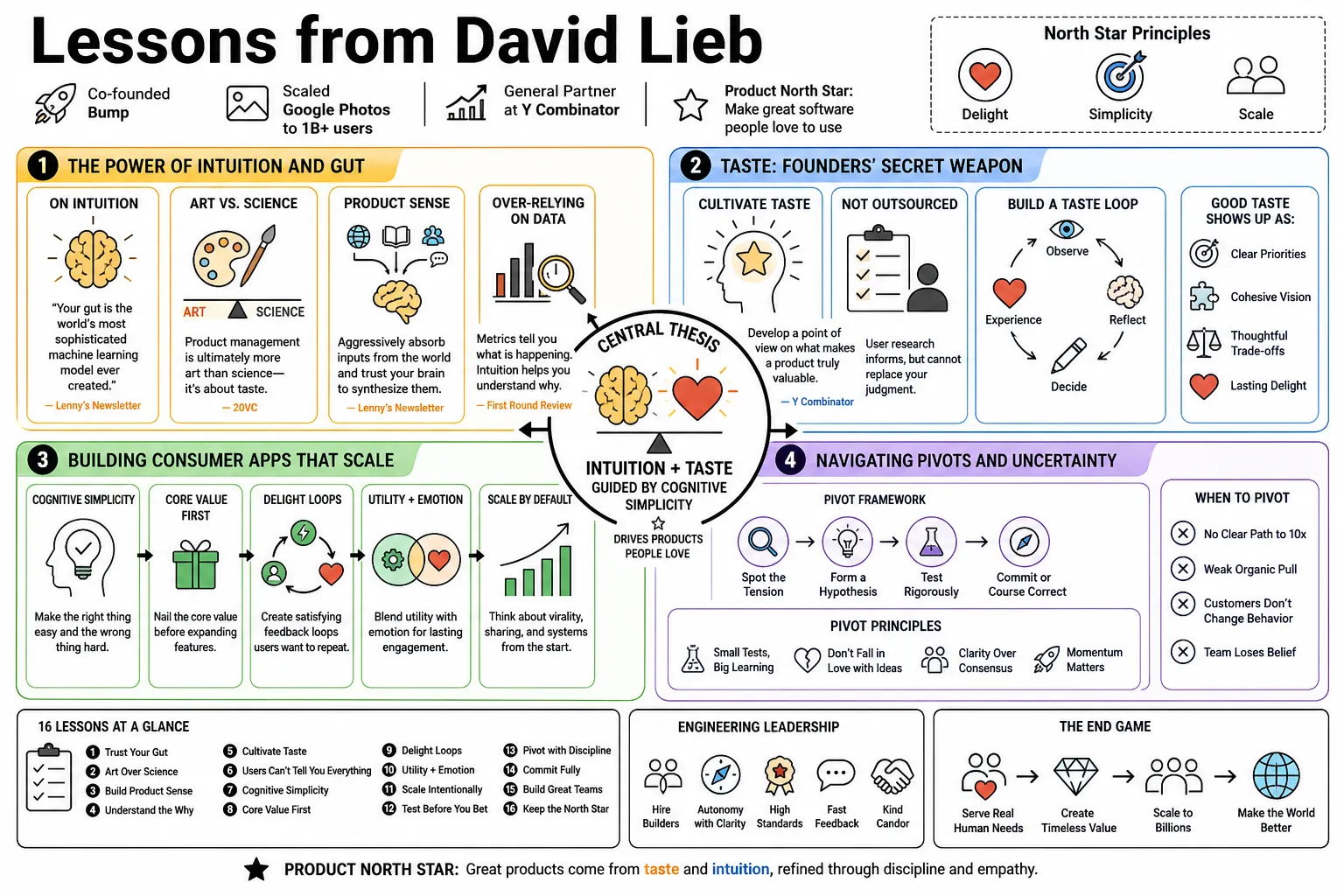
Lessons from David Lieb
David Lieb is a general partner at Y Combinator who co-founded Bump and led Google Photos. This collection gathers his own words from a Y Combinator podcast conversation. — David Lieb (Y Combinator).
Part 1: The Power of Intuition and Gut
- On the brain as a computing platform: David Lieb: "I think we overlook the fact that we’ve got the best computing platform that has ever been built, and it’s our brains, and we can use it to give it inputs, and then let it do its magic and pattern match, and then output our intuition." — Google Photos Product Lead and Bump Cofounder David Lieb with Gustaf Alströmer (Y Combinator podcast transcript; his turns).
- On living at the edge of the future: David Lieb: "I think we more emotionally understood it or personally understood it, and I think we really use this technique that PG talks about, which is if you want to come up with great startup ideas, just try to live at the edge of the future." — Google Photos Product Lead and Bump Cofounder David Lieb with Gustaf Alströmer (Y Combinator podcast transcript; his turns).
- On learning from reporters: David Lieb: "Every reporter wanted to talk about the coolest apps on the iPhone, and so I remember I met one reporter from the Chicago Tribune at a random business school conference once." — Google Photos Product Lead and Bump Cofounder David Lieb with Gustaf Alströmer (Y Combinator podcast transcript; his turns).
- On what tests cannot tell you: David Lieb: "We bring them out to people, and you can learn a lot of usability things, like whether the actual flows will work, but you can’t really test do they care by doing those sorts of tests." — Google Photos Product Lead and Bump Cofounder David Lieb with Gustaf Alströmer (Y Combinator podcast transcript; his turns).
- On the first person outside your friends: David Lieb: "I remember the first time I saw someone in the wild bump that wasn’t my friend, and it was a really visceral feeling." — Google Photos Product Lead and Bump Cofounder David Lieb with Gustaf Alströmer (Y Combinator podcast transcript; his turns).
- On starting with a contact-sharing problem: David Lieb: "We built Bump to share the contact-sharing problem, and people started using it for that." — Google Photos Product Lead and Bump Cofounder David Lieb with Gustaf Alströmer (Y Combinator podcast transcript; his turns).
- On trusting your gut: David Lieb: "If I had to pick a higher level thing, it would be: trust your gut on where this thing should go, and allow it to go those ways." — Getting to know YC's newest Group Partner, David Lieb (Y Combinator blog interview, 2024; his answers).
Part 2: Designing for Cognitive Simplicity
- On assuming people understand the value: David Lieb: "The moment you assume people understand the value you’re adding — especially when it’s a new concept — you dive into cognitive overhead territory." — Cognitive Overhead Is Your Product's Overlord (First Round Review; David Lieb's quoted words).
- On a more social environment: David Lieb: "One reason we did it at bars is that people are in a more social environment, so bumping was something that you would actually do there, whereas managing your photos maybe is harder to find the moment when people are in that mode." — Google Photos Product Lead and Bump Cofounder David Lieb with Gustaf Alströmer (Y Combinator podcast transcript; his turns).
- On a visceral moment: David Lieb: "I think we all feel it, and we all know that feeling, but seeing it from the perspective that I get to see it, it’s one of the most powerful things in the human experience, I think." — Google Photos Product Lead and Bump Cofounder David Lieb with Gustaf Alströmer (Y Combinator podcast transcript; his turns).
- On high friction that empowers: David Lieb: "It was incredibly high friction but it empowered them by putting them in charge of the process." — Cognitive Overhead Is Your Product's Overlord (First Round Review; David Lieb's quoted words).
- On letting users make the choices: David Lieb: "The more choices your user makes within your product, especially ones you could have made for them, the easier it is to use and understand." — Cognitive Overhead Is Your Product's Overlord (First Round Review; David Lieb's quoted words).
- On the young and old as detectors: David Lieb: "Your best cognitive overhead detectors are the young and old." — Cognitive Overhead Is Your Product's Overlord (First Round Review; David Lieb's quoted words).
- On Flock being a cognitive maze: David Lieb: "We saw the value being added with Flock’s predictive abilities — and a small group of users really loved them — but it was a cognitive maze for the rest of the world." — Cognitive Overhead Is Your Product's Overlord (First Round Review; David Lieb's quoted words).
- On making people work more: David Lieb: "The most successful products make people work more." — Cognitive Overhead Is Your Product's Overlord (First Round Review; David Lieb's quoted words).
- On the young, old and drunk test: David Lieb: "Look at your own products and see if they pass the young, old, and drunk test." — Cognitive Overhead Is Your Product's Overlord (First Round Review; David Lieb's quoted words).
Part 3: Customer Engagement and Dogfooding
- On the next user at a billion: David Lieb: "When you get to a billion or more users, the next person who joins your product, they’re very different than the first person who joined your product, and so you’ve got to really understand that." — Google Photos Product Lead and Bump Cofounder David Lieb with Gustaf Alströmer (Y Combinator podcast transcript; his turns).
- On living in India: David Lieb: "A couple summers ago, I spent two weeks in India just living in India, trying to understand what about Indian people is different than what is about people in Mountain View, and there’s a lot of differences." — Google Photos Product Lead and Bump Cofounder David Lieb with Gustaf Alströmer (Y Combinator podcast transcript; his turns).
- On being the only support person: David Lieb: "In fact, at Bump, until I think through the acquisition, I was the only customer support person." — Google Photos Product Lead and Bump Cofounder David Lieb with Gustaf Alströmer (Y Combinator podcast transcript; his turns).
- On using your own product: David Lieb: "The first thing we do is use it ourselves, and if we think it’s not working, then it’s very likely it’s not going to work in the market." — Google Photos Product Lead and Bump Cofounder David Lieb with Gustaf Alströmer (Y Combinator podcast transcript; his turns).
- On machine-clustered feedback: David Lieb: "We have some AI systems that read the feedback, try to cluster it into different clusters, and then some humans look at that and try to understand if there’s interesting insights." — Google Photos Product Lead and Bump Cofounder David Lieb with Gustaf Alströmer (Y Combinator podcast transcript; his turns).
Part 4: The Reality of Pivots and Startup Journeys
- On leaving the traditional path: David Lieb: "I went to business school, and that’s where I left the traditional path of an engineer and went into the startup world with Bump." — Getting to know YC's newest Group Partner, David Lieb (Y Combinator blog interview, 2024; his answers).
- On trying ads: David Lieb: "We tried ads in the product also as a little test, and we basically concluded we could basically get maybe one million, oh sorry, $1, for every user of the product per year on average." — Google Photos Product Lead and Bump Cofounder David Lieb with Gustaf Alströmer (Y Combinator podcast transcript; his turns).
- On pressure from fancy investors: David Lieb: "During the journey of Bump, there was so much pressure on us because we raised a lot of money from fancy investors that it probably made it harder for us to see where this product wanted to go — and ultimately it wanted to become Google Photos!" — Getting to know YC's newest Group Partner, David Lieb (Y Combinator blog interview, 2024; his answers).
- On raising less: David Lieb: "In hindsight, I wish I had raised a little bit less money in that Series B, because it would have forced us to have some of these existential questions or discussions a little bit earlier." — Google Photos Product Lead and Bump Cofounder David Lieb with Gustaf Alströmer (Y Combinator podcast transcript; his turns).
- On the wave of mobile: David Lieb: "What we saw was mobile is this huge wave that we all knew was going to be really big, and Bump was the most popular app on mobile, and it solved some of these core problems that we all believed would be real." — Google Photos Product Lead and Bump Cofounder David Lieb with Gustaf Alströmer (Y Combinator podcast transcript; his turns).
- On the Google fit: David Lieb: "Compared to when we would talk to Facebook or talk to Apple, the DNA fit just wasn’t quite as good, I think, so that was another reason that Google was a good– Google has been on the photos trajectory for a while, beginning with Picasa." — Google Photos Product Lead and Bump Cofounder David Lieb with Gustaf Alströmer (Y Combinator podcast transcript; his turns).
- On a meta mistake: David Lieb: "The meta problem that I made, or meta mistake I made was I really believed in this vision for what we could build in the photo space so much that I was just determined to solve it." — Google Photos Product Lead and Bump Cofounder David Lieb with Gustaf Alströmer (Y Combinator podcast transcript; his turns).
Part 5: Navigating Product-Market Fit
- On product-market fit for a group: David Lieb: "Even with Google Photos today, my answer would be we certainly have product-market fit for a large group of people in the world, but there’s another group of people who use our product that I wouldn’t say is product-market fit necessarily." — Google Photos Product Lead and Bump Cofounder David Lieb with Gustaf Alströmer (Y Combinator podcast transcript; his turns).
- On a large group of people: David Lieb: "Ultimately, if you want to be huge in a consumer space, you’ve got to get to a large group people, and the question is do you have product-market fit for that large group of people." — Google Photos Product Lead and Bump Cofounder David Lieb with Gustaf Alströmer (Y Combinator podcast transcript; his turns).
Part 6: Retention and Measuring Success
- On long-term cohort retention: David Lieb: "With Bump, the actual dynamic was that our longterm cohort retention was really good actually, if you measured it on a wide enough time period." — Google Photos Product Lead and Bump Cofounder David Lieb with Gustaf Alströmer (Y Combinator podcast transcript; his turns).
- On downloads and users: David Lieb: "We got up to 150 million downloads of our app, and I think at the peak we were at 10 million monthly active users." — Google Photos Product Lead and Bump Cofounder David Lieb with Gustaf Alströmer (Y Combinator podcast transcript; his turns).
- On a business model that was not going to work: David Lieb: "The high level arc of the story is that while Bump got very popular — I think we were installed on like, 20-40% of all phones in the world at the time — we never really had a business model that was going to work." — Getting to know YC's newest Group Partner, David Lieb (Y Combinator blog interview, 2024; his answers).
- On frequency of use and retention: David Lieb: "Our long term frequency of use and retention was just not good enough that we could build even an advertising-based model on top of it." — Getting to know YC's newest Group Partner, David Lieb (Y Combinator blog interview, 2024; his answers).
Part 7: Hiring and Team Culture
- On AI solving real problems: David Lieb: "The thing that really worked about Google Photos is it was one of the first examples of AI solving real problems that people could resonate with." — Google Photos Product Lead and Bump Cofounder David Lieb with Gustaf Alströmer (Y Combinator podcast transcript; his turns).
Part 8: The Founder Ecosystem and Y Combinator
- On the early YC experience: David Lieb: "When we did YC in Summer of 2009, the entirety of the experience was as follows: you go to the Mountain View office on Tuesday nights, PG serves you chili, there’s a speaker for an hour, and then you go home." — Getting to know YC's newest Group Partner, David Lieb (Y Combinator blog interview, 2024; his answers).
- On YC operating like a startup: David Lieb: "The biggest one is the way that YC operates very similarly to the startups we advise." — Getting to know YC's newest Group Partner, David Lieb (Y Combinator blog interview, 2024; his answers).
- On a business school summer: David Lieb: "I showed up to business school and I met a couple people in the computer science department who had built apps over the summer." — Google Photos Product Lead and Bump Cofounder David Lieb with Gustaf Alströmer (Y Combinator podcast transcript; his turns).
- On being shoulder-to-shoulder with founders: David Lieb: "I had a bunch of conversations and I came to realize that the part of the job I love the most is being shoulder-to-shoulder with founders when they’re trying to make something new in the world." — Getting to know YC's newest Group Partner, David Lieb (Y Combinator blog interview, 2024; his answers).
- On not chasing deals: David Lieb: "We’re not typical venture investors where we’re going out and having to chase deals, and win deals, and schmooze… we have the privilege of having the best founders in the world apply on our website." — Getting to know YC's newest Group Partner, David Lieb (Y Combinator blog interview, 2024; his answers).
- On raising money with no plan: David Lieb: "If you have no idea how you’re going to raise it, you’re just like, I need some more money, you should only do that if you already have a very proven business model, and there’s risks that you want to mitigate." — Google Photos Product Lead and Bump Cofounder David Lieb with Gustaf Alströmer (Y Combinator podcast transcript; his turns).