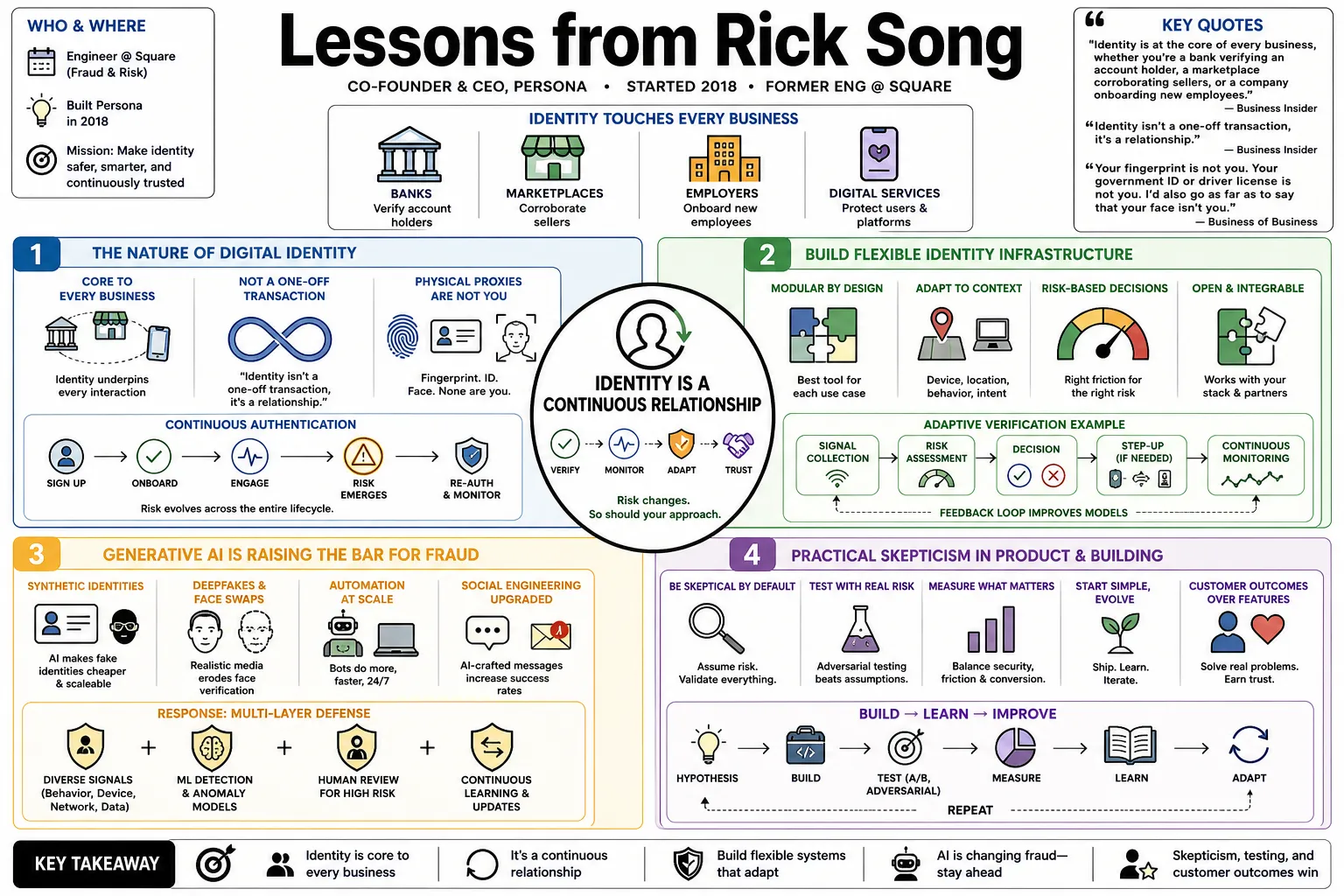
Rick Song is the co-founder and CEO of Persona, a unified identity platform he started in 2018. Before Persona, Song worked as an engineer at Square, where his exposure to fraud and risk shaped his view that identity verification cannot be solved with a single static tool. This profile synthesizes his ideas on building flexible infrastructure, the impact of generative AI on fraud, and practical skepticism in product development.
Part 1: The Nature of Digital Identity
- On defining identity: "Identity is at the core of every business, whether you're a bank verifying an account holder, a marketplace corroborating sellers, or a company onboarding new employees." — Source: Business Insider
- On the longevity of verification: "Identity isn't a one-off transaction, it's a relationship." — Source: Business Insider
- On physical proxies: "Your fingerprint is not you. Your government ID or driver license is not you. I'd also go as far as to say that your face isn't you." — Source: Business of Business
- On continuous authentication: Treating identity as a one-time check ignores the reality that risk evolves throughout the entire lifecycle of a user's engagement. — Source: Persona Blog
- On context dependence: Verification is highly contextual; the level of friction acceptable for a social media account is vastly different from opening a commercial bank account. — Source: Bank On It Podcast
- On humanizing data: A digital identity is more than a collection of data points. It represents a real human attempting to interact safely with a digital service. — Source: Forbes
- On the illusion of the silver bullet: "The fundamental challenge for identity online is that it's this uncertain thing... Companies treated identity as a silver bullet. But what I'd seen was that there wasn't a single way to solve all this." — Source: Forbes
- On static versus dynamic identities: Identity should be viewed as a flexible, configurable layer that adapts to changing circumstances, rather than a rigid set of rules. — Source: First Round Review
- On balancing friction: The ultimate goal of identity verification is introducing just enough friction to deter bad actors while remaining largely invisible to good users. — Source: Persona Blog
Part 2: Product Strategy and Skepticism
- On identifying failure: "'Why would a customer not want this?' is often a far more interesting question than why they would." — Source: First Round Review
- On confirmation bias: When dreaming up big ideas, it is incredibly easy to succumb to confirmation bias; finding the scenario where you are wrong is essential. — Source: First Round Review
- On the pre-mortem: The practice of intentionally imagining why a product idea or strategy might fail before committing resources is critical for building resilient solutions. — Source: First Round Review
- On the Ideal Customer Profile (ICP): "We did the ICP exercise 17 times in the early days... I think in earnest we never really had one, but we tried for sure." — Source: Lenny's Newsletter
- On resisting narrow focus: Over-specializing towards a narrow ICP early on can restrict a platform's ability to serve broader, horizontal use cases. — Source: Lenny's Newsletter
- On building for reality: Early product strategies often fail because founders focus on how a feature should work in theory, rather than how a user will break it in practice. — Source: First Round Review
- On pragmatic development: Emphasize practical utility and fault tolerance over building the theoretically perfect system from day one. — Source: Lenny's Newsletter
- On continuous iteration: Product strategy should be treated as an ongoing experiment rather than a rigid roadmap that cannot adjust to new evidence. — Source: First Round Review
- On user skepticism: Anticipate that customers will be highly skeptical of new infrastructure, and build trust through extreme reliability rather than marketing promises. — Source: Persona Blog
- On questioning standard advice: Following standard startup advice, like rigidly defining an ICP, can sometimes distract from building what the market actually needs. — Source: First Round Review
Part 3: The Impact of Generative AI and Deepfakes
- On the core threat: "We're facing an identity authenticity crisis, where the line between real and synthetic has become increasingly blurred." — Source: Biometric Update
- On shifting paradigms: "The question is no longer 'is this a bot or not?' but rather 'who is the bot acting on behalf of, and what is their intent?'" — Source: Biometric Update
- On the scale of AI fraud: "Given the 50x increase in deepfakes over the past few years, it's evident that generative AI will continue to transform the fraud field." — Source: Biometric Update
- On defensive evolution: As generative AI makes impersonation easier than ever, organizations must adopt enhanced solutions to guarantee access attempts tie to verified individuals. — Source: VentureBeat
- On the arms race: There is a continuous arms race between generative AI-based fraud techniques and the detection systems built to stop them. — Source: VentureBeat
- On synthetic identities: The ease of creating entirely fake personas using AI means historical verification methods like document checks are no longer sufficient on their own. — Source: Biometric Update
- On bot distinction: Constantly trying to distinguish if an interaction is driven by a bot may become a pointless distinction; the focus must shift to identifying the underlying human intent. — Source: Forbes
- On state-sponsored threats: Advanced AI tools have lowered the barrier to entry, allowing state-sponsored actors and individual fraudsters alike to easily infiltrate enterprises. — Source: VentureBeat
- On behavioral context: Addressing AI threats requires a shift toward evaluating a user's behavioral history across the internet rather than relying on point-in-time checks. — Source: FinTech Buzz
- On face spoofs: The rapid advancement of injection attacks and AI face spoofs requires identity platforms to build dedicated, dynamic defenses to block synthetic media. — Source: Biometric Update
Part 4: Lessons from Square
- On engineering at scale: Working at Square across distinct products like Cash App and Caviar highlighted that different verticals demand entirely different identity configurations. — Source: Forbes
- On the limitations of manual review: "Traditional IDV workflows are also clunky, time-consuming, and non-secure, and often involve contractors manually verifying other individuals' extremely personal information." — Source: Persona Blog
- On horizontal challenges: The varied needs of a large fintech organization demonstrated why point solutions fail to scale horizontally across diverse business units. — Source: Forbes
- On defining the problem: His time at Square clarified that identity is not a solved commodity but a fragmented ecosystem requiring infrastructure-level innovation. — Source: Bank On It Podcast
- On risk tolerance: Different products within the same company can have vastly different risk tolerances, necessitating a highly configurable identity engine. — Source: First Round Review
- On operational overhead: Managing fraud internally often leads to massive operational overhead when tools are not designed to automate complex decision-making. — Source: Persona Blog
- On data privacy: Handling highly sensitive customer information internally exposed the need for secure, third-party infrastructure to safely manage personally identifiable information. — Source: Bank On It Podcast
- On compliance as a moving target: Regulatory requirements constantly shift, meaning static identity tools inevitably create compliance debt over time. — Source: Forbes
- On user experience: Strict fraud controls often inadvertently punish good users; the challenge is building systems that can accurately isolate bad actors without degrading the product experience. — Source: Persona Blog
Part 5: Building a Platform over a Point Solution
- On platform architecture: "There are a lot of identity companies that emerge as like, 'Hey, we just do finance.' My belief was, what if you focus on just a narrow ICP, then you keep specializing towards them and you build your platform entirely around them?" — Source: Lenny's Newsletter
- On modular design: Building a true platform requires creating modular building blocks that allow customers to construct customized workflows suited to their unique logic. — Source: First Round Review
- On infrastructure value: The real value of an identity platform lies in being the underlying infrastructure that unifies fragmented data sources into a single risk engine. — Source: Persona Blog
- On the drop-in widget: Offering a smooth, drop-in integration helps companies overcome the technical hurdles of implementing strong identity verification from scratch. — Source: GrowthCap Advisory
- On resisting specialization: Avoiding deep specialization in one industry early on ensures the architecture remains flexible enough to serve entirely new markets as they emerge. — Source: Lenny's Newsletter
- On customer empowerment: The best platforms don't dictate how a business should handle identity; they provide the tools for the business to encode its own unique risk policies. — Source: Persona Blog
- On technical debt: Adopting a platform approach prevents businesses from accumulating massive technical debt associated with maintaining in-house identity integrations. — Source: Forbes
- On broad visibility: A unified platform provides a broad view of user identity, connecting dots that would otherwise be missed by isolated verification checks. — Source: First Round Review
- On edge cases: Infrastructure must be designed to gracefully handle the endless edge cases of human identity, which rarely fit neatly into predefined boxes. — Source: Persona Blog
- On scaling operations: A strong platform scales technically and operationally, enabling trust and safety teams to manage exponentially larger user bases. — Source: GrowthCap Advisory
Part 6: Hiring and Founding Dynamics
- On founding partnerships: A strong co-founder relationship, like his with Charles Yeh, relies on complementary technical skills and a shared skepticism of unproven ideas. — Source: First Round Review
- On early hires: "We hired Vincent [Tsao] because Charles and I believed his professional experience and willingness to give it his all were a perfect fit." — Source: Lenny's Newsletter
- On the reluctant founder: Approaching entrepreneurship with reluctance and deep analytical rigor often leads to more resilient business models than blind optimism. — Source: First Round Review
- On valuing grit: In the early days, hiring individuals who demonstrate sheer determination and adaptability is often more valuable than finding a perfect resume match. — Source: Lenny's Newsletter
- On alignment: Ensuring early team members share the core philosophy of the company, such as viewing identity as a continuous relationship, is critical for product coherence. — Source: First Round Review
- On organizational culture: A culture that encourages questioning assumptions and actively searching for flaws in the product prevents costly strategic errors. — Source: Lenny's Newsletter
- On scaling the team: As a platform scales, hiring must transition from generalists to domain experts who can deepen the product's capabilities across specific vectors. — Source: First Round Review
- On embracing failure: Building a high-functioning team requires creating an environment where conducting pre-mortems and discussing potential failures is rewarded, not penalized. — Source: First Round Review
- On shared vision: The founding team must maintain a unified vision of the long-term architecture, even when facing pressure to build short-term, unscalable features. — Source: Persona Blog
Part 7: The Evolving Fraud field
- On biometrics: "Our core belief around the identity space is that there won't be a silver bullet. Biometric isn't perfect, verifying government ID isn't perfect, or consolidated risk scores..." — Source: Biometric Update
- On COVID-19: In a Global Risk Community interview, Song says COVID accelerated the move of transactions online and pushed the digital economy forward, making it more important for businesses to know who is behind the screen. — Reference: Global Risk Community transcript on COVID accelerating online transactions and identity needs
- On dynamic threats: Fraud vectors mutate rapidly; a static defense system will inevitably be bypassed by highly motivated and organized bad actors. — Source: VentureBeat
- On workforce identity: The shift to remote work has made workforce identity verification a critical vulnerability, requiring enterprise-grade solutions to prevent corporate infiltration. — Source: VentureBeat
- On interconnected fraud: Fraudsters operate in sophisticated networks; stopping them requires analyzing link analysis and recognizing patterns across vast datasets. — Source: Persona Blog
- On friction as a tool: Strategic application of friction during high-risk actions is an effective way to deter automated fraud while preserving the experience for trusted users. — Source: Bank On It Podcast
- On the limitations of databases: Relying solely on static databases for verification is increasingly dangerous, as massive data breaches have made personally identifiable information widely available. — Source: Forbes
- On deepfake accessibility: The democratization of deepfake tools means that highly sophisticated impersonation attacks are no longer restricted to well-funded adversaries. — Source: Biometric Update
- On proactive security: The industry must transition from reactive fraud mitigation to proactive identity infrastructure that anticipates emerging attack vectors. — Source: Persona Blog
Part 8: The Future of Trust Online
- On the necessity of trust: As digital interactions become increasingly abstracted, proving identity is the foundational layer required for any meaningful online commerce or community. — Source: Business Insider
- On user control: The future of digital identity involves giving individuals greater control and visibility over how their personal information is shared and utilized. — Source: Bank On It Podcast
- On global standards: Achieving widespread trust online will require navigating a complex web of varying international privacy regulations and cultural expectations around identity. — Source: Forbes
- On smooth experiences: The ultimate technological achievement for identity infrastructure is to make strong verification so smooth that the user barely realizes it is happening. — Source: Persona Blog
- On intent over identity: As AI agents proliferate, systems will need to prioritize verifying the intent and authorization behind an action, rather than just the human identity. — Source: Biometric Update
- On continuous innovation: Because bad actors constantly evolve, the infrastructure supporting online trust must be built to support continuous, rapid iteration. — Source: First Round Review
- On cross-industry insights: True identity platforms will use insights gained from preventing fraud in one industry, like crypto, to proactively protect users in entirely different sectors, like healthcare. — Source: Persona Blog
- On the role of infrastructure: Identity should be treated like payments or cloud hosting: a fundamental utility that companies plug into rather than attempting to build themselves. — Source: GrowthCap Advisory
- On the end goal: Building a unified identity platform is more than about stopping fraud; it is about enabling businesses to safely serve more people on a global scale. — Source: Business Insider