Adrian McDermott is CTO at Zendesk, where he has led product, engineering, and operations through the company’s growth from startup to global customer-service platform. Since June 2025, he has also served as an independent director on Weave’s board. He argues that customer service should move from a cost center to a driver of loyalty, with human-centered AI improving resolution without breaking continuity across the customer journey. — Modern CTO interview. — Weave board announcement.
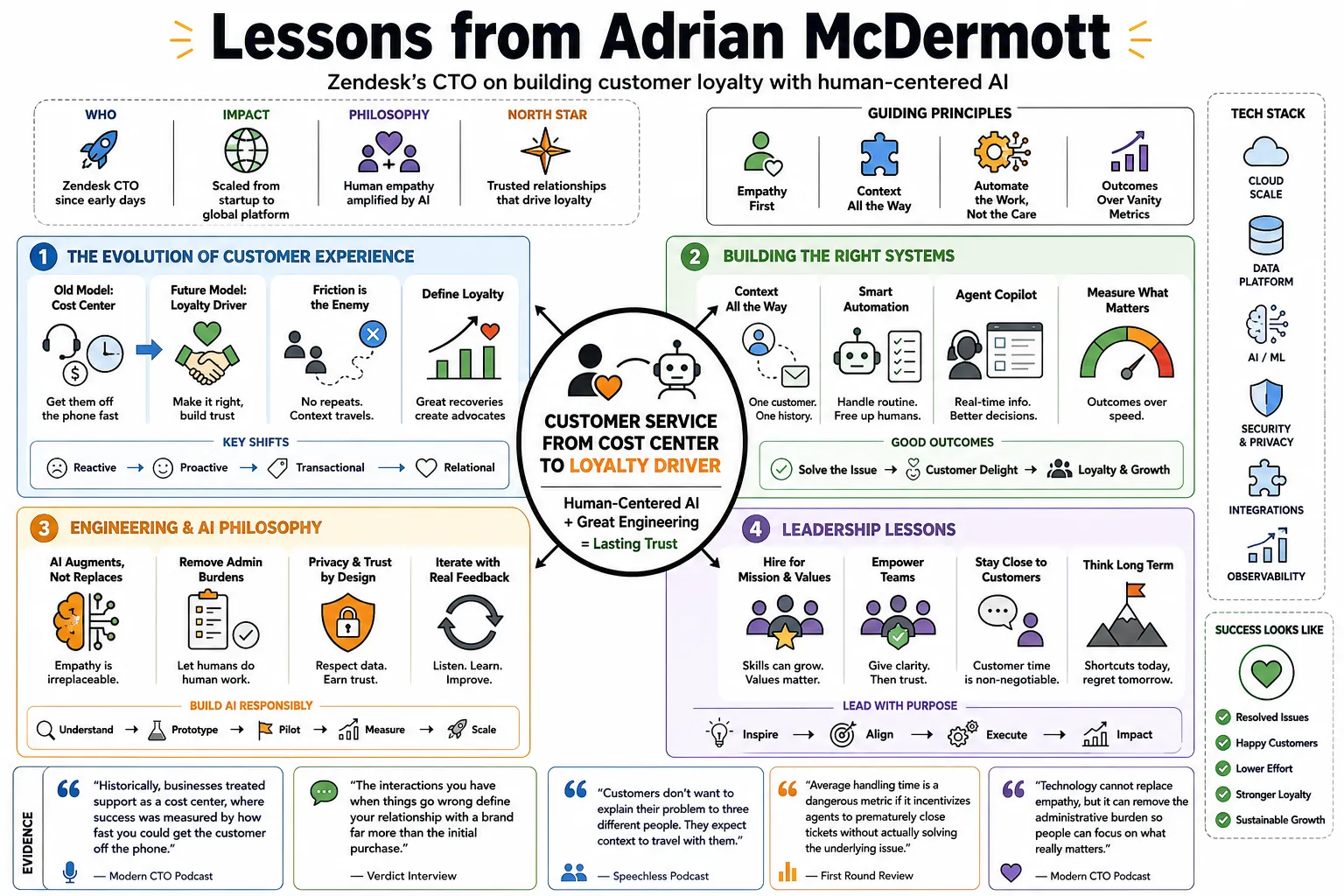
Part 1: The Evolution of Customer Experience
- The old model: McDermott describes customer service as carrying unmet demand, not merely a queue to shrink; automation can help pay down that service debt. — Modern CTO interview.
- Brand loyalty: Bad service can push customers to competitors; effective and personalized support helps a brand earn and retain them. — Zendesk CTO on AI and Service.
- Friction: Repeatedly explaining a problem is a major source of friction, so support systems need to retain customer context. — Modern CTO interview.
- Metrics: Service metrics should reflect customer value, including satisfaction and lifetime value, rather than only activity counts. — Four Big Shifts in Customer Service.
- Empathy: AI can take repetitive work off agents’ plates so people can handle complex issues and deepen customer relationships. — Five CX Resolutions.
- Proactive support: McDermott urges service teams to anticipate issues and prevent repeats instead of waiting for complaints to arrive. — Five CX Resolutions.
- Self-service: Customers increasingly want a direct answer rather than a list of links they must search through themselves. — Zendesk CTO on AI and Service.
- Omni-channel: Conversational service should connect the channels customers already use and preserve context across front- and back-office systems. — Frontier Enterprise interview.
- Agent experience: Giving agents relevant context and recommended solutions helps them resolve requests more quickly. — Purposeful AI Platforms.
- Personalization: Personalization depends on recognizing intent, routing by expertise and carrying relevant customer context into the interaction. — Purposeful AI Platforms.
- Whole-journey handoffs: Evaluate the customer’s journey across touchpoints, not just whether an isolated support interaction closed. — Five CX Resolutions.
Part 2: The Reality of Artificial Intelligence
- Generative models: Generative models let support agents identify a customer’s task and converse beyond rigid rule-based menus. — Modern CTO interview.
- Implementation: For an AI agent to complete a support task, the company’s underlying processes need digital interfaces, not only a more capable model. — Modern CTO interview.
- Trust: Outcome-based AI pricing requires buyers to trust that automation can deliver resolutions and that the vendor shares some risk. — Modern CTO interview.
- Agent assist: A copilot can tee up a relevant answer for a human agent and improve consistency and response speed. — Modern CTO interview.
- Training data: Knowledge coverage and company policy determine how many inquiries an AI answer system can handle reliably. — Modern CTO interview.
- Intent detection: Intent and sentiment models can categorize what a customer needs and route the request to the right expertise. — Purposeful AI Platforms.
- Fine-tuning: Zendesk uses industry-specific interaction patterns and continuing feedback to adapt pretrained models to customer operations. — Purposeful AI Platforms.
Part 3: Scaling Product and Engineering
- Hiring engineers: After interviewing many engineers, McDermott put less weight on credentials and more on how candidates think, collaborate and improve others. — First Round Review interview.
- Technical debt: Engineering leaders need to protect time for refactoring and application health while the business keeps shipping. — First Round Review interview.
- Engineering managers: As teams grow beyond one shared standup, McDermott adds management layers or experienced leaders when the structure needs them. — Modern CTO interview.
- Product-led growth: Early Zendesk taught users a support workflow out of the box; clear defaults made self-service onboarding work. — First Round Review interview.
- System reliability: The service a SaaS customer relies on must stay healthy and dependable while the team adds upgrades and fixes. — First Round Review interview.
- Feature bloat: New initiatives need a distinct investment test, but chasing them must not starve the core product customers pay for today. — First Round Review interview.
- Refactoring: McDermott treats refactoring and operational housekeeping as recurring investments rather than optional work after features ship. — First Round Review interview.
Part 4: Leadership and Culture
- Evangelism: A technology leader should speak with customers and carry the cost of their problems back into engineering decisions. — First Round Review interview.
- Retention: McDermott asks employees what role they want next and sees preparing them for that future as part of management. — First Round Review interview.
- Alignment: Leading both product and engineering helped McDermott connect customer insight with realistic delivery choices. — First Round Review interview.
Part 5: Automation and Service Debt
- Service debt: Service debt is the unmet support people would like to offer; better automation can expose and address that demand. — Modern CTO interview.
- Bad bots: McDermott contrasts older bots that failed to understand customers with AI that can give more seamless help. — Purposeful AI Platforms.
- Human handoffs: When a request reaches a human, routing and shared context should spare the customer from repeating the problem. — Purposeful AI Platforms.
- Automation limits: Automate repetitive tasks such as password resets and order-status checks, leaving people more time for complex problems and relationships. — Five CX Resolutions.
- Customer intent: A model that identifies the customer’s task and follows up conversationally can handle needs that rigid rule-based bots could not. — Modern CTO interview.
- Proactive triggers: Use AI to anticipate issues and fix root causes upstream, rather than waiting for the next ticket. — Five CX Resolutions.
- Measuring success: Measure whether support improves the overall experience and resolves root causes, not just how much activity automation deflects. — Five CX Resolutions.
- Continuous improvement: AI support workflows need versioned changes, outcome measurement and continuing adjustment rather than a set-and-forget launch. — Five CX Resolutions.
- The automation paradox: McDermott argues that easier automated service can increase use by revealing support demand that friction previously suppressed. — Modern CTO interview.
Part 6: Building vs. Buying Software
- Core competencies: McDermott treats build, partner and buy as contextual choices; acquiring specialists can be better than asking a core team to master a new field. — First Round Review interview.
- Platform ecosystems: Zendesk used partners in its ecosystem and later bought expertise when chat became a deeper product commitment. — First Round Review interview.
- API design: APIs give sophisticated customers flexibility for edge cases without forcing complexity on every user. — First Round Review interview.
Part 7: Future of Work and Agentic AI
- Autonomous agents: McDermott expects AI to move from answering questions toward taking actions while blending automated and human service. — Four Big Shifts in Customer Service.
- The agent's role: He expects human specialists to configure, monitor, audit and improve AI service agents. — Five CX Resolutions.
- Seat-based pricing: Zendesk is shifting some AI economics from human seats toward customer resolutions as an outcome metric. — Modern CTO interview.
- Skill shifts: As routine work is automated, support staff can focus more on complex problem-solving and customer relationships. — Five CX Resolutions.
- System integration: Agentic service needs access to digitized processes and APIs to complete tasks across systems. — Modern CTO interview.
- Job displacement: McDermott expects many service jobs to evolve and new AI-operations roles to emerge; he does not promise replacement jobs for everyone. — Five CX Resolutions.
- Collaboration: Human teams will configure, review and continuously improve AI agents rather than leave them unattended. — Five CX Resolutions.
- AI governance: Escalation flows and AI changes should be versioned, reviewed and rolled out thoughtfully against clear outcomes. — Five CX Resolutions.
Part 8: The Role of the Modern CTO
- Technical vision: McDermott now concentrates on strategy, listening to customers and structural choices as Zendesk’s technology leader. — Modern CTO interview.
- Navigating hype: During disruption, McDermott spends more time listening and experimenting before turning AI excitement into strategy. — Modern CTO interview.
- Organizational design: When team size outgrows the current structure, add or change leadership layers rather than assuming the old organization will keep working. — Modern CTO interview.
- Legacy systems: A technical leader has to explain why investing in application health matters to the customers paying for the service. — First Round Review interview.
- The CTO lifecycle: The leadership structure that works for a small team changes as the organization grows into multiple teams and directors. — Modern CTO interview.
- Intellectual honesty: McDermott advises acknowledging organizational mistakes, correcting them and continuing rather than defending a failed structure. — Modern CTO interview.