Arvind Jain is Glean’s founder and CEO and a co-founder of Rubrik. Before Glean, he led engineering teams at Google. Glean builds enterprise search, AI assistance and an agent platform around internal company knowledge. The lessons below cover his product, leadership and enterprise AI approach. — Glean — Arvind Jain.
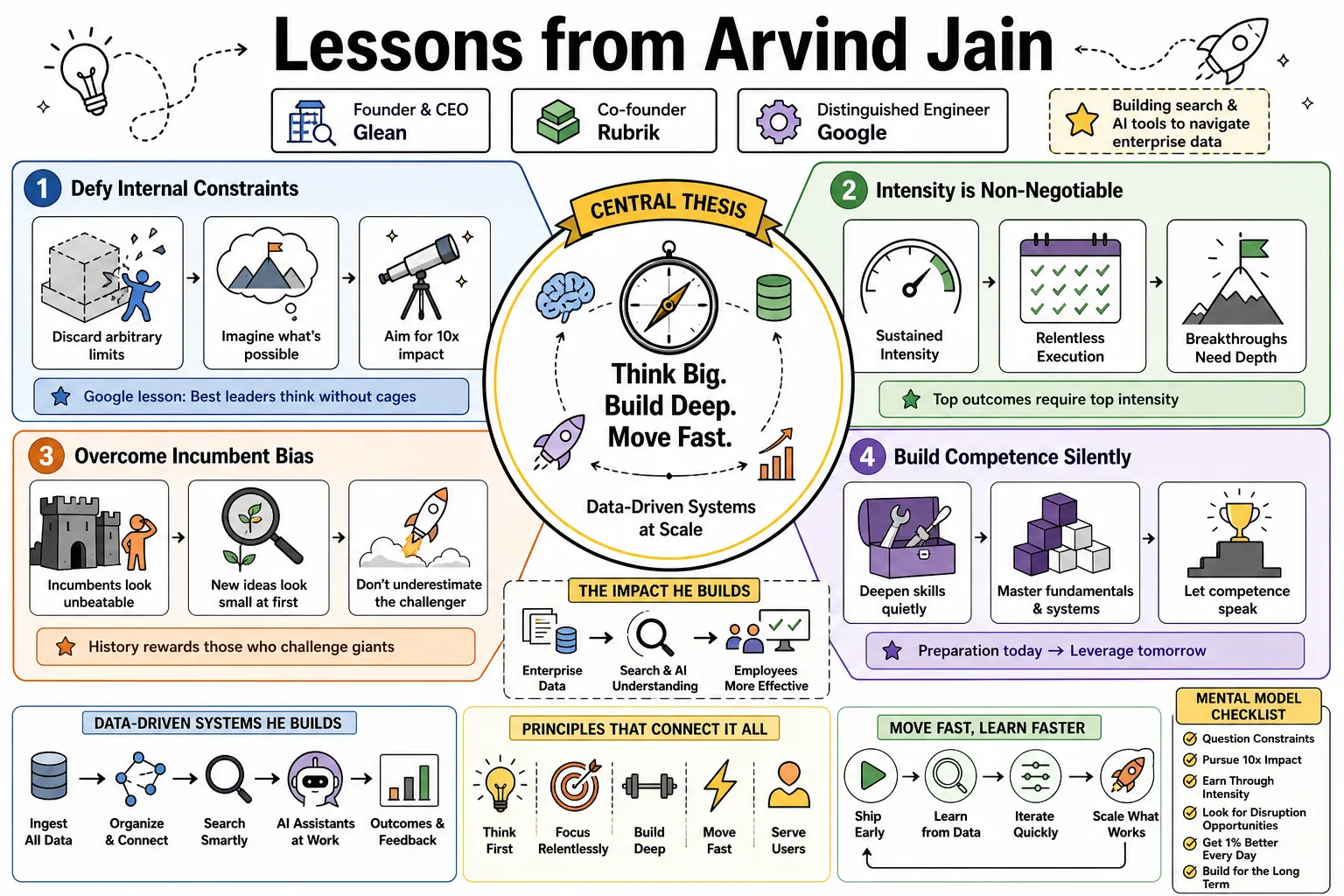
Part 1: The Google Influence & Thinking Big
- On defying internal constraints: Jain learned from Larry Page to explore what a project could achieve before constraining it by budget or immediate profitability. — Goldman Sachs — Transforming Work Productivity with AI.
- On the necessity of intensity: Jain credits sustained effort and the desire to succeed—not technical ability alone—for the progress he saw among talented Google colleagues. — Grit — Arvind Jain and Mamoon Hamid.
- On overcoming incumbent bias: Do not abandon an important problem merely because a large company might tackle it. Jain argues that a focused startup can solve it differently. — Sequoia — Training Data.
- On building competence silently: Glean spent its early years building and refining search with customers before widespread interest in enterprise AI arrived. Quiet periods can give a team room to develop a useful product. — Founders in Arms — Arvind Jain.
Part 2: The Origins of Glean & Identifying Pain Points
- On solving the fragmentation problem: At Rubrik, Jain saw headcount growth outpace productivity while employees struggled to find scattered knowledge. Scaling a team does not by itself remove information bottlenecks. — Mixergy — Building Glean.
- On pain-driven product development: Start with a recurring problem people actually experience. Jain pursued Glean after employees repeatedly complained about finding information and existing products did not meet the need. — Mixergy — Building Glean.
- On early transformer adoption: Jain describes using BERT-based models for semantic search when Glean began in 2019. This helped match questions to meaning rather than relying only on shared keywords. — Gradient Dissent — Arvind Jain.
- On enterprise search failures: Enterprise search requires access to data across systems. Jain explains that standardized SaaS APIs made integrations more practical than the custom data feeds required by older deployments. — Mixergy — Building Glean.
Part 3: The Future of Agentic AI
- On the personal AI team: Jain envisions each employee working with AI assistants, coaches and coworkers. This is his prediction for how work could change, not a claim that such teams already perform every role reliably. — Gradient Dissent — Arvind Jain.
- On proactive companions: Jain’s longer-term vision is an assistant that understands work context and offers help proactively, rather than waiting for a prompt. He describes contextual briefings as an example. — Startup Project — Enterprise AI Agents.
- On the force multiplier effect: Jain describes using AI to assemble current technical explanations from documents, resolved tickets and code changes. His aim is to help employees do more, not simply reduce headcount. — Gradient Dissent — Arvind Jain.
- On utilizing untapped potential: Jain sees substantial room to move beyond answering simple questions into more complex workflows. He also warns that errors can compound across steps and that human assistance remains important. — Sequoia — Training Data.
- On shifting workflows: Jain imagines conversational and voice interfaces that gather context from multiple systems. This could simplify interaction, but he does not establish that specialized business applications will disappear. — Pigment — Solving Enterprise Search with AI.
Part 4: AI Implementation & AI Instinct
- On unlearning old habits: Changing habits takes practice, not just a mandate. Jain describes encouraging employees to complete one meaningful task with AI and celebrating useful experiments. — Startup Project — Enterprise AI Agents.
- On testing for learning mindsets: Jain describes giving candidates work that would be difficult within the interview’s time window without AI, then observing whether they reach for it. The test looks for curiosity and adaptability, not just coding speed. — Pigment — Solving Enterprise Search with AI.
- On leading by example: Jain tries AI first for questions he once sent directly to colleagues, then asks an expert to check uncertain answers. He urges continued experimentation as model capabilities change. — Goldman Sachs — Transforming Work Productivity with AI.
- On fine-tuning versus out-of-the-box: Use external foundation models for generation and reasoning where they suffice. Jain reserves custom training for retrieval and fine-tuning for narrow tasks where smaller models can be faster or cheaper. — Gradient Dissent — Arvind Jain.
Part 5: Trust and Data Context in the Enterprise
- On the trust moat: Jain emphasizes customer trust and useful experiences over relying on a fixed technology moat. Enterprise data belongs to customers, and technology can become obsolete. — Pigment — Solving Enterprise Search with AI.
- On context as a prerequisite: An assistant answering company-specific questions needs company-specific knowledge. Jain’s distinction is access to internal context, not that general-purpose AI has no corporate uses. — Gradient Dissent — Arvind Jain.
- On suppressing hallucinations: Ground answers in retrieved information and check whether claims are supported by that input. Jain describes citations and suppressing unsupported output, while acknowledging that errors still occur. — Gradient Dissent — Arvind Jain.
- On human escalation: When the system cannot answer, Jain describes directing users to people who work on the topic. He also sees agents asking humans for information as a plausible future workflow, not flawless automatic escalation. — Gradient Dissent — Arvind Jain.
- On strict permissions: Carry source permissions into retrieval so answers use information the signed-in user may access. Jain also warns that custom model training needs care to avoid leaking restricted information. — Gradient Dissent — Arvind Jain.
Part 6: Leadership and Scaling
- On hands-off management: Delegation depends on earned trust. Jain describes stepping back as leaders repeatedly demonstrate sound judgment and attention to detail, rather than trying to solve every problem himself. — Alisa Cohn — From Start-Up to Grown-Up.
- On the necessity of self-reflection: Jain periodically questions whether his leadership still fits the company’s next stage. He uses that reflection to identify a specific behavior to change, rather than a long list of intentions. — Alisa Cohn — From Start-Up to Grown-Up.
- On avoiding leadership bottlenecks: Stay informed without making every product decision depend on the founder. Jain describes letting teams experiment and users determine what works, while using internal updates to follow progress. — Founders in Arms — Arvind Jain.
- On hiring for desire: Look for technical capability alongside a genuine desire to succeed and work on the problem. Jain asks why candidates care about Glean’s mission and what they hope to learn. — Alisa Cohn — From Start-Up to Grown-Up.
- On valuing ownership over credentials: Prestigious credentials alone do not explain performance. Jain says hard work and drive distinguished people he observed at Google; the interview does not establish a universal ranking of all hiring signals. — Grit — Arvind Jain and Mamoon Hamid.
- On transitioning to CEO: Becoming CEO required Jain to learn beyond engineering: selling, understanding other functions and adapting to different working styles. He describes that learning as ongoing. — Alisa Cohn — From Start-Up to Grown-Up.
Part 7: Product Development & Business Metrics
- On tracking AI success: Usage shows adoption, not necessarily business value. Jain recommends measuring changes in existing operating metrics, such as support response time and ticket resolution, rather than inventing an AI-only success measure. — Pigment — Solving Enterprise Search with AI.
- On speed as survival: Jain treats speed as essential in a changing market. He describes rewarding teams for discarding and rebuilding technology when a better approach becomes available. — Pigment — Solving Enterprise Search with AI.
- On monthly planning cycles: Jain describes moving from quarterly to monthly product planning so the team can reconsider priorities and technology as capabilities change. This is Glean’s approach, not a universal planning rule. — Pigment — Solving Enterprise Search with AI.
- On solving real problems first: Begin with a business problem and use AI to solve it better. Jain does not regard an AI label as a substitute for a useful product. — Sequoia — Training Data.
- On product-led growth: Jain wanted a product-led approach, but Glean needed company-wide data connections and security approval. Its deployment model required working with IT rather than asking individual employees to connect every system. — Grit — Arvind Jain and Mamoon Hamid.
- On natural evolution versus pivoting: Jain describes Glean’s move from retrieving documents to synthesizing answers as a continuation of its original purpose, enabled by stronger models—not a change to an unrelated problem. — Founders in Arms — Arvind Jain.
Part 8: The Role of Sales and Customer Collaboration
- On technical founders learning sales: Technical founders still need to learn selling. Jain describes learning to earn customers’ attention and connect their problems to the product, rather than expecting engineering quality to sell itself. — Alisa Cohn — From Start-Up to Grown-Up.
- On close customer collaboration: Work with customers before broad rollout. Jain describes validating the problem, learning which applications customers used, prioritizing integrations and letting a small group test the product. — Mixergy — Building Glean.
- On honest positioning: Separate what the product does today from the future vision. Jain prefers conservative promises because a failed deployment can damage trust and leave little chance to recover. — Founders in Arms — Arvind Jain.
- On knowing when to say no: A founder cannot fix every issue. Jain describes focusing with his executive team on the most important priorities and resisting involvement in less consequential details. — Alisa Cohn — From Start-Up to Grown-Up.
- On ignoring the hype cycle: Judge AI enthusiasm by practical demand and usefulness. Jain found the surge in interest helpful because Glean already had a working product, but that interest did not remove the need to keep improving it. — Founders in Arms — Arvind Jain.
- On making tools sticky: Integrations are only part of usefulness: the system must learn which information matters and deliver value with little setup burden for employees. Jain emphasizes an effective experience from initial deployment. — Mixergy — Building Glean.
Part 9: Agent Architecture, Context, and Operating Discipline
- On personalization as the core ranking problem: Enterprise relevance depends on the person asking. Jain’s onboarding-guide example shows why role, team and permissions must influence which information is returned. — Sequoia — Training Data.
- On knowledge graphs as AI infrastructure: Jain describes mapping people, roles, documents and their relationships to identify relevant knowledge. A collection of documents alone does not provide that organizational context. — Sequoia — Training Data.
- On RAG as a product foundation: Useful RAG needs dependable retrieval, permissions and ranking—not just a vector-search demo. Jain stresses that retrieval errors and stale information can undermine the generated answer. — Sequoia — Training Data.
- On stale-data judgment: Do not simply blame customers for messy data. Jain argues that enterprise AI should distinguish fresh, authoritative information from obsolete material, much as a careful human would. — Startup Project — Enterprise AI Agents.
- On agents needing actions, not just answers: Agents need both information and the ability to act across enterprise systems. Jain makes governance and access control part of those integrations, rather than treating actions as unrestricted. — Startup Project — Enterprise AI Agents.
- On review loops for outbound work: In Jain’s prospecting example, AI researches accounts and drafts outreach, then salespeople review its work before messages go out. Faster preparation does not remove the review step. — Startup Project — Enterprise AI Agents.
- On proactive trigger-based agents: Agents can run on schedules or when specified conditions occur. Jain distinguishes those workflows from his broader future vision of a companion that anticipates needs throughout the day. — Startup Project — Enterprise AI Agents.
- On hard problems as a startup advantage: Difficulty is not enough: the problem must be useful to solve and fit the team’s strengths. Jain sees technically demanding, broadly valuable problems as opportunities for lasting differentiation. — Startup Project — Enterprise AI Agents.
- On avoiding monolithic AI platforms: Jain favors an open stack rather than a single vendor doing every layer. Context, models, orchestration and interfaces should remain interoperable as they evolve. — Glean — The Emerging Agent Architecture.
- On context as enterprise IP: Separate organizational context from the model layer so changing models or vendors does not require rebuilding accumulated knowledge and workflow understanding. — Glean — The Emerging Agent Architecture.
- On choosing models by task: Choose models for the task rather than committing to one provider for everything. Jain describes different choices for coding, research, image generation and lightweight routing. — Glean — The Emerging Agent Architecture.
- On the context-orchestration feedback loop: Context should guide orchestration, while execution traces and feedback improve the context available to subsequent runs. Jain presents this as a foundation for dependable automation. — Glean — The Emerging Agent Architecture.
- On unified security defaults: Use consistent security foundations across search, RAG, agents and code generation. Jain emphasizes identity, encryption, data isolation and preventing unauthorized actions rather than separate policies for each tool. — Glean — The Emerging Agent Architecture.
- On interfaces beyond chat: Jain reports stronger adoption when agents appear inside applications employees already use. He expects specialized interfaces alongside chat, built on shared context and security. — Glean — The Emerging Agent Architecture.
- On treating agents like software: Treat agents as software systems: define the business opportunity and scope, establish metrics, supply permission-aware context, develop and test, launch carefully, then monitor and improve. — Glean — Agent Development Lifecycle.
- On portfolio-level agent ROI: Evaluate agent programs as portfolios with clear ownership, risk and business outcomes. Jain advocates repeatable operating standards rather than disconnected pilots whose combined value is unclear. — Glean — Agent Development Lifecycle.