Performance psychologist Gio Valiante has coached top PGA Tour golfers and served as head performance coach at Point72 Asset Management. His primary framework separates a "mastery orientation" from an "ego orientation" to help high performers beat the fear of humiliation that limits their ability. This profile gathers his core ideas on building resilience, designing better environments, and executing under pressure without freezing up over outcomes.
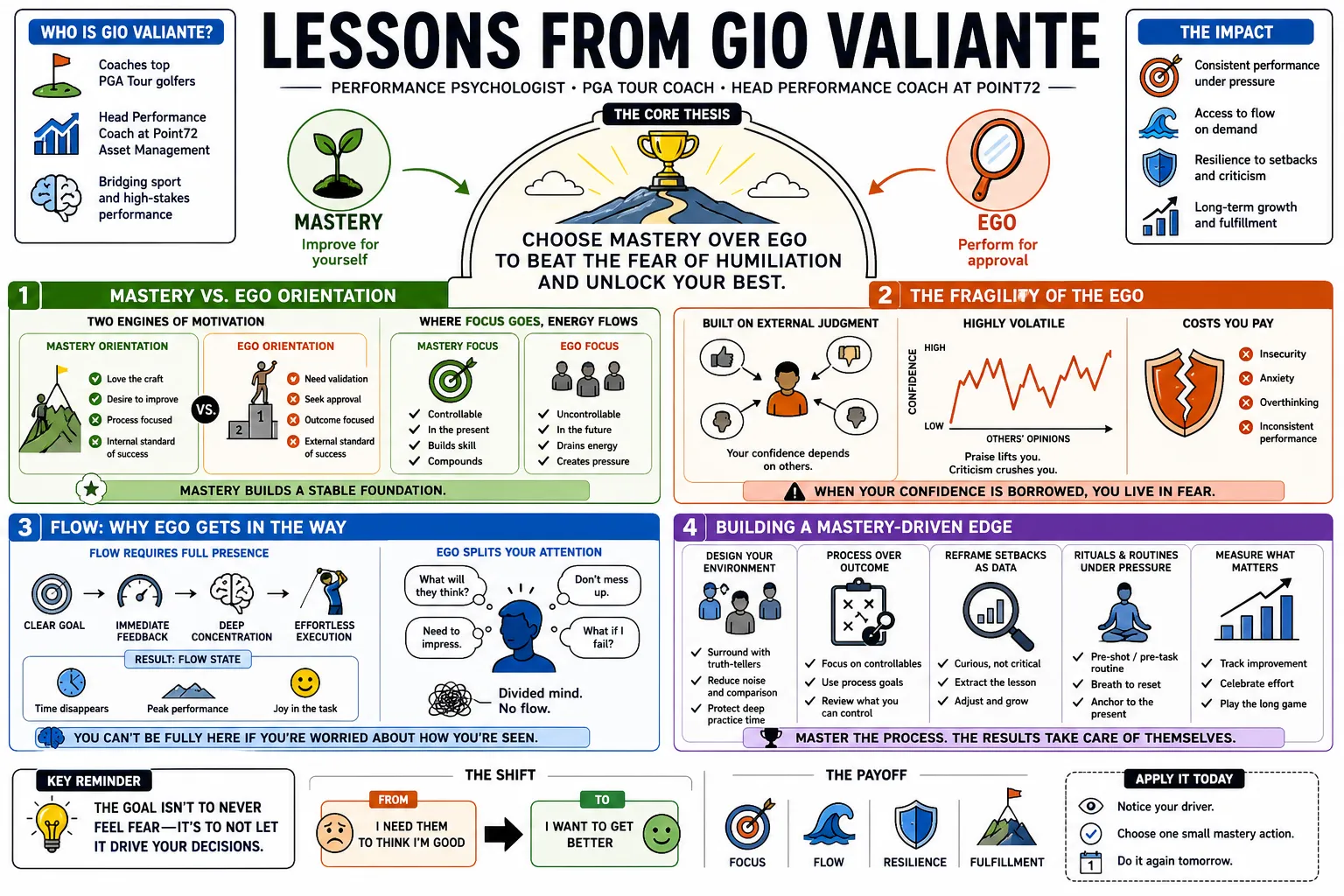
Part 1: Mastery vs. Ego Orientation
- On the two engines of motivation: Performers are generally driven by either a mastery orientation (a love for the craft and a desire to improve) or an ego orientation (a need for external validation and peer approval). — Reference: The Knowledge Project
- On the fragility of the ego: When your primary motivation is avoiding embarrassment or seeking praise, your confidence becomes unstable because it relies entirely on the social judgment of others rather than your own baseline of skill. — Reference: Fearless Golf
- On achieving flow: An ego-driven mindset makes entering a state of flow nearly impossible, as you cannot be fully immersed in the present task if part of your brain is worried about how you are being perceived. — Reference: Josh Nichols Podcast
- On protecting the craft: A mastery mindset protects the purity of the work. You engage deeply with the process regardless of external rewards, creating a durable foundation for long-term success. — Reference: The Meb Faber Show
- On separating worth from performance: Individuals focused on mastery do not link their fundamental human value to their professional outcomes, allowing them to take necessary risks without existential dread. — Reference: The Knowledge Project
- On the pitfalls of perfectionism: Ego orientation often breeds perfectionism, which is essentially an avoidance strategy masked as high standards, preventing performers from exposing their inevitable flaws. — Reference: Fearless Golf
- On intrinsic curiosity: True mastery is fueled by a profound curiosity to understand the nuances of a discipline, transforming grueling practice sessions into engaging problem-solving exercises. — Reference: Gio Valiante Results
Part 2: Process Over Outcome
- On detaching from results: The most consistent performers focus entirely on the execution of their specific plan in the moment, purposefully stripping away any thoughts about the ultimate score or financial return. — Reference: The Meb Faber Show
- On eliminating doubt: When you are completely committed to a detailed, well-thought-out process, there is no mental space left for fear or second-guessing. — Reference: Fearless Golf
- On living into a pattern: Adopting a process-oriented mindset isn't an overnight switch; it requires small, consistent behavioral changes that slowly recalibrate how you relate to pressure and expectations. — Reference: The Knowledge Project
- On the illusion of control: Fixating on outcomes is counterproductive because results often hinge on variables outside your control, whereas your process and preparation remain entirely within your grasp. — Reference: The Meb Faber Show
- On trusting the math: Over a long enough time horizon, a rigorously applied process will yield positive results, provided you do not abandon your system at the first sign of short-term variance. — Reference: Business Insider
- On staying in the present: Outcome thinking drags your mind into the future, but high performance can only occur when your attention is anchored firmly in the immediate, observable present. — Reference: Fearless Golf
- On evaluating decisions: A good outcome does not justify a poor process, just as a bad outcome does not invalidate a solid process; performers must review their execution rather than just the final scoreboard. — Reference: Institutional Investor
Part 3: The Anatomy of Fear
- On fear as physical tension: Fear--whether it is the fear of a bad golf shot or a losing trade--manifests physically as tension, which ruins rhythm and temporarily turns a highly skilled individual into an incompetent one. — Reference: Fearless Golf
- On the central governor: The human brain operates with a built-in protective mechanism that attempts to shut down performance early to save us from perceived psychological or physical failure. — Reference: The Knowledge Project
- On reframing arousal: Elite performers do not eliminate fear; instead, they learn to interpret the physical symptoms of anxiety--like an elevated heart rate--as a sign of readiness and excitement rather than impending doom. — Reference: Fearless Golf
- On the biological cost of stress: Sustained psychological fear releases stress hormones that degrade cognitive function over time, making it critical to find periods of total mental recovery. — Reference: The Knowledge Project
- On identifying triggers: Managing fear starts with aggressively mapping out the exact scenarios that trigger your anxiety, bringing unconscious physiological responses into conscious awareness. — Reference: Josh Nichols Podcast
- On shrinking the threat: When facing a daunting challenge, the mind tends to catastrophize; effective coaching helps performers scale down the perceived threat to match the actual reality of the situation. — Reference: Gio Valiante Results
- On breathing through panic: Because fear hijacking begins in the body, taking deliberate control of your respiratory rate is the fastest way to signal safety back to a panicking brain. — Reference: Fearless Golf
Part 4: Environment and Habit
- On the limits of willpower: Trying to change your behavior through sheer willpower is often a losing battle. A much more effective strategy is to redesign your environment so that the desired behaviors become the default. — Reference: The Knowledge Project
- On the output of life: A successful career is rarely the result of raw talent alone; it is the lagging indicator of repeated, highly disciplined daily habits. — Reference: The Knowledge Project
- On social surroundings: The systems and people you surround yourself with dictate your baseline performance far more than internal psychological traits that you actively try to fix. — Reference: The Knowledge Project
- On designing friction: To break destructive habits in high-stress environments, you must introduce deliberate friction between the urge to act and the execution of the poor choice. — Reference: Business Insider
- On automated discipline: High performers offload as many routine decisions as possible into automated habits, preserving their limited cognitive bandwidth for moments of intense pressure. — Reference: The Meb Faber Show
- On cultural contagion: Mindsets are highly contagious; immersing yourself in a culture that rewards intellectual honesty and mastery will naturally elevate your own standards over time. — Reference: Institutional Investor
- On systemic recovery: True endurance requires building rest and psychological detachment into your daily schedule as non-negotiable habits, rather than waiting until burnout forces a pause. — Reference: The Knowledge Project
Part 5: Mistakes as Feedback
- On neutralizing bad outcomes: Instead of treating a poor shot or a bad trade as an indictment of your self-worth, treat it as neutral, analytical feedback to prevent a single error from causing an emotional spiral. — Reference: Fearless Golf
- On self-punishment: The brain should not punish itself for mistakes. High performers learn to catch cognitive errors early and adjust without lingering on the psychological pain of the misstep. — Reference: Business Insider
- On the necessity of failure: Embracing a fearless process means accepting that calculated risks will sometimes fail, and you must design a mental system that allows you to absorb those failures without being crippled by them. — Reference: The Meb Faber Show
- On rapid resets: The hallmark of a professional is the speed at which they can process a mistake, extract the necessary lesson, and wipe the emotional slate clean for the very next action. — Reference: Gio Valiante Results
- On removing the sting of critique: When you operate with a mastery orientation, critical feedback is no longer perceived as a personal attack but rather as a highly valued tool for accelerated improvement. — Reference: The Knowledge Project
- On avoiding the sunk cost trap: Refusing to admit a mistake often leads to compounding errors; accepting the initial loss swiftly protects you from the devastating consequences of trying to prove yourself right. — Reference: Institutional Investor
- On post-event debriefs: Implementing a structured, objective review process after a performance helps separate the emotional experience of a failure from the mechanical breakdown that actually caused it. — Reference: The Meb Faber Show
Part 6: Building True Confidence
- On self-efficacy: True confidence is not just a vague feeling of greatness; it is self-efficacy--the specific, earned belief in your ability to execute a particular task based on evidence and training. — Reference: Fearless Golf
- On the danger of arrogance: While successful people often possess high levels of confidence, it must be paired with extreme self-awareness. When performers believe they have all the answers, the market or the game will eventually punish them. — Reference: Business Insider
- On the trust mindset: Deliberate practice is meant to build a "trust mindset" where, under pressure, you can let go of mechanical, conscious thoughts and allow your trained body to simply execute. — Reference: Fearless Golf
- On earning your swagger: Unshakable confidence cannot be hacked or affirmed into existence; it is forged strictly through hours of rigorous, highly specific preparation that leaves no stone unturned. — Reference: The Meb Faber Show
- On navigating slumps: During periods of underperformance, true confidence relies on scaling back to the fundamentals and trusting that historical competence will eventually override a temporary dip in form. — Reference: The Knowledge Project
- On managing expectations: False confidence often stems from unrealistic expectations, whereas authentic confidence is grounded in a highly accurate assessment of your current capabilities and limitations. — Reference: The Meb Faber Show
- On projecting certainty: While inner doubt is natural, learning to outwardly project physical certainty and strong body language can create a biofeedback loop that gradually convinces the mind to settle down. — Reference: Josh Nichols Podcast
Part 7: Focus and Routine
- On pre-shot routines: A consistent routine before execution acts as a mental anchor. It forces you to stay present and bridges the gap between active thinking and trusting your physical capability. — Reference: Fearless Golf
- On quiet eyes: Maintaining a calm, steady physical gaze on a target helps quiet the mind. It prevents your focus from wandering into fearful, hypothetical scenarios about what might go wrong. — Reference: Fearless Golf
- On making adjustments: The best performers actively make small adjustments based on immediate feedback, using their routine to reset their emotional baseline before the next attempt. — Reference: The Meb Faber Show
- On sensory filtering: In high-stakes environments, the ability to selectively filter out irrelevant noise and narrow your sensory focus onto only the variables that matter is a critical competitive advantage. — Reference: The Knowledge Project
- On bridging the transition: A well-rehearsed routine serves as a psychological bridge, taking a performer from a state of analytical preparation into an intuitive state of fluid execution. — Reference: Gio Valiante Results
- On temporal boundaries: Routines create strict temporal boundaries, ensuring that past failures or future anxieties cannot bleed into the sacred space of the immediate performance window. — Reference: The Knowledge Project
- On the rhythm of performance: Elite execution relies heavily on rhythm; disrupting your established routine introduces erratic timing that can unravel even the most sophisticated mechanical skills. — Reference: Fearless Golf
Part 8: High-Stakes Parallels
- On investors and athletes: Whether you are managing billions of dollars or standing over a putt to win a major championship, the psychological stressors--fear, impatience, and the urge to force an outcome--are remarkably similar. — Reference: The Meb Faber Show
- On market drawdowns: Empathy and emotional steadiness are critical during market drawdowns. Without a structured mental game, portfolio managers are highly susceptible to cognitive biases and revenge trading. — Reference: Institutional Investor
- On intellectual honesty: A culture of high performance requires intellectual honesty--critiquing your own investment thesis to identify biases rather than stubbornly defending a losing position to protect your ego. — Reference: The Meb Faber Show
- On managing the streak: Whether riding a hot hand on the course or a massive winning streak in the markets, maintaining a process-driven humility is the only way to prevent success from breeding catastrophic complacency. — Reference: Business Insider
- On the illusion of action: In both trading and golf, doing nothing is often the hardest yet most profitable decision; fighting the urge to act simply out of boredom or anxiety separates amateurs from professionals. — Reference: Institutional Investor
- On enduring scrutiny: Top performers in both arenas must develop a thick skin against public and institutional scrutiny, recognizing that external opinions have no bearing on the underlying math of their strategy. — Reference: The Meb Faber Show