Amanda Kahlow founded 6sense, which later grew beyond $100 million in annual revenue. She stepped aside as CEO in early 2020 and returned to startup work with 1mind in late 2023. In these interviews, she discusses fundraising, enterprise sales and her vision for AI-led buyer conversations. — Product Market Fit Show.
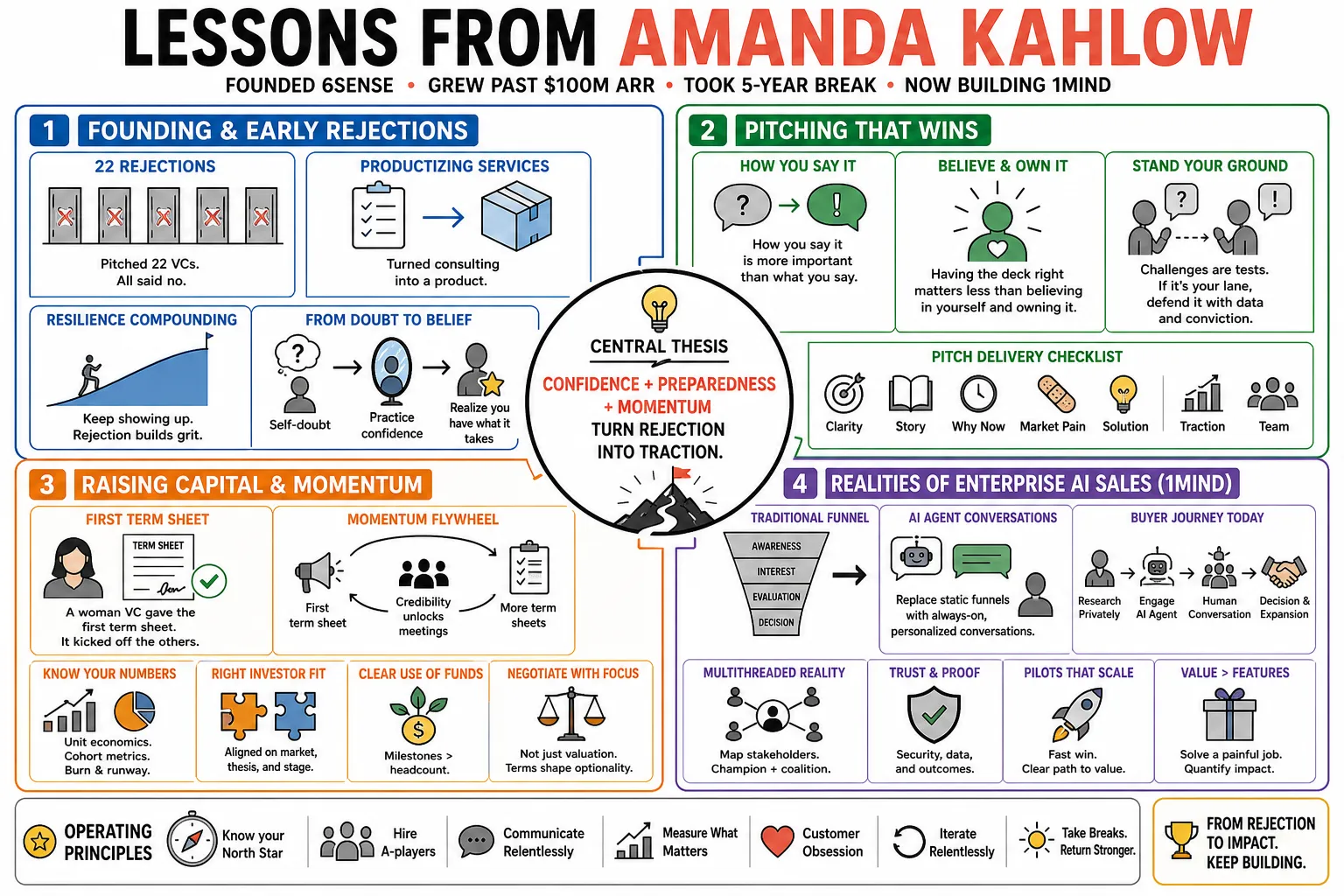
Part 1: Founding, Pitching, and Raising Capital
- Why the VC Meetings Stalled: After more than 60 investor meetings and 22 all-partner meetings, Kahlow learned that services revenue alone was not enough: investors wanted a credible technical founding team and a product. Adding technical cofounders brought multiple term sheets. — Product Market Fit Show.
- Check the Fundraising Boxes: Kahlow says that strong customer demand did not compensate for missing product and technical-founder credentials when she sought venture financing for 6sense. — Product Market Fit Show.
- Confidence in the Pitch: Kahlow attributes some early fundraising difficulty to self-doubt and says deliberate confidence changed how she presented herself to investors; her later account also identifies the missing technical team as a concrete obstacle. — Write2Market Interview.
- The First Term Sheet: Kahlow recalls that a woman VC offered the first 6sense term sheet; although she did not take it, that offer helped catalyze others. — Write2Market Interview.
- How the Pitch Lands: Kahlow emphasizes delivery and confidence as well as content when presenting to investors. — Write2Market Interview.
- Believe Beyond the Deck: Her fundraising advice is to own the business and believe in it rather than treating slide polish as the decisive factor. — Write2Market Interview.
- Handle Investor Challenges: When an investor questions market focus, Kahlow advises founders to explain the reasoning behind their own position instead of reflexively changing it to please the investor. — Write2Market Interview.
- Slow the Pitch: Kahlow advises founders to speak more slowly and make fewer leaps between ideas so investors can follow the argument. — Write2Market Interview.
- Pitch with the Product: For 1mind’s Series A, Kahlow sent an AI version of herself equipped with her deck and supporting materials to roughly 60 selected VCs; she says it reached a term sheet within three days. — Product Market Fit Show.
Part 2: Rethinking Go-To-Market and AI Superhumans
- From Caregiver Technology to Sales: Kahlow says a lab had built AI caregiver technology for people with dementia, which resonated after her mother died from the disease; she then proposed applying the technology to B2B sales. — AI’ve Got Questions.
- Start from the Conversation: Rather than add AI to every layer of the existing sales process, Kahlow asked what B2B buying would look like if designed anew around the buyer conversation. — AI’ve Got Questions.
- Buying Happens in Conversation: Kahlow’s 1mind thesis puts the live buyer–seller conversation ahead of tools that merely summarize, forecast, or support it afterward. — AI’ve Got Questions.
- Collapse the Sales Handoffs: She envisions one AI-led interaction spanning qualification, account-executive work, technical questions, and customer handoff, rather than serial transfers between roles. This is her product vision, not a claim that all those roles have disappeared. — Product Market Fit Show.
- Specialized Agents Behind One Persona: Topline reports Kahlow describing roughly 15 backend agents behind a single 1mind persona, including agents for small talk, demos, and slides. — Topline Podcast.
- The Face Is Optional: Kahlow says 1mind drops the animated face on live calls when it distracts from the conversational product. — Topline Podcast.
- Prioritize the Buying Experience: In a Topline interview, Kahlow argues that improving the buyer experience should be the test for product choices, rather than pursuing internal efficiency alone. — Topline Podcast.
- Engage the Visitor in the Moment: Kahlow wants an immediate substantive conversation for website visitors who otherwise encounter forms or basic chatbots and leave. — AI’ve Got Questions.
Part 3: The Changing Role of Human Salespeople
- A Forecast, Not a Settled Future: Kahlow predicts substantial disruption to human seller roles. Treat that as her forecast, not an established outcome. — Topline Podcast.
- Her Prediction About Buyer Preference: Kahlow predicts that some buyers will prefer an AI interaction if it provides faster, more accurate and empathetic answers; the preference is a forecast, not a measured general fact. — Topline Podcast.
- Acknowledge Job Displacement: Kahlow says AI will replace some jobs and argues for candid discussion and reskilling rather than assurances that every existing sales role is safe. — AI’ve Got Questions.
- Trust Drives the Deal: In Kahlow’s enterprise-meeting example, she presents buyer trust in the quality of answers—not whether the seller is human—as central to a sale. — Topline Podcast.
- Correctability as a Selling Point: Kahlow argues that an AI agent can be updated after an error, while also acknowledging that people scrutinize AI mistakes closely; this is her claim, not a guarantee that errors never recur. — AI’ve Got Questions.
- Let the AI Handle Technical Depth: Kahlow recounts an enterprise meeting where executives directed technical questions to her AI assistant Nigel; the hosts report a resulting deal. This is one anecdote, not a general performance benchmark. — Topline Podcast.
- Patience and Qualification: Kahlow describes the AI agent as able to answer repeated questions and ask about budget, timing, and decision makers without the time pressure of a human representative. — AI’ve Got Questions.
- Reskill for Emerging Work: Kahlow gives an example of a data scientist moving into prompt engineering at 1mind and argues that AI displacement will require adaptation. It does not establish that prompt-engineering jobs will grow indefinitely. — AI’ve Got Questions.
Part 4: Leadership, Resilience, and Identity
- A Mission to Empower Women: Kahlow describes empowering women and girls as part of her personal mission and connects it to her entrepreneurial work. — AI’ve Got Questions.
- Space for Motherhood: After stepping aside from 6sense in early 2020, Kahlow spent several years focused on family before starting 1mind in late 2023; her Sales Talk appearance also discusses IVF and adoption. — Sales Talk for CEOs.
- Release the Need for Control: Kahlow says she learned to let go of outcomes she could not control and to notice where tension signaled a need for perspective. — Write2Market Interview.
- Pair Conviction with Self-Correction: Kahlow urges founders to use their judgment rather than follow generic advice blindly, but says her old tendency to assume she was right made her underuse investor input; she now deliberately asks what she got wrong. — Product Market Fit Show.
- Test Board Fit Early: Kahlow advises treating prospective investors as potential board partners during fundraising, so founders can evaluate the working relationship as well as the term sheet. — Write2Market Interview.
Part 5: Strategy, Speed, and Execution
- Speed with Customer Obsession: Kahlow describes speed, execution and close attention to customer outcomes as advantages in an AI market where product building has become easier. — Product Market Fit Show.
- Ask What Was Wrong: Kahlow says she now asks herself what she got wrong, countering her earlier tendency to insist she was right. — Product Market Fit Show.
- Start with Enterprise Problems: Kahlow says she began both 6sense and 1mind with large enterprise customers, despite advice to start smaller, because she knew that market and wanted to solve its hard problems first. — Product Market Fit Show.
- Redesign from the Top: Kahlow argues that executive-led redesign of organizational workflows can produce more value from AI than asking each employee to use it only for incremental personal efficiency. — Topline Podcast.
- Look Beyond Seller Dashboards: Kahlow criticizes AI features that only improve forecasting and dashboards while leaving the buyer conversation unchanged; she wants revenue teams to address the interaction itself. — Topline Podcast.
- Read Behavioral Buying Signals: Before 6sense, Kahlow observed that resemblance to a past customer was not evidence that another account was ready to buy; she built around patterns of buying behavior instead. — Product Market Fit Show.