John Wooden coached UCLA men's basketball to 10 NCAA championships in his final 12 seasons. He also developed the Pyramid of Success and taught that success should be judged by the effort to reach one's own potential, not only by a game result. — Academy of Achievement Interview.
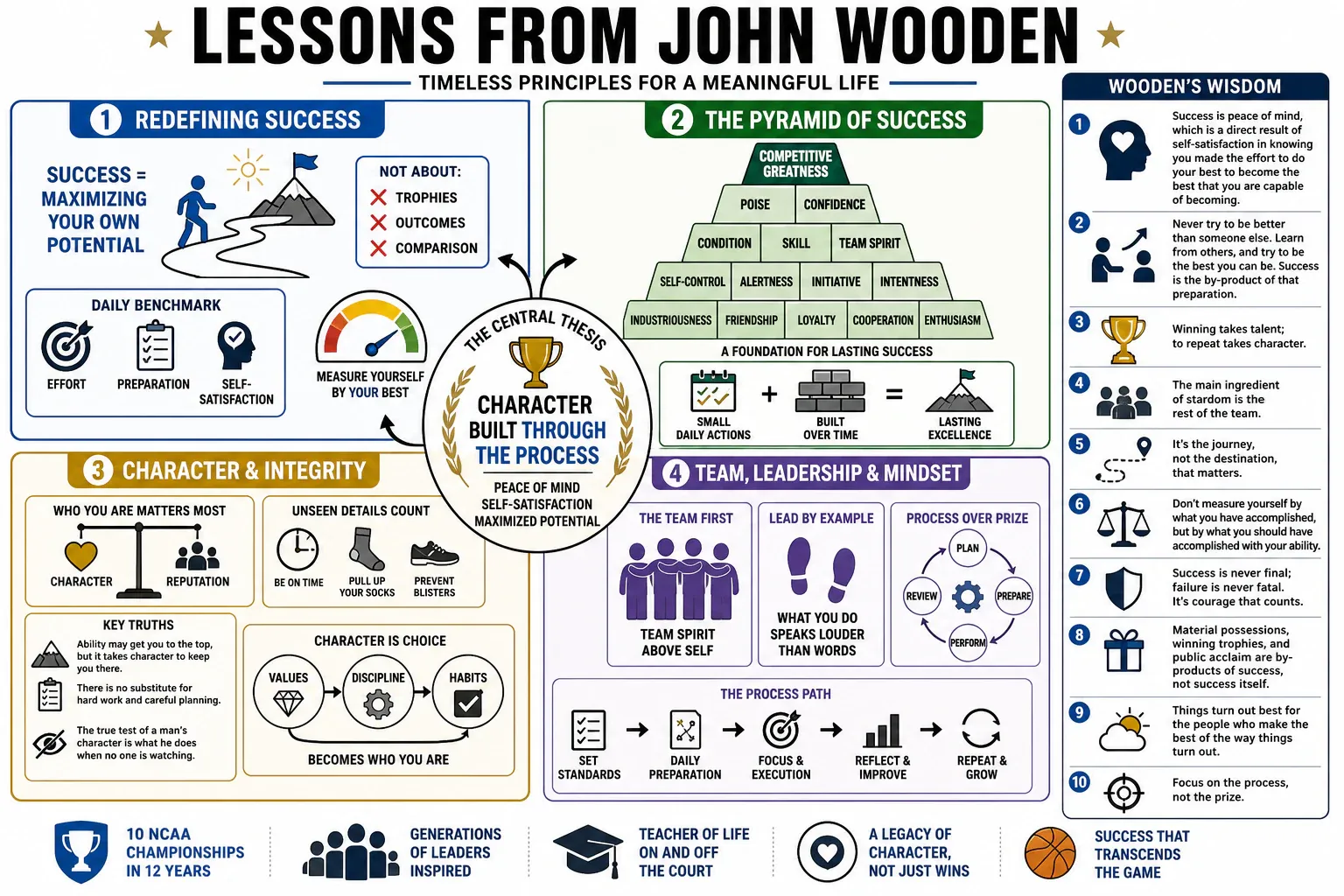
On the Definition of Success
Wooden rejected winning percentage as a sufficient measure of success. In his definition, success depended on making the best effort possible with one's own abilities rather than comparing oneself with others. — Academy of Achievement Interview.
Lessons:
- Wooden defined success as the peace of mind that comes from making one's best effort to reach one's own capability. — Academy of Achievement Interview.
- Wooden urged people not to measure themselves against others. He taught them to learn from others while continuing to make the most of their own abilities. — Academy of Achievement Interview.
- Wooden treated character and self-control as essential to sustained achievement, not just ability to reach a high level. — Wooden's Pyramid of Success.
- Wooden prized a player who helped make the team great over a talented player who pursued individual glory. — Wooden's Pyramid of Success.
- Wooden valued the struggle and improvement along the way, not only the final result. — Academy of Achievement Interview.
- Wooden judged effort against each person's ability, rather than by accomplishments or comparison with others. — Academy of Achievement Interview.
- Wooden saw persistence through a difficult path as part of achievement; a past success or failure did not replace continued effort. — Wooden's Pyramid of Success.
- For Wooden, trophies and material rewards were not sufficient measures of success; he judged success by whether a person had made their best effort. — Academy of Achievement Interview.
- Wooden emphasized responding constructively to circumstances and doing the best possible under the conditions that exist. — Academy of Achievement Interview.
- Wooden concentrated on preparation and daily improvement rather than treating the final score as the sole measure of success. — UCLA Magazine Interview.
On Character and Integrity
Wooden linked character to self-control and taught players to attend to small habits. In a direct interview, he described details as practical and ethical: putting on socks properly to prevent blisters, showing courtesy, and taking responsibility for mistakes. — Academy of Achievement Interview.
Lessons:
- Wooden distinguished character—what a person actually is—from reputation, which depends on what others think. — UCLA Magazine Interview.
- Wooden argued that character matters alongside ability, especially in continuing to perform well after reaching a high level. — Academy of Achievement Interview.
- Wooden placed very hard work at the foundation of achievement and paired it with thoughtful preparation. — Wooden's Pyramid of Success.
- Wooden kept his father's creed close, including the instructions to be true to himself and make each day his masterpiece. — Academy of Achievement Interview.
- Wooden treated players as students and people first; he wanted his coaching to benefit them beyond their athletic years. — Academy of Achievement Interview.
- Wooden valued good values in the people around him and taught that a team's conduct mattered along with talent. — Academy of Achievement Interview.
- Wooden followed his father's rule against lying, cheating, and stealing. — Academy of Achievement Interview.
- "It's what you learn after you know it all that counts." — Wooden's Pyramid of Success.
On Teamwork and Coaching
Wooden placed team spirit above individual glory: he sought players willing to sacrifice for the group's welfare and leaders who shared ideas and responsibilities. His coaching also required care for players as people beyond the court. — Wooden's Pyramid of Success.
Lessons:
- Wooden sought players who made the team better, not merely individuals who could display their own talent. — Wooden's Pyramid of Success.
- Wooden expected coaches to listen and share ideas because other people on a team could contribute good thinking. — Wooden's Pyramid of Success.
- Wooden corrected players within a relationship of care and responsibility for their development beyond the game. — Academy of Achievement Interview.
- Wooden did not treat size as everything when recruiting; he said he would give up some size to gain quickness. — Academy of Achievement Interview.
- Wooden held himself to improvement too: he described admitting mistakes and changing course rather than letting pride impede the team. — Academy of Achievement Interview.
- Wooden treated enthusiasm as a force that energizes hard work and stimulates teammates. — Wooden's Pyramid of Success.
- Wooden sought mutual respect and camaraderie with players rather than trying to be their buddy or win their affection. — Wooden's Pyramid of Success.
- Wooden saw a coach's example and visible care for players as part of the job, extending beyond athletic performance. — Academy of Achievement Interview.
- Wooden valued skill so highly that he preferred a more skilled person with less experience to the reverse. — Wooden's Pyramid of Success.
On Preparation and Hard Work (The Pyramid of Success)
Wooden placed Industriousness and Enthusiasm at the foundation of his Pyramid of Success. He described the first as very hard work and the second as the energy that makes such work powerful; he also stressed mastery of details and thorough preparation. — Wooden's Pyramid of Success.
Lessons:
- "Failing to prepare is preparing to fail." — Academy of Achievement Interview.
- Wooden paid attention to small practical details—from how players wore shoes and socks to how they treated others—because he believed those details shape bigger outcomes. — Academy of Achievement Interview.
- Wooden favored small improvements made day after day rather than expecting a sudden leap in performance. — UCLA Magazine Interview.
- Wooden treated practice as the central place to teach fundamentals and prepare players for games. — UCLA Magazine Interview.
- Wooden put enthusiasm beside hard work as a foundation of success, saying it energizes effort and affects colleagues. — Wooden's Pyramid of Success.
- Wooden distinguished productive preparation from mere exertion: he planned practices in detail and expected players to improve specific skills. — UCLA Magazine Interview.
- "Discipline yourself, and others won't need to." — UCLA Magazine Interview.
- Wooden's idea of competitive greatness was to be at one's best when the challenge required it, after proper preparation. — Wooden's Pyramid of Success.
- Wooden considered genuine confidence earned through complete preparation and the skills it develops. — Wooden's Pyramid of Success.
On Life and Wisdom
Wooden said his father gave him a seven-point creed. Its guidance included being true to himself, helping others, making friendship a fine art, reading good books, making each day a masterpiece, preparing for a rainy day, and expressing gratitude and seeking guidance. — Academy of Achievement Interview.
Lessons:
- Wooden valued helping others without expecting repayment; in an interview he recalled teaching his son that such giving brought him great joy. — UCLA Magazine Interview.
- Wooden expected mistakes from people who acted and urged them to learn rather than fear failure. — Wooden's Pyramid of Success.
- Wooden taught poise in both good and bad circumstances: stay true to one's principles without being thrown off balance. — Wooden's Pyramid of Success.
- Wooden focused attention on what a person can do today, because present action can change the future even though the past cannot. — Academy of Achievement Interview.
- Wooden urged people to make the most of the abilities and circumstances they could control rather than comparing themselves with others. — Academy of Achievement Interview.
- "Make friendship a fine art." — Academy of Achievement Interview.
- Wooden spoke of his wife Nellie with deep affection and described her as a devoted mother to their children. — UCLA Magazine Interview.
- "Be quick, but don't hurry." — Wooden's Pyramid of Success.
- Wooden treated small acts of care and consideration as part of leadership and team spirit. — Academy of Achievement Interview.
- Wooden warned that confidence should not harden into arrogance, especially after success; continued hard effort remained necessary. — Wooden's Pyramid of Success.
Sources:
- Official Coach Wooden: Pyramid of Success: Wooden's first-person excerpts from his books explain the original Pyramid blocks. — Wooden's Pyramid of Success.
- Academy of Achievement: John Wooden Interview: Original long interview on success, character, coaching, and his father's creed. — Academy of Achievement Interview.
- Official Coach Wooden Bookstore: Catalog of WOODEN: A Lifetime of Observations and Reflections, My Personal Best: Life Lessons From an All-American Journey, and The Essential Wooden. — Official Coach Wooden Bookstore.
- TED: The Difference Between Winning and Succeeding: Wooden's recorded 2001 talk on the meaning of success. — TED Talk.
- UCLA Magazine: Coach! John Wooden Life Lessons: Carl Fussman's 2000 original interview with Wooden. — UCLA Magazine Interview.