Adam Robinson is a US Chess Federation Life Master, global macro hedge fund advisor, and co-founder of The Princeton Review who is renowned for his multi-disciplinary approach to strategy and learning. By synthesizing insights from game theory, behavioral economics, and personal philosophy, he has developed profound mental models for outsmarting the competition and finding magic in everyday life. The following collection distills his most impactful lessons on investing, human connection, decision-making, and mastering the "Great Game" of life.
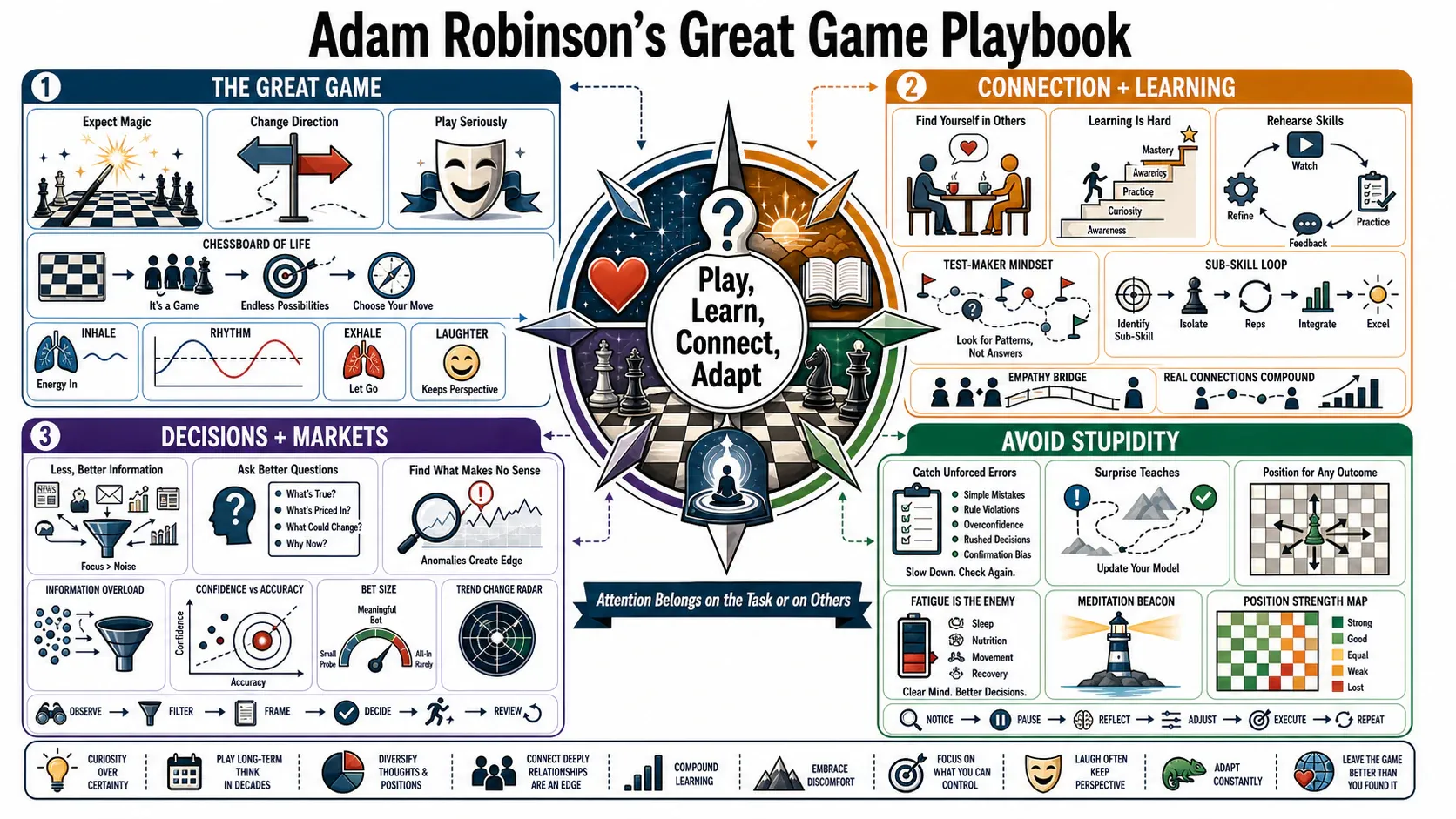
Part 1: The Great Game of Life
- On The Great Game: "The Great Game is life. We play many games in life... Everything is a game. Games suggest something that’s not serious, but of course, games are intensely serious." — Source: [Farnam Street]
- On Expecting Magic: "Lean into each moment and every encounter expecting magic or miracles." — Source: [The Tim Ferriss Show]
- On Playfulness: "Seriousness is a trap. Approaching life, investing, and even chess as a form of play allows for greater creativity and less fear of failure." — Source: [What Got You There Podcast]
- On Changing Direction: "If you’re not getting the results you want, change what you’re doing. A good starting point is to take a step in the opposite direction." — Source: [The Tim Ferriss Show]
- On Inhalation vs. Exhalation: "Life has rhythms of inhalation (listening, learning, being inspired) and exhalation (acting, creating, implementing). Most people are out of balance, stuck in one phase." — Source: [What Got You There Podcast]
- On Laughter: "The sooner you can laugh at yourself, the sooner you will really be living life." — Source: [Tribe of Mentors]
- On Enthusiasm: "Enthusiasm is one of the most powerful engines of success. When you do a thing, do it with all your might. Put your whole soul into it." — Source: [Tribe of Mentors]
- On The Win-Win Game: "The great game of life is a win-win game. When you look at the world differently, you look at yourself differently." — Source: [Farnam Street]
- On Creation: "Bringing ideas to life follows four stages: Inspiration, Logical Ingenuity, Implementation, and Iteration." — Source: [What Got You There Podcast]
Part 2: Connection and Others
- On Connection: "Whenever possible, connect with others." — Source: [The Tim Ferriss Show]
- On Creating Delight: "With enthusiasm, strive always to create fun and delight for others." — Source: [The Tim Ferriss Show]
- On Finding Yourself: "I think the people who are going on a search to 'find themselves' will never find themselves. You find yourself only in the midst of others." — Source: [Farnam Street]
- On Changing the World: "If you want to change the world, you have to enroll others in your plans and vision." — Source: [Tribe of Mentors]
- On The Paradox of Happiness: "The paradox of the most important things in life—happiness, love, success—is that you can't look for them. Happiness catches us by surprise; it's a byproduct of being fully engaged." — Source: [The Tim Ferriss Show]
- On Focus: "There are only two places your attention should be: either on the task at hand or on others." — Source: [The Tim Ferriss Show]
- On Giving: "Immense pleasures and satisfactions can be derived from focusing on others. The more you give to others, the more the universe gives you back in return." — Source: [The Tim Ferriss Show]
- On Empathy: "Everyone you meet is fighting a battle you know nothing about. Be kind. Always." — Source: [Tribe of Mentors]
- On The Two-Drink Minimum: "Commit to being fully present with someone for the duration of two drinks, ensuring you don't rush away or remain distracted by technology." — Source: [What Got You There Podcast]
- On The Needs of the World: "The world doesn't need more marketers and businessmen. The world needs healers and problem-solvers who use their hearts. Your heart is a million times more powerful than your brain." — Source: [Tribe of Mentors]
Part 3: Learning and Education
- On Genuine Learning: "Few things are as potentially difficult, frustrating, or frightening as genuine learning, yet nothing is so rewarding and empowering." — Source: [Mixergy]
- On The Difficulty of Learning: "You need to know that learning is hard. The reason you need to know it’s hard is that if you think it’s easy, as soon as you encounter difficulty, you’re going to think the problem is you." — Source: [Farnam Street]
- On Efficient Learning: "Successful students are not necessarily smarter than their less successful peers, they have simply mastered the art of efficient learning." — Source: [Mixergy]
- On Rehearsal: "The key to learning any skill... is to rehearse it. Break it down into sub-skills and then rehearse each of those skills." — Source: [Farnam Street]
- On The Joe Bloggs Principle: "Standardized tests are predictable. On easy questions, the obvious answer is correct; on hard questions, the obvious answer is a distractor designed to fool the average test-taker." — Source: [Mixergy]
- On Thinking Like the Test-Maker: "To succeed on standardized tests, students should think like the test writers to identify the specific patterns and logic used to create questions." — Source: [Mixergy]
- On Modeling Struggle: "Parents should model the struggle of learning for their children. If children think learning is always easy, they will blame themselves when they encounter difficulty." — Source: [Farnam Street]
- On Intelligence: "In America, we’ve deified 'intelligence.' And the problem with 'intelligence' is that it works against you. If you’re intelligent, you shouldn’t have to work too hard." — Source: [Farnam Street]
- On Active Learning: "Students should take control of their education by asking better questions and engaging deeply with material rather than passively receiving it." — Source: [Farnam Street]
- On Standardized Tests: "Standardized tests do not measure intelligence, but rather how well a student can navigate the specific traps set by test-makers." — Source: [Mixergy]
Part 4: Decision Making and Problem Solving
- On Information vs. Confidence: "More information often increases an investor's confidence without increasing their accuracy, leading to dangerous over-leveraging." — Source: [CMC Markets]
- On Information Diet: "I will always be better off consuming a smaller amount of high-quality information than trying to consume it all." — Source: [The Tim Ferriss Show]
- On Action: "The most difficult thing is the decision to act. The rest is merely tenacity." — Source: [The Tim Ferriss Show]
- On Persistence: "If you did not get what you want, it's a sign either that you did not seriously want it or you tried to bargain over the price." — Source: [The Tim Ferriss Show]
- On Bandwidth: "I not infrequently say yes too often, to my regret, because I wind up overloading my cognitive or physical or energy bandwidths or simply run out of time." — Source: [Tribe of Mentors]
- On Logic vs. Evolution: "Our species had many eons of evolution before we ever came up with logic. So one of my principles is: Never make a decision when I’m confused." — Source: [Farnam Street]
- On Good Questions: "A good question is one that prompts other questions... a good question is one that increases the choices that I have." — Source: [Farnam Street]
- On Simplicity: "Take a simple idea and take it seriously... The highest achievers are always really simple people. They’ve got like one or two ideas and they’re just working it to death." — Source: [What Got You There Podcast]
- On Saying No: "By saying no to many things, you're saying yes to a couple of things that are so important. The simplest thing is the ability to focus on a single thing or two." — Source: [What Got You There Podcast]
- On Missing Out: "The world will go on if I don't read, create, or do everything." — Source: [The Tim Ferriss Show]
Part 5: Investing and The Market
- On Making Sense: "When investors say a market trend 'makes no sense,' it is their model of the world that doesn't make sense. The world always makes sense; we just don't understand it." — Source: [The Tim Ferriss Show]
- On Opportunities: "If you want to find gold, it's where things don't make sense. It's an algorithm for finding the greatest opportunities." — Source: [Farnam Street]
- On Powerful Trends: "The most powerful trends won't make sense until it becomes too late to profit from them." — Source: [The Tim Ferriss Show]
- On Bet Sizing: "Adjust your bet size to your conviction level." — Source: [CMC Markets]
- On Emotional Detachment: "If you're nervous about the trade, you've put too much money at risk. You should be able to be playful about a trade." — Source: [CMC Markets]
- On Markets as Systems: "Markets are complex systems where trends are essentially the dissemination of an idea." — Source: [What Got You There Podcast]
- On Market Philosophy: "Traditional fundamental and technical analysis can often be misleading. It is better to focus on game theory and behavioral economics." — Source: [CMC Markets]
- On Building an Edge: "There is no single correct way to invest. Create a system tailored to your specific talents and weaknesses." — Source: [What Got You There Podcast]
- On Updating Views: "Use probabilistic reasoning to update your views as new information arrives, aiming to identify major trend changes weeks or months in advance." — Source: [Farnam Street]
Part 6: Stupidity and Mistakes
- On Defining Stupidity: "I define 'stupidity' as 'overlooking or dismissing conspicuously crucial information.'" — Source: [Farnam Street]
- On Intelligence and Stupidity: "Stupidity is the cost of intelligence operating in a complex environment. It’s almost inevitable." — Source: [Farnam Street]
- On Unforced Errors: "Success often comes from avoiding unforced errors rather than seeking brilliant insights." — Source: [Farnam Street]
- On Checklists: "High-performers don't necessarily make fewer mistakes—they use rigorous systems and checklists to catch them before they become fatal." — Source: [Farnam Street]
- On the Engineering of Stupidity: "Stupidity is engineered by factors like rushing, information overload, fatigue, and being outside your normal environment." — Source: [Farnam Street]
- On Avoiding Bad Decisions: "If factors like rushing, fatigue, or information overload are present, don’t make any important decisions." — Source: [Farnam Street]
- On Wisdom: "All advice is a warning. All wisdom is a warning." — Source: [Farnam Street]
- On Anomalies: "Surprise is always telling you that your model of the world is incorrect. Which is fantastic—it's a learning opportunity." — Source: [What Got You There Podcast]
- On Failed Strategies: "Most people simply double down on failing strategies rather than pivoting when they don't get the results they want." — Source: [The Tim Ferriss Show]
Part 7: The Mind and Meditation
- On The Unconscious Mind: "The unconscious mind is far more powerful than the conscious one. Train it by allowing yourself time and listening to your body." — Source: [The Tim Ferriss Show]
- On Meditation: "Meditation is a way to relinquish control of the conscious mind so that the more powerful unconscious mind can take over, and analysis of the world improves." — Source: [The Tim Ferriss Show]
- On Productivity: "Meditation is one of the most practical, powerful, productivity-enhancing tools ever created." — Source: [The Tim Ferriss Show]
- On the Felt Sense: "Rely on a kinesthetic or 'felt sense' in your body to recognize when a move or a situation is right or wrong, as the unconscious processes information faster than logic." — Source: [Farnam Street]
- On Negative Emotions: "If I realize my focus is off, and certainly when I'm experiencing any negative emotions, I ask myself, 'Where should my attention be right now?'" — Source: [The Tim Ferriss Show]
- On The Beacon: "When distracted, remind yourself that the answer to where your attention should be is almost always 'my mission,' which acts as a beacon." — Source: [The Tim Ferriss Show]
- On Adam's Wager: "Whether we are at a critical end-of-times inflection point for humanity or not, the logical choice is to radically change our behavior toward more cooperation and awareness." — Source: [What Got You There Podcast]
- On Heart Rate Variability: "Heart rate variability (HRV) training is a powerful way to tap into the unconscious and regulate your nervous system." — Source: [The Tim Ferriss Show]
- On Living in Your Head: "Shift from a life lived entirely in your head to one focused outwardly on connection and presence." — Source: [Farnam Street]
Part 8: Mastery, Strategy, and Chess
- On The Genius Toolset: "Geniuses often have very limited toolsets—they have a hammer, and their genius lies in looking for nails." — Source: [The Tim Ferriss Show]
- On Deep Mastery: "A singular, deep mastery of patterns applied with relentless focus is often more powerful than a broad range of mediocre skills." — Source: [The Tim Ferriss Show]
- On Informed Simplicity: "Move past complexity to reach informed simplicity. While beginners see a mess and experts see complex variations, masters see the essential truth or logic of a position." — Source: [Farnam Street]
- On Predicting the Future: "You shouldn't try to predict the future, which is impossible; instead, you should position yourself so that you are prepared for any outcome." — Source: [Farnam Street]
- On Positioning: "Just as in chess, position yourself so that you are operating from a foundation of strength, where almost any move you make is likely to be positive." — Source: [What Got You There Podcast]
- On Coordination: "Improve the coordination and potential of your pieces rather than just calculating a single winning line." — Source: [Farnam Street]
- On Staying in the Game: "View life and investing as a game where the ultimate goal is to stay in the game and continuously learn, rather than just winning a single point." — Source: [What Got You There Podcast]
- On Outflanking Competition: "Rather than fighting the competition head-on, outflank them by approaching the problem from a completely different angle." — Source: [The Tim Ferriss Show]
- On The Logic of Positions: "A master doesn't just see individual pieces on a board; they see the underlying logic and interconnectedness of the entire system." — Source: [Farnam Street]