Alex Atallah co-founded OpenSea and served as its CTO through the NFT marketplace's early growth. He later co-founded OpenRouter, where he is CEO, to make a fragmented market of AI models and inference providers easier for developers to navigate. Across both companies, his work has centered on the same underlying problem: how to turn a fast-moving technical ecosystem into dependable infrastructure without removing the choice and experimentation that make the ecosystem valuable.
The lessons below draw primarily from Atallah's own writing and long-form talks about building OpenRouter and OpenSea. They cover market discovery, technical architecture, standards, marketplaces, team design, operating AI infrastructure in production, and his view of how AI changes engineering work.
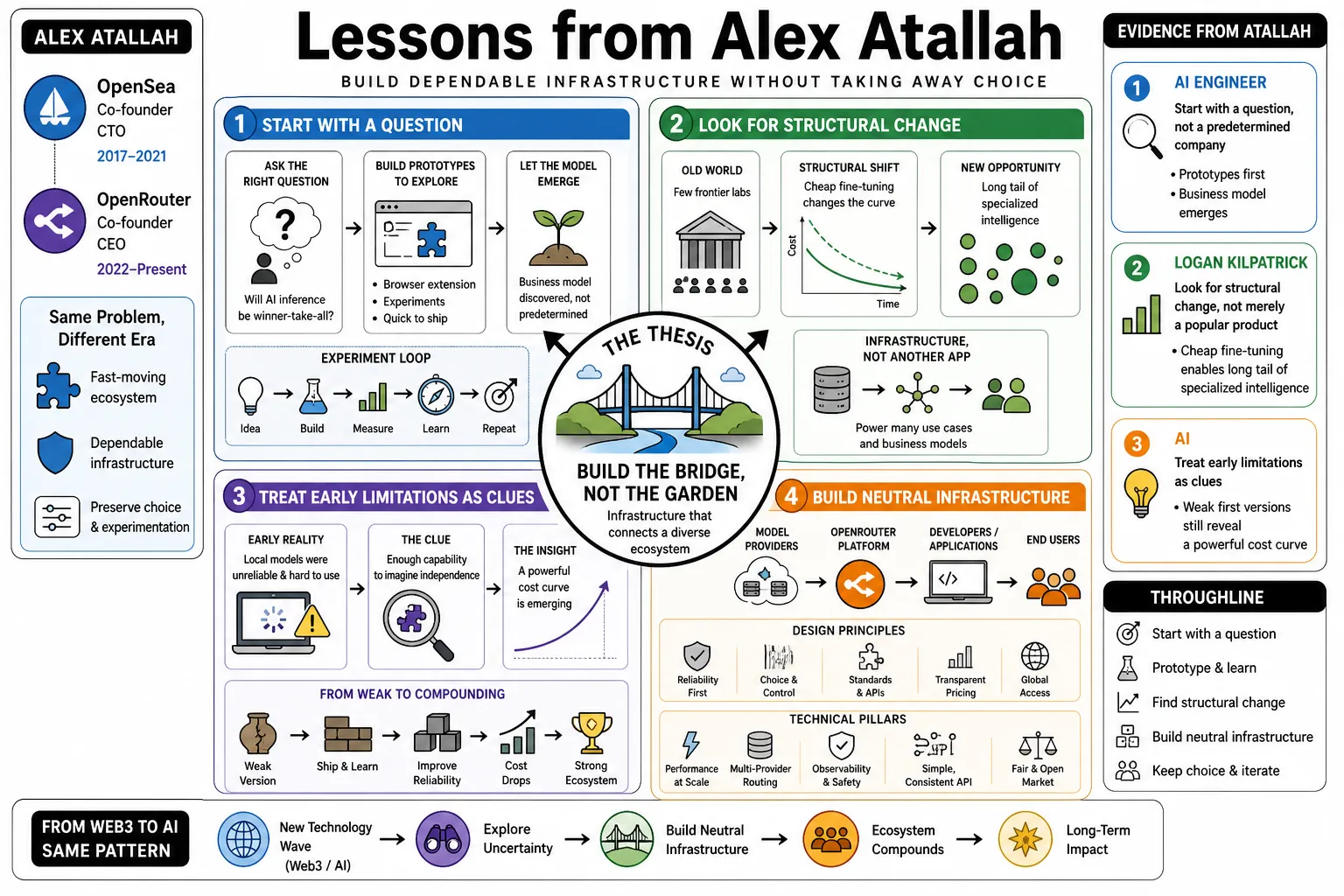
Part 1: Start with a question, not a predetermined company
- Use prototypes to investigate uncertain markets: OpenRouter began as an attempt to answer whether AI inference would become winner-take-all. Atallah built experiments first, including a browser extension, and allowed the business model to emerge from what those experiments revealed. — Reference: AI Engineer
- Look for structural change, not merely a popular product: The arrival of inexpensive fine-tuning convinced him that useful models could proliferate far beyond a few frontier labs. The opportunity was therefore not another chatbot, but infrastructure for a long tail of specialized intelligence. — Reference: Logan Kilpatrick
- Treat early limitations as clues: The first local models were unreliable and difficult to use, yet they showed enough capability to suggest that independent developers could eventually compete with organizations spending vastly more on training. Weak first versions can still reveal a powerful cost curve. — Reference: AI Engineer
- Find the missing market around the technology: Once thousands of models seemed plausible, discovery, evaluation, access, and inference became the unsolved layer. Atallah recognized that a model ecosystem would need a marketplace and common access point, not just a repository of weights. — Reference: Logan Kilpatrick
- Test user control before centralizing decisions: Window AI let users bring a chosen model into model-agnostic web applications. That experiment tested whether people wanted portability and choice before OpenRouter developed into a routing marketplace. — Reference: AI Engineer
Part 2: Build for a heterogeneous market
- Assume important workloads will remain multi-model: OpenRouter's usage led Atallah to reject the idea that one model family would dominate every task. Different models remain sticky for different purposes, so infrastructure should make switching and combining them inexpensive. — Reference: AI Engineer
- Separate model choice from provider choice: Developers often want to choose the model themselves but should not have to manage every company that serves it. OpenRouter therefore exposes model-level choice while handling provider differences, availability, and performance underneath. — Reference: This Week in Startups
- Standardize commodity layers while preserving meaningful choice: The same model served by two clouds should behave consistently even when price, latency, or capacity differs. Standardization belongs where it removes accidental complexity, not where it erases useful differentiation. — Reference: AI Engineer
- Let market fragmentation define the product: OpenRouter became a marketplace because providers for the same model varied in cost, speed, caching, tool support, and structured-output capabilities. Aggregating those differences turned operational disorder into a useful comparison layer. — Reference: AI Engineer
- Design around the needs of several operators at once: Atallah frames the gateway problem as a combination of developer choice, CTO reliability, CFO cost predictability, and CISO policy control. Infrastructure becomes strategic when it reconciles these concerns rather than optimizing only one. — Reference: Limitless Podcast
Part 3: Reliability is a product feature
- Aggregate capacity to improve uptime: A model may be available from many providers, each with different failure patterns. Routing across them can materially improve availability without forcing the developer to build and maintain a fallback system. — Reference: AI Engineer
- Make the intermediary nearly invisible: A routing layer loses credibility if it adds noticeable delay. Atallah's team moved logic and caching toward the edge so the benefits of aggregation would not be offset by routing latency. — Reference: Logan Kilpatrick
- Treat caching as architecture, not a late optimization: OpenRouter used edge infrastructure and database-adjacent caching to reduce routing overhead. For a high-volume gateway, where data lives and how often it travels are core product decisions. — Reference: Logan Kilpatrick
- Understand billing behavior at the stream boundary: Providers do not all handle cancellation the same way; some continue generating or billing after a stream is dropped. A dependable abstraction must account for these unglamorous edge cases, not just normalize the happy path. — Reference: AI Engineer
- Build observability for the scale of the underlying object: LLM requests produce large, fast-moving analytical datasets. Atallah described evolving OpenRouter's analytics architecture as usage grew, rather than assuming conventional application analytics would remain sufficient. — Reference: Logan Kilpatrick
Part 4: Standards should lower switching costs without freezing innovation
- Adopt the familiar interface when it accelerates adoption: OpenRouter made its API compatible with the dominant OpenAI pattern so developers could try other models without rewriting their applications. Familiarity can be a distribution strategy. — Reference: Logan Kilpatrick
- Make a standard extensible rather than absolute: Atallah describes healthy tension between standards and standard breakers. A useful common interface should support the mainstream path while leaving room for novel prompt formats, model features, and raw access. — Reference: Logan Kilpatrick
- Use type safety as a defense against ecosystem complexity: When every provider emits slightly different schemas, strict types catch mismatches before they become production incidents. The more heterogeneous the inputs, the more valuable precise contracts become. — Reference: Logan Kilpatrick
- Normalize semantics, not just endpoint names: Tool calls, finish reasons, caching behavior, and output formats can differ even when APIs look compatible. A real abstraction handles these behavioral differences instead of merely forwarding requests. — Reference: AI Engineer
- Extend inference with middleware-like components: OpenRouter's plugin approach treats capabilities such as web search or document parsing as transformations around the inference stream. This allows one capability to work across models without requiring every application to reimplement it. — Reference: AI Engineer
Part 5: Let usage teach you what benchmarks miss
- Distinguish popularity from quality: Raw token volume shows traction, not necessarily the best model for a job. Atallah is explicit about that limitation, which makes the metric more useful and prevents a leaderboard from pretending to answer a different question. — Reference: Logan Kilpatrick
- Prefer retention when measuring durable utility: A model that users repeatedly return to for the same workload may be more valuable than one generating a temporary spike in traffic. Repeated use is a better signal of fit than raw attention alone. — Reference: Logan Kilpatrick
- Use empirical behavior to improve discovery: OpenRouter's rankings are designed to show which models power users actually use for coding, roleplay, writing, translation, and other workloads. Observed choices complement synthetic evaluations. — Reference: Logan Kilpatrick
- Build a benchmarking muscle before making claims: Atallah argues that AI product assertions need evaluations or benchmarks behind them. Measurement does more than prove progress; it directs teams and model builders toward concrete capabilities. — Reference: This Week in Startups
- Keep recommendations neutral: OpenRouter has avoided selling sponsored routing preference because a gateway must be trusted to compare models and providers fairly. Neutrality is not just a policy; it is part of the product's credibility. — Reference: This Week in Startups
Part 6: Communities expose the edge cases
- Recruit power users as an early-warning system: OpenRouter's enthusiasts surface obscure provider errors, new model behavior, and unusual finish reasons quickly. A demanding community can extend the effective testing surface of a small team. — Reference: Logan Kilpatrick
- Make ecosystems healthier to strengthen the company: When Atallah left his operating role at OpenSea, he concluded that the strongest companies and ecosystems reinforce each other. Infrastructure businesses create durable advantage by helping complements succeed. — Reference: Alex Atallah
- Recognize that shared incentives change participation: In his review of OpenSea's 2021, Atallah distinguished communities organized around shared interests from networks whose members also share ownership incentives. The latter can turn audiences into active teams. — Reference: Alex Atallah
- Use transparency to lower participation barriers: Atallah saw public blockchain activity as a way for builders and users to join without permission. The wider lesson is that observable systems let outsiders learn, verify, and contribute faster. — Reference: Alex Atallah
- Expect early categories to look like toys: CryptoKitties, virtual land, and digital art appeared niche, yet their diversity suggested a broader platform. New markets are easier to see when founders study several strange use cases rather than waiting for one respectable mainstream example. — Reference: Alex Atallah
Part 7: Scale by handing work to stronger owners
- Transfer functions deliberately as the company grows: At OpenSea, Atallah moved business development, support, marketing, and technical leadership to specialized executives. A founder's job is not to preserve personal scope but to put each function under the best available owner. — Reference: Alex Atallah
- Choose leaders who combine first principles and execution: He looked for people who could balance original reasoning, established practice, and operational excellence. Scaling requires neither blind process nor permanent improvisation, but the ability to use both appropriately. — Reference: Alex Atallah
- Return to zero-to-one when that is your comparative advantage: Atallah stepped away after OpenSea had a stronger leadership foundation because building from scratch remained his primary passion. Self-awareness about the stage where one creates the most value can guide founder succession. — Reference: Alex Atallah
- Shut down businesses whose incentives fight the product: His earlier fintech startup learned that strong analytical tools threatened the very hedge funds expected to buy them. A capable product cannot overcome a market structure that makes customers fear adoption. — Reference: Alex Atallah
- Preserve the ability to exit a platform: In designing his publishing stack, Atallah emphasized portable data, few dependencies, and low refactoring cost. The same principle applies to infrastructure products: reduce lock-in so users can adopt without betting their future on one vendor. — Reference: Alex Atallah
Part 8: Engineering becomes an experimental discipline
- Manage AI agents with taste and science: Atallah expects software engineers to coordinate many AI systems. Their leverage will come from judgment developed through experience and from disciplined predictions tested against data. — Reference: Alex Atallah
- Anchor experiments to an outcome metric: Prompt changes and agent techniques need a product or business KPI, test and validation data, and measured results. Without a target, teams can generate activity without learning. — Reference: Alex Atallah
- Seek context machines cannot already see: Humans retain an advantage when they gather information from customers, physical environments, and other non-digital settings. The value lies not only in possessing context but in using it to redirect an investigation. — Reference: Alex Atallah
- Organize products around topics rather than fixed counterparties: Atallah uses publish-subscribe as a broader product principle: producers and consumers can coordinate through shared topics without knowing each other in advance. Marketplaces, search, and personalized AI all benefit from this decoupling. — Reference: Alex Atallah
- Expect successful products to rebundle over time: Composable components accelerate early experimentation, but after product-market fit they can add latency, cost, or competitive leakage. Teams should revisit modularity as the product matures rather than treating maximum composability as permanent doctrine. — Reference: Alex Atallah
Part 9: Treat AI infrastructure as a control plane
- Measure reliability by defects avoided, not percentage points gained: Cutting a structured-output defect rate from 2% to 1% sounds incremental, but it halves the bugs, support tickets, and operational interruptions caused by that failure mode. Production teams should translate small rate improvements into their downstream consequences. — Reference: OpenRouter
- Use production-scale evidence to prioritize infrastructure work: OpenRouter evaluated response healing across large request volumes and found sharply different gains by model. Real traffic reveals where reliability investments matter most and prevents teams from generalizing from a handful of examples. — Reference: OpenRouter
- Automate narrow repairs close to the failure: Rather than make every application handle malformed JSON independently, OpenRouter repairs common syntax failures in the gateway before responses reach application code. Shared infrastructure is the right place for repeatable corrections that can be applied consistently. — Reference: OpenRouter
- State the boundary of an automated fix: Response healing corrects JSON syntax, not missing fields, wrong types, or other schema errors. Trust improves when an infrastructure layer explains precisely what it repairs and leaves semantic validation to the application. — Reference: OpenRouter
- Move volatile model choices out of application code: A hard-coded model slug turns a provider decision into a deployment dependency. Server-side presets let teams change the underlying model once while keeping every calling service stable. — Reference: OpenRouter
- Distinguish provider failover from model failover: Routing to another provider keeps the same model available during an endpoint failure, but it cannot help when the model itself is retired. Resilient systems need separate plans for both kinds of disappearance. — Reference: OpenRouter
- Version operational policy so it can be rolled back: Presets preserve configuration history and let operators re-designate a previous version. Routing, parameters, and fallback order should be treated like deployable infrastructure, with a recovery path that does not require reverting and redeploying every application. — Reference: OpenRouter
- Centralize data policy with routing policy: A preset can enforce requirements such as zero data retention while selecting only qualifying providers and models. Compliance rules are more dependable when they live in the control plane instead of being restated correctly by every caller. — Reference: OpenRouter