Alexa Grabell co-founded Pocus after seeing how difficult it was for sales teams to use product and customer data in their daily work. She helped develop product-led sales practices and later applied AI to account research and seller workflows. Pocus joined Apollo in 2026; her current title is not inferred here. — Our Next Chapter: Pocus Is Joining Apollo.
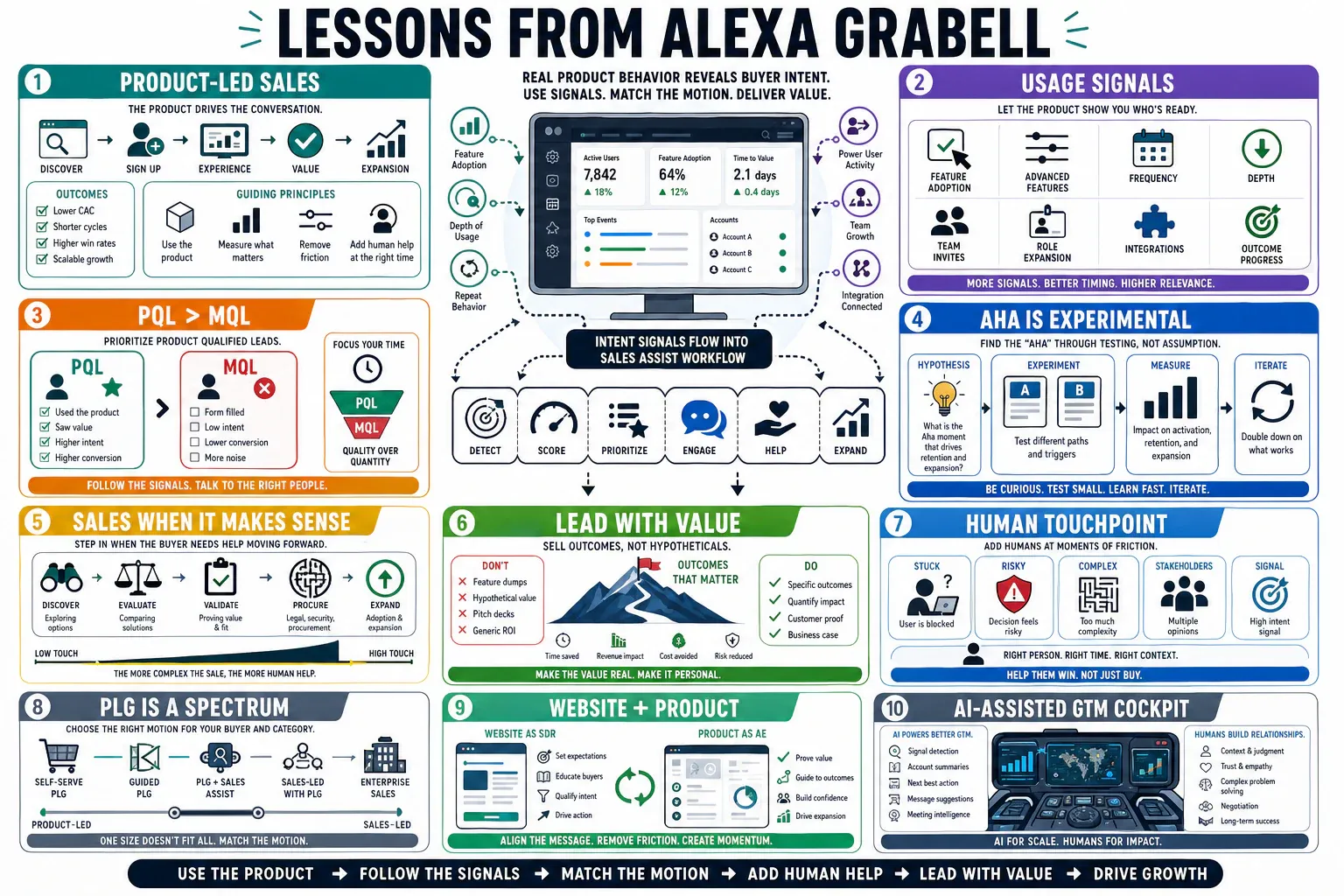
Part 1: The Transition to Product-Led Sales
- On product-led growth: In a product-led motion, a user can discover and experience product value before speaking with a salesperson; the appropriate level of sales involvement varies by buyer and product. — The Product-Led Growth Spectrum.
- On experimenting with PQLs: Grabell says a product-qualified lead definition should be tested and revised as teams learn which usage patterns actually predict value, rather than frozen around one supposed aha event. — Not Boring Founder Conversation, Part Two.
- On timing the sales hire: Grabell rejects a fixed ARR threshold for adding sales: hire when the product, customer needs and company goals make human help useful. — Dock Grow & Tell Interview.
- On leading with value: In product-led sales, Grabell favors using what customers are trying to do in the product to offer relevant help rather than pitching a hypothetical feature list. — Dock Grow & Tell Interview.
- On product-qualified leads: Product behavior can show which users or accounts are finding value and might benefit from outreach; Grabell treats PQL definitions as hypotheses to refine. — Not Boring Founder Conversation, Part Two.
- On sales assist: Grabell describes sales assist as a hybrid role that answers questions, removes friction and helps people get value without imposing a full sales cycle on every user. — What Is the Sales-Assist Role?.
- On human help: When self-serve users encounter friction, a sales-assist touchpoint can help them reach value; Grabell argues that the right motion depends on the user and product. — What Is the Sales-Assist Role?.
- On the limits of self-service: Grabell argues that a self-serve product and sales involvement can coexist when customers need help understanding or expanding use. — Dock Grow & Tell Interview.
- On usage signals: Pocus’s original account proposes using product-usage signals to prioritize accounts for relevant sales outreach, not treating every login as purchase intent. — Introducing Pocus’s Product-Led Sales Platform.
- On enterprise buying: Grabell’s spectrum includes sales-led assistance for buyers whose organizational purchase involves more people and needs than self-service can address. — The Product-Led Growth Spectrum.
Part 2: Defining the PLG and PLS Spectrum
- On the PLG spectrum: Grabell places fully self-serve and sales-led journeys on a continuum; where a company belongs depends on its buyer, product and growth stage. — Dock Grow & Tell Interview.
- On buyer personas: Grabell contrasts developer buyers, who may prefer documentation and self-service, with sales or HR buyers who may want more human conversation. — Dock Grow & Tell Interview.
- On developer buyers: For some developer tools, Grabell says buyers want to explore documentation and build independently before they speak to a salesperson. — Dock Grow & Tell Interview.
- On moving beyond individual use: A product adopted by individuals may need a different conversation when a company considers wider deployment; the sales role can help buyers see organizational applications. — Dock Grow & Tell Interview.
- On choosing a sales motion: Grabell recommends matching self-serve and human-assisted sales to the customer’s preferences and product complexity instead of copying a fashionable motion. — The Product-Led Growth Spectrum.
- On hybrid models: Grabell argues that companies can combine product-led discovery with human help for implementation or larger opportunities; neither self-service nor sales must be exclusive. — The Product-Led Growth Spectrum.
- On adding sales without stigma: Grabell objects to treating sales hiring as a failure of PLG; a useful sales motion can be introduced when customers and the business warrant it. — Dock Grow & Tell Interview.
- On maturing a go-to-market motion: Grabell describes a spectrum in which companies may support both self-serve adoption and more involved enterprise conversations as needs change. — The Product-Led Growth Spectrum.
Part 3: The Synergy of Data and Sales
- On sales-data silos: At Dataminr, Grabell saw sales teams struggle to access product and customer data that could help them decide whom to contact and why. — Dock Grow & Tell Interview.
- On data access beyond sales: Pocus later described extending accessible revenue data to marketing and customer success as well as sales; the earlier sales-only focus was not permanent. — Introducing the Revenue Data Platform.
- On the modern data stack gap: Grabell argues that data can sit in a warehouse while the people serving customers lack an accessible way to use it in daily workflows. — Sneak Peek at the Pocus Platform.
- On data-informed selling: Grabell’s account of product-led sales asks reps to use actual account and product context when deciding where they can help. — Introducing Pocus’s Product-Led Sales Platform.
- On insights outside CRM: Grabell says useful sales signals often live in product and warehouse data rather than only in traditional CRM fields. — Sneak Peek at the Pocus Platform.
- On operationalizing data: Pocus was built to surface account-level usage and other signals to go-to-market teams without requiring each rep to query the warehouse. — Introducing Pocus’s Product-Led Sales Platform.
- On contextual outreach: A rep who sees relevant product activity can offer help tied to a customer’s current use rather than sending a generic pitch. — Focus Beats Volume.
- On actionable signals: Grabell emphasizes turning raw data into prioritized actions in the seller’s workflow, rather than handing reps a larger unranked dashboard. — Focus Beats Volume.
- On prioritizing opportunities: Pocus’s signed account describes using product and account context to focus reps on a smaller set of potentially relevant opportunities; this is its proposed approach, not a universal probability guarantee. — Focus Beats Volume.
- On blending sales operations and selling: Grabell’s Dataminr experience connected analytical sales operations to frontline decisions, inspiring tools that make data usable by sellers. — Beyond Quota Interview.
Part 4: Early Stage Startup and Validation
- On extensive discovery: Grabell says the founders spoke with roughly 350 sales teams by the seed round; a separate early discovery stretch lasted about three months at 10–20 conversations a week. The two figures should not be collapsed into “350 leaders in 12 weeks.” — SaaS Club Founder-Led Sales Interview.
- On founder-led selling: Grabell says she learned the mechanics of selling and negotiating by leading early Pocus customer conversations herself. — SaaS Club Founder-Led Sales Interview.
- On founder optimism: Grabell tells Wellfound she values optimistic builders who can navigate uncertainty; the unverified “delusional optimism” quotation is removed. — Wellfound Interview with Alexa Grabell.
- On initial customer focus: Early Pocus discovery centered on sales teams and their data-access pain; the later product explicitly expanded to marketing and customer success, so this was a starting focus rather than a permanent refusal. — Introducing the Revenue Data Platform.
- On design partners: Grabell describes sharing Figma concepts and working with design partners before a fully built product, using their feedback to test the proposed workflow. — Dock Grow & Tell Interview.
- On building from a sales-ops pain: At Dataminr, Grabell worked around the difficulty of getting useful product and account data to sales teams; that recurring pain informed the Pocus idea. — Dock Grow & Tell Interview.
- On testing before building: Grabell describes using interviews, mocks and design partners to validate demand before committing to the full product; the specific first-ten-customers comparison is unverified. — Dock Grow & Tell Interview.
Part 5: Category Creation and Community
- On learning while naming a category: Grabell describes product-led sales as a field shaped by practitioners; Pocus used essays and conversations to develop shared definitions rather than claiming a fixed doctrine. — What Is Product-Led Sales?.
- On community as a source of help: Grabell says building a community made it easier to learn from and collaborate with people interested in the same GTM problem; the claimed inbound-lead effect is not quantified. — Not Boring Founder Conversation, Part One.
- On synthesizing practice: Pocus’s playbook drew on practitioners’ experiments and examples so teams could learn from what others were trying in product-led sales. — Launching the Product-Led Sales Playbook.
- On shared language: Pocus offered several definitions of product-led sales to help practitioners discuss the motion across teams; the alleged internal-champion effect is not established as a measured outcome. — Five Product-Led Sales Definitions.
- On coordinating investor support: Grabell recounts convening investors together at a kickoff so they understood the vision and could help, rather than managing each relationship only in isolation. — Not Boring Founder Conversation, Part One.
- On defining product-led sales: Grabell’s category essays spell out the underlying data-and-sales problem as well as Pocus’s proposed solution; the earlier absolute problem-before-product rule is not directly established. — What Is Product-Led Sales?.
- On a shared playbook: Pocus published a product-led sales playbook built from examples and community input; calling it more valuable than the software was not verified. — Launching the Product-Led Sales Playbook.
- On practitioner participation: Grabell’s community retrospective credits members with exchanging ideas and shaping the product-led-sales discussion; it does not establish that top-down campaigns never matter. — Celebrating 1,000+ Product-Led Sales Community Members.
- On speaking for a problem space: Grabell’s category writing educates teams about product-led sales and its tradeoffs alongside describing Pocus; the absolute vendor-second trust maxim is not presented as her verified quote. — What Is Product-Led Sales?.
Part 6: Artificial Intelligence as a Supercharger
- On AI augmenting sellers: Grabell says Pocus pursued AI to make sellers more effective with research and account context, not on the premise that AI would immediately replace them. — Wellfound Interview with Alexa Grabell.
- On potential seller capacity: Grabell suggests AI-assisted research could, in theory, let a seller handle a larger book of business; doubling is a possibility she discusses, not a measured outcome. — Wellfound Interview with Alexa Grabell.
- On AI for a real problem: Grabell says the team looked for a concrete customer problem before choosing where AI belonged, rather than adding an AI feature merely because it was fashionable. — Wellfound Interview with Alexa Grabell.
- On relevance instead of volume: Grabell’s signed Pocus essay argues that AI outreach should help sellers concentrate on relevant accounts and context rather than sending more generic messages; it does not prove AI reps consistently outperform. — Focus Beats Volume.
- On reducing manual research: Grabell describes AI tools that gather account context and surface relevant actions, freeing sellers from some manual data work; no direct source establishes complete CRM-update automation. — Wellfound Interview with Alexa Grabell.
- On combining signals: Pocus’s AI approach joins account and activity signals to recommend what deserves attention; the exact “thousands to one next step” statistic is removed. — Focus Beats Volume.
- On human sales work: Grabell’s product-led sales account retains a human role for helping customers navigate questions and more involved buying; it does not assert that every listed skill is permanently beyond AI. — What Is the Sales-Assist Role?.
- On AI in the workflow: Pocus presents AI account research and recommendations in the seller’s existing workflow rather than requiring a separate uncontextualized chatbot. — Focus Beats Volume.
Part 7: Hiring and Building Team Culture
- On hiring for learning speed: Grabell says she looks for a candidate’s learning trajectory and ability to improve, not only credentials or prior role titles; the graph-intercept wording is unnecessary. — Wellfound Interview with Alexa Grabell.
- On desired teammate traits: Grabell describes seeking smart, humble, optimistic people who can learn quickly; these are her hiring preferences, not a universally validated formula. — Wellfound Interview with Alexa Grabell.
- On cultural fit and growth: Grabell asks whether candidates will thrive in Pocus’s fast-moving culture, rather than merely tolerate the environment. — Wellfound Interview with Alexa Grabell.
- On shipping and iterating: Grabell names “ship-erate” as a value: release work, learn from its use and improve, while still exercising judgment about the stakes. — Wellfound Interview with Alexa Grabell.
- On evaluating candidates: Grabell says working sessions and reference checks can reveal how a candidate operates beyond a conversational interview; the claim that these are always the two most important steps is softened. — Not Boring Founder Conversation, Part Two.
- On resourcefulness: Grabell’s hiring account values people who can move quickly, learn and take on work in an early-stage environment; “ultimate competitive advantage” is removed. — Wellfound Interview with Alexa Grabell.
- On candid feedback: Grabell describes seeking feedback and coaching as she grew into CEO responsibilities; the previous causal claim that optimism and humility automatically create radical candor is unsupported. — SaaS Club Founder-Led Sales Interview.
- On staying focused while hiring: Grabell’s account of early hiring emphasizes matching people and roles to the company’s stage; it does not establish a standing policy that the team must remain exceptionally lean. — Wellfound Interview with Alexa Grabell.
Part 8: Founder Mindset and Productivity
- On a competitive streak: Grabell describes feeling strongly about winning and learning from losses in her direct Beyond Quota interview; the lesson is framed as her personal motivation, not a prescription for long hours. — Beyond Quota Interview.
- On protecting morning focus: Grabell says that, while working East Coast hours, she often reserves roughly 6–9 a.m. for priority work before meetings; “every single day” is not established. — SaaS Club Founder-Led Sales Interview.
- On reviewing priorities: Grabell describes returning to the few priorities that move the business forward and reviewing her week; the rigid every-Sunday ritual is not verified. — SaaS Club Founder-Led Sales Interview.
- On an unexpected early ambition: Grabell says she once aimed to become a professional dancer before studying engineering; the claim that dance discipline caused later sales success is not established. — Beyond Quota Interview.
- On learning sales by doing: Grabell entered founder-led sales without a conventional enterprise-selling career and learned by speaking directly with prospective customers. — SaaS Club Founder-Led Sales Interview.
- On growing into the CEO role: Grabell describes seeking feedback and an executive coach as the company grew; the emotional-equilibrium maxim is replaced with this directly supported leadership lesson. — SaaS Club Founder-Led Sales Interview.
- On listening to customer work: Grabell’s original discovery focused on sales teams’ daily difficulty accessing usable data; the lesson is to understand a workflow before proposing a product. — Dock Grow & Tell Interview.
- On the company’s broader trajectory: Pocus’s 2026 announcement says it joined Apollo to bring its AI and data work into a wider sales platform; this is the stated next chapter, not a promise of a particular legacy. — Our Next Chapter: Pocus Is Joining Apollo.