Alexander Taubman co-founded Long Lake Management to buy traditional service businesses and overhaul their operations with AI. Using his background at Goldman Sachs and Oaktree Capital, he aims to bring software margins to labor-heavy industries like HOA management and corporate travel. This profile covers his strategy for AI roll-ups, the Nexus platform, and long-term capital ownership.
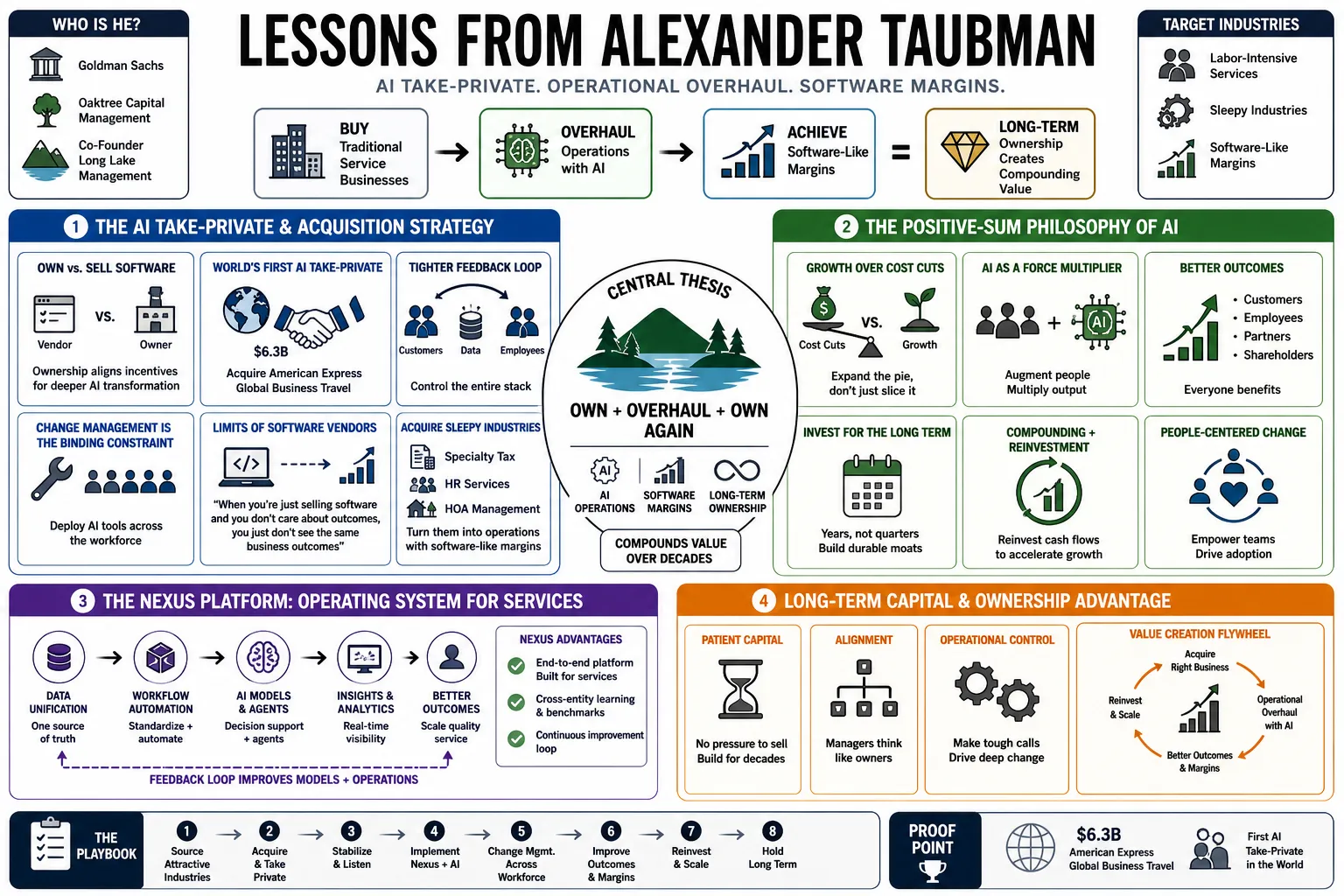
Part 1: The AI Take-Private and Acquisition Strategy
- On owning vs. selling software: Long Lake Management’s model argues that acquiring service businesses outright aligns incentives for executing an AI transformation more deeply than operating as an external software vendor. — Reference: No Priors interview
- On the first AI take-private: Long Lake announced a $6.3 billion agreement to acquire American Express Global Business Travel, executing what is considered the world's first AI take-private deal. — Reference: No Priors interview
- On feedback loops: "The feedback loop with customers and employees is tighter when you control the entire stack." — Source: No Priors interview
- On change management: The binding constraint on generating value from enterprise AI is the operational change management necessary to deploy the tools across a workforce. — Reference: No Priors interview
- On the limits of traditional software vendors: "When you're just selling software and you don't actually care what happens with the business outcomes, you just don't see the same business outcomes" — Source: No Priors interview
- On acquiring sleepy industries: Taubman's firm acquires companies in labor-intensive sectors like specialty tax, HR services, and HOA management to turn them into operations with software-like margins. — Reference: No Priors interview
Part 2: The Positive-Sum Philosophy of AI
- On growth over cost-cutting: Long Lake deliberately runs a strategy that uses automation to boost the customer experience and drive top-line growth instead of just cutting costs to expand margins. — Reference: No Priors interview
- On job creation through productivity: "we actually think AI makes people more productive and we have more productive people, you want more of them." — Source: No Priors interview
- On a positive-sum future: "We think AI is incredibly positive sum" — Source: No Priors interview
- On raising compensation: Creating a 30-40% increase in employee efficiency allows the holding company to afford above-market wages for its staff. — Reference: No Priors interview
- On talent magnetism: Employees prefer retaining their AI capabilities so strongly that the portfolio companies experience very high retention and become magnets for talent. — Reference: No Priors interview
- On the pain of losing AI tools: "It’s like giving up email or something. You’re not going to do it." — Source: No Priors interview
- On building the best workplace: "We want to basically be the best place to work in every industry that we operate" — Source: No Priors interview
- On customer retention: Integrating AI reduces errors in everyday tasks like board reporting and email, naturally speeding up response times and improving customer retention. — Reference: No Priors interview
Part 3: The Nexus Platform and Technical Execution
- On shared infrastructure: "roughly 80% of the infrastructure is shared across the verticals" — Source: No Priors interview
- On deploying the platform: "sort of our Nexus platform sits in between the models on one side, we're model agnostic, and the data sources, the skills, the workflows of the business." — Source: No Priors interview
- On deployment speed improvements: After requiring over a year to implement its first acquisition effectively, Long Lake can now deploy its platform and see immediate impact within days. — Reference: No Priors interview
- On the 20% customization: Applying the shared platform to a new vertical requires adapting the final 20% to map specific workflows, clean distinct data sets, and integrate with legacy enterprise software. — Reference: No Priors interview
- On immediate time savings: Automating mundane tasks rapidly recovers 25-30% of a service employee's typical day. — Reference: No Priors interview
- On enterprise AI penetration: Enterprise adoption of AI use cases is estimated to be only about 1% penetrated across the American economy. — Reference: No Priors interview
Part 4: Transforming Service Businesses and Unit Economics
- On software-like margins: Transforming labor-intensive service operations changes the unit economics so that revenue can grow with high incremental margins, behaving more like a software business. — Reference: No Priors interview
- On the marginal tax rate of growth: Historically, growing a service business by 20% required a proportional 20% increase in headcount, creating a high marginal cost that consumed new revenue. — Reference: No Priors interview
- On accelerating organic growth: "We are growing organically. We, when we invested in the businesses, they're typically growing zero to five percent a year in terms of volume. We're now growing 20 plus percent a year." — Source: No Priors interview
- On the compounding flywheel: The higher margins generated by automation are reinvested into both company growth and better internal tools, fueling a self-reinforcing cycle of efficiency. — Reference: No Priors interview
- On the Amex GBT asset: The 111-year history and long-standing customer trust of American Express Global Business Travel represents an irreplaceable asset suited for multi-decade compounding. — Reference: No Priors interview
- On empowering agents: "Imagine basically your travel counselor with AI superpowers" — Source: No Priors interview
- On CEO satisfaction: Operators of traditional service firms report having the best stretches of their careers because they are finally equipped to scale their companies like software startups. — Reference: No Priors interview
Part 5: Background, Talent, and Long-Term Ownership
- On long-term stewardship: Taubman explicitly rejects the standard private equity playbook of cutting costs and flipping assets after two to three years. — Reference: No Priors interview
- On the logic of building: "What are you going to do? … build the best company in the industry and then sell it? That just doesn’t make sense to me." — Source: No Priors interview
- On winning competitive deals: Promising to be a long-term steward of the business and offering rollover equity makes Long Lake a uniquely attractive buyer to founders. — Reference: No Priors interview
- On the hiring divide: "Technologists are very bad at hiring business people early on … business people tend to be awful at hiring engineers." — Source: No Priors interview
- On building a cross-functional team: To bridge the traditional gap between tech and business, Long Lake recruited engineers from Palantir, Ramp, and Robinhood, alongside dealmakers from top private equity firms. — Reference: No Priors interview
- On the appeal to engineers: Long Lake courts top technical talent by offering them the challenge of deploying advanced lab research into the real economy. — Reference: No Priors interview
- On earlier financial experience: Taubman spent years managing proprietary capital as an investment professional in Goldman Sachs’ Special Situations Group. — Reference: Oaktree Acquisition Corp. profile
- On SPAC leadership: At Oaktree Capital Management, Taubman helped launch the Value Equities strategy and served as President for multiple SPACs, including the vehicle that took Hims & Hers Health public. — Reference: Renaissance Capital
- On educational background: His foundation in business and markets comes from completing a B.A. in Economics at Harvard College and an MBA at Harvard Business School. — Reference: Oaktree Acquisition Corp. profile
- On philanthropic involvement: He actively supports youth initiatives and the arts by serving as a Trustee of the Heckscher Foundation for Children and a board member at the Museum of Contemporary Art Detroit. — Reference: Alexander Taubman LinkedIn
- On paying more for assets: "we can actually pay more than anyone else because we can operate the deals better." — Source: No Priors interview
Part 6: Deployment, Ownership, and Execution
- On testing vertical AI against the real job: Long Lake reports that Nexus performs five times better than general-purpose models in its internal evaluations, reinforcing the value of measuring AI against specific industry workflows rather than broad benchmarks. — Reference: CNBC
- On making change durable: Owning the operating company and embedding engineers inside it for years gives an AI transformation a better chance of surviving contact with daily work than a short external deployment. — Reference: CNBC
- On doing the unglamorous integration work: Effective deployment begins with mapping workflows, understanding and cleaning data sources, and integrating them so models can reliably access the information the business uses. — Reference: No Priors interview
- On separating time-to-value from transformation: Initial platform integration can produce time savings and margin improvement within weeks, while changing the full operating model remains a multi-year project. — Reference: No Priors interview
- On matching capital duration to operating change: Permanent ownership gives Long Lake the time to keep investing through a multi-year transformation instead of forcing the work into a short exit window. — Reference: No Priors interview
- On applying a growth mindset to established companies: The AI-rollup playbook uses productivity gains and reinvested cash to expand customer-facing capacity and fund further acquisitions rather than relying primarily on leverage and cost extraction. — Reference: CNBC
- On treating execution as the real risk: Buying legacy businesses is only the beginning; the strategy requires an operating organization capable of running companies and implementing technical change over long holding periods. — Reference: CNBC