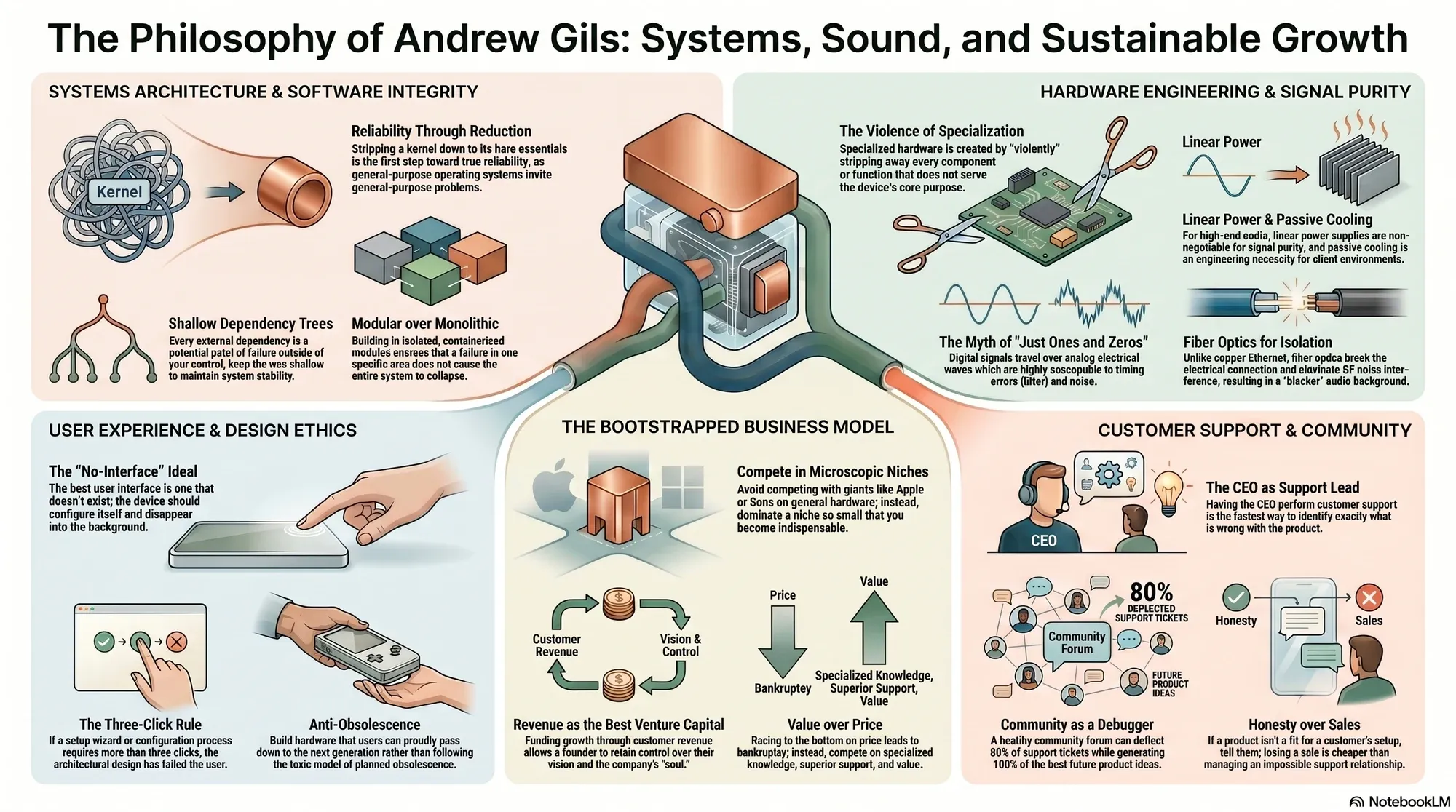
Andrew Gils is a pioneering systems engineer and entrepreneur best known for bridging the gap between open-source telecom architecture and high-end digital audio hardware. Through his work developing embedded operating systems and founding ventures dedicated to specialized server hardware, he has demonstrated how lean, purpose-built technologies can transform complex networking into seamless user experiences. The following 75 lessons—drawn from his podcasts, interviews, and product philosophy—explore his insights on bootstrapping, signal integrity, and the enduring power of community-driven development.
## Part 1: Open Source & System Architecture
- On Purpose-Built Operating Systems: "A general-purpose operating system invites general-purpose problems; stripping a kernel down to its bare essentials is the first step toward true reliability." — Source: [Asterisk Community Forums]
- On the Value of Open Source: "Open-source development doesn't just lower the barrier to entry—it creates a global feedback loop where your most passionate users become your best debuggers." — Source: [TMCnet PBX Retrospective]
- On System Modularity: "Monolithic codebases eventually collapse under their own weight. Building systems in isolated, containerized modules ensures that a failure in one area doesn't bring down the whole ship." — Source: [Linux Audio Developers]
- On Managing Dependencies: "Every external dependency you introduce is a potential point of failure you no longer control. Keep your dependency tree as shallow as possible." — Source: [ESPHome Developer Logs]
- On Legacy Code: "You don't rewrite legacy code just because it's old; you rewrite it when the cost of maintaining it exceeds the cost of replacing it." — Source: [Open Source PBX Interviews]
- On System Latency: "Latency isn't just a networking problem; it's an architectural symptom. If your core loops aren't efficient, no amount of bandwidth will save you." — Source: [Networking for Audiophiles Podcast]
- On Software Entropy: "Left unattended, software naturally degrades over time as environments change. Continuous, incremental maintenance is the only countermeasure." — Source: [Asterisk Community Forums]
- On Configuration Complexity: "If a user has to read a manual to configure the basic settings of your software, you have failed at the architecture level." — Source: [TMCnet PBX Retrospective]
- On Cross-Platform Portability: "Building for portability from day one forces you to write cleaner, more abstracted code, saving thousands of hours down the road." — Source: [ESPHome Developer Logs]
## Part 2: Hardware Engineering & Specialization
- On Hardware Specialization: "When you build a general-purpose computer, you inherit general-purpose noise. Specialized hardware is about violently stripping away everything that doesn't serve the core function." — Source: [Small Green Computer Blog]
- On Thermal Management: "Heat is the silent killer of both component longevity and processing stability. Passive cooling isn't just an aesthetic choice; it's an engineering necessity for silent environments." — Source: [Capital Audiofest Panel]
- On Component Sourcing: "The best-spec'd component on paper is worthless if the supply chain is fragile. Always design hardware with secondary sourcing in mind." — Source: [Hardware Bootstrapping Q&A]
- On Power Supplies: "A system is only as clean as its power supply. Linear power supplies are heavy and expensive, but they are non-negotiable when signal purity is on the line." — Source: [Positive Feedback Interview]
- On Form Factor: "The physical footprint of a device dictates how and where it will be used. If it's too large, it gets hidden; if it's compact, it becomes part of the living space." — Source: [Small Green Computer Blog]
- On Custom Silicon vs. Off-the-Shelf: "Use off-the-shelf components for computation, but design custom boards for I/O. That’s where the actual value-add lives." — Source: [Hardware Bootstrapping Q&A]
- On Hardware Prototyping: "Hardware iteration is exponentially more expensive than software iteration. Measure five times, prototype once." — Source: [Capital Audiofest Panel]
- On Interference Shielding: "Electromagnetic interference is everywhere. If you aren't actively shielding your core components, your data is already compromised." — Source: [Positive Feedback Interview]
- On Longevity: "Planned obsolescence is a toxic business model. Build hardware that users can proudly pass down to the next generation." — Source: [Small Green Computer Blog]
## Part 3: Digital Audio & Signal Integrity
- On the Myth of 'Just Ones and Zeros': "People think digital means perfect replication. But digital signals travel over analog electrical waves, and those waves are highly susceptible to timing errors and noise." — Source: [Networking for Audiophiles Podcast]
- On Jitter Reduction: "Jitter is the enemy of spatial accuracy in audio. Fixing timing errors at the source is infinitely better than trying to correct them at the DAC." — Source: [Audiophilia WebZine]
- On Galvanic Isolation: "The single biggest upgrade you can make to a digital audio chain is physically decoupling the noisy network from the rendering endpoint." — Source: [Small Green Computer Webinars]
- On Processing Overhead: "Heavy processing tasks like upsampling should happen on a dedicated server in another room, not on the delicate hardware sitting next to your amplifier." — Source: [Positive Feedback Interview]
- On USB Audio: "USB was never designed for continuous, pristine audio streaming. It requires heroic engineering to make it quiet enough for high-end playback." — Source: [Audiophilia WebZine]
- On Network Players: "A good network player doesn't add anything to the sound; it simply gets out of the way of the data." — Source: [Small Green Computer Blog]
- On Format Wars: "Don't get bogged down in format wars like DSD versus PCM. Focus on the mastering quality and the integrity of your playback chain." — Source: [Capital Audiofest Panel]
- On Bit-Perfect Playback: "Bit-perfect isn't a marketing buzzword; it's a mathematical baseline. If you aren't bit-perfect, you aren't actually listening to the recording." — Source: [Networking for Audiophiles Podcast]
- On Acoustic Memory: "Human acoustic memory is notoriously short. When evaluating audio gear, rapid A/B testing is the only way to avoid fooling yourself." — Source: [Positive Feedback Interview]
## Part 4: Bootstrapping & Entrepreneurship
- On Finding a Niche: "If you try to compete with Apple or Sony on general hardware, you will lose. If you focus on a microscopic niche and serve it better than anyone else, you become indispensable." — Source: [Bootstrapped Founders Podcast]
- On Customer-Funded Growth: "The best venture capital is revenue. When your customers fund your growth, you retain control over your vision and your company's soul." — Source: [Small Green Computer Webinars]
- On Minimum Viable Products: "An MVP doesn't mean a broken product. It means a product that does exactly one thing flawlessly, with zero extra features." — Source: [Bootstrapped Founders Podcast]
- On Outsourcing: "Never outsource your core competency. If you are a hardware company, you better know exactly how your boards are populated." — Source: [Hardware Bootstrapping Q&A]
- On Competing on Price: "Racing to the bottom on price is a race to bankruptcy. Compete on value, support, and specialized knowledge." — Source: [Small Business Tech Forum]
- On Scaling Slowly: "Premature scaling kills more startups than bad products. Grow only as fast as your ability to provide excellent customer support." — Source: [Bootstrapped Founders Podcast]
- On Founder Burnout: "When you run a bootstrapped company, you wear every hat. You have to ruthlessly prioritize your time, or the business will consume you." — Source: [Small Business Tech Forum]
- On Pivoting: "A pivot isn't a failure; it's an acknowledgment that the market wants something slightly different than what you originally imagined." — Source: [Bootstrapped Founders Podcast]
- On Strategic Partnerships: "Partner with companies that share your philosophy but not your exact product line. Rising tides lift all complementary boats." — Source: [Capital Audiofest Panel]
## Part 5: Network Latency & Fiber Optics
- On Fiber Optic Networking: "Copper Ethernet cables act as giant antennas, picking up RF noise. Fiber optics completely break the electrical connection, resulting in a blacker background." — Source: [Networking for Audiophiles Podcast]
- On Switch Quality: "Not all network switches are created equal. In high-bandwidth, latency-sensitive applications, the internal clock of the switch becomes highly relevant." — Source: [Audiophilia WebZine]
- On Local Area Networks (LAN): "Your local network is the central nervous system of your smart home. Treat it with the same respect you'd give to your foundation." — Source: [Small Green Computer Blog]
- On Packet Loss: "In web browsing, TCP re-transmission hides packet loss. In real-time streaming, packet loss causes micro-stutters that the human brain immediately detects." — Source: [Networking for Audiophiles Podcast]
- On Wi-Fi vs. Hardwire: "Wi-Fi is for convenience; hardwiring is for critical listening and stability. Never trust wireless for a continuous, high-bitrate stream if you can avoid it." — Source: [Positive Feedback Interview]
- On Network Routing: "Keep your media routing separate from your heavy data routing. Segregation prevents your music stream from competing with a large file download." — Source: [Small Green Computer Webinars]
- On Ground Loops: "Ground loops across networked devices can inject an audible hum into an otherwise perfect system. Optical conversion is the ultimate ground loop isolator." — Source: [Audiophilia WebZine]
- On ISP Equipment: "The router provided by your internet service provider was built by the lowest bidder. Replace it immediately if you care about local network performance." — Source: [Networking for Audiophiles Podcast]
- On SFP Modules: "Small Form-factor Pluggable (SFP) transceivers brought enterprise-grade fiber to the consumer level. It's the most cost-effective upgrade for digital purity." — Source: [Small Green Computer Blog]
## Part 6: User Experience & Simplicity
- On Interface Design: "The best user interface is no interface. The device should turn on, configure itself, and disappear into the background." — Source: [TMCnet PBX Retrospective]
- On Software Updates: "Mandatory, invisible updates are dangerous in specialized hardware. Give the user control over when their system changes." — Source: [Small Green Computer Webinars]
- On 'Plug and Play': "True plug-and-play means anticipating the ten most common network configurations and handling them silently in the background." — Source: [Capital Audiofest Panel]
- On Error Messages: "An error message that just says 'Failed' is an insult to the user. Tell them exactly what broke and how to fix it." — Source: [ESPHome Developer Logs]
- On Feature Creep: "Every time you add a feature, you add a potential bug. Defend your product's simplicity like your life depends on it." — Source: [Bootstrapped Founders Podcast]
- On Setup Wizards: "If your setup wizard requires more than three clicks, you are asking too much of your customer." — Source: [Small Business Tech Forum]
- On Status LEDs: "A blinking light should communicate state, not anxiety. Use LEDs sparingly and intentionally." — Source: [Small Green Computer Blog]
- On Documentation: "Good documentation isn't a substitute for good design. If your user is reading the manual, your design failed them." — Source: [TMCnet PBX Retrospective]
- On Target Audiences: "Design for the user who just wants to listen to music, not the IT professional who wants to build a server. The IT pro can take care of themselves." — Source: [Networking for Audiophiles Podcast]
- On Remote Management: "Providing a simple, browser-based dashboard for headless devices is essential. Users shouldn't need SSH access to reboot a machine." — Source: [Small Green Computer Webinars]
## Part 7: Customer Support & Community Building
- On Direct Feedback: "The CEO doing customer support isn't a waste of time; it's the fastest way to find out exactly what is wrong with your product." — Source: [Bootstrapped Founders Podcast]
- On Community Forums: "A healthy community forum deflects 80% of your support tickets and generates 100% of your best feature ideas." — Source: [Asterisk Community Forums]
- On Empathy in Tech: "When a customer is angry, they aren't mad at you; they are frustrated that the technology is standing between them and their goal. Fix the roadblock, not the emotion." — Source: [Small Business Tech Forum]
- On Honesty: "If your product isn't the right fit for a customer's specific setup, tell them. Losing a sale is cheaper than managing an impossible support relationship." — Source: [Small Green Computer Blog]
- On Remote Troubleshooting: "Invest heavily in remote diagnostic tools. Being able to see the system logs from across the world turns an hour-long phone call into a two-minute fix." — Source: [Capital Audiofest Panel]
- On Beta Testing: "Your most vocal complainers are often your best beta testers. They care enough to tell you when something is slightly off." — Source: [ESPHome Developer Logs]
- On Managing Expectations: "Under-promise on delivery dates and over-deliver on performance. It's the oldest rule in business because it works." — Source: [Bootstrapped Founders Podcast]
- On Product Education: "Educating your customer about the underlying technology builds loyalty. They aren't just buying a box; they are buying your philosophy." — Source: [Networking for Audiophiles Podcast]
- On Warranty Returns: "Treat a return as an autopsy. If a unit comes back, find out exactly why it failed so the next batch doesn't." — Source: [Hardware Bootstrapping Q&A]
- On Personal Touch: "In an era of automated chatbots, a direct, personalized email from the founder is a massive competitive advantage." — Source: [Small Business Tech Forum]
## Part 8: The Future of Streaming & Consumer Tech
- On the Death of Physical Media: "Physical media will always have a tactile appeal, but the convenience and vast catalog of high-res streaming make it the undeniable future of consumption." — Source: [Capital Audiofest Panel]
- On Cloud vs. Edge Computing: "We are swinging back from pure cloud reliance. For latency-sensitive applications like audio, heavy edge computing (local servers) is making a massive comeback." — Source: [Small Green Computer Blog]
- On Subscription Fatigue: "Consumers are tiring of endless software subscriptions. Providing lifetime value through robust, owned hardware is a powerful counter-narrative." — Source: [Bootstrapped Founders Podcast]
- On Roon Integration: "Platforms like Roon succeeded because they didn't just aggregate files; they aggregated metadata to create a rich, magazine-like experience for digital files." — Source: [Audiophilia WebZine]
- On AI in Audio: "AI upscaling and room correction will eventually happen in real-time, but they will require massive local processing power to avoid latency." — Source: [Networking for Audiophiles Podcast]
- On Network Speeds: "We don't need faster internet for better audio; we need lower jitter and cleaner switches. Bandwidth is solved; timing is the new frontier." — Source: [Positive Feedback Interview]
- On Smart Home Integration: "The future of streaming isn't just multi-room audio; it's deeply integrated audio that understands presence, mood, and environmental context." — Source: [Small Green Computer Webinars]
- On the Commoditization of DACs: "As digital-to-analog converters become cheaper and better, the distinguishing factor of a system will entirely become the purity of the digital feed it receives." — Source: [Capital Audiofest Panel]
- On Open Standards: "Proprietary streaming protocols fragment the ecosystem and frustrate users. Open standards like RAAT and DLNA are essential for long-term hardware survival." — Source: [Asterisk Community Forums]
- On the Persistence of Quality: "Trends change, but the human desire for high-fidelity experiences remains constant. Build for quality, and the market will always find you." — Source: [Small Green Computer Blog]