Arthur Mensch is co-founder and CEO of Mistral AI, the French AI company he started in 2023 with Guillaume Lample and Timothée Lacroix. An École Polytechnique alumnus, he spent nearly three years at Google DeepMind before founding Mistral. The company still states a mission to make frontier AI open to all, but its scope has expanded beyond models: Mistral now builds full-stack systems spanning frontier models, developer tools, applications, and compute for enterprises and governments.
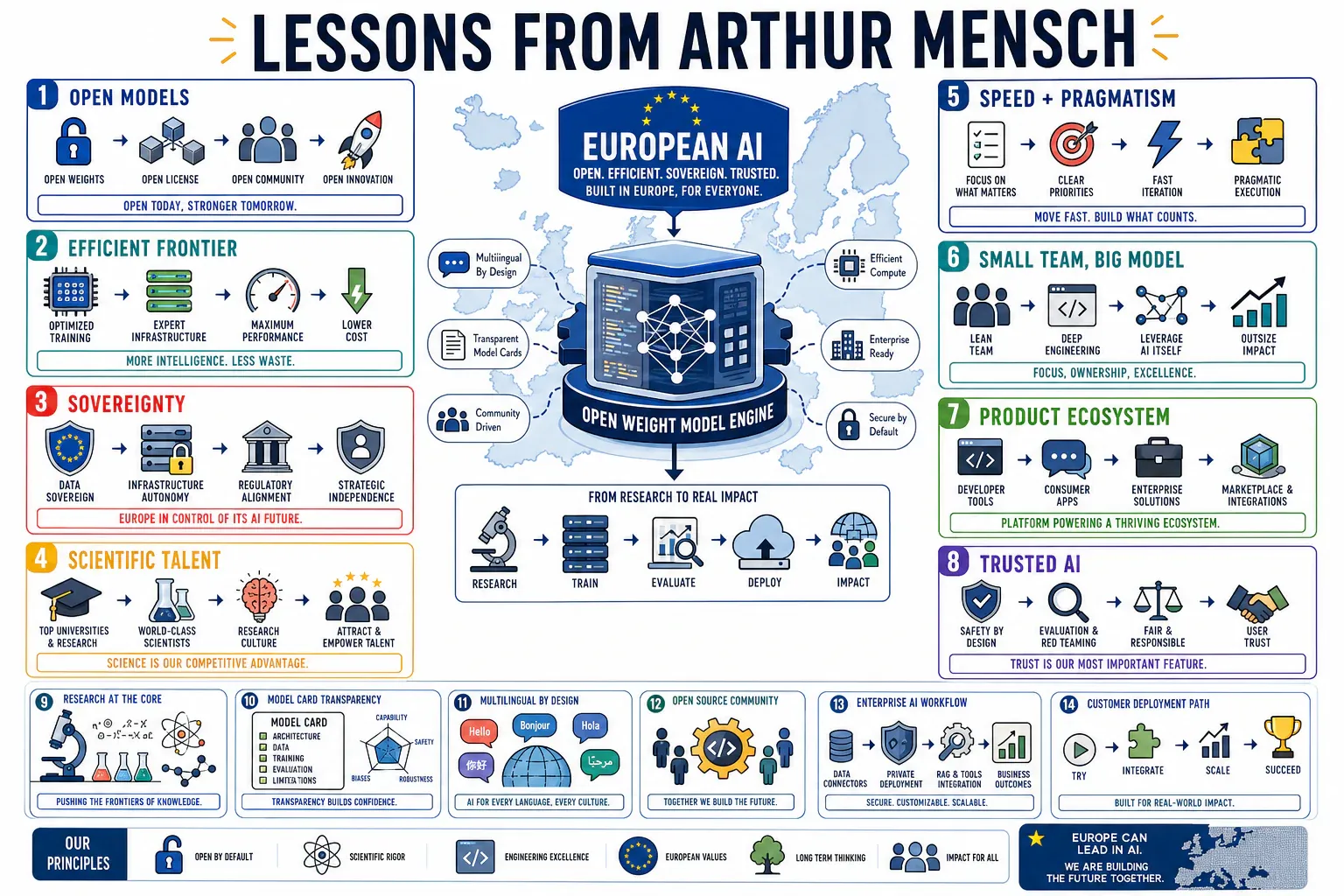
On Openness and Open Source
Learnings:
- Open Releases Can Create an Alternative to an AI Oligopoly: Mistral argues that training its own models, releasing them openly, and fostering community contributions can build a credible alternative to an emerging AI oligopoly.
- Open Models Enable External Auditing: Mistral argues that community-backed development helps fight censorship and bias, while open models let public institutions and companies audit systems for flaws and misuse.
- Open Weights Give Developers Control: Releasing model weights lets developers deploy models on their own infrastructure and customize guardrails, editorial tone, and fine-tuning instead of depending entirely on a black-box API.
- Open Releases Can Challenge an AI Oligopoly: Mistral argues that releasing its own models openly and fostering community contributions can create a credible alternative to an emerging AI oligopoly.
- Openness Is Part of Mensch’s Safety Case: Mensch has argued that open-source development puts AI under the highest level of scrutiny.
Quotes:
- Mistral’s launch statement put the principle plainly: “At Mistral AI, we believe that an open approach to generative AI is necessary.”
- Mensch linked broad access to safety: “We’re betting on making our models available to everyone so that … everyone can understand the capabilities they may have, even for attackers. And we think that’s going to lead us to a safer system.”
- Mensch warned against concentrated control of AI: “We don’t want to be in a world where three or four enormous companies own the making and deployment of AI.”
- Treat AI Models as Software Infrastructure: Mensch argues that AI is another abstraction of software, so broad restrictions on model release miss the point; quality and risk controls should focus on applications placed on the market.
On Competition and Strategy
Learnings:
- Pair Capital Efficiency with Small Research Squads: Mensch says Mistral can spend a fraction of what competitors spend by pursuing capital efficiency, while organizing research into five-person squads for areas such as data and pretraining.
- Build a European Frontier Competitor: Mensch points to France's pool of experienced model builders and says Mistral intends to compete at the frontier and eventually become as competitive as the leading labs.
- Successful AI Research Teams Stay Small: Mensch says AI teams that succeed are typically four or five people, and Mistral organizes work into five-person squads for areas such as data and pretraining.
- Pair Foundation Models with a Developer Platform: Mistral builds foundational models, then adds a portable enterprise platform and developer tools so customers can customize and deploy them.
- Combine Leading Open Models with Paid Premium Services: Mistral intends to offer leading open-source models alongside premium features available through monetized services.
Quotes:
- Mensch set a frontier-level ambition for Mistral: “We also intend to compete on the frontier” and “eventually to be as competitive as the others.”
- Recognize the Window and Move Quickly: Mensch says he and co-founders Guillaume Lample and Timothée Lacroix were at DeepMind and Meta when GPT convinced them there was an opportunity to create a company quickly and recruit a strong team from day one.
- Aim to Release the Best Open-Source Models: Mensch says Mistral's purpose is to release the best open-source models, supported by enterprise features that can sustain the business.
On AI Regulation and Policy
Learnings:
- Regulate Applications, Not Foundation Models: Mensch argues that rules should target applications placed on the market rather than the foundational models or infrastructure used to build them.
- Separate Ill-Defined Existential-Risk Debate from Product Safety: Mensch argues that debate about ill-defined existential risk should not displace practical work on controlling deployed models, evaluating outputs, handling bias, and setting editorial tone.
- Balance State Support with Regulatory Restraint: Mensch says state support matters for European AI companies, but warns that European regulators tend to move too quickly.
Quotes:
- Guard Against Regulatory Capture: Mensch argues that European rules should target applications rather than foundation models, describing that approach as the only enforceable way to prevent U.S. regulatory capture.
On the Future of AI and Technology
Learnings:
- Measure AI by Empowerment and Usefulness: Mensch says the goal is not abstract intelligence but useful systems that combine technical and business knowledge to accelerate technological progress.
- Treat AGI as a Direction, Not a Finish Line: Mensch describes AGI as the direction of accelerating technological progress, with substantial work still needed across physical understanding, human behavior, legacy systems, organizations, and deployment.
- Expect Commoditization and Reduce Vendor Lock-In: Mensch expects AI technology to commoditize and says building on open-source models leaves users less locked into a single vendor.
Quotes:
- Treat AI as an Open Scientific Frontier: Mensch says current systems solve some problems well but still struggle to understand humans, interact with the physical world, and work across fields such as robotics, materials science, and biotechnology.
On Building and Deploying AI Systems
Learnings:
- Shift the Focus from Models to Systems: Mensch argues that useful AI combines models with contextual data and tools so it can act on a user's behalf, while adopters encode their own expertise into the system.
- Work Backward from the Business Problem: Instead of starting with an AI solution, Mensch recommends choosing a valuable workflow, working with subject-matter experts, and customizing the system to the process or machine being improved.
- Replatform Workflows without Discarding Systems of Record: Mensch expects custom AI applications to replace some vertical workflow software, while the databases and record systems that hold organizational data continue to serve as infrastructure.
- Fit Robotics Models to the Platform and Mission: Mensch says robotic control models must be customized to the hardware, mission, data, actions, and guardrails, with early deployments favored where machines can take on work that is unsafe for humans.
Sources
- Mistral AI — “Bringing open AI models to the frontier”
- Mistral AI — About Mistral
- Elad Gil — Discussion with Arthur Mensch
- TIME — Mistral AI's CEO on Microsoft and Europe's AI Ecosystem
- Arthur Mensch — Statement after the AI Safety Summit
- Sequoia Capital — Open sourcing the AI ecosystem
- CNBC International — Europe Wants an AI Champion. Can Mistral Deliver?
- Sifted — Mistral CEO warns against U.S. dominance in AI
- TIME — E.U. AI regulation and foundation models
- Big Technology Podcast — Who Wins if AI Models Commoditize?
- École Polytechnique — Arthur Mensch on AI and entrepreneurship
- CNBC — Mistral sees the world moving beyond AI models
- CNBC — Enterprise software could switch to AI
- The Economic Times — Mistral sees AI as utility
- École Polytechnique — Mistral AI company and alumni profile