Boris Cherny is a software engineering leader and the author of "Programming TypeScript," widely recognized for his work at Anthropic, Airbnb, and Facebook. His insights bridge the gap between rigorous static typing and the high-velocity world of AI-native software development, redefining what it means to be a "builder" in the modern era.
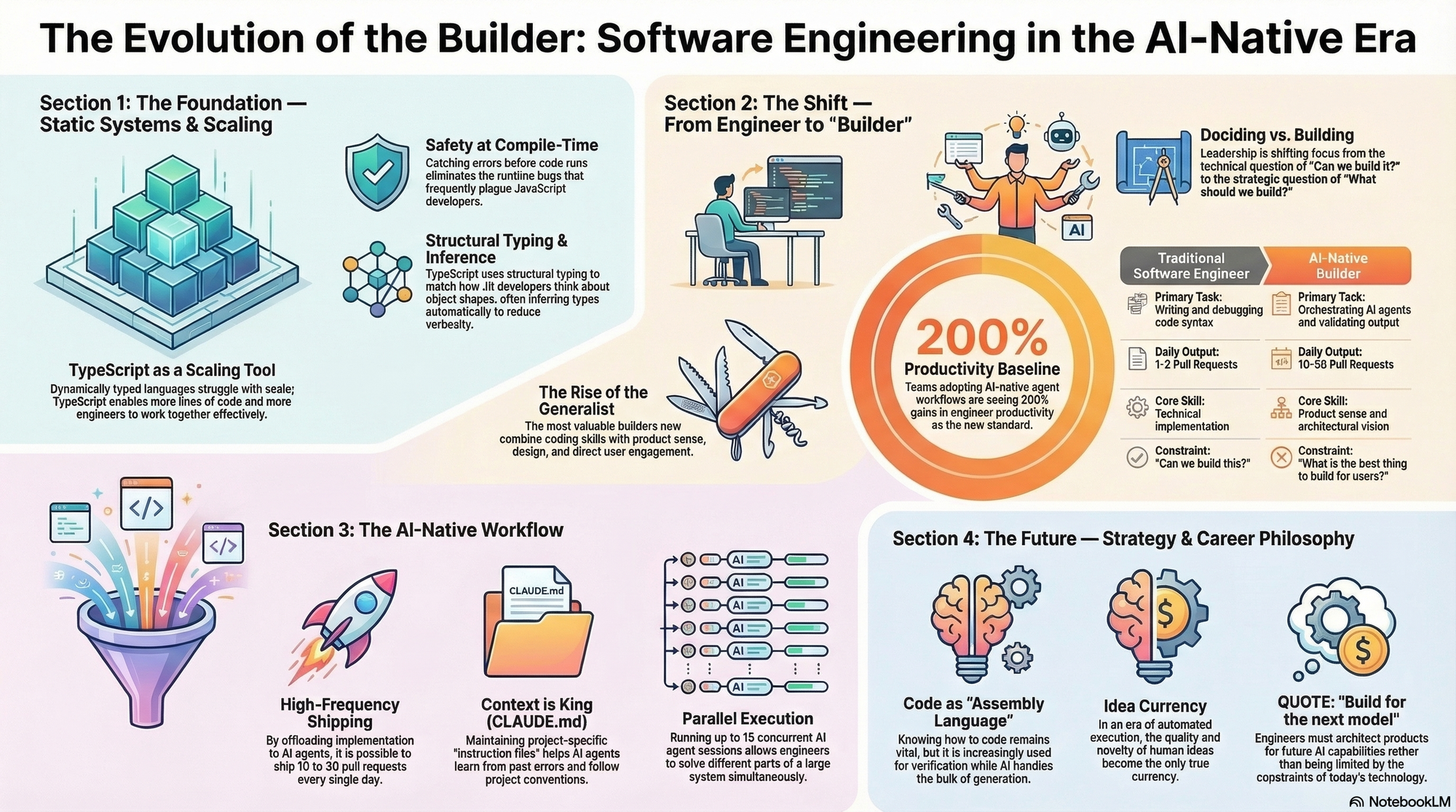
Part 1: Mastering TypeScript and Static Systems
- On Scaling JavaScript: "Any programmer working with a dynamically typed language will tell you how hard it is to scale to more lines of code and more engineers." — Source: Goodreads
- On TypeScript's Primary Value: "TypeScript makes programming fun with its powerful static type system, enabling you to eliminate bugs in your code and scale across more engineers." — Source: O'Reilly
- On Gradual Typing: "TypeScript is a gradually typed language, allowing for compile-time verification of JavaScript projects incrementally without adding excessive burden." — Source: SE Radio
- On Type Inference: "TypeScript can infer types for most elements without explicit declarations, making the language less verbose while maintaining safety." — Source: Lucky Bookshelf
- On Compile-Time Safety: "Errors caught at compile time, before the code ever runs, significantly reduces the occurrence of runtime bugs that plague JS developers." — Source: Bookey
- On the Role of the Compiler: "The TypeScript compiler (TSC) translates code while performing checks; type annotations exist only for validation and do not affect execution." — Source: Lucky Bookshelf
- On Structural Typing: "TypeScript uses structural typing to determine compatibility, which naturally reflects how JavaScript developers think about object shapes." — Source: SE Radio
- On JavaScript Compatibility: "Every valid JavaScript program is also a TypeScript program, though it might not initially pass all type-checks." — Source: YouTube
- On Function Safety: "Functions are the fundamental building blocks of any TypeScript application; typing their inputs and outputs correctly is the first step to a robust system." — Source: Programming TypeScript
- On Advanced Type Logic: "Mastering mapped and conditional types allows you to express complex data relationships in a way that is both safe and readable." — Source: Programming TypeScript
Part 2: The Evolution of Engineering Leadership
- On the Changing Engineering Role: "Engineering is changing and great engineers are more important than ever because they must now orchestrate complex AI systems." — Source: Simon Willison
- On Human-AI Coordination: "Someone still has to prompt the Claudes, talk to customers, and decide exactly what to build next." — Source: Simon Willison
- On Generalist Talent: "I love engineers who code but also do product work, handle design, and have the product sense to talk to their users." — Source: Developing.dev
- On the Evolution to 'Builder': "The traditional 'software engineer' title will evolve into 'builder,' where all team members engage in coding with AI assistance." — Source: Waydev
- On Strategic Token Usage: "CTOs should start by giving engineers as many tokens as possible during experimentation to maximize creative output." — Source: Lenny's Newsletter
- On Project Underfunding: "Underfunding projects slightly can force teams to leverage AI tools like Claude more effectively to fill resource gaps." — Source: Business Insider
- On Deciding vs. Building: "The primary challenge for leadership is shifting from 'can we build it?' to 'what should we build?'" — Source: Roger Wong
- On Management's New Focus: "Managers must focus on architecture and user problems rather than technical minutia, which AI is increasingly solving." — Source: Waydev
- On Productivity Metrics: "In the AI era, productivity gains of 200% per engineer are the new baseline for teams that adopt native agent workflows." — Source: Simon Willison
- On Hiring for Product Sense: "When technical implementation is commoditized, hiring for curiosity and product sense becomes the competitive advantage." — Source: Lenny's Newsletter
Part 3: High-Performance Product Development
- On Rapid Prototyping: "AI allows us to make the magic of rapid prototyping a reality, enabling engineers to build complex features in hours rather than weeks." — Source: YouTube
- On Forward-Looking Architecture: "Build products with an eye toward future AI capabilities, rather than being constrained by the limits of today's models." — Source: YouTube
- On the Solvability of Coding: "At this point, it is safe to say that coding is largely a solved problem for the vast majority of applications." — Source: Waydev
- On Eliminating Technical Minutia: "I have never enjoyed coding as much as I do today because I don't have to deal with the tedious details of implementation." — Source: Waydev
- On Engineering Satisfaction: "Engineers are enjoying their jobs more as AI handles git wrangling and dependency hell, leaving them with the high-level puzzles." — Source: Waydev
- On Systematic Feedback Loops: "Documenting mistakes in a project-specific instruction file allows AI to learn from past errors and improve its output over time." — Source: Implicator.ai
- On User-Centric Development: "The most important input for a builder is direct conversation with the user; the AI can handle the rest of the stack." — Source: Developing.dev
- On High-Frequency Shipping: "By offloading implementation to agents, it's possible to ship 10 to 30 pull requests every single day." — Source: Simon Willison
- On Validation as the New Writing: "The engineer's job has shifted from writing the code to reviewing, validating, and ensuring the quality of AI-generated work." — Source: YouTube
- On Architectural Boundaries: "Architecture matters more than ever in an AI world because agents need clear boundaries and modular systems to be effective." — Source: Waydev
Part 4: AI-Native Engineering Workflows
- On Parallel Agent Sessions: "Run multiple instances of your AI agents in parallel to maximize efficiency and avoid waiting for a single task to finish." — Source: Medium
- On Context Maintenance: "Context is a valuable but fragile resource; engineers must keep it fresh and documented to maintain AI performance." — Source: Implicator.ai
- On AI-Native Coding Adoption: "Since late 2025, I have written 100% of my production code using AI, focusing entirely on intent and verification." — Source: Simon Willison
- On Concurrent Workstreams: "Executing up to 15 concurrent sessions allows you to solve different parts of a large system simultaneously." — Source: Medium
- On Instruction Files (CLAUDE.md): "Maintain a living codebase for your AI's 'brain' using files like CLAUDE.md to store project conventions and rules." — Source: Implicator.ai
- On Cost Optimization Strategies: "Only focus on the cost of AI tokens after an idea is proven; use the highest-tier models early to ensure quality." — Source: Lenny's Newsletter
- On Error Records: "AI learns best when past errors are systematically recorded within the project context for the model to reference." — Source: Medium
- On Process Automation: "Automate everything that doesn't require a creative decision, from linting to infrastructure deployment." — Source: SE Radio
- On Model Access for Teams: "Don't bottleneck your team's creativity by limiting access to the largest, most capable language models." — Source: YouTube
- On AI-Generated Documentation: "AI agents are better than humans at writing their own PR descriptions and keeping documentation in sync with code changes." — Source: Simon Willison
Part 5: Career Philosophy and the Future of Work
- On Workplace Disruption: "AI agents will fundamentally alter every kind of work that can be performed on a computer, far beyond just coding." — Source: Quasa.io
- On the Transition Pain: "The shift to AI-native work will be very disruptive and potentially painful for those who do not adapt their skills." — Source: Quasa.io
- On Human Vision: "The human in the loop exists to coordinate vision, negotiate with other teams, and set the long-term direction." — Source: Simon Willison
- On Code as Assembly Language: "Knowing how to code remains vital, but it is fast becoming the 'assembly language' of the future, used for verification." — Source: Waydev
- On Fast-Moving Fields: "In a field moving this fast, you must build for the capabilities of the next model, not just the one you have today." — Source: YouTube
- On the Return of the Builder: "Engineering is more fun now because we are builders again, focused on the 'why' rather than just the 'how'." — Source: Waydev
- On T-Shaped Skills: "To stay relevant, engineers must intentionally develop skills in product management, design, and user psychology." — Source: Developing.dev
- On Software Deflation: "AI is a deflationary force for software development, making it possible to build 10x more for a fraction of the cost." — Source: Lenny's Newsletter
- On Idea Currency: "In an era of automated execution, the quality and novelty of your ideas are the only true currency." — Source: Roger Wong
- On the Ultimate Goal of Tooling: "The goal of all developer tools is to get out of the way so the user's idea can reach the world as fast as possible." — Source: SE Radio