Alex Graveley has built GitHub Copilot, Hackpad and Dropbox Paper, and later worked on Minion AI and Perplexity’s Comet browser. His direct interviews and writing discuss AI product design, agents and lessons from founding companies. — Alex Graveley Résumé.
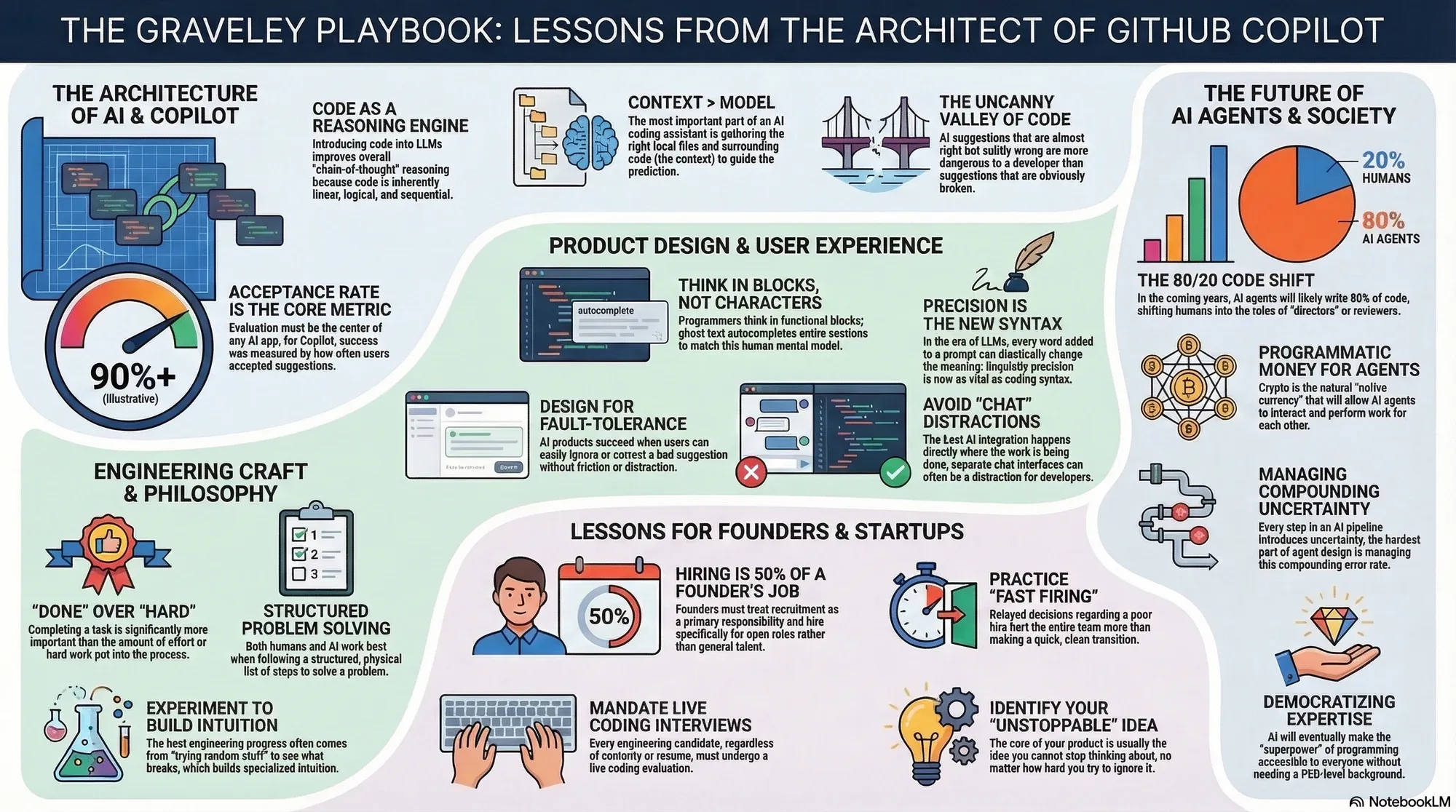
Part 1: The Architecture of AI & Copilot
- On Code as Reasoning: Graveley thought adding code to early language-model training had helped chain-of-thought reasoning; he pointed to code’s sequential structure as a possible reason. — No Priors Interview.
- On Baseline Evaluation: For Copilot, the team tested model and prompt improvements by removing a Python test body, asking the model to generate it and running the test; Graveley describes a steady rise in successful generations. — Building With AI Interview.
- On Training Artifacts: The early code model was a small training experiment, not a polished coding assistant; Copilot improved through better models, prompts and product design. — No Priors Interview.
- On Latency as a Feature: Copilot completion latency mattered because a suggestion arriving after the developer had typed past its position was no longer useful; the team investigated regional network delays. — No Priors Interview.
- On Model Malleability: Graveley distinguishes broad pre-training from more malleable, faster-iterating post-training when deciding how to adapt an AI system. — Building With AI Interview.
- On Determinism: Building with LLMs calls for trial and error rather than assuming the deterministic intuition used for conventional software will always predict behavior. — Building With AI Interview.
- On Context Windows: The Copilot team improved coding suggestions not only with models but with prompting and training context that included earlier code versions and diffs. — No Priors Interview.
- On Inspectable Suggestions: Copilot’s block-level ghost text let a developer quickly judge a suggested completion against the current block; the value lay partly in making imperfect output easy to evaluate. — No Priors Interview.
- On Code History: Graveley describes Copilot’s code model learning from a large body of GitHub code and diffs; the product still depended on prompt, latency and interface work. — No Priors Interview.
- On Tiny Teams: A very small GitHub team pursued Copilot while many colleagues doubted AI applications would work, then iterated through substantial model and product improvements. — Building With AI Interview.
- On Context budgets: In Tenzin Wangdhen’s account of working with Graveley, Graveley favored short prompts for familiar implementation tasks and spent context on the project’s distinctive constraints. — The Power of Focus in Agentic Coding.
Part 2: Product Design & User Experience
- On Thinking in Blocks: Copilot’s team moved beyond single-line autocomplete because developers could assess whether a suggested block of code did what they intended. — No Priors Interview.
- On Fault-Tolerant UX: An assistant is easier to use when a person can inspect and correct its output; Graveley’s early assistant prototype let human operators edit suggested replies before sending them. — Building With AI Interview.
- On Reducing Friction: In Minion, Graveley tried to reduce the steps between a user request and a completed browser task by having the agent navigate pages, ask for missing details and check before payment. — Building With AI Interview.
- On Iterative Interfaces: Graveley sees AI as enabling iterative interfaces in which the user and system refine an answer or action through feedback. — Building With AI Interview.
- On Real-Time Collaboration: Graveley founded Hackpad as a real-time collaborative wiki and later shipped Dropbox Paper based on that work. — Alex Graveley Résumé.
- On Chat and Action: Minion used a chat entry point but carried out the requested task in the browser; the useful design distinction is acting in the workflow, not avoiding chat altogether. — Building With AI Interview.
- On User Trust: Graveley says trust grows from asking hard questions and from questioning prior assumptions. — 2x Founder Mistakes.
- On Constraining the Action Space: For an LLM agent, Graveley worked to constrain the available action space and improve the model’s reasoning about each page and user request; the original does not claim every prompt word has a drastic effect. — Building With AI Interview.
- On Design Simplicity: Graveley recommends keeping an LLM workflow’s action space small where possible, because uncertainty accumulates across multiple model calls. — Building With AI Interview.
- On Scope creep: Wangdhen reports that working with Graveley shifted his focus from generating more code to finishing the few tasks that actually moved a user-facing milestone. — The Power of Focus in Agentic Coding.
Part 3: Lessons for Founders & Startups
- On Hiring for Roles: Hire for an open role that exists now, rather than recruiting generally impressive people without a clear need. — 2x Founder Mistakes.
- On Live Coding: Graveley recommends live coding interviews for engineering candidates. — 2x Founder Mistakes.
- On Raising Capital: Raise capital when you are confident about where the company is going. — 2x Founder Mistakes.
- On Remote Work: Graveley cautions that many people are less effective working remotely than in person. — 2x Founder Mistakes.
- On Learning Curves: At an early startup, he advises against counting on a new hire to learn a whole new area of expertise during a critical build. — 2x Founder Mistakes.
- On Decision Speed: When a hire clearly is not working out, Graveley’s succinct advice is to fire fast. — 2x Founder Mistakes.
- On Personal Accountability: He urges a shift from vague collective intention toward a specific personal commitment to act. — 2x Founder Mistakes.
- On Founder Failure Modes: Graveley names poor health and loneliness as founder failure modes worth taking seriously. — 2x Founder Mistakes.
- On Hiring Responsibility: Graveley says hiring accounts for roughly half a founder’s job. — 2x Founder Mistakes.
- On the Core Idea: The product idea a founder cannot shake may point toward the company’s core, in Graveley’s experience. — 2x Founder Mistakes.
- On Fake work: Wangdhen reports that Graveley called unneeded agent-produced work “fake work”: activity that neither moves a metric nor removes a blocker for users. — The Power of Focus in Agentic Coding.
- On Early Optimization: In Wangdhen’s account, Graveley warned that building for scale while the product had only a handful of users could be a form of avoidance. — The Power of Focus in Agentic Coding.
- On Task Execution: Wangdhen describes Graveley turning a vague week of work into a short handwritten task list and working through it toward a specific shipped milestone. — The Power of Focus in Agentic Coding.
Part 4: The Future of Agents & AI Society
- On Heavy Copilot Use: Graveley observed that Copilot already wrote an unusually high share of code for some heavy users, while saying that a future in which agents wrote almost all code was hard for him to imagine. — No Priors Interview.
- On AI Dangers: Graveley said he was more immediately worried about malicious people using AI than AI itself killing humanity, while appreciating that others study existential risks. — No Priors Interview.
- On Societal Resilience: Discussing AI misuse, Graveley endorsed the idea of stress-testing social defenses, including stronger detection of automated impersonation and spam. — No Priors Interview.
- On the Agentic Shift: Graveley’s Minion example shows an agent navigating web pages, asking the user for missing information and taking bounded steps toward a completed task. — Building With AI Interview.
- On Problem Decomposition: Graveley argues that an agent can approach a complex task by breaking it into a list of steps, gathering needed information and using tools as required. — No Priors Interview.
- On Compounding Uncertainty: Uncertainty compounds across an LLM pipeline: even individually reliable steps can produce a poor outcome when chained together. — Building With AI Interview.
- On Building Without a PhD: Graveley later concluded that he did not need a mathematics PhD to build useful AI applications and wishes he had kept experimenting earlier. — Building With AI Interview.
- On Executable Feedback: Executable code gives an AI-produced answer a useful test: running it can reveal something about whether the result works. — No Priors Interview.
- On The Human Bottleneck: As agents handle larger software goals, Graveley says human attention becomes a bottleneck; his proposed direction gives agents broader business context while preserving coordination among parallel work. — Omniscient Agents.
Part 5: Engineering Craft & Open Source Philosophy
- On the 'Just Try It' Mentality: For AI application builders, Graveley recommends trying ideas and observing what works; repeated experiments helped Copilot improve from weak early results. — Building With AI Interview.
- On Learning in the Open: Graveley recalls being drawn to open-source work because the GPL and sharing code publicly let others learn from the same work that had taught him. — No Priors Interview.
- On Shipping: Graveley emphasizes completing the work over merely putting in long hours. — 2x Founder Mistakes.
- On Asking for Help: Asking for help is a strength, Graveley writes in his founder-mistakes list. — 2x Founder Mistakes.
- On Continuous Learning: Graveley says no one yet has a complete answer for how to build AI software, so an unknown area can be an opportunity to experiment. — Building With AI Interview.
- On Appreciation: Graveley reminds founders to pause and appreciate the work along the way. — 2x Founder Mistakes.
- On Undirected scope: Wangdhen’s firsthand account says Graveley constrained an agentic-coding sprint to a fixed task list; adding more concurrent agents without direction had increased unfinished work. — The Power of Focus in Agentic Coding.
- On Done-states: In Wangdhen’s account, each item in Graveley’s short task list needed an observable done-state that could be checked when the work shipped. — The Power of Focus in Agentic Coding.