Anthropologist and ethnobotanist Wade Davis has spent his career documenting indigenous cultures and the natural world. He is best known for the concept of the ethnosphere, arguing that human cultural diversity is just as fragile and important as biological diversity. These lessons draw from his fieldwork among remote groups, his botanical studies, and his observations on modern society.
Part 1: The Ethnosphere and Cultural Relativism
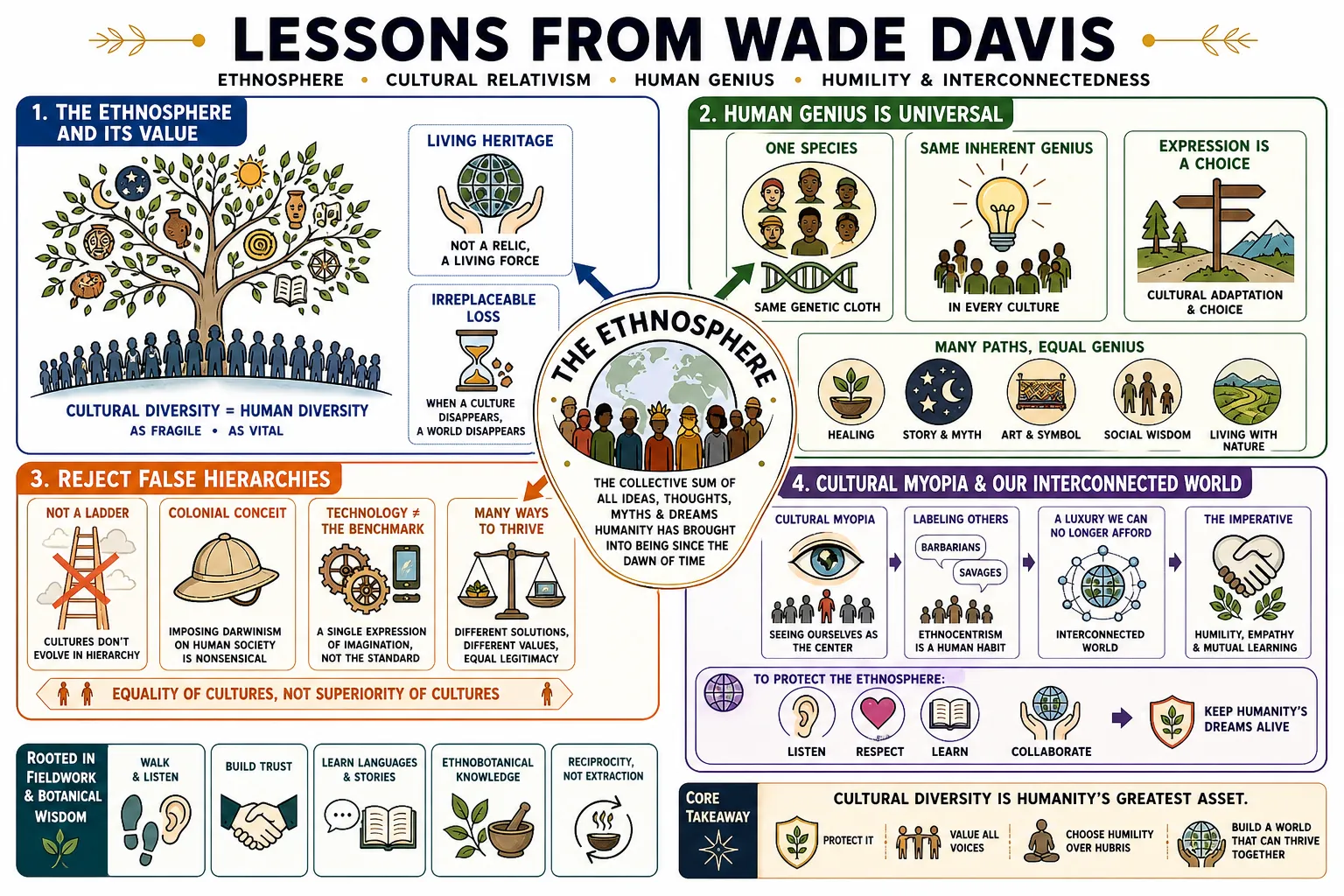
- On the ethnosphere: The ethnosphere represents the collective sum of all ideas, thoughts, myths, and dreams that human consciousness has brought into being since the dawn of time. — Reference: The Ethnobotanical Assembly
- On human genius: Scientific and genetic evidence reinforces the core anthropological truth of cultural relativism, proving that all people are cut from the same genetic cloth and possess the same inherent genius. — Reference: 52 Insights
- On false hierarchies: The idea that cultures evolve and improve in a hierarchy of success is a nonsensical colonial conceit, wrongly attempting to impose Darwinian principles on human society. — Reference: 52 Insights
- On technology and progress: A society's technological sophistication is a single specific manifestation of human imagination, not the definitive benchmark by which all human advancement should be measured. — Reference: 52 Insights
- On cultural myopia: It is a ubiquitous human trait for cultures to view themselves as the center of the world, often defining neighboring tribes as barbarians or savages, but this ethnocentrism is a luxury an interconnected world can no longer afford. — Reference: 52 Insights
- On the parallel tracks of loss: The same economic and industrial forces that threaten and erode the planet's biological diversity are simultaneously destroying its cultural diversity. — Reference: The Ethnobotanical Assembly
- On differing environmental lenses: Whether a culture regards a mountain as inert geology or as a living deity shapes how people manage, respect, and relate to that landscape. — Reference: National Geographic Education
- On ecological reciprocity: Many Indigenous societies organize their relationship with nature around reciprocity: the earth offers its bounty, and people owe the earth fidelity in return. — Reference: Qualia
- On humanity's ecological role: Traditional cultures often see people not as an unavoidable ecological burden but as participants whose rituals and responsibilities help maintain natural balance. — Reference: Qualia
- On the cultural roots of climate change: The climate crisis is a problem for all humanity, but it arose from a particular worldview that stripped nature of spirit and consumed its stored energy as a commodity. — Reference: Qualia
- On botanical scapegoating: Efforts to eradicate traditional coca fields began decades before cocaine became a public problem, revealing that prohibition was also an attack on Indigenous cultural identity. — Reference: The Tim Ferriss Show #871
Part 2: Fieldwork and the Study of Other Cultures
- On botany as a bridge: Studying plants provided a concrete, grounded way to approach indigenous communities as a humble apprentice seeking mentorship, rather than turning up as an outsider demanding to study their personal lives. — Reference: The Ethnobotanical Assembly
- On the academic divide: Historically, there was a deep chasm between biologists, who often viewed indigenous people as an environmental problem, and anthropologists, who resented the elitism they perceived in naturalists. — Reference: The Ethnobotanical Assembly
- On the scholar as activist: The lessons of biology and anthropology are too vital to remain hidden away inside universities; anthropologists have a duty to speak out and act as advocates for the societies they study. — Reference: 52 Insights
- On recognizing cultural divides: Growing up in Quebec, divided by a physical boulevard into distinct English and French communities, served as an early lesson in recognizing the subtle cultural prohibitions that keep people from understanding alternative ways of living. — Reference: 52 Insights
- On the Canadian frontier: Unlike the United States, Canada was initially formed as a merchant society built around the fur trade rather than a settler society attempting to conquer the land. — Reference: Mongabay
- On the erasure of identity: Denying Andean communities access to coca is not comparable to removing an ordinary beverage; the plant is woven into their spiritual identity, social obligations, and relationship with Pachamama. — Reference: The Tim Ferriss Show #871
Part 3: Spirituality, Myth, and the Psychedelic Experience
- On the role of the shaman: A shaman's primary function is to unleash an individual's wild genius and free their spirit, often utilizing techniques of ecstasy or trance to achieve their ends. — Reference: The Ethnobotanical Assembly
- On the role of the priest: Unlike shamans who focus on individual release, priests exist to socialize people into a manageable congregation, serving the interests of a state or a powerful orthodoxy. — Reference: The Ethnobotanical Assembly
- On psychedelics: Psychedelic substances possess a subversive power precisely because they unleash uncontrollable aspects of the human experience that fall outside the bounds of managed, orthodox religion. — Reference: The Ethnobotanical Assembly
- On changing social acceptance: Plant medicines like ayahuasca have transitioned in a couple of generations from being entirely obscure to the Western public to becoming commonly recognized and utilized. — Reference: The Ethnobotanical Assembly
- On forms of divine connection: Cultures structure religious ecstasy differently: some speak about the divine, some seek direct communion with it, and others experience spirit through embodied possession and dance. — Reference: Qualia
- On psychedelics and social change: Modern histories often understate how widespread psychedelic experiences helped catalyze twentieth-century movements around civil rights, feminism, and environmental awareness. — Reference: Qualia
- On ritual manifestation: In some Amazonian traditions, ceremonial participants do not merely symbolize ancestors or natural forces; within the ritual, they become those presences. — Reference: Qualia
Part 4: The Craft of Storytelling and Writing
- On the medium of anthropology: Communicating the lessons of anthropology requires narrative and storytelling rather than relying on strict politics or academic polemics. — Reference: The Ethnobotanical Assembly
- On grammar as a foundation: A deep, intuitive grasp of grammar acts as the fundamental architecture of writing; without understanding these basic structural rules, it is impossible to become an effective writer. — Reference: The Tim Ferriss Show #652 Transcript
- On respecting the audience: Simplifying complex cultural stories until their substance disappears insults both the people being documented and the audience expected to understand them. — Reference: National Geographic Education
Part 5: Environmental Conservation and Western Landscapes
- On the degradation of the Colorado River: What was once a vibrant waterway and monument to natural heritage has been degraded into a plumbing system meant to connect massive reservoirs. — Reference: Outside Online
- On flawed agricultural ideals: Western expansion was driven by a misguided Jeffersonian belief that the arid landscape could be neatly divided so every person could have their own cultivated farm. — Reference: Outside Online
- On ruining rivers for minor gains: Western expansion decimated almost every river in the arid West, yet only managed to successfully cultivate an area roughly the size of Missouri. — Reference: Outside Online
- On flawed water rights: The original flow estimates used to partition the Colorado River were calculated during unseasonably wet years in the 1920s, resulting in drastic overestimations of the water actually available. — Reference: Outside Online
Part 6: Perspectives on American Exceptionalism
- On the illusion of the American empire: The devastation of the COVID-19 pandemic definitively stripped away the lingering myth of American exceptionalism. — Reference: Mongabay
- On manufacturing and capability: A nation that formerly manufactured fighter planes by the hour and defeated polio was abruptly exposed as being unable to produce basic paper masks and cotton swabs during a medical crisis. — Reference: Mongabay
- On the impermanence of empires: No empire or historical era remains fixed at its height; recognizing that every epoch eventually changes is a necessary form of political humility. — Reference: CBC Radio IDEAS
Part 7: Action, Opportunity, and the Course of Life
- On the source of creativity: Growing up in a middle-class environment can foster the misconception that creativity is a subjective spark that strikes at random, when in reality, it is the direct consequence of taking action. — Reference: 52 Insights
- On embracing opportunity: By placing oneself in situations where success is the only option, it is possible to achieve goals that previously seemed entirely out of reach. — Reference: The Ethnobotanical Assembly
- On opportunism: Young people should aim to be genuine opportunists who remain open to serendipity, rather than rigidly planning or scheming their paths in life. — Reference: The Ethnobotanical Assembly
- On scientific literacy: True leadership and civic qualification should require a fundamental understanding of biology, such as knowing the formula for photosynthesis. — Reference: Mongabay
- On building a career: A meaningful professional path is assembled choice by choice and experience by experience, not discovered as a fully formed destination. — Reference: National Geographic Education
Part 8: Masculinity, Discretion, and Heroism
- On quiet heroism: Early twentieth-century explorers like Charles Howard Bury operated with a sense of decorum and discretion, entirely unwilling to litter the world with their own egos. — Reference: The Guardian
- On integrated masculinity: It is possible for men to be secure enough in their masculinity to discuss love, paint watercolors, and collect butterflies, while still retaining the physical and mental fortitude to fight in trenches or climb the world's tallest peaks. — Reference: The Guardian