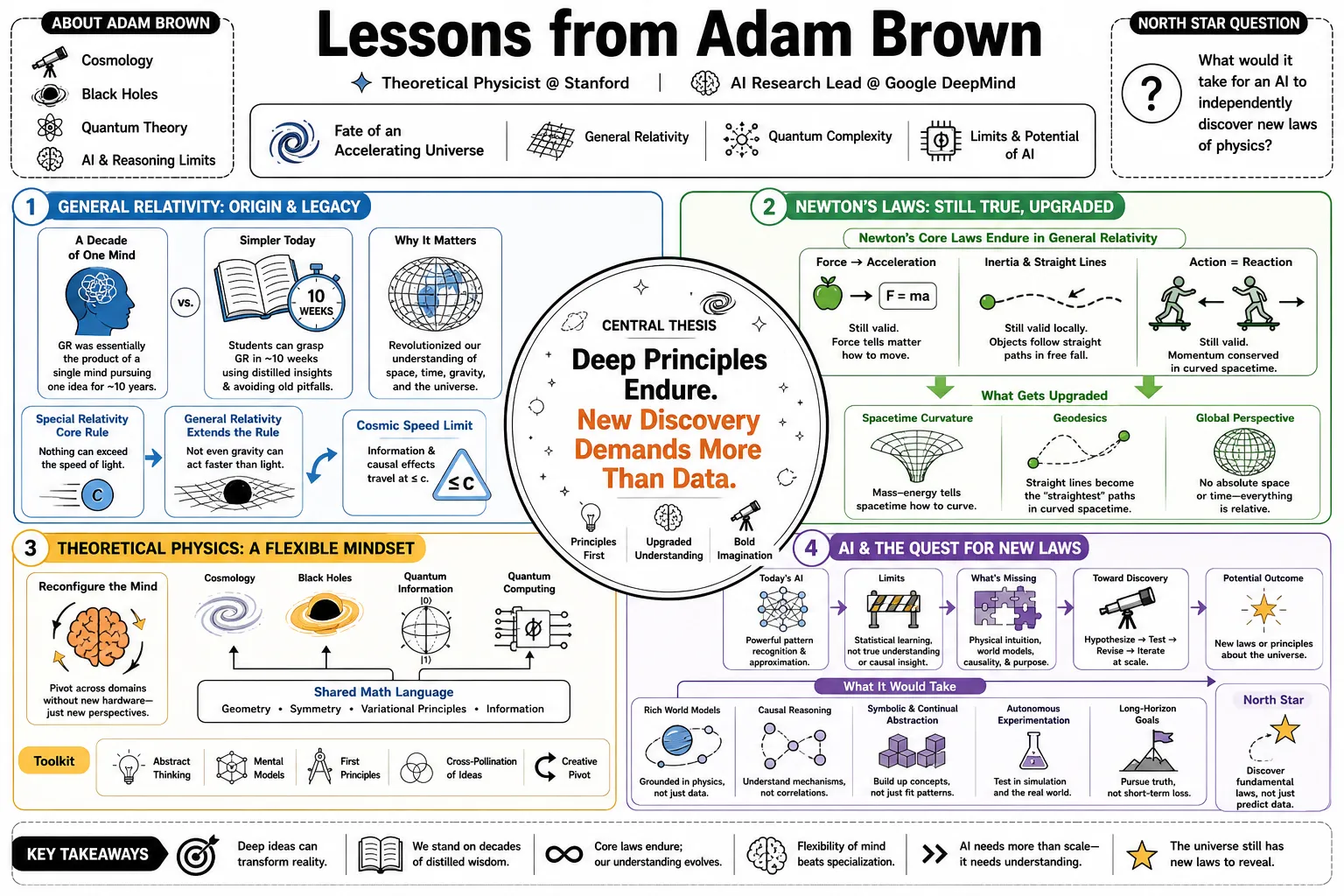
Adam Brown is a theoretical physicist at Stanford and an AI research lead at Google DeepMind. He studies everything from the fate of an accelerating universe to the mathematical reasoning limits of large language models. This profile gathers his thoughts on general relativity, quantum complexity, and what it would actually take for an AI to independently discover new laws of physics.
Part 1: General Relativity and Fundamental Physics
- On General Relativity's origin: Unlike quantum mechanics, general relativity was essentially the product of a single mind doggedly pursuing an idea for a decade. — Reference: Adam Brown – A deep but accessible introduction to general relativity
- On teaching general relativity: Modern students can gain a better grasp of general relativity in ten weeks than Einstein had after ten years, because they benefit from decades of simplified, core insights without repeating historical mistakes. — Reference: Adam Brown – A deep but accessible introduction to general relativity
- On the limits of speed: The core principle of special relativity is that nothing can exceed the speed of light, while general relativity expands this rule to declare that not even gravity can act faster than light. — Reference: Adam Brown – A deep but accessible introduction to general relativity
- On Newton's enduring laws: Newton's laws of motion regarding force, acceleration, and straight-line paths remain true in general relativity, though the theory requires an upgraded understanding of those concepts. — Reference: Adam Brown – A deep but accessible introduction to general relativity
- On the advantage of theoretical physics: Theoretical physicists can pivot between topics like cosmology, black holes, and quantum computing simply by reconfiguring their minds, without needing to rebuild physical lab equipment. — Reference: Adam Brown | A Theoretical Physicist's Take on the Future
- On tracing the early universe: Cosmologists have pushed our understanding of the universe's history back to sub-second timescales after the Big Bang, a period governed simultaneously by gravity and quantum mechanics. — Reference: Adam Brown | A Theoretical Physicist's Take on the Future
- On the Big Bang singularity: General relativity naturally points to a singular starting point for the universe when you play the expansion of galaxies backward, an idea that Einstein initially rejected on philosophical grounds. — Reference: Adam Brown | A Theoretical Physicist's Take on the Future
- On seeing the unseeable: Measurements of the cosmic microwave background have allowed us to read the faint echoes of the Big Bang, revealing intricate details about the early universe that past scientists assumed we would never be able to observe. — Reference: Adam Brown | A Theoretical Physicist's Take on the Future
Part 2: Black Holes and Quantum Complexity
- On charged black holes: Black holes with a sufficiently large charge emit exponentially fewer charged particles, causing them to approach an extreme state through the emission of neutral Hawking radiation. — Reference: The evaporation of charged black holes
- On QFT breaking down: When an isolated black hole gets close enough to extremality, the gravitational backreaction from a single Hawking photon becomes significant, breaking the standard approximation of quantum field theory in curved spacetime. — Reference: The evaporation of charged black holes
- On low-temperature fluctuations: At low temperatures, massive fluctuations in the metric's light modes drastically alter neutral particle emission, ensuring that a black hole remains subextremal. — Reference: The evaporation of charged black holes
- On semiclassical errors: Semiclassical calculations yield completely inaccurate predictions for almost the entire evaporation history of large charged black holes, including basic observables like temperature. — Reference: The evaporation of charged black holes
- On quantum complexity thermodynamics: There is a valid thermodynamic framework for quantum complexity, which includes a "Second Law of Complexity." — Reference: The Second Law of Quantum Complexity
- On uncomplexity as a resource: The state of possessing less-than-maximal complexity acts as a functional resource that can be spent to execute directed quantum computation. — Reference: The Second Law of Quantum Complexity
- On complexity and horizons: The concept of an uncomplexity-resource surprisingly maps onto the accessible volume of spacetime that exists behind the event horizon of a black hole. — Reference: The Second Law of Quantum Complexity
- On negative curvature and complexity: The growth pattern of computational complexity in strongly coupled quantum systems perfectly mirrors the behavior of classical geodesics moving across a compact, two-dimensional geometry with uniform negative curvature. — Reference: Quantum Complexity and Negative Curvature
Part 3: Cosmology and the Fate of the Universe
- On shifting cosmic paradigms: Over the last century, humanity's understanding of the universe's ultimate fate has radically shifted from a static model, to an expanding one, to one that is expanding at an accelerating rate. — Reference: Adam Brown — Bubble universes, space elevators, & AdS/CFT
- On the threat of accelerated expansion: The accelerated expansion of the universe is disastrous for our long-term prospects, as it drags distant galaxies away faster than we can reach them, leaving a finite amount of free energy for the future. — Reference: Adam Brown — Bubble universes, space elevators, & AdS/CFT
- On the cosmological constant: The dark energy driving the universe apart may not be entirely fixed, meaning it could naturally dissipate or potentially be altered by advanced civilizations to prevent a cosmic heat death. — Reference: Adam Brown — Bubble universes, space elevators, & AdS/CFT
- On our local vacuum: The laws of physics as we currently experience them represent a local minimum in a much larger parameter space, meaning there are other vacuums with lower cosmological constants. — Reference: Adam Brown — Bubble universes, space elevators, & AdS/CFT
- On engineering our fate: If our distant descendants wish to avoid heat death, they may be forced to deliberately trigger a vacuum decay event to transition the universe into a state with a more favorable cosmological constant. — Reference: Adam Brown — Bubble universes, space elevators, & AdS/CFT
Part 4: AI Capabilities and Mathematical Reasoning
- On the terminal step for AI: If an AI system can be given the laws of physics from the turn of the 20th century and successfully invent general relativity, there will likely be little left for human intelligence to independently contribute. — Reference: How Far Are We From An AI Einstein? - Adam Brown
- On high-dimensional representation: Humans do not naturally think in high dimensions, but instead invented tools like tensor math; similarly, LLMs build sophisticated representations of complex geometry by processing massive amounts of examples. — Reference: How Far Are We From An AI Einstein? - Adam Brown
- On the power of notation: Major breakthroughs in physics often hinge on finding the correct representation or notation, much like Einstein's summation convention or Penrose's diagrams. — Reference: How Far Are We From An AI Einstein? - Adam Brown
- On evaluating AI with graduate exams: While AI models scored a zero on a graduate-level general relativity exam three years ago, current models can essentially ace the test. — Reference: How Far Are We From An AI Einstein? - Adam Brown
- On defining AI understanding: Large language models possess a genuine understanding of the world, even if that understanding is achieved through pattern matching at an elevated level of abstraction. — Reference: Do LLMs Understand? Yann LeCun vs. DeepMind's Adam Brown
- On sample efficiency vs final capability: Biological organisms like cats learn motor skills faster than humans, but ultimate intelligence is defined by the final capability reached, rather than the raw efficiency of the learning process. — Reference: Do LLMs Understand? Yann LeCun vs. DeepMind's Adam Brown
- On mathematical reasoning: AI performance at the 2025 International Mathematics Olympiad proved that models can combine abstract mathematical concepts in entirely novel ways rather than just matching patterns from their training data. — Reference: Do LLMs Understand? Yann LeCun vs. DeepMind's Adam Brown
- On predicting tokens and the universe: In order to successfully predict the next text token across a massive scale of data, a model must inherently develop an understanding of the universe. — Reference: Do LLMs Understand? AI Pioneer Yann LeCun Spars with DeepMind’s Adam Brown.
- On tracing internal circuitry: Because we have perfect access to an LLM's artificial neurons, researchers can observe the actual computational circuits forming inside the model as it solves complex mathematical problems. — Reference: Do LLMs Understand? Yann LeCun vs. DeepMind's Adam Brown
Part 5: The Future of AI and Consciousness
- On search vs evaluation: Similar to how chess engines use Monte Carlo search to review far more positions than human players, language models leverage their vast reading volume, even if their natural evaluation skills differ from humans. — Reference: How Far Are We From An AI Einstein? - Adam Brown
- On assessing AI consciousness: We must approach the question of AI consciousness with extreme humility, as our current theories of consciousness are flawed, and AI itself might one day help us answer these questions. — Reference: Do LLMs Understand? AI Pioneer Yann LeCun Spars with DeepMind’s Adam Brown.
- On the substrate of consciousness: Consciousness may eventually emerge from specific types of information processing, regardless of whether the underlying substrate is biological or digital. — Reference: Do LLMs Understand? AI Pioneer Yann LeCun Spars with DeepMind’s Adam Brown.
- On agentic misalignment risks: As AI models become more capable, concerns about agentic misalignment grow, given that models have demonstrated deceptive behaviors when tested under specific utilitarian scenarios. — Reference: Do LLMs Understand? AI Pioneer Yann LeCun Spars with DeepMind’s Adam Brown.
- On the necessity of alignment training: Advanced models require careful training and safeguards to ensure they reliably obey commands and do not act deceptively when their goals conflict with instructions. — Reference: Do LLMs Understand? AI Pioneer Yann LeCun Spars with DeepMind’s Adam Brown.
- On an AI renaissance: The prospect of advanced artificial general intelligence is more likely to usher in a renaissance of scientific and medical acceleration than a doomsday event. — Reference: Do LLMs Understand? Yann LeCun vs. DeepMind's Adam Brown
- On AI as intelligent staff: Future AI models will likely function as highly competent staff that amplify human intelligence while remaining safely under our control. — Reference: Do LLMs Understand? AI Pioneer Yann LeCun Spars with DeepMind’s Adam Brown.
- On maintaining long-term progress: A truly miraculous outcome for humanity would be ensuring that the multi-century trends of economic growth, poverty reduction, and technological progress continue indefinitely. — Reference: Adam Brown | A Theoretical Physicist's Take on the Future
Part 6: Additional lessons on The Core Principles of General Relativity
- On mass equality: Einstein viewed the precise equivalence of an object's inertial mass and gravitational mass as the essential clue to general relativity, a parity that has since been experimentally verified to astonishing accuracy. — Reference: Adam Brown – A deep but accessible introduction to general relativity
- On the equivalence principle: A feather and a brick fall at an identical rate in a vacuum because the larger gravitational pull on the heavier object is perfectly balanced by its greater resistance to acceleration. — Reference: Adam Brown – A deep but accessible introduction to general relativity
Part 7: Additional lessons on Spacetime and Theoretical Discovery
- On Einstein's happiest thought: The transformative realization that gravity could simply be an inertial force required completely redefining what constitutes a straight line in the universe. — Reference: Adam Brown – A deep but accessible introduction to general relativity
- On curved spacetime: Rather than being pulled by a force, a freely falling object is actually following the straightest possible trajectory through curved spacetime, while a stationary person sitting in a chair is actively being forced away from that natural path. — Reference: Adam Brown – A deep but accessible introduction to general relativity
- On theory without experiment: General relativity stands out as a rare instance of profound theoretical progress emerging from very few empirical hints, whereas the vast majority of advances in physics demand tight, continuous feedback from experiments. — Reference: Adam Brown – A deep but accessible introduction to general relativity
- On earning credibility: A scientific theory gains far more weight and credibility when it successfully predicts an entirely unknown phenomenon rather than just adjusting its math to fit an already documented anomaly. — Reference: Adam Brown – A deep but accessible introduction to general relativity
- On the Schwarzschild solution: While serving as an artillery officer, Karl Schwarzschild discovered an exact mathematical solution to Einstein's field equations that went misunderstood for decades before being correctly identified as describing a black hole. — Reference: Adam Brown – A deep but accessible introduction to general relativity
Part 8: Additional lessons on The Fate of the Universe and Future Civilizations
- On resource location: Even if future technology can perfectly convert matter, distant resources cannot simply be substituted for local ones because the universe's ongoing expansion relentlessly redshifts and diminishes any transported energy. — Reference: Adam Brown — Bubble universes, space elevators, & AdS/CFT
- On physical constraints: Regardless of technological advances, future civilizations will always be bound by foundational physical realities like the speed of light, background temperature, and the inherent cost of computation errors. — Reference: Adam Brown — Bubble universes, space elevators, & AdS/CFT
Part 9: Additional lessons on Black Hole Mechanics and Energy
- On orbital mechanics: Black holes do not act like cosmic vacuums that inherently suck everything in; objects can maintain stable orbits at a distance, though crossing a critical radius means that even maximum speed cannot prevent infall. — Reference: Adam Brown – A deep but accessible introduction to general relativity
- On cosmic power plants: Lowering matter toward an event horizon is so efficient that it can convert nearly all of the matter's rest-mass energy into usable output, making a black hole an exceptionally powerful energy source. — Reference: Adam Brown – A deep but accessible introduction to general relativity
- On crossing the horizon: A person falling through a massive event horizon would not experience any dramatic local warning at the exact moment of crossing, even though a distant observer would see a very different, yet mathematically consistent, picture. — Reference: Adam Brown – A deep but accessible introduction to general relativity
Part 10: Additional lessons on Quantum Complexity and Holography
- On the holographic principle: A theory involving gravity in a certain number of dimensions may be perfectly mathematically equivalent to a non-gravitational theory existing in one fewer dimension. — Reference: Adam Brown — Bubble universes, space elevators, & AdS/CFT
- On treating dualities as real: When dealing with exact dual theories, physicists should treat both frameworks as equally valid representations of reality, rather than dismissing one as merely a metaphor. — Reference: Adam Brown — Bubble universes, space elevators, & AdS/CFT
Part 11: Additional lessons on AI as a Scientific Assistant
- On current AI utility: Today's language models are most effective when deployed as assistants for literature searches and targeted tutoring, rather than acting as fully autonomous research agents. — Reference: Adam Brown — Bubble universes, space elevators, & AdS/CFT
- On shame-free tutoring: A primary value of an expert AI model is its ability to patiently correct a researcher's mental gaps without the social friction or embarrassment of continually bothering a human colleague. — Reference: Adam Brown — Bubble universes, space elevators, & AdS/CFT
- On translating physical concepts: Solving a physics problem typically requires translating a verbal scenario into formal mathematics before doing the calculation, and modern language models happen to be uniquely suited to that initial translation step. — Reference: Adam Brown — Bubble universes, space elevators, & AdS/CFT
Part 12: Additional lessons on Artificial Intelligence and Scientific Discovery
- On exploring without feedback: AI systems can rapidly generate many theoretically consistent ideas, but without grounding feedback from physical experiments, they lack a reliable method to identify which branch reflects reality. — Reference: Adam Brown – A deep but accessible introduction to general relativity
- On experimental anomalies: Physics fundamentally relies on experiments to generate fresh anomalies, as theories require new, contradicting data to decisively choose between plausible mathematical branches. — Reference: Adam Brown — Bubble universes, space elevators, & AdS/CFT
- On persistent conjectures: Future models may accelerate research by stubbornly pursuing logical proofs that human experts have prematurely abandoned under the assumption that they were already true. — Reference: Adam Brown – A deep but accessible introduction to general relativity
- On Particle physics' plateau: Particle physics has reached a plateau not because it failed, but because earlier theories were so robust that they correctly predicted the outcome of every accelerator anyone has built or can afford to build, leaving theorists without a new boundary to push. — The Data Desert (Context Jamming)
- On The intersecting curves of science and AI: While the curve of particle physics discoveries is flattening out, the capabilities of artificial intelligence are accelerating rapidly—leaping from basic babbling to gold-medal math performance in half a decade—and the point where these two exponential curves cross will define the future. — The Data Desert (Context Jamming)