Andy Matuschak is an independent researcher, software engineer, and designer who explores learning, knowledge work, and tools for thought. His work challenges traditional methods of learning and offers practical strategies for deep and lasting understanding. — Andy Matuschak, personal site.
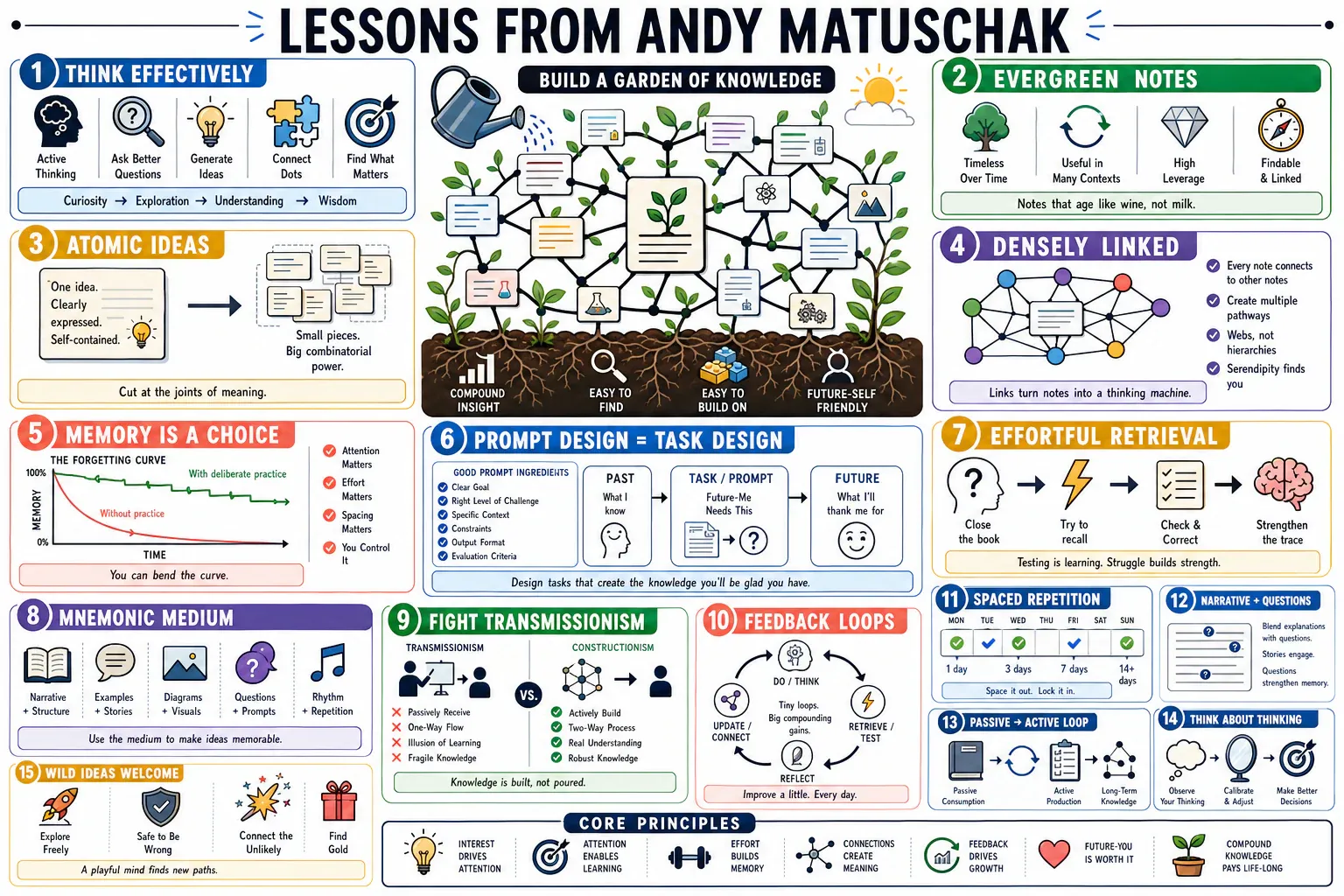
On Evergreen Notes and Better Thinking
The concept of "evergreen notes" is central to Matuschak's philosophy on thinking and writing. These are not just notes for remembering, but for developing insights over time.
- The Goal is Effective Thinking, Not Note-Taking: "'Better note-taking' misses the point; what matters is 'better thinking'." Evergreen-note practices are about effectively developing insight. — Reference: Andy Matuschak, "Evergreen notes" (working notes).
- Evergreen Notes Evolve. "Evergreen notes are written and organized to evolve, contribute, and accumulate over time, across projects." [1][2]
- Atomic Notes: His first principle for notes worth developing over time: "Evergreen notes should be atomic." — Reference: Andy Matuschak, "Evergreen notes" (working notes).
- Concept-Oriented Notes: Another principle: "Evergreen notes should be concept-oriented," organized around concepts rather than books or sources. — Reference: Andy Matuschak, "Evergreen notes" (working notes).
- Densely Linked Notes. "Evergreen notes should be densely linked" to create a network of ideas that can spark new connections and insights. [1]
- Write for Yourself First. "Write notes for yourself by default, disregarding audience." [1] This reduces the cognitive load and encourages more honest and exploratory thinking.
- Associative Ontologies Over Hierarchical Taxonomies: "Prefer associative ontologies to hierarchical taxonomies." — Reference: Andy Matuschak, "Evergreen notes" (working notes).
- Do Your Own Thinking. Matuschak emphasizes the importance of not just passively consuming information but actively engaging with it. He quotes Schopenhauer: "When we read someone else thinks for us: we merely repeat his mental process." [4]
On Spaced Repetition and the Mnemonic Medium
Matuschak is a strong advocate for spaced repetition systems (SRS) and has explored their potential beyond simple flashcards through his work on the "mnemonic medium."
- Making Memory a Choice: Spaced repetition systems "make memory a choice." He credits the phrase to Michael Nielsen's "Augmenting Long-term Memory." — Reference: Andy Matuschak, "How to write good prompts: using spaced repetition to create understanding" (2020).
- The Power of Retrieval Practice: Retrieval strengthens memory, but effort matters: "if it's too easy to recall the answer, retrieval practice has little effect." — Reference: Andy Matuschak, "How to write good prompts: using spaced repetition to create understanding" (2020).
- The Mnemonic Medium: With Michael Nielsen he built Quantum Country, an experimental "mnemonic book" that embeds spaced repetition prompts directly into the text. — Reference: Andy Matuschak and Michael Nielsen, "How can we develop transformative tools for thought?" (2019).
- Good Prompts are Good Tasks: "When you write a prompt in a spaced repetition system, you are giving your future self a recurring task. Prompt design is task design." — Reference: Andy Matuschak, "How to write good prompts: using spaced repetition to create understanding" (2020).
On Why Books and Traditional Education Often Fail
Matuschak is critical of passive learning methods and advocates for more active and engaging approaches.
- The Flaw of Transmissionism: "Books don't work for the same reason that lectures don't work: neither medium has any explicit theory of how people actually learn things." — Reference: Andy Matuschak, "Why books don't work" (2019).
- The Illusion of Understanding: After reading a non-fiction book, most readers will struggle to remember its ideas. This is the starting premise of his "Why books don't work" argument. — Reference: EconTalk, "Andy Matuschak on Books and Learning" (2019).
- Passive Consumption is Ineffective: Books rely on "transmissionism," the discredited notion that knowledge can be directly transmitted from author to reader. — Reference: Andy Matuschak, "Why books don't work" (2019).
- Learning Requires Metacognition: Readers must run their own metacognition: "Did I understand that? Should I re-read it? Consult another text?" — Reference: Andy Matuschak, "Why books don't work" (2019).
- The Need for Feedback Loops: "Readers must run their own feedback loops," which competes with actually thinking about the book's ideas. — Reference: Andy Matuschak, "Why books don't work" (2019).
- What Comes After the Book? Matuschak poses this as a central question for his research: "Is it pictures of pages on screens? Is it videos of lectures? Why are all the answers to this question so boring?" [14]
- Learning by Immersion Has Limits: Learning by immersion works when the material's complexity is low relative to your prior knowledge. Otherwise "you really do need explicit guidance, scaffolding, practice, and attention to memory support." — Reference: Andy Matuschak, "How Might We Learn?" (2024).
- The Importance of Autonomy in Learning: Drawing on Piaget, he stresses "the training of autonomy," in a broader sense than merely being free to choose what to do. — Reference: objc.io, "A Generation of Lifelong Learners," interview with Andy Matuschak (2015).
On the Nature of Knowledge Work and Creativity
Matuschak's ideas extend to the broader practice of knowledge work, emphasizing the importance of process and environment.
- Knowledge Work as a Skill: He contrasts athletes and musicians, who deliberately practice their craft, with knowledge workers, who rarely do. — Reference: Andy Matuschak, personal site.
- Insight as an Accumulative Process. An effective system for knowledge work allows insights to "accumulate" over time, rather than being lost after a single project is completed. [1]
- The Value of "In-Progress" Work. Sharing work that is still in development can be valuable, though it requires a different approach to presentation than finished pieces. [18]
- Good Questions are Crucial. "To extract meaning from... data, you need good questions. More perniciously: unless you have good questions in mind, you're probably not even collecting the right data." [14]
- Tools for Thought: His work is "focused on creating user interfaces that expand what people can think and do." — Reference: Andy Matuschak, personal site.
- On Tools that serve serious practice: Personalization should reach the primary interfaces where experts actually work, not merely peripheral automations. — MIT HCI Seminar — Apps and programming: two accidental tyrannies
Practical Learnings and Strategies
Beyond the high-level concepts, Matuschak offers concrete advice for learners and thinkers.
- Use a Reading Inbox. Have a system to "capture possibly-useful references" so you can process them later without interrupting your flow. [1]
- Maintain a Writing Inbox. Use a "writing inbox for transient and incomplete notes" to capture fleeting thoughts before they are fully formed into evergreen notes. [1]
- Write About What You Read. To truly internalize a text, you must "write about what you read." [1]
- The "Expert Response Heuristic." A good spaced repetition prompt should be one that an expert on the topic could answer quickly and accurately: Cloze-deletion prompts "usually fail the Expert response heuristic," a test he credits to Issa Rice. — Reference: Andy Matuschak, "Cloze deletions often create frustrations in non-technical mnemonic texts" (working notes).
- Beware of Poorly Worded Prompts. In a mnemonic medium, readers can become frustrated if they feel they are memorizing the author's specific wording rather than the underlying concept. [12]
- Metacognitive Supports as Scaffolding: Courses provide "metacognitive support" that books lack. Well-designed media can do the same. — Reference: Andy Matuschak, "Why books don't work" (2019).
- Continuously Evolving Tools: His project Orbit is "a platform for memory system experiments." — Reference: Andy Matuschak, personal site.
- On The limits of coding agents: Generating one-off tools and glue code is useful, but it does not yet deliver adaptable software for the core of a practitioner’s work. — MIT HCI Seminar — Apps and programming: two accidental tyrannies
Learn more:
- Evergreen notes
- Andy Matuschak: Designing Education - David Perell
- Andy Matuschak on Books and Learning - Econlib
- Do your own thinking - Andy Matuschak's notes
- Behind the Scenes of My Interview Research Process — Andy Matuschak Crashes My Crib (#162) - The Joe Walker Podcast
- A Chat with Andy Matuschak: Knowledge Work, Note Taking and Spaced Repetition
- Books 2.0 - by Kyle Harrison - Investing 101 - Substack
- Why books work: A rebuttal to Andy Matuschak - Josh Bernoff
- Cloze deletions often create frustrations in non-technical mnemonic texts
- 2021-02-02 Patreon letter - In search of better questions
- Evergreen notes turn ideas into objects that you can manipulate - Steph Ango
- How Might We Learn? - Andy Matuschak
- A Generation of Lifelong Learners - objc.io
- 2021-09-30 Patreon letter - Architectures for a more flexible mnemonic medium