Bryan Kim is a prominent technology executive, operator, and venture capitalist known for his deep expertise in consumer technology, hyper-growth, and artificial intelligence. Having scaled growth and finance at Snap Inc. through its IPO, served as CFO of Bungalow, and led consumer AI investments as a Partner at Andreessen Horowitz (a16z), he possesses a unique vantage point on what makes generational products succeed. The following insights capture his core philosophies on momentum, product-led growth, founder ambition, and the rapidly evolving landscape of consumer AI.
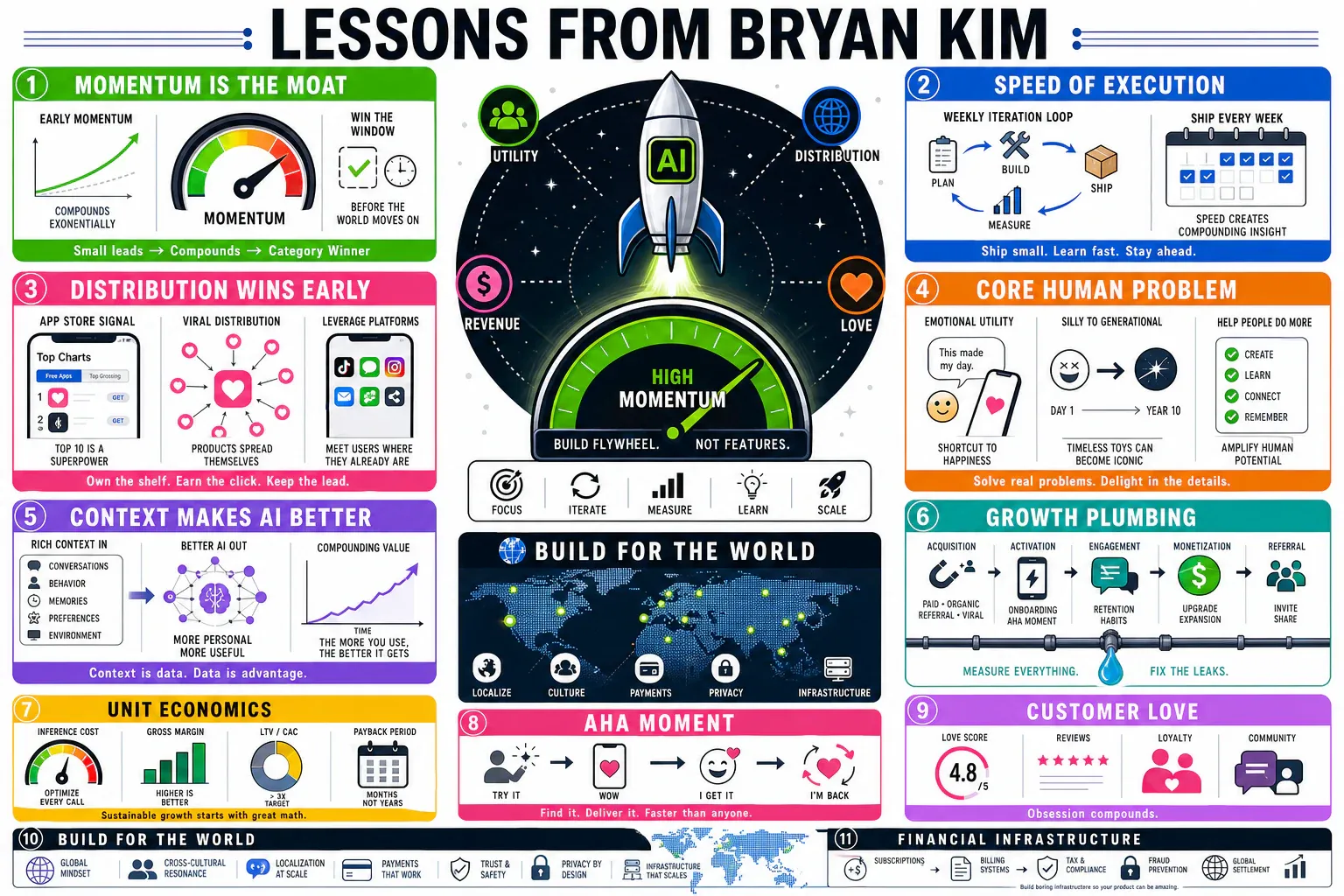
Part 1: The AI Revolution and "Momentum as a Moat"
- On The Only Defensible Moat: "The only defense against copycats... is unfortunately the speed of execution." — Source: [a16z]
- On Momentum: "In Consumer AI, momentum is the moat." — Source: [Digital Native]
- On The "AI Flock": "Startups are like a flock flying together; you must flap your wings harder to stay ahead of the second fastest pigeon." — Source: [a16z]
- On Building in Real-Time: "You get to build the plane as it falls off the cliff." — Source: [Sourcery Podcast]
- On Foundational Models: "Technical moats are harder to maintain when underlying models are updated constantly." — Source: [a16z]
- On Escaping the Pack: "Breakout moments require engineering viral distribution before the underlying technology shifts again." — Source: [The Consumer VC]
- On Unprecedented Opportunity: "The AI revolution is a unique moment in history that is still in its very early stages." — Source: [Economic Times]
- On Urgency: "If you don't have momentum now, it's just harder to capture that." — Source: [Sourcery Podcast]
- On Distribution: "Distribution outpaces proprietary tech in the early days of an AI paradigm shift." — Source: [a16z]
- On Iteration Velocity: "The ability to launch fast and iterate weekly creates a temporary but vital competitive advantage." — Source: [Medium]
Part 2: The Reality of Consumer AI
- On Witchcraft vs. Utility: "Some AI startups feel like witchcraft—magical but fleeting; they must eventually solve a core human problem to survive." — Source: [a16z]
- On Context in AI: "Context makes AI products infinitely better, and harder to replace." — Source: [Sourcery Podcast]
- On High-Stakes Trust: "AI voice agents will move from science fiction to enterprise-scale deployment by earning high-stakes trust." — Source: [a16z]
- On The 1% of Creators: "The current stage of AI is driven by the 1% of creators who are finding new ways to use the technology." — Source: [The Consumer VC]
- On The Evolution of Social: "AI will facilitate existing human relationships rather than just replacing them." — Source: [36Kr]
- On Early Monetization: "High inference costs make early monetization essential in consumer AI." — Source: [a16z]
- On Ads in AI: "Advertising is the most time-tested tool for scaling internet services to billions of users who won't pay for subscriptions." — Source: [a16z]
- On Breaking Through the Noise: "A powerful, provocative message can be a highly effective distribution strategy for consumer companies." — Source: [Sourcery Podcast]
- On Ubiquity: "Because AI products are ubiquitous, engineering true breakout moments is harder than in the mobile era." — Source: [Digital Native]
- On Silly Origins: "Generational products often start out looking like very silly toys." — Source: [The Consumer VC]
Part 3: Growth, Plumbing, and Unit Economics
- On Growth Plumbing: "Every consumer company runs growth. Very few run it well. The reason is almost never strategy. It's plumbing." — Source: [a16z]
- On Growth Infrastructure: "The biggest bottleneck in growth is often the underlying data infrastructure—schemas, event taxonomies, and attribution." — Source: [Medium]
- On P&L Reality: "AI app companies often have public-company-level P&Ls very early on due to compute costs." — Source: [The Consumer VC]
- On Growth vs. Profitability: "We're still in the era where growth equals profitability, with the momentum of growth winning out." — Source: [Sourcery Podcast]
- On Financial Discipline: "Hyper-growth requires building robust financial infrastructure before the scale breaks the system." — Source: [36Kr]
- On App Store Rankings: "Consistently staying in the top 10 app store ranking is a clear signal of deep product-market fit and user necessity." — Source: [The Consumer VC]
- On Scaling Finance: "You have to scale the finance team in lockstep with user growth to understand true unit economics." — Source: [Medium]
- On The Mobile Era Contrast: "Unlike the mobile era, where companies could build slowly and focus on retention first, AI startups must prioritize velocity." — Source: [a16z]
- On Inference Costs: "Marginal costs per user change the traditional software-as-a-service margin structure." — Source: [a16z]
Part 4: Product-Led Growth and The "Aha Moment"
- On Product-Led Growth: "No amount of marketing dollars can fix a product, so make sure that your growth is coming from the product itself." — Source: [Digital Native]
- On The Snap Aha Moment: "When a new user joins, did we get them five friends and did they snap with each other? If we got that right, they'll be retained." — Source: [The Consumer VC]
- On Core Emotional Utility: "Growth is about identifying the core emotional utility and ensuring users reach it quickly." — Source: [Medium]
- On Universal Appeal: "If you're building something, build it for the entire world." — Source: [Sourcery Podcast]
- On Monetization Priorities: "The 'tip of the spear' isn't monetization, but rather understanding the specific metrics of customer love." — Source: [The Consumer VC]
- On Over-Engineering: "If the product requires too much marketing to explain, the emotional utility hasn't been found." — Source: [Digital Native]
- On Retention Indicators: "Users will explore other surface areas of a product only if the initial core loop is deeply satisfying." — Source: [a16z]
- On Viral Growth: "True viral growth is a byproduct of users genuinely needing to bring their friends into the experience." — Source: [The Consumer VC]
- On Building for the Masses: "Providing broad access to the masses is the ultimate test of a consumer product's viability." — Source: [a16z]
Part 5: Founder Psychology and Ambition
- On Founder Ambition: "Building in AI is an IQ test for founders; not leveraging it is a failure to recognize a historical opportunity." — Source: [Medium]
- On The Mission: "The ultimate professional mission is to work for or work with visionary founders." — Source: [The Consumer VC]
- On Conviction: "Building conviction over time means seeing a founder's vision translate into empirical numbers." — Source: [Sourcery Podcast]
- On Winning Teams: "The fastest teams don't just keep pace, they breakout and they win." — Source: [Sourcery Podcast]
- On Techno-Optimism: "Advancement in technology can actually help people live better lives; curbing innovation often results in 'gunk'." — Source: [a16z]
- On Adapting to Reality: "My job is to observe... people will do what they do. I don't fully understand why, but it's happening." — Source: [The Consumer VC]
- On Founder Rebellion: "Startups are 'rebels' fighting against established incumbents." — Source: [a16z]
- On Decisiveness: "The current AI market rewards founders who make rapid, decisive choices over those who over-deliberate." — Source: [36Kr]
- On Time to Build: "There comes a point where observing is not enough; it is simply time to build." — Source: [Economic Times]
Part 6: Navigating the "Primordial Soup" of Startups
- On The Primordial Soup: "The current AI landscape is a chaotic 'primordial soup' where everything is churning and unclear." — Source: [36Kr]
- On Early Adoption: "While millions of devices run AI apps, very few have truly surpassed early chat interfaces in daily active usage." — Source: [Medium]
- On The Killer Economics of Software: "Software-based AI has 'killer economics' compared to capital-intensive bets like self-driving hardware." — Source: [The Consumer VC]
- On Sustaining the Flywheel: "Capturing mindshare starts the flywheel of talent and revenue." — Source: [Digital Native]
- On Market Noise: "In a noisy market, being provocative can sometimes be the only way to get users to try your product." — Source: [Sourcery Podcast]
- On The Evolution of Tools: "AI will start taking significant mindshare away from traditional, static productivity tools." — Source: [a16z]
- On Product Velocity: "Shipping new features faster than the competition is the only reliable way to navigate an uncertain market." — Source: [Medium]
- On User Behavior: "Don't fight user behavior; if users are adapting a tool in an unexpected way, lean into it." — Source: [The Consumer VC]
- On Market Timing: "The window to establish a dominant consumer AI brand is uniquely open but closing rapidly." — Source: [36Kr]
- On Capital Requirements: "Early-stage AI companies often require significant capital just to stay in the race, changing the seed-stage playbook." — Source: [Sourcery Podcast]
Part 7: Investment Philosophy and High-Velocity Dealmaking
- On Urgency in Deals: "Urgency, not delegation, wins deals; founders expect direct partner engagement." — Source: [Sourcery Podcast]
- On Showing Up: "Booking a flight on 90 minutes' notice to meet a founder shows the level of commitment required to win competitive deals." — Source: [Sourcery Podcast]
- On Operator-Led Investing: "Former operators who have scaled companies are uniquely positioned to identify and support early-stage startups." — Source: [Medium]
- On Bypassing the Bureaucracy: "In a fast-moving market, investors cannot afford to loop in assistants; they must be on the front lines." — Source: [Sourcery Podcast]
- On Observing vs. Forcing: "A good investor observes what is naturally taking off rather than forcing a thesis onto the market." — Source: [The Consumer VC]
- On Evaluating Execution: "Investors should evaluate startups based on high-velocity execution and monetization quality." — Source: [Sourcery Podcast]
- On High-Conviction Bets: "When you see an outlier in consumer behavior, you have to make a concentrated, high-conviction bet." — Source: [a16z]
- On Strategic Acquisitions: "Smart acquisitions can fundamentally alter and accelerate a company's product identity." — Source: [Medium]
- On Financial Infrastructure: "Investors must look beyond the pitch to see if the startup has the financial plumbing to survive hyper-growth." — Source: [Digital Native]
Part 8: The Future of Health, Creation, and Connection
- On The Future of Creation: "AI is fundamentally revolutionizing how humans create, lowering the barrier to entry for high-quality output." — Source: [a16z]
- On Consumer Health: "AI-driven medical intelligence will shift consumer health from reactive treatment to proactive optimization." — Source: [a16z]
- On Audio as a Medium: "Audio is a universal human medium, and AI voice technology will change how we interact with information globally." — Source: [Sourcery Podcast]
- On Connection and Socializing: "Next-generation social apps will use AI to foster deeper, more meaningful real-world connections." — Source: [36Kr]
- On Invisible Assistants: "The future of productivity lies in 'invisible' desktop assistants that operate contextually in the background." — Source: [Sourcery Podcast]
- On Personalization: "AI products will become hyper-personalized, making generalized software feel obsolete." — Source: [Medium]
- On Video Editing: "AI-powered video tools will democratize professional-grade editing, empowering a new class of creators." — Source: [a16z]
- On Shifting Paradigms: "We are moving from a mobile-first paradigm to an AI-first paradigm, requiring entirely new user interfaces." — Source: [The Consumer VC]
- On The Ultimate Goal: "The ultimate promise of consumer AI is to give people their time back so they can focus on what makes them human." — Source: [a16z]