Chris Manning is a Stanford professor of linguistics and computer science whose research helped bring statistical and neural methods into natural language processing. He coauthored the GloVe word-vector paper and has studied language understanding, reasoning, and the limits of systems trained mainly on text. This profile gathers his research arguments and stated views, with their dates and uncertainties kept in view. — Manning’s Stanford Bio.
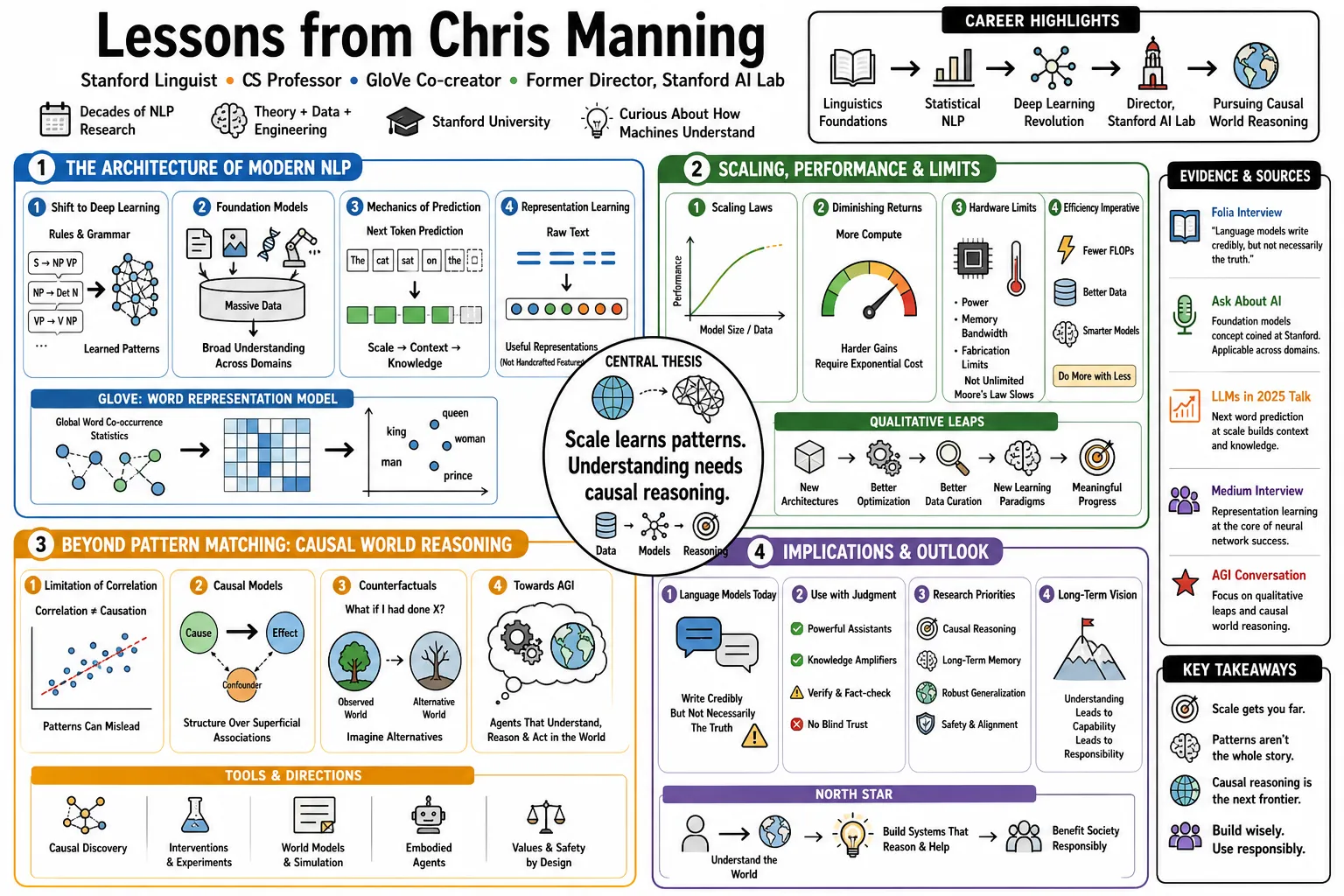
Part 1: The Architecture of Modern NLP
- From rules to learned patterns: Manning recalls a shift from hand-coded grammar and rules to statistical models trained on digital text, followed by neural networks that learn from examples. — Folia Interview.
- Foundation models across domains: Manning says Stanford used “foundation models” for large models trained on broad data, with the approach extending beyond text to vision, genomics, robotics and other signals. — Stanford Online Q&A.
- Prediction as a learning signal: In Manning’s account, predicting the next word or filling a masked span provides a self-supervised task through which a large model can learn useful patterns of language and the world. — Manning’s Dædalus Essay.
- Learn useful intermediate representations: Manning identifies representation learning—finding reusable intermediate representations in neural networks—as a reason pretrained language models can transfer to many downstream NLP tasks. — DeepLearning.AI Interview.
- Scale revealed unexpected capabilities: Manning says researchers did not expect much language understanding from scaled-up next-word models before 2018; larger neural language models then showed unexpectedly broad new capabilities. — Stanford Engineering Interview.
- From task fine-tuning to prompting: Manning contrasts BERT-era task-specific fine-tuning with GPT-3’s ability, in his 2020 account, to perform varied tasks from instructions or a few examples without retraining for each one. — DeepLearning.AI Interview.
- Linguistics still informs AI: Manning says computational models need both machine-learning engineering and knowledge of human language; linguistic structure remains a useful part of the subject domain. — Stanford Engineering Interview.
- Global word vectors: The 2014 GloVe paper by Pennington, Socher and Manning models word vectors using global word co-occurrence statistics, showing one way distributional patterns capture semantic relationships. — GloVe Paper.
Part 2: The Limits of Scale and the Path to AGI
- Treat AGI dates skeptically: In a 2023 Stanford Q&A, Manning cautioned that confident predictions of systems surpassing people at almost every task by 2030 reflected “irrational exuberance”; he did not rule out long-run progress. — Stanford Online Q&A.
- Learning from less data: Manning contrasts the enormous text exposure of GPT-3 with the much smaller experience through which children acquire language, arguing that flexible learning remains a key gap. — DeepLearning.AI Interview.
- Brain energy as an efficiency challenge: Manning points to the brain’s low power use and infants’ ability to learn from limited data as reasons to seek better learning methods alongside more efficient hardware. — Stanford Online Q&A.
- Adapt to new tasks: In Manning’s 2020 view, human-like intelligence would require systems that can keep learning new tasks as they encounter them, beyond the fixed training of a large pretrained model. — DeepLearning.AI Interview.
- Meta-learning as a research path: Manning pointed to meta-learning—building systems better at learning new tasks—as one possible direction toward flexible general intelligence. — DeepLearning.AI Interview.
- Structure can improve learning efficiency: Manning argues that more data and compute help, but adding useful structure may let world models learn causal relationships more efficiently than relying on scale alone. — Latent Space Podcast.
Part 3: Causal World Models and Spatial Reasoning
- Video quality is not causal understanding: Manning and coauthors caution that visually impressive generated video need not model how objects behave after an action; persistent state and causal consequences are separate requirements. — Moonlake World-Models Essay.
- Collect actions as well as observations: Manning argues that passive video often lacks the action labels needed to learn consequences, making interactive or simulated environments a promising source of action-conditioned data. — Latent Space Podcast.
- Abstract beyond pixels: The Moonlake authors argue that predicting at pixel resolution can be costly for long-horizon planning, while compact semantic representations can retain the state relevant to action. — Moonlake World-Models Essay.
- Condition predictions on actions: Manning defines a useful world model by its ability to predict how the world may change when an action is taken, particularly over longer horizons. — Latent Space Podcast.
- Link vision with symbolic structure: Manning sees a research opportunity in connecting visual input to more abstract or symbolic representations, rather than treating pixels alone as the whole understanding problem. — Latent Space Podcast.
- Cognitive tools compress reasoning: Manning and coauthors argue that language, mathematics and programming provide symbolic abstractions that can help world models represent causal relationships more efficiently. — Moonlake World-Models Essay.
- Evaluation grows harder with open tasks: Manning notes that straightforward question-answering benchmarks were easier to define than evaluations for open-ended recommendations and interactive world models. — Latent Space Podcast.
Part 4: Intelligence, Meaning, and Human Language
- Speech is fast and ambiguous: Manning marvels that people exchange meaning in real time even though words have many meanings and conversations reach across past and future events. — Folia Interview.
- Language networks human minds: Manning argues that language lets people pool thought and knowledge across individuals and generations; in his account, this social network amplifies human intelligence. — Manning’s Dædalus Essay.
- Understanding needs world contact: Manning says text prediction gives machines more language knowledge than some assume, but fuller understanding may require active connections to the physical world. — Folia Interview.
- Emotional understanding remains open: Manning treats it as an open philosophical question whether a computer without humanlike emotional responses could truly understand experiences such as happiness or despair. — Folia Interview.
- Learnable linguistic structure: Manning argues that language models learning grammatical structure from data challenge strong claims that such structure must be fully innate; he treats the comparison with human acquisition cautiously. — TWIML Episode 686.
- Look beyond fluent language: Manning says advances in language generation bring harder questions about reasoning and how knowledge of the world is represented into sharper focus. — TWIML Episode 686.
- Study models as language evidence: Manning argues that examining what language models learn can illuminate linguistic structure, while the model–human-learning comparison still requires care. — TWIML Episode 686.
Part 5: Society, AI Safety, and Practical Applications
- Fluency is not fact-checking: Manning warns that language models can write convincing answers while inventing details, so credible prose should not be mistaken for verified truth. — Folia Interview.
- Teach students to critique AI output: Manning points to a Stanford colleague’s assignment in which students identify inaccuracies in generated answers as one way to adapt teaching to language models. — Folia Interview.
- Prioritize present social harms: In a 2023 interview, Manning argued that attention to hypothetical AI takeover can distract from concrete social problems that already need work. — Folia Interview.
- Search has multiple jobs: Manning expects chatbots to answer many direct questions, while link-based search remains useful when people want to compare sources, navigate to sites or complete transactions. — Stanford Online Q&A.
- Two levels of explainability: Manning distinguishes probing which input features influence a model from asking a large language model to explain a decision; he presents the latter as a promising capability, not proof that self-explanations are faithful. — Stanford Online Q&A.
- Human abilities beyond text recall: Manning says LLMs may know far more written facts than any person while people may retain stronger practical ability to navigate the world for decades; he frames the latter as a forecast. — Stanford Online Q&A.