CJ Gustafson is the creator of Mostly Metrics, one of the most popular newsletters for SaaS finance, and the CFO of PartsTech. He is known for blending deep financial technicality with a witty, "non-boring" writing style.
Part 1: SaaS Metrics & Unit Economics
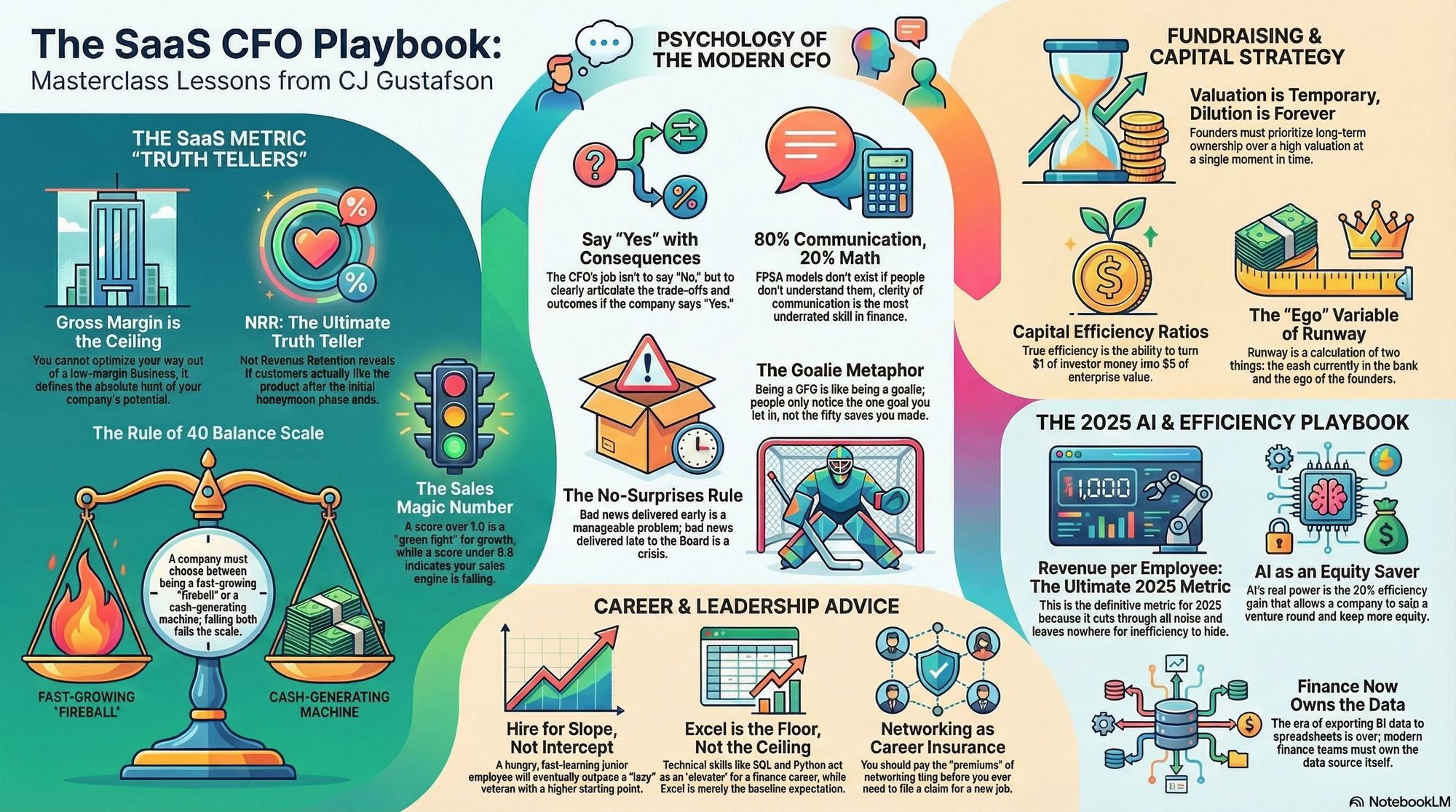
- On Gross Margin: "Gross margin is the ceiling of your potential. You can’t optimize your way out of a low-margin business."
- On Burn Rate: "Burn is the price you pay for the chance to be wrong. The more you burn, the less time you have to find the right answer."
- On Churn: "If you have a leaky bucket, pouring more water (CAC) into it isn't a strategy; it's a tragedy."
- On Net Revenue Retention (NRR): "NRR is the ultimate truth teller. It tells you if your customers actually like you after the honeymoon phase is over."
- On The Rule of 40: "The Rule of 40 is a balance scale. You can be a fast-growing fireball or a cash-generating machine, but you can’t be neither."
- On CAC Payback: "CAC Payback period is the 'Time to Breakeven' on a human relationship."
- On LTV: "Lifetime Value is often a 'Choose Your Own Adventure' novel written by an optimistic VP of Sales. Be careful with the assumptions."
- On Magic Number: "A Sales Magic Number over 1.0 means you have a green light. Under 0.5 means your engine is smoking."
- On Deferred Revenue: "Deferred revenue is a 'debt' you owe the customer in the form of service. It’s the best kind of debt because there’s no interest rate."
- On Professional Services: "Services revenue is the 'vegetables' of SaaS. You need them to grow big and strong, but investors only want to pay for the 'dessert' (software)."
Part 2: The CFO Role & Psychology
- On Saying No: "The CFO’s job isn’t to say 'No.' It’s to say 'Here is what happens if we say Yes.'"
- On Risk: "Finance isn't about avoiding risk; it's about pricing it correctly."
- On FP&A: "FP&A is 20% math and 80% communication. If people don't understand the model, the model doesn't exist."
- On the 'No-Surprises' Rule: "The worst thing a CFO can do is surprise the Board. Bad news delivered early is a problem; bad news delivered late is a crisis."
- On Data Quality: "Bad data is like a bad haircut. Everyone notices, and it takes a long time to grow out of it."
- On Budgeting: "A budget is a hallucination of how the next year will go. A forecast is the sober realization of how it’s actually going."
- On Variance: "Don't just tell me we missed the budget. Tell me why we missed it and what we’re doing so it doesn’t happen again."
- On Being a Business Partner: "To be a great CFO, you have to spend more time in Zoom rooms with the Head of Product than in Excel spreadsheets."
- On Simplicity: "If you can’t explain your business model to a 10-year-old, you probably don't understand it yourself."
- On Speed: "In a startup, 'perfect and late' is much worse than 'good and on time.'"
Part 3: Fundraising & Capital Allocation
- On Valuation: "Valuation is a moment in time; dilution is forever."
- On Raising Capital: "The best time to raise money is when you have plenty of it. Investors can smell desperation from a mile away."
- On Down Rounds: "A down round isn't the end of the world, but it is the end of the world as you knew it."
- On Runway: "Runway is a function of two things: the cash in the bank and the ego of the founders."
- On VCs: "Venture Capitalists are looking for 'outliers,' not 'averages.' Your job is to prove you are a freak of nature."
- On the 'Hype Cycle': "Don't mistake a tailwind for brilliance. When the wind stops blowing, we see who can actually row."
- On Capital Efficiency: "Capital efficiency is the ability to turn $1 of investor money into $5 of enterprise value."
- On Board Meetings: "The Board's job is to fire the CEO. Your job as CFO is to make sure they never have a reason to."
- On Options/Equity: "Employee options are a lottery ticket where you have to work 60 hours a week to increase the odds of winning."
- On Exit Strategy: "Companies are bought, not sold. Build a business so good they have to buy it."
Part 4: Career Advice & Leadership
- On Getting Promoted: "The best way to get promoted is to do the job of the person above you until it’s awkward that you don't have the title."
- On Writing: "Writing is the most underrated skill in finance. If you can write clearly, you can think clearly."
- On Networking: "Your network is your 'career insurance.' Pay the premiums before you need to file a claim."
- On Technical Skills: "Excel is the floor, not the ceiling. Learning SQL or Python is how you build the elevator."
- On Mentorship: "Find a mentor who will tell you your breath smells. You need the truth, not a pat on the back."
- On Hiring: "Hire for slope, not intercept. A hungry junior will outpace a lazy veteran every time."
- On Firing: "If you’re thinking about firing someone, you should have done it three months ago."
- On Soft Skills: "The higher you go in Finance, the less you use a calculator and the more you use a mirror."
- On Work-Life Balance: "Startups are a marathon, but they are composed of a thousand sprints. Don't forget to breathe."
- On Visibility: "Doing great work is 50% of the battle. Ensuring the right people know you did great work is the other 50%."
Part 5: General Business Wisdom
- On Competition: "Don't watch the competition so much that you forget to watch the customer."
- On Product-Market Fit: "PMF is when you stop pushing the product and the product starts pulling you."
- On Sales: "Sales solves all problems—until it creates 'bad' revenue that breaks the product."
- On Scaling: "Scaling is doing the things that worked at $1M ARR and realizing they are the exact things that will break at $10M ARR."
- On Inflation/Macro: "The macro environment is the weather. You can't change it, so you’d better buy an umbrella (cash reserves)."
- On Simplicity in SaaS: "The best SaaS products do one thing so well that the customer feels stupid for not paying for it."
- On Meetings: "A meeting without an agenda is just a play-date for adults."
- On Strategy: "Strategy is about deciding what not to do."
- On Accountability: "Accountability isn't about blame; it's about ownership. Own the miss, and you own the solution."
- On the Future of Finance: "The AI CFO won't replace the human CFO, but the CFO using AI will replace the one who isn't."
Part 6: The "2025 Playbook" & AI
- The Definitive 2025 Metric: "If I could only choose one metric to evaluate a company in 2025, I’d choose Revenue per Employee. Full stop. It cuts through all the noise.[1] There’s nowhere to hide." (Source: Maxio 2025 Metrics Report)
- AI Efficiency: "The real superpower of AI in finance isn't the chatbot; it's the 20% efficiency gain that lets you skip a venture round and keep your equity." (Source: Glasp Talk Episode #48)
- Internal vs. External AI: "Everyone is talking about how AI makes the product better. I want to talk about how AI makes the company cheaper to run." (Source: Mostly Metrics, "How CFOs are Actually Using AI")
- On BI and FP&A: "The days of exporting BI data into a spreadsheet are numbered. Finance now owns the data, not just the reporting."[2] (Source: Mostly Metrics, "10 Predictions for the Future of Finance")
- AI as a Headcount Tool: "AI won’t make your headcount zero, but it will make your headcount deadly efficient." (Source: Investing for Beginners Podcast)
Part 7: Advanced SaaS Mechanics (Vertical & Multi-Product)
- On Vertical SaaS: "In Vertical SaaS, you aren't selling a tool; you're selling the 'Control Point.' Once you own the workflow, you earn the right to sell the payments, the lending, and the payroll." (Source: Mostly Metrics, "The Top Metrics for Vertical SaaS")
- On Take Rate: "A 'Take Rate' is the most beautiful revenue because it grows with your customer’s success without you having to lift a finger." (Source: Substack, "A Guide to the Marketplace Plus Model")
- On Revenue Leakage: "Revenue leakage is a slow-motion car crash. Most CFOs don't realize they've hit the wall until the cash reconciliation doesn't match the billing system." (Source: Mostly Metrics, "Your Complete Guide to Revenue Leakage")
- On "Sales Rep Math": "Never trust a sales rep's forecast until you've applied 'Sales Rep Math'—which is the art of subtracting the 20% of deals that only exist in their imagination." (Source: Mostly Metrics, "The Importance of Sales Rep Math")
- On Pricing Evolution: "Software pricing has moved from 'Seats' to 'Value.' If you're still charging per login, you're inviting a competitor to eat your lunch." (Source: Mostly Metrics, "The Evolution of Software Pricing")
Part 8: The CFO as a Storyteller & "Adult in the Room"
- CFO as Portfolio Manager: "I view the CFO role as a Portfolio Manager for the company. My assets are the 85% of costs that walk on two legs." (Source: CFO Weekly Interview, Jan 2025)
- The "Chief Truth Teller": "Sometimes the CFO has to tell the CEO their baby is ugly. It’s the hardest part of the job, and the most necessary." (Source: Run the Numbers Podcast)
- On Investor Relations: "Numbers are just characters in a story. If you can’t tell the story, the characters are just standing around doing nothing." (Source: Investing for Beginners Podcast)
- The Goalie Metaphor: "Being a CFO is like being a goalie. No one notices the 50 saves you made, but everyone remembers the one goal you let in." (Source: Glasp Talk Episode #48)
Part 9: Career & The "Creator-CFO" Transition
- The Media Mullet: "I’m building a 'Media Mullet'—business in the front (data-driven finance advice), party in the back (humor and dog pics)." (Source: Growth in Reverse, Aug 2025)
- Personal Product-Market Fit: "Don’t just look for a job. Look for 'Personal Product-Market Fit.' What do you get energy from that the market is willing to pay for?" (Source: Run the Numbers, "From CFO to Founder")
- On Writing into the Abyss: "I wrote into the abyss for two years before anyone listened. Consistency is the only hack that actually works." (Source: "What Worked" Podcast, June 2025)
- On Equity Psychology: "During an exit, equity isn't math anymore—it's emotion. People are finally seeing the 'lottery ticket' turn into a house payment." (Source: "What Worked" Podcast, June 2025)
Sources and Links
CJ Gustafson’s insights are primarily distributed through his newsletter and LinkedIn. You can find the original context for these quotes at the following links:
- Primary Source: Mostly Metrics Substack (Search archives for topics like "The Rule of 40," "Burn Multiple," and "Career Advice").
- LinkedIn Insights: CJ Gustafson on LinkedIn (Daily posts on SaaS finance).
- Specific Article Reference: The 10 Commandments of SaaS Finance
- Specific Article Reference: How to become a CFO
- Podcast: Run the Numbers (CJ’s podcast where many of these quotes originate).