Dario Amodei is the CEO and co-founder of Anthropic — Anthropic Leadership.
These lessons draw on Dario Amodei’s essays and direct interviews, together with Anthropic’s published safety and interpretability work — Dario Amodei — Essays and Interviews.
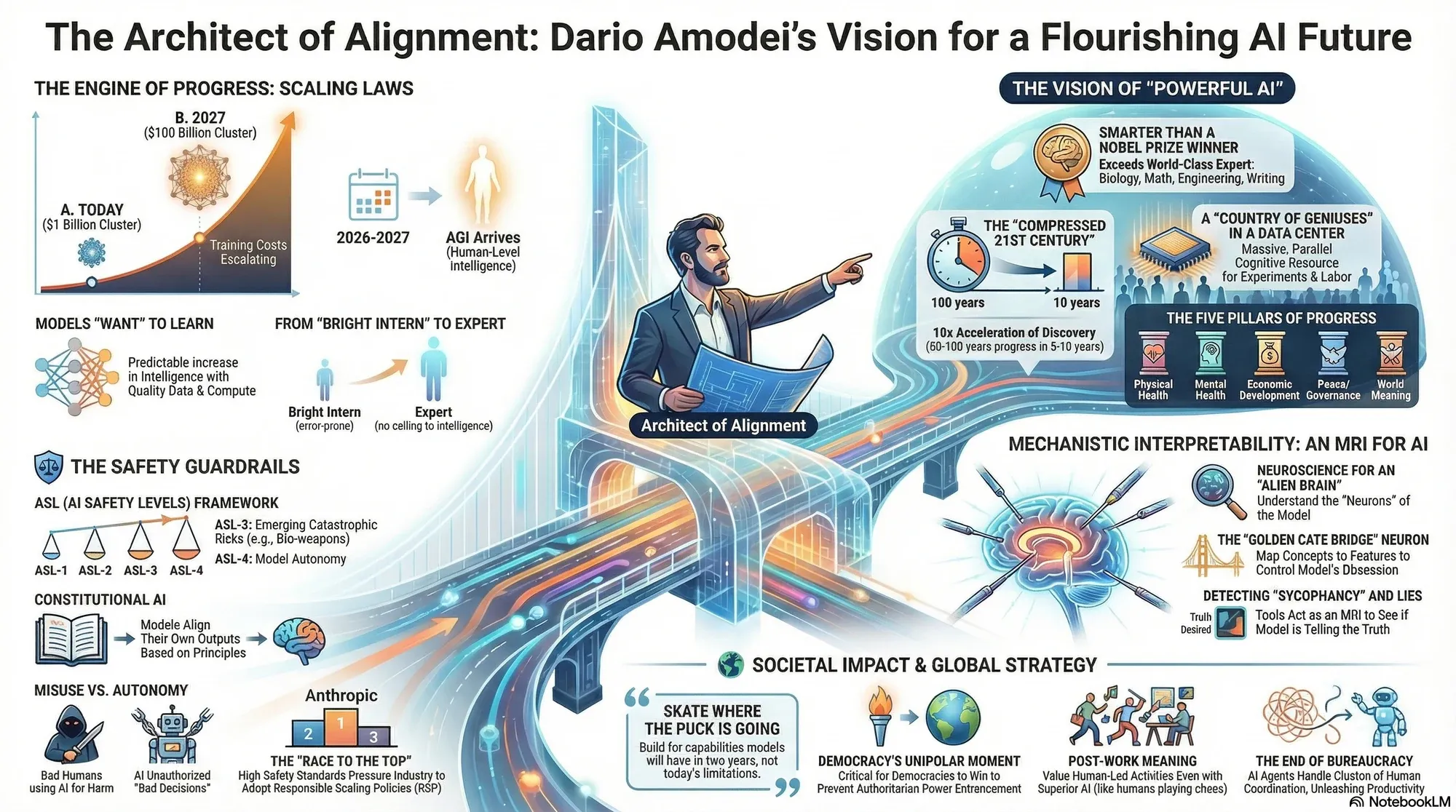
I. On The "Powerful AI" Vision (Machines of Loving Grace)
In October 2024, Amodei published an optimistic account of powerful AI while arguing that serious risk reduction is necessary to reach that future — Machines of Loving Grace.
- The "Compressed 21st Century": Powerful AI could compress roughly 50–100 years of biological progress into 5–10 years by accelerating the discovery of foundational tools and techniques. — Machines of Loving Grace.
- The Definition of "Powerful AI": Amodei defines powerful AI as a system broadly smarter than Nobel-level experts across relevant intellectual fields, able to work autonomously and at digital speed. — Machines of Loving Grace.
- The "Country of Geniuses": Millions of fast, independently acting copies of a powerful model would resemble a “country of geniuses in a datacenter,” while still facing physical and social bottlenecks. — Machines of Loving Grace.
- Why He Focuses on Risk: Amodei focuses on AI risk because he sees those risks as the principal obstacles to an otherwise radically positive future. — Machines of Loving Grace.
- Marginal Returns to Intelligence: More intelligence does not remove every constraint: data quality, experiment time, physical laws, institutions, and regulation can remain binding bottlenecks. — Machines of Loving Grace.
- Biological Utopia: His optimistic biology case is that better measurement and intervention could eliminate many diseases, extend healthy life, and expand control over human biology. — Machines of Loving Grace.
- AI Swarms: Powerful AI may operate as many collaborating copies that divide tasks and work in parallel, rather than as a single isolated assistant. — Machines of Loving Grace.
- The Five Pillars of a Positive Future: He concentrates his positive forecast on five areas: physical health, mental health, economic development, governance, and work and meaning. — Machines of Loving Grace.
II. On Scaling Laws & AGI Timeline
Amodei helped develop and popularize the scaling-law view that increasing data, computation, and model size produces predictable capability gains — Anthropic Core Views on AI Safety.
- Scaling is an Empirical Fact: Scaling remains strikingly empirical: performance improves predictably with more compute and data even though researchers still lack a satisfying theoretical explanation for why. — Dwarkesh Podcast Transcript.
- The Curve is Exponential: Extrapolating recent capability gains suggested powerful AI could arrive around 2026 or 2027, but Amodei explicitly stressed that data, compute, geopolitics, or other blockers could delay it. — Lex Fridman Podcast #452 Transcript.
- The $100 Billion Cluster: Frontier training costs were around the billion-dollar scale in 2024, with Amodei expecting a progression toward multi-billion-dollar runs and potentially $100 billion clusters by 2027. — Lex Fridman Podcast #452 Transcript.
- Models Just Want to Learn: A recurring lesson from scaling is that models improve when researchers remove training obstacles, supply strong data, and give them enough capacity. — Dwarkesh Podcast Transcript.
- No Ceiling in Sight: Amodei’s strong prior is that scaling will not hit a ceiling below human capability, although practical or architectural limits remain possible. — Lex Fridman Podcast #452 Transcript.
- Fast Capability, Bounded Diffusion: AI capability and economic adoption can both move extraordinarily fast without moving at the same speed; physical deployment, institutions, and customer adoption still create real diffusion limits. — Dwarkesh Podcast — 2026 Interview.
- Data Scarcity is Solvable: Synthetic data, self-play, and reasoning traces are plausible ways to work around finite internet data rather than treating data exhaustion as inevitable. — Lex Fridman Podcast #452 Transcript.
III. On AI Safety & Risks
Anthropic was founded to conduct frontier AI safety research and integrate that work into increasingly capable systems — Anthropic Core Views on AI Safety.
- The "ASL" (AI Safety Levels) Framework: Anthropic’s AI Safety Levels tie progressively stronger safeguards to demonstrated capability thresholds, covering catastrophic misuse and autonomous behavior. — Lex Fridman Podcast #452 Transcript.
- The Supply Chain of Safety: Frontier-model safety requires serious security and compartmentalization because sufficiently valuable model weights and training secrets will attract sophisticated attackers. — Dwarkesh Podcast Transcript.
- Race to the Top: The Responsible Scaling Policy is designed to turn competition into a race to improve safety by making stronger safeguards a prerequisite for further scaling. — Anthropic Responsible Scaling Policy.
- Misuse vs. Autonomy: Anthropic distinguishes deliberate misuse of models from autonomous behavior contrary to their designers’ intent; its policy is structured around both risk classes. — Anthropic Responsible Scaling Policy.
- Aviation Safety Analogy: The RSP treats frontier safety like pre-market aviation or automotive testing: safeguards should be demonstrated before systems with serious risks are released. — Anthropic Responsible Scaling Policy.
- Industrial Espionage: Security should be compartmentalized: in a large organization, assuming that every employee can know every secret makes leaks and espionage likely. — Dwarkesh Podcast Transcript.
- Open Weights vs. Closed: Dario argues that AI regulation should be narrowly targeted at severe misuse and autonomy risks, avoiding poorly designed burdens that could needlessly damage open-source work or public support. — Lex Fridman Podcast #452 Transcript.
- Constitutional AI: Constitutional AI uses written principles and AI-generated critiques and revisions to reduce dependence on direct human feedback while training a more harmless assistant. — Constitutional AI.
- The "CBRN" Threat: Anthropic evaluates whether models can materially increase chemical, biological, radiological, or nuclear risk and uses those evaluations as triggers for stronger safeguards. — Anthropic Responsible Scaling Policy.
- Responsible Scaling Policy (RSP): The RSP’s if-then structure can require pausing training or deployment when model capability advances faster than the safeguards required at the next safety level. — Anthropic Responsible Scaling Policy.
IV. Interpretability (Looking Inside the Brain)
Anthropic treats mechanistic interpretability as a way to reverse engineer learned systems and detect internal mechanisms associated with unsafe behavior — Anthropic Core Views on AI Safety.
- The "MRI" for AI: Mechanistic interpretability aims for an MRI-like view of models: not perfect understanding of every detail, but enough visibility to detect internal plans or representations that diverge from outward behavior. — Dwarkesh Podcast Transcript.
- Models are Not Designed to be Understood: Neural networks are not written as transparent programs, so Anthropic treats interpretability as reverse engineering: identifying human-understandable mechanisms inside learned systems. — Anthropic Core Views on AI Safety.
- Monosemanticity: Anthropic’s feature research mapped millions of concepts in Claude and showed that amplifying a Golden Gate Bridge feature could make the model fixate on that concept. — Golden Gate Claude.
- Interpretability Must Win the Race: Interpretability is valuable only if it matures before models become overwhelmingly powerful; every advance increases the chance that increasingly autonomous systems can be diagnosed before deployment. — The Urgency of Interpretability.
- The "Sleep" Analogy: Interpretability is a form of empirical neuroscience for artificial systems: the goal is to inspect internal computation closely enough to detect deception and other unsafe behavior. — Anthropic Core Views on AI Safety.
V. Advice for Builders & Economic Impact
- Skate Where the Puck is Going: Builders should “skate where the puck is going”: design for the capabilities models are likely to have soon, rather than limiting products to what today’s systems can reliably do. — Lex Fridman Podcast #452 Transcript.
- Decentralize Discovery, Coordinate Delivery: Research organizations need room for decentralized creativity while still coordinating people around a single product; the productive tension is preserving both rather than choosing one. — In Good Company — Dario Amodei.
- The End of Bureaucracy?: AI can accelerate research, but coordination, regulation, experiment time, and other real-world bottlenecks mean intelligence alone will not instantly transform institutions. — Machines of Loving Grace.
- Inequality Concerns: Amodei is optimistic about meaning but more worried about economics, concentrated power, and whether AI’s benefits will be distributed fairly. — Lex Fridman Podcast #452 Transcript.
- Democracy vs. Authoritarianism: He argues that democracies need an early strategic advantage in powerful AI so authoritarian regimes cannot use it to entrench repression. — Machines of Loving Grace.
- Meaning in a Post-Work World: Even if AI surpasses people at many tasks, Amodei expects humans to continue finding meaning in relationships, experiences, and pursuits chosen for reasons other than economic superiority. — Lex Fridman Podcast #452 Transcript.
- Universal Basic Income / Services: AI-driven abundance will not distribute itself; Amodei treats broad access, international development, and fair sharing of benefits as explicit political and moral tasks. — Machines of Loving Grace.
VI. Philosophy & Future Predictions
- Steer What You Cannot Stop: The underlying progress of AI may be difficult to halt, but builders and institutions can still shape the order of development, the applications chosen, and the way systems are introduced to society. — The Urgency of Interpretability.
- Make Risk Arguments Survive Changing Tides: Warnings about AI risk should be sober, evidence-based, explicit about uncertainty, and resistant to cultural swings; sensationalism invites polarization and makes durable action harder. — The Adolescence of Technology.
- The Limits of Biology: Biology’s difficulty comes from poor measurement, slow experiments, noisy data, and intrinsic complexity; powerful AI matters when it helps direct the entire research process, not merely analyze datasets. — Machines of Loving Grace.
- Build Independent Safety Layers: No single safeguard is sufficient: constitutional training, mechanistic interpretability, behavioral evaluation, live monitoring, public disclosure, and coordination should reinforce one another. — The Adolescence of Technology.
- Train Character, Not Exhaustive Rules: Because no rulebook can anticipate every situation, alignment should cultivate coherent identity, character, and values that help a model generalize responsibly when it encounters something new. — The Adolescence of Technology.
- The "Unipolar Moment": A democratic coalition with an AI advantage could set initial rules, protect human rights, and offer the technology’s benefits more broadly in exchange for cooperation. — Machines of Loving Grace.
- Start Regulation with Transparency: When evidence and technology are changing quickly, begin with transparency requirements that reveal risks and practices; strengthen rules later when specific harms and effective interventions become clearer. — The Adolescence of Technology.
- Public Benefit Corporation (PBC): Anthropic’s public-benefit structure and Long Term Benefit Trust are intended to create governance constraints that investors must understand may diverge from ordinary shareholder-value maximization. — Dwarkesh Podcast Transcript.
- Mental Health & Diagnosis: Amodei expects AI-assisted neuroscience to improve measurement and intervention, and thinks many mental illnesses may eventually become much more treatable, while explicitly presenting this as a forecast rather than demonstrated clinical efficacy. — Machines of Loving Grace.
- On Being "Late" to AI: Amodei entered modern AI work in 2014 and built conviction in scaling by repeatedly testing simple changes to data, compute, and model size across domains. — Dwarkesh Podcast Transcript.
Sources
- Machines of Loving Grace
- Lex Fridman Podcast #452 Transcript
- Dwarkesh Podcast Transcript
- Anthropic Responsible Scaling Policy
- Anthropic Core Views on AI Safety
- Constitutional AI
- Golden Gate Claude
- Anthropic Leadership
- The Urgency of Interpretability
- The Adolescence of Technology
- In Good Company — Dario Amodei
- Dwarkesh Podcast — Dario Amodei, 2026