David Perell is often called the "Writing Guy," known for his "Write of Passage" course and his deep dives into how the internet reshapes business, learning, and status.
Part 1: The Philosophy of Writing
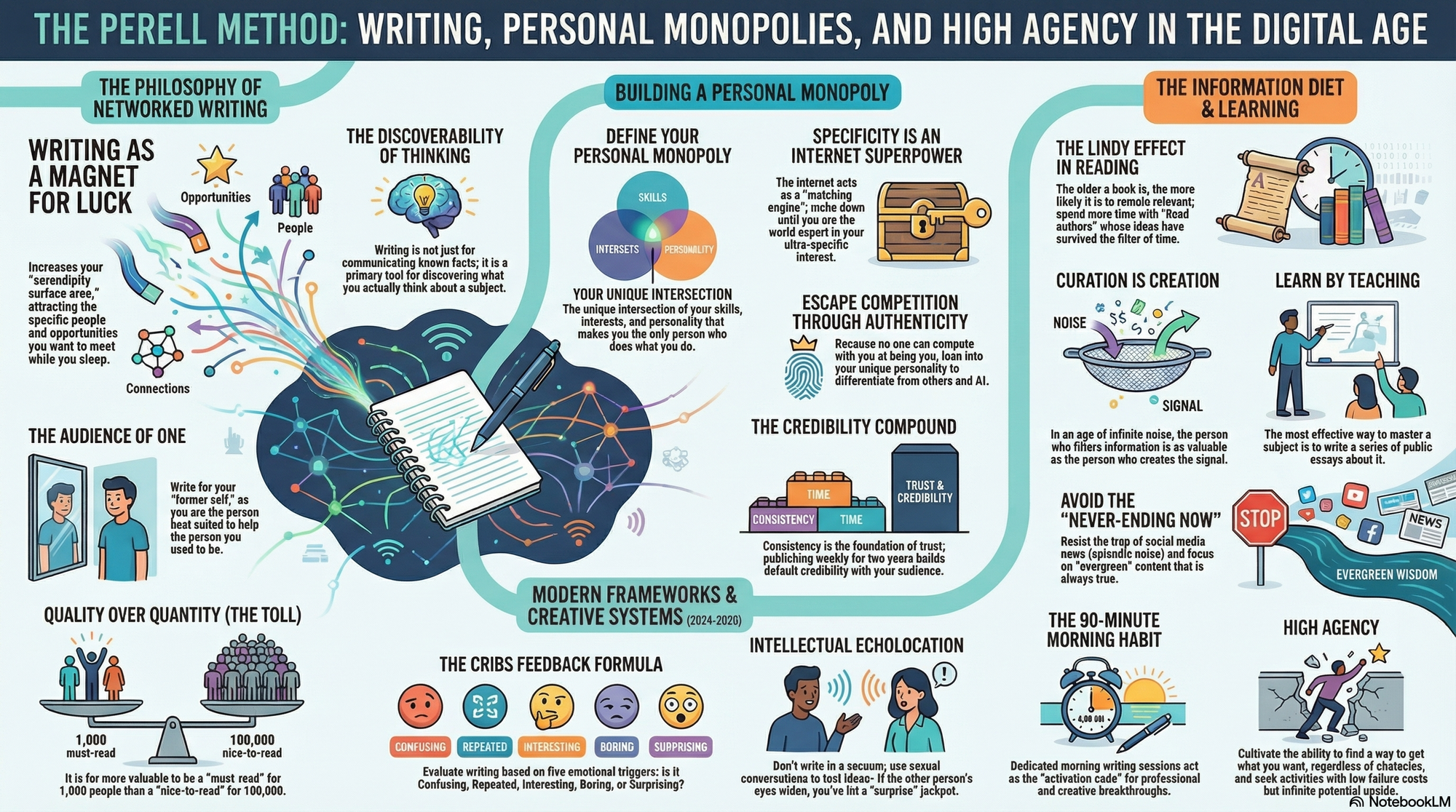
- Writing as a Magnet: "Writing is a magnet for ideas, people, and opportunities. By sharing your thoughts, you attract the people you want to meet."
- The Discoverability of Thinking: "Writing isn’t just for communicating what you already know; it’s a way to discover what you actually think."
- The Audience of One: "Write for your former self. You are the person best suited to help the person you used to be."
- Networked Writing: "On the internet, your writing works for you while you sleep. It is a 24/7 networking machine."
- Quality over Quantity (The Toll): "It is better to be a 'must-read' for 1,000 people than a 'nice-to-read' for 100,000."
- The Serendipity Surface Area: "Writing increases your 'luck surface area.' The more you publish, the more likely a life-changing opportunity will find you."
- The Clarity of Simplicity: "Good writing is about taking complex ideas and making them simple, not taking simple ideas and making them sound complex."
- Feedback Loops: "The fastest way to improve your writing is to publish it. Public feedback is the ultimate editor."
- The 80/20 of Writing: "80% of the value of writing comes from 20% of the ideas. Spend your time finding the big idea, not obsessing over commas."
- Imitation as a Bridge: "Don’t worry about being original at first. Copy the styles of your heroes until you find your own voice."
Part 2: Building a "Personal Monopoly"
- Define Your Monopoly: "A Personal Monopoly is the unique intersection of your skills, interests, and personality that makes you the only person who does what you do."
- The Internet Rewards Specificity: "The more specific you are, the more the internet works in your favor. Niche down until you are the world expert."
- Permissionless Apprenticeship: "Don't wait to be hired. Start doing the work for the person you want to work for, and publish it."
- Specific Knowledge: "You want to be known for something that feels like play to you but looks like work to others."
- The Matching Engine: "The internet is the best matching engine in human history. It connects people with ultra-specific interests."
- Escape Competition Through Authenticity: "No one can compete with you at being you."
- Build in Public: "Show the process, the struggles, and the behind-the-scenes. People don't just want the finished product; they want the story."
- The Credibility Compound: "Consistency is the foundation of credibility. If you publish every week for two years, people start to trust you by default."
- Career Insurance: "Your personal brand and your email list are the only true forms of career insurance."
- The Cost of Boring: "The biggest risk is being boring. If you don't take a stand, no one will remember you."
Part 3: The Information Diet & Learning
- Garbage In, Garbage Out: "Your output is only as good as your input. Curate your information diet like you curate your food."
- The Lindy Effect: "The older a book is, the more likely it is to remain relevant. Read things that have stood the test of time."
- Read to Solve Problems: "Don't just read to finish books. Read to solve the specific problems you are currently facing."
- Curation is Creation: "In an age of infinite information, the person who filters the noise is as valuable as the person who creates the signal."
- The Boredom Threshold: "If a book is boring you, stop reading it. Life is too short to read books that don't spark curiosity."
- Learn by Teaching: "The best way to learn a subject is to write a series of essays about it."
- Mimetic Desire: (Borrowing from Rene Girard) "We want what others want because we imitate their desires. Be careful who you choose as your role models."
- Conversation as Research: "Your best writing ideas usually come from things you say in casual conversation. Pay attention to what makes your friends lean in."
- The Wisdom of the Giants: "Spend more time with dead authors than living ones. Their ideas have survived the ultimate filter: time."
- Avoid the News: "The news focuses on the 'episodic' (what happened today) while you should focus on the 'evergreen' (what is always true)."
Part 4: High Agency & Modern Success
- High Agency: "High agency is the ability to find a way to get what you want, regardless of the obstacles."
- The Paradox of Choice: "Constraints don't limit creativity; they enable it. Give yourself a deadline and a word count."
- Serious Play: "The most successful people in the world are often the ones who have turned their childhood obsessions into their adult careers."
- The Frictionless Life: "Structure your life to minimize the friction between having an idea and executing on it."
- The Value of Paradoxes: "Truth usually lives in the tension between two opposing ideas."
- Seek Asymmetric Upside: "Look for activities where the cost of failure is low but the potential for success is infinite (like publishing an article)."
- The Power of Observation: "Most people look, but few see. Training yourself to notice the details is a competitive advantage."
- The Newsletter Advantage: "Email is the only platform where you own the relationship with your audience."
- Intellectual Curiosity: "Follow your curiosity, even when it seems 'unproductive.' Curiosity is the best compass for long-term success."
- The Social Media Trap: "Use social media to distribute your ideas, not to consume other people's distractions."
Part 5: Creativity & Productivity
- Capture Everything: "The human brain is for having ideas, not storing them. Use a 'Second Brain' to save every insight."
- The First Draft is for You: "The first draft is just you telling yourself the story. The revision is where you tell the reader."
- Active vs. Passive Consumption: "If you aren't taking notes, you aren't learning; you're just entertaining yourself."
- The "Work" of Rest: "Your best ideas often come when you aren't working—walking, showering, or dreaming."
- Write with the Door Closed: "Write the first draft for yourself with the door closed. Edit for the world with the door open."
- The Compound Effect of Ideas: "Small ideas, when connected over time, turn into massive intellectual breakthroughs."
- Find Your Peak Hours: "Do your hardest creative work when your brain is freshest. For most, that’s first thing in the morning."
- The Art of the Hook: "If you don't grab the reader's attention in the first two sentences, they will never read the rest."
- Writing is Editing: "You don't write a great essay; you edit a mediocre one into a great one."
- The Goal of Education: "The goal of education is not to fill a bucket, but to light a fire. It should make you more curious, not less."
Yes, there is a wealth of "Modern David Perell" insights, particularly from 2024 and 2025, that move beyond the basics of "writing as a magnet." His recent work focuses on differentiating from AI, the emotional mechanics of feedback, and intellectual wonder.
Here are 25 additional quotes and frameworks to round out the top 75, including his latest 2024–2025 learnings.
Part 6: Modern Frameworks & Systems (2024–2025)
- The CRIBS Framework: "To give or receive great writing feedback, use CRIBS: Is it Confusing, Repeated, Interesting, Boring, or Surprising? Focus on the reader's emotion, not just the grammar." (Source: CRIBS: My Writing Feedback Formula)
- Echolocation for Ideas: "Don't write in a vacuum. Use conversation as echolocation. Throw out an idea in a casual chat; if the other person's eyes widen or they lean in, you’ve hit a 'surprise' jackpot worth writing about." (Source: How I Write Podcast)
- The 90-Minute Habit: "The 90 minutes I spend writing every morning is my most important habit and the activation code for just about everything good that happens to me." (Source: The Ultimate Guide to Writing Online)
- Write with Personality to Beat AI: "The best way to differentiate yourself against AI is to write with personality. Use off-beat words and tell personal stories that a machine could never have lived." (Source: 10 Rare Writing Tips, Medium 2024)
- The Consistency-Quality Arbitrage: "The internet rewards frequency as the price of entry, but quality is the force multiplier. Be consistent enough to be found, but good enough to be remembered." (Source: Glasp Archive)
- "Get to the Freaking Point": (Often cited by Perell via Morgan Housel) "In an age of infinite distraction, the person who says the most in the fewest words wins." (Source: How I Write with Morgan Housel, 2025)
- Memorizing Poetry: "Memorizing poetry isn't an academic exercise; it’s a way to internalize the rhythm of great language so it eventually comes out in your own prose." (Source: How I Write: 2025 Reflections)
- High Care, Low Emotion: "For difficult leadership or feedback: High care, high empathy, low emotion. Care about the person, understand their struggle, but keep the emotional turbulence out of the decision." (Source: Annual Review 2022/2023)
- Intellectual Echolocation: "Your best writing isn't what you think is interesting, but what your audience reacts to most strongly. Test ideas on social media as a feedback loop for your long-form essays." (Source: Every.to Interview)
- The Curse of Knowledge: "Once you know a lot about a subject, you stop seeing what’s interesting about it. Talk to beginners to rediscover the 'surprise' in your own expertise." (Source: Monday Musings)
Part 7: Deep Philosophy & Success
- Wonder as a Survival Skill: "Wonder is the moment where you are taken aback by the miracle of the world. In a cynical age, protecting your sense of wonder is an act of creative survival." (Source: How I Write with Robert Macfarlane, 2025)
- Writing as a Reality Check: "When facing a tough problem, there is no better tool than forcing yourself to write it out. If you can’t write it, you don’t understand it." (Referencing his interview with Sam Altman) (Source: How I Write with Sam Altman)
- The "Baton Passing" of Ideas: "A book is not just a pile of information; it's a series of baton passes between concepts. If the research is weak, the baton falls." (Source: How I Write with Ezra Klein, 2025)
- Originality is Obscure Sources: "Originality is often just the result of having more obscure or diverse inputs than your peers." (Source: Founders Podcast with David Senra)
- The Penny Problem Gap: "People’s behavior changes fundamentally once an action costs even one penny. Free is a different world than $0.01." (Source: Monday Musings)
- Comfort the Confused: "Great writers comfort the confused and confuse the comforted." (Source: Goodreads - David Perell Quotes)
- The Never-Ending Now: "Social media feeds trap us in a 'Never-Ending Now.' We prioritize the last 24 hours of noise over the last 2,400 years of wisdom." (Source: The Never-Ending Now Essay)
- Practice Analytically, Perform Intuitively: "Do the hard, boring drills of writing (grammar, structure) so that when you sit down to create, you can let your intuition take the lead." (Source: Perell.com - Practice Analytically)
- "Be More Honest": "When you're stuck, the best writing prompt is simply: 'Be more honest.'" (Source: 10 Rare Writing Tips)
- The Personal Monopoly is a Process: "You don't 'find' a personal monopoly; you stumble into it by following your curiosity and listening to what people ask you for." (Source: Forcing Function Interview)
Part 8: The Power of Presence
- The Architecture of Attention: "Curate your physical and digital space to protect your deep work. If your phone is in the room, it's taking up mental bandwidth even if it's off." (Source: Monday Musings)
- The Mystery of Childhood: "The memories you keep from childhood are clues to your soul. Write about them to figure out what you truly stand for." (Source: How I Write with Jayne Anne Phillips, 2025)
- Writing to Learn vs. Writing to Teach: "Write to learn when you're a beginner; write to teach once you've earned the scars. Both are valid, but they require different tones." (Source: Monday Musings)
- The Social Media Trap: "People change their behavior when they know they are being watched. Social media is a performance; writing is a confession." (Source: The Social Media Trap Essay)
- The Goal of Online Writing: "To become a beacon. Not for everyone, but for the right people." (Source: The Ultimate Guide to Writing Online)
Sources and Links
To explore David Perell's work further, these are the primary hubs where these ideas originated:
- Perell.com (Official Website): The central archive of his long-form essays, including "The Ultimate Guide to Writing Online."
- Monday Musings & Friday Finds: His weekly newsletters where many of the "Information Diet" and "Personal Monopoly" concepts were first tested.
- Write of Passage: His flagship course that teaches the "Networked Writing" philosophy.
- How It Works Podcast: Interviews with high-agency individuals where he explores themes of creativity and success.
- David Perell’s Twitter/X: Where he frequently posts "threads" that distill these 50 points into digestible bites.
- The North Star Podcast: His earlier podcast focused on the intersection of media, business, and learning.
- How I Write Podcast (YouTube): The best place for his most current (2025) deep-dives with world-class authors.
- Writing Examples: A curated gallery of great writing David uses to teach specific techniques.
- David’s Annual Reviews: Where he distills the hardest business and life lessons he learned that year.
- CRIBS System Detailed Guide: His primary 2024/2025 methodology for improving draft quality.