Armand Farrokh and Nick Cegelski co-founded 30 Minutes to President’s Club (30MPC) and co-authored Cold Calling Sucks (And That’s Why It Works). Their teaching emphasizes specific, usable sales talk tracks and frameworks. — 30MPC Book and Authors.
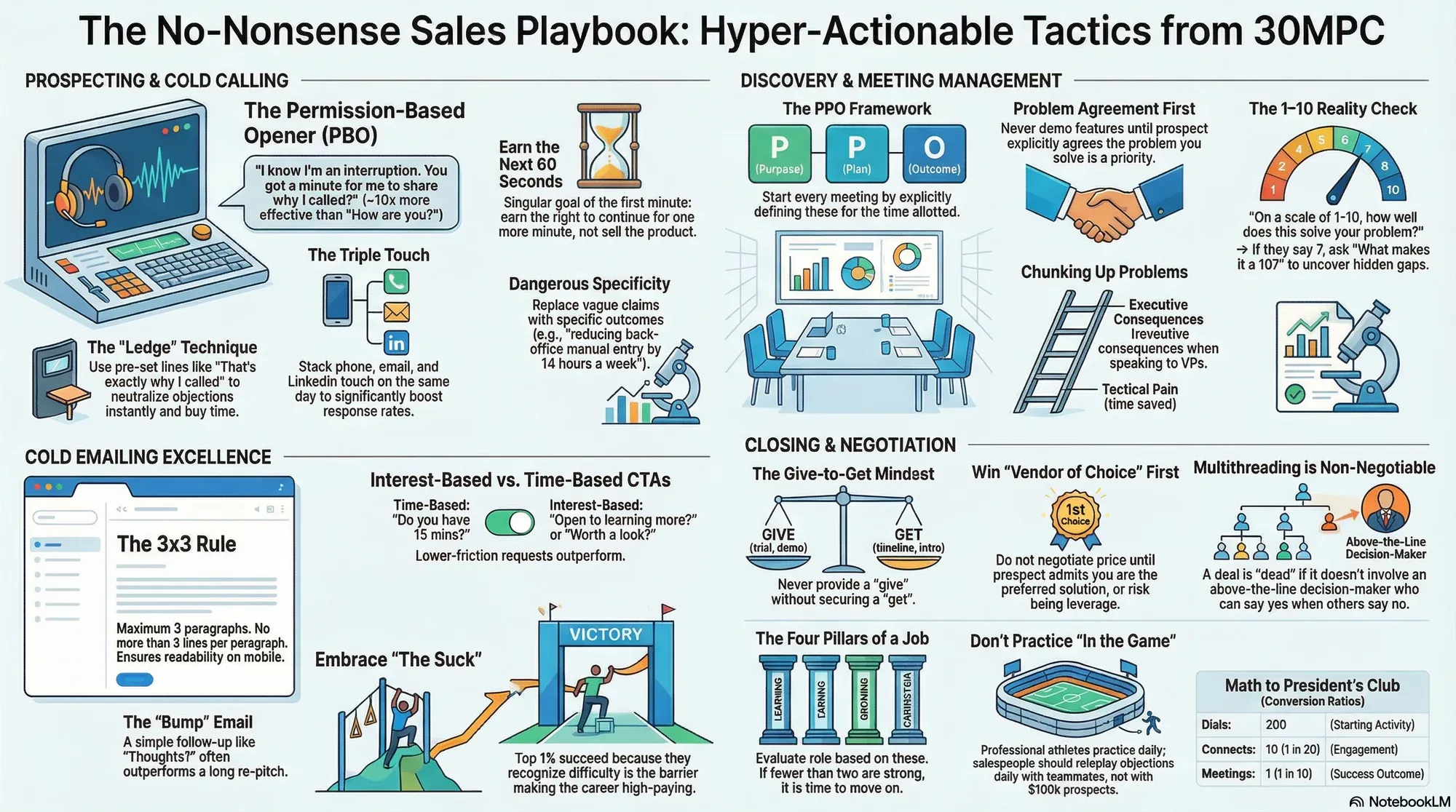
I. Prospecting & Cold Calling
- The Goal of the First 60 Seconds: “The goal of the first 60 seconds is to earn the next 60 seconds.” — Cold Calling Sucks — Chapter 1.
- The Tailored Permission Opener: Lead with a relevant trigger, acknowledge that this is a cold call, and ask for about 30 seconds to explain why you called. The book's PBO comparison is against a generic bad-time opener; it does not establish the claimed tenfold lift over 'How are you?'. — 30MPC Cold-Calling Framework.
- The Ledge: After an objection, a prepared acknowledgment can give the seller a moment to recompose before asking the next question. Armand credits this tactic to guest Jeb Blount. — 30MPC: 15 Sales Tactics.
- Heard the Name Tossed Around Opener: Open with relevant peer, competitor, or investor context; then introduce yourself and ask whether the prospect has heard your name. The context, rather than the canned wording, is the point. — 30MPC Cold-Calling Framework.
- Dangerous Specificity: Avoid vague efficiency language; state the specific problem and the concrete change your solution is meant to create. — 30MPC cold-calling framework.
- Sell the Test Drive, Not the Car: After acknowledging a budget objection, invite the prospect to take a look so they understand the option if budget later becomes available; do not force an immediate purchase discussion. — 30MPC Cold-Calling Framework.
- The Triple Touch: Use email, phone, and LinkedIn in a deliberate sequence, with each theme presenting a distinct problem rather than repeating the same pitch. — 30MPC Outbound Sequence.
- Preparation vs. Research: Armand recommends a brief disqualification check and a brief search for one relevant trigger before dialing, so research does not become an excuse to avoid calling. — Sales Evangelist Interview.
- Tone Is Part of the Call: Speak at a measured pace and avoid a rushed, upward-inflected or robotic delivery that makes the opener sound canned. — Cold Calling Sucks — Chapter 1.
- The Difficulty Is the Filter: The authors treat the discomfort of cold calling as part of its advantage: doing difficult outreach others avoid can separate a seller. — Cold Calling Sucks — Introduction.
- Kyle Coleman's 5×5×5 Method: Guest Kyle Coleman's 5×5×5 method sets five minutes to research a person or account, identifies five relevant insights, and spends five minutes writing the email. It is not five key accounts. — 30MPC Interview with Kyle Coleman.
- Voicemail as an Email Nudge: Armand recommends leaving a voicemail that points to a contemporaneous email. His article reports a higher reply rate for this double-tap approach (5.87% versus 2.73%); it does not establish a doubled email-open rate. — 30MPC Voicemail Guide.
- Be Disarmingly Blunt: Own that you are making a cold call instead of hiding the interruption. — 30MPC cold-calling framework.
- Avoid "Telemarketer" Habits: Never open with "How's your day going?"—strangers don't care, and it triggers immediate defense. — 30MPC cold-calling framework.
II. Cold Emailing
- The 3×3 Cold Email: Keep a cold email to three short parts: a personalized problem, a one-sentence solution, and an interest-based call to action. — 30MPC Sales-Email Guide.
- Interest-Based Calls to Action: Close with a small question about interest in the idea before asking a cold prospect to commit to a meeting. — 30MPC Cold-Email Breakdown.
- Subject Lines That Resemble Real Correspondence: Use a short, personalized subject tied to a specific trigger; avoid a promotional sales headline. — 30MPC Cold-Email Breakdown.
- Write Like a Person: Keep cold-email wording plain, concise, and conversational instead of mistaking formal language for credibility. — 30MPC Sales-Email Guide.
- Trigger, Tension, Trust: Nick explains guest Jason Bay's Triple T framework: lead with a relevant trigger, connect it to a business tension, and add credible trust rather than sending a generic template. — 30MPC Triple T Explainer.
- Prefer Plain-Text Outreach: Armand recommends simple, relevant cold emails without pictures or fancy graphics as part of deliverability-conscious outreach. — 30MPC Deliverability Guide.
- The Short Bump: One brief follow-up in the same thread can direct attention back to the first, well-targeted email; vary later follow-ups rather than repeating a bare 'any thoughts?' indefinitely. — 30MPC Outbound Sequence.
III. Discovery & Meeting Management
- PPO (Purpose, Plan, Outcome): Set a meeting agenda by naming its purpose, the plan for the time together, and the decision or outcome sought; Armand teaches this approach while crediting Doug Landis. — 30MPC — PPO Agenda.
- Bucket Questions: Offer a small set of plausible problem categories so a buyer can correct your assumptions and guide discovery; the hosts credit Kevin Dorsey for this technique. — 30MPC — Discovery Trees.
- The 1–10 Feedback Question: After a demo, ask the buyer to rate fit and explain what would raise the score; the hosts identify Brian LaManna as the source of this pulse check. — 30MPC — Best Sales Tactics of 2023.
- Problem Agreement First: Before a full solution demo, establish that the buyer recognizes a problem worth solving; this is the first exit criterion in the hosts' sales process. — 30MPC — Five-Stage Sales Process.
- Look for Trouble: When a prospect shows hesitation, name the concern or ask what reservation a stakeholder may have rather than letting it go unspoken. — Nick Cegelski — Look for Trouble.
- Solution Agreement: After agreeing on the problem, confirm that the buyer sees the proposed approach as a fitting solution before advancing the deal. — 30MPC — Five-Stage Sales Process.
- Challenge a Champion's Assumptions: Ask a champion questions they cannot yet answer about the buying group, then help them reach the people who can; Armand credits guest Morgan Melo for the tactic. — 30MPC — Multithread and Get to Power.
- Chunk Up Problems: Translate operational pain into business impact that an executive can evaluate, rather than inventing a numeric consequence. — 30MPC — Top-Down Selling.
- The Humbling Disclaimer: Use a modest disclaimer before a difficult discovery question so the buyer has room to correct an assumption; the hosts learned this from Charles Muhlbauer. — 30MPC — Discovery Questions.
- Demo Only the Relevant Pain: Show the buyer how the product addresses the problem they agreed matters, leaving out impressive features that do not advance that story. — 30MPC — If Your Demo Is Falling Flat.
IV. Process, Closing & Negotiation
- Give to Get: When a buyer requests a commercial concession, ask for a reciprocal commitment rather than giving value away without learning whether the deal can close. — 30MPC — Finish a Negotiation in One Cut.
- Buyer Agreements, Not Seller Activities: Advance a deal when the buyer makes the relevant agreement, not merely because the seller completed a meeting or demo. — 30MPC — Five-Stage Sales Process.
- The Three Whys of Negotiation: Before discussing price, establish why the buyer would purchase at all, why this vendor, and why now. — 30MPC — Negotiation Clinic Part 1.
- Present Price, Then Pause: After stating the price, give the buyer room to respond instead of rushing to fill the silence with a concession. — 30MPC — Negotiation Clinic Part 1.
- Win Preferred-Vendor Status First: Confirm that the buyer prefers your solution before negotiating price, or a discount may simply become leverage against another vendor. — 30MPC — Negotiation Clinic Part 1.
- Access to Decision-Makers: An enthusiastic champion is not enough if the team cannot reach the people who must agree to the problem, solution and purchase. — 30MPC — Multithread and Get to Power.
- Executive-to-Executive Outreach: When a champion cannot open a path to power, a matched executive on your side can send a brief note to the relevant buyer executive without a hard ask. — 30MPC — Multithread and Get to Power.
- The Golden Path: Before a key meeting, map the champion, decision-makers and influencers and plan the order in which to engage them. — 30MPC — Multithread and Get to Power.
- Don't Overreact to One Bad Day: Keep a steady calling cadence through short-term swings and change the process only when a pattern, not one disappointing day, warrants it. — Armand Farrokh — Bad Sales Day.
- Test an Extreme Ask: When a buyer makes an extreme demand, say plainly that the gap may make a deal impossible and see whether they re-engage before conceding. — 30MPC — Finish a Negotiation in One Cut.
- On High Intent Without Attachment: Negotiate with high intent to win the right deal while remaining detached enough to resist bad terms and buyer games. — 30MPC Negotiation Episode #580
- Prepare the Champion for Procurement: Before year-end procurement, discuss likely commercial requests with the champion while building a mutual close plan. — 30MPC — Close Deals Before Year-End.
- Get the Full Ask Before Trading: Ask for the buyer's full and final set of commercial requests, including billing terms, before constructing one conditional proposal. — 30MPC — Finish a Negotiation in One Cut.
- Conditional Approval Before Finance: Before seeking internal approval for concessions, obtain a conditional agreement on timing and remaining approvals so the ask relates to an executable deal. — 30MPC — Finish a Negotiation in One Cut.
- Offer Tradeoff Packages: Return with two or three clear packages that trade price, term or scope, aiming to conclude negotiation in one considered proposal. — 30MPC — Finish a Negotiation in One Cut.
V. Career & Leadership
- Four Career Pillars: Evaluate a role across learning, earning, growth and connection; if only two are strong, consider a change. — 30MPC — Career Advice, Episode 498.
- Prospect Into a Sales Job: Connect with current reps and cold-email leaders to earn a conversation rather than relying only on an application. — 30MPC — Career Advice, Episode 498.
- Build Early Work Ethic: Early in a sales career, put in the work and shadow strong performers to learn how they handle rejection. — 30MPC — Career Advice, Episode 498.
- Make the First Dials: Armand recommends making cold calls before inbox work and other distractions to build momentum. — 30MPC — How to Be a Cold Calling Machine.
- Batch Similar Sales Work: Block separate time for preparation, calls, email and customer conversations to reduce context switching. — 30MPC — How to Time Block in Sales.
- Sell Candidates Out of the Job: Mark Kosoglow's hiring method candidly explains the role's hard parts before a candidate commits. — 30MPC — Mark Kosoglow's Hiring Playbook.
- Reinforce Training Afterward: In Mark Kosoglow's 20/80 rule, formal training is about 20% of the work and reinforcement afterward about 80%. — 30MPC — How to Lead Sales Trainings.
- Roleplay Before Live Selling: Armand's onboarding program devotes its second week to mock sales conversations and objection practice. — 30MPC — Four-Week Sales Onboarding.
- Teach Exact Words and Actions: Armand breaks a skill into concrete steps and shows the literal words a rep can say instead of leaving it at a platitude. — 30MPC — How I Leveled Up My Sales Team.
I. Advanced Prospecting Frameworks
- Mr. Miyagi Objection Method: Agree with the objection, invite clarification, then sell a low-friction test drive instead of the whole product. — 30MPC — Cold Calling Framework.
- Offer Not to Call Again: When a prospect brushes off a call, agree to send information and ask one clarifying question, promising not to keep calling if irrelevant. — 30MPC — Cold Calling Framework.
II. Discovery & The "Sales Cycle" Evolution
- Obtain Power Agreement: After problem and solution agreement, obtain agreement from the executive decision-maker or economic buyer. — 30MPC — Five-Stage Sales Process.
- Purge Low-Intent Pipeline: Define conditions for worthwhile opportunities, then remove deals outside that slot before they consume selling capacity. — 30MPC — Unstoppable Sales Team, Episode 593.
III. Leadership & Operations
- Document What Good Looks Like: Document key sales-process steps and collect calls, emails, or recordings that show good execution, then use those examples in roleplay. Armand presents this as a tactic learned from guest Kevin 'KD' Dorsey. — 30MPC: 15 Sales Tactics.
- Four Management Rhythms: Mark Kosoglow describes deal reviews, team meetings, one-on-ones and skill-building sessions as management rhythms. — 30MPC — How to Lead Sales Trainings.
- Reverse-Engineer Activity Goals: Use actual conversion ratios to work backward from a meeting goal; Nick's toolkit provides a Math to President's Club calculator. — 30MPC — Sales Leadership Care Package.
- On Winning Private Buy-In Before Public Change: When changing a team's behavior, win over individuals privately before asking the group to commit publicly. — 30MPC SDR-Team Episode #589
- On Testing Coachability with a Mock Call: Use a mock cold call in interviews to observe whether a candidate can absorb feedback and execute under pressure, not merely describe how they would sell. — 30MPC SDR-Team Episode #589
Sources and Further Learning
- 30MPC Toolkit: Browse the official collection of sales scripts, templates and checklists. — 30MPC — Toolkit.
- 30MPC Tactic TV: Watch the official video library's cold-call, email, discovery and leadership sessions. — 30MPC — Tactic TV.
- Cold Calling Sucks (And That's Why It Works): Read Armand Farrokh and Nick Cegelski's book on prospecting and their cold-calling framework. — 30MPC — The Book on Cold Calling.
- Jason Bay's Reply Method: Explore the guest cold-email course that 30MPC features; a specific reply-rate outcome is not asserted. — 30MPC — Reply Method with Jason Bay.
- 30MPC Podcast: Browse the official podcast archive for full episodes. — 30MPC — Podcast Archive.
- 30MPC YouTube Channel: Browse the official video channel. — 30MPC — YouTube Channel.
- LinkedIn Profiles: Armand Farrokh on LinkedIn and Nick Cegelski on LinkedIn (directory links)
Sources
Learn more:
- Sales Negotiation Clinic, Part 1: How To Win The Negotiation Before It Starts, by Armand Farrokh. — 30MPC — Negotiation Clinic, Part 1.
- How to Build a World-Class SDR Team
- Exactly How to Build an Unstoppable Sales Team in 60 Days: 30MPC episode 593 with Armand Farrokh. — 30MPC — Episode 593.