Oliver Tuszik is Cisco’s Executive Vice President and Chief Sales Officer, with a career rooted in technology sales and channel strategy. He has pushed the company toward partner-led managed services to ready enterprise infrastructure for AI and digital sovereignty. This profile details his approach to building partner networks, handling IT complexity, and running sales teams.
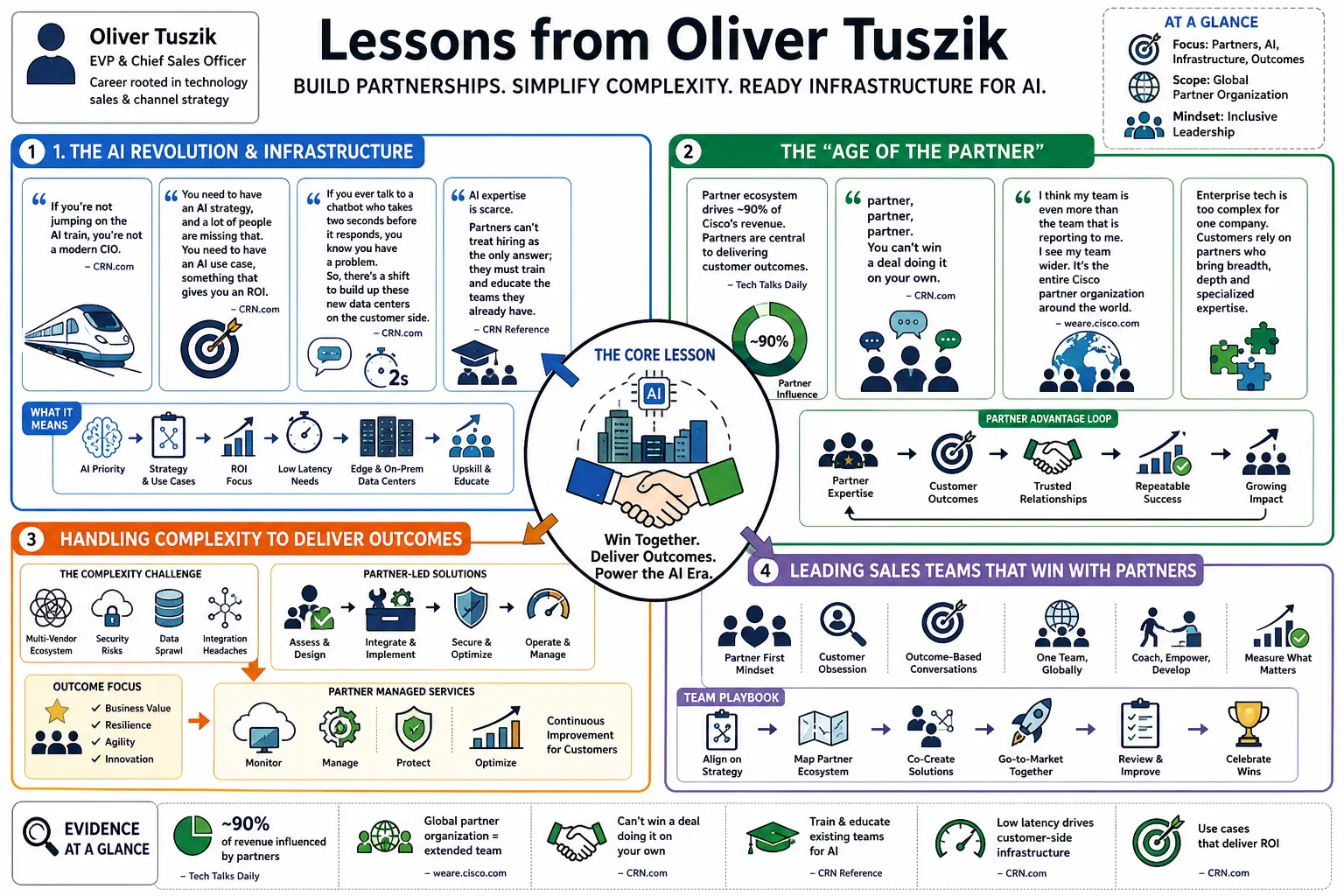
Part 1: The AI Revolution and Infrastructure
- On modern priorities: "If you’re not jumping on the AI train, you’re not a modern CIO." — Source: crn.com
- On defining AI initiatives: "You need to have an AI strategy, and a lot of people are missing that. You need to have an AI use case, something that gives you an ROI." — Source: crn.com
- On latency constraints: "If you ever talk to a chatbot who takes two seconds before it responds, you know you have a problem. So, there’s a shift to build up these new data centers on the customer side." — Source: crn.com
- On engineering gaps: AI expertise is scarce, so partners cannot treat hiring as the only answer; they must train and educate the teams they already have. — Reference: CRN
Part 2: The "Age of the Partner"
- On routes to market: Cisco’s partner ecosystem is not a peripheral channel; partners influence roughly 90% of the company’s revenue and are central to delivering customer outcomes. — Reference: Tech Talks Daily
- On collaboration: "partner, partner, partner. You can’t win a deal doing it on your own." — Source: crn.com
- On inclusive leadership: "I think my team is even more than the team that is reporting to me. I see my team wider. It's the entire Cisco partner organization around the world." — Source: weare.cisco.com
- On solving complexity: Because enterprise technology is too complex for one company to manage, customers increasingly rely on partners who can combine products and services into cohesive outcomes. — Reference: Tech Talks Daily
Part 3: Unique Value and Profitability
- On differentiation: "If you are a partner, you need to be unique. You need to create a value that nobody else can create because this creates profitability," — Source: crn.com
- On avoiding generic offerings: "If you are not different, if you are not unique, you will struggle to make margins. You will struggle to reach your customers." — Source: crn.com
- On identifying strengths: "Depending on where you’re coming from, start with that. Don’t start with the technology from Cisco or anything else. Start with, ‘What makes me special? Why do I win? Why do customers see value?’" — Source: crn.com
- On compounding value: Adding a small, custom piece of software on top of standard hardware can transform a conventional product into a highly profitable, specialized solution. — Reference: crn.com
Part 4: Transforming IT and Digital Resilience
- On shifting perceptions of IT: Digital transformation has moved technology from a back-office cost toward a board-level source of business value. — Reference: Tech Talks Daily
- On acting fast: Partners should follow fast in AI: move with urgency, but begin with a strategy, a real use case, and a credible return on investment. — Reference: CRN
- On career alignment: "Being the EVP for Global Sales is a dream job for me, and one that I’ve been preparing for all my life. I was an engineer, developing software and designing networks at university before [realizing] I was more suited to sales and leading teams." — Source: crn.com
Part 5: Data Sovereignty and Security
- On corporate assets: "The biggest asset is their data. Look at Cisco, our key differentiator is that we have data from about 40 years of managing networks." — Source: crn.com
- On local control: Offering organizations control over their own data—such as allowing European clients to host encryption keys locally—is essential for meeting regional compliance and governance requirements. — Reference: blogs.cisco.com
- On hybrid deployments: Many organizations need architectures that mix the security of on-premises control with the flexibility and speed of cloud-based software. — Reference: blogs.cisco.com
- On AI security pressures: Companies are eager to adopt AI tools so they do not fall behind, but they also require guarantees that their proprietary data will not leak into public training models. — Reference: crn.com
Part 6: Leadership and Team Culture
- On informal communication: "I was looking for a format which is more interactive, less formal, more talking with each other. And I came up with the idea of a coffee klatch. It describes a kind of get together, relaxed, no agenda, unplanned, unpredictable." — Source: weare.cisco.com
- On starting the day: "Before I speak, before I go to the shower, I get an espresso. I take my shower, then another espresso, then a cappuccino, and then I'm ready to start." — Source: weare.cisco.com
- On team diversity: "It's about different people, different ideas, different strengths – all working together to help our partners and Cisco succeed." — Source: weare.cisco.com
Part 7: The Shift to Services and Subscriptions
- On modern revenue models: Transitioning away from one-off sales toward software, managed services, and as-a-service frameworks enables partners to build steadier recurring revenue. — Reference: Tech Talks Daily
- On network visibility as a service: Providing network and application visibility tools via a SaaS model helps partners improve their bottom lines while addressing their customers' shift to the cloud. — Reference: computerweekly.com
- On reducing customer burden: Customers want flexible consumption models and clearly defined outcomes, leaving the work of managing solution complexity to their technology partners. — Reference: Tech Talks Daily
Part 8: Customer Proximity as an Operating System
- On leaving the office: Customer understanding improves when teams spend time where customers actually operate instead of relying on conference-room abstractions. — Reference: Cisco
- On the purpose of a visit: The strongest onsite visits are designed to understand how the business runs, what leaders are accountable for, and where technology helps or gets in the way—not to present or sell. — Reference: Cisco
- On shared ownership: A customer’s experience is shaped by sales, engineering, services, finance, legal, and operations together, so customer centricity cannot belong to one function. — Reference: Cisco
- On questioning assumptions: Listen, observe, and ask thoughtful questions to discover how customers define success and where they feel friction—not merely to confirm an existing point of view. — Reference: Cisco
- On operational observation: The most useful insights often come from seeing how decisions get made, where constraints exist, and where complexity slows progress. — Reference: Cisco
- On alignment through proximity: Direct customer exposure gives different functions a common picture of priorities, producing clearer strategies and better execution. — Reference: Cisco
- On changing the relationship: Proximity makes conversations less transactional and more like partnerships because customers are more willing to explain how their businesses really work. — Reference: Cisco
- On making it routine: Customer immersion should be embedded across teams and levels as a recurring operating practice, because Cisco succeeds only when its customers do. — Reference: Cisco
Part 9: Turning AI Demand into Execution
- On developing scarce skills: When experienced AI talent is scarce and expensive, training the existing team becomes a strategic capability rather than a secondary enablement program. — Reference: CRN
- On infrastructure before applications: Many customers need sustainable, scalable infrastructure before ambitious AI use cases can move from experimentation into daily operations. — Reference: CRN
- On packaging complexity: Integrated packages let customers start faster and avoid becoming the systems integrator responsible for diagnosing which component failed. — Reference: CRN
- On the opportunity stack: AI expands demand for technology, security, capable infrastructure, and automation at the same time, giving partners several legitimate ways to create value. — Reference: CRN
Part 10: Sovereignty, Resilience, and Choice
- On governance as an imperative: Digital resilience and responsible data governance are operating requirements, not optional compliance projects. — Reference: Cisco
- On deployment choice: Customers need the freedom to select on-premises, SaaS, or integrated hybrid architectures according to their security posture, operating model, and strategic goals. — Reference: Cisco
- On geographic control: The ability to store and process data within a region is a practical precondition for sovereignty, not merely a contractual promise. — Reference: Cisco
- On building resilience through trust: Technology choices matter, but long-term partnership and trust are what make digital resilience durable. — Reference: Cisco
Part 11: Partner Economics and Customer Outcomes
- On balancing the economics: A vendor can protect partner profitability and create predictable long-term business without compromising customer success. — Reference: CRN
- On focus through consumption models: As-a-service models give businesses flexibility to focus on their core strengths while partners manage more of the underlying technology. — Reference: Tech Talks Daily
- On multi-partner delivery: Complex customer demands increasingly require agreements that combine several partners rather than forcing one provider to pretend it can supply every capability. — Reference: Tech Talks Daily
- On visibility as management: For businesses that depend on networks and applications, visibility into the digital experience is a critical measure for managing performance holistically. — Reference: Computer Weekly
Part 12: Compounding Context Across a Career
- On seeing both sides of the ecosystem: Leading a major Cisco partner before joining Cisco gave Tuszik firsthand context for the incentives and constraints on both sides of a channel relationship. — Reference: Cisco
- On internal mobility: Moving through Germany leadership, global partners and SMB, EMEA, and global sales allowed him to compound company context while steadily widening his operating scope. — Reference: Cisco
- On cross-functional sales leadership: Global sales execution depends on close partnership with product, customer experience, marketing, and operations so customer needs translate into coherent business outcomes. — Reference: Cisco
Part 13: Designing an Ecosystem Program
- On co-design before launch: Cisco 360 emerged from years of discussion, iteration, and learning with partners, treating program design as a collaborative operating process rather than a top-down announcement. — Reference: Oliver Tuszik on LinkedIn
- On changing the operating model: A partner program can be more than a set of incentives; it can transform how a company partners, sells, wins, and grows with its ecosystem. — Reference: Oliver Tuszik on LinkedIn
- On predictable growth: Program design should help partners grow more predictably and profitably, giving them economics they can plan around rather than episodic rewards. — Reference: Oliver Tuszik on LinkedIn
- On rewarding early adopters: New programs create an advantage for partners that lean in early, learn the mechanics, and position themselves before the wider ecosystem catches up. — Reference: Oliver Tuszik on LinkedIn
- On preserving specialization: The strongest ecosystem programs help partners focus on what they do best while opening opportunities across a broader portfolio and more customer contexts. — Reference: Oliver Tuszik on LinkedIn
Part 14: Raising the Ambition for AI
- On looking beyond productivity: Automation, optimization, and acceleration still matter, but using AI only for productivity leaves much of its strategic potential untouched. — Reference: Oliver Tuszik on LinkedIn
- On shared cognition: The deeper shift is toward humans and AI thinking, planning, and making decisions together—not merely people issuing better prompts. — Reference: Oliver Tuszik on LinkedIn
- On aiming higher: Leaders should judge AI by whether it enables work that once felt impossible, not only by whether it makes familiar work faster. — Reference: Oliver Tuszik on LinkedIn
Part 15: Performing Through Market Transitions
- On the source of ecosystem complexity: Accelerating technology, changing buying behavior, new purchasing options, and digital-first business models combine to create challenges organizations cannot manage alone. — Reference: Cisco
- On unexpected collaborators: Outcome-led ecosystems require companies to partner with organizations they may not have worked with before when the customer problem crosses traditional boundaries. — Reference: Cisco
- On multi-role partner teams: Effective channel teams move fluidly among closing deals, planning joint marketing, generating leads, and helping partners construct managed-service offers. — Reference: Cisco
- On preparing for transitions: Ecosystem leadership includes helping partners anticipate both technology shifts and external headwinds so they can adapt before the pressure becomes existential. — Reference: Cisco
- On extending the vendor platform: Partners create defensible value by adding their own intellectual property and services, simplifying customer workloads, and translating technology into line-of-business outcomes. — Reference: Cisco
- On mapping a disruption: A shock can move partners through three distinct operating phases—increased technology demand, an economic slowdown, and a return to growth—each requiring a different commercial response. — Reference: Cisco
- On finding the recovery lanes: After disruption, the strongest growth opportunities often concentrate in managed services, XaaS, automation, adoption services, and custom applications. — Reference: Cisco