Over 28 years at T-Mobile, Mike Katz rose from the retail floor to Chief Business and Product Officer. He helped drive the "Un-carrier" strategy by treating customer complaints as business opportunities, pushing changes like the end of long-term contracts and the launch of satellite connectivity. Katz stepped down from his executive role in July 2026 and remains a strategic adviser through December.
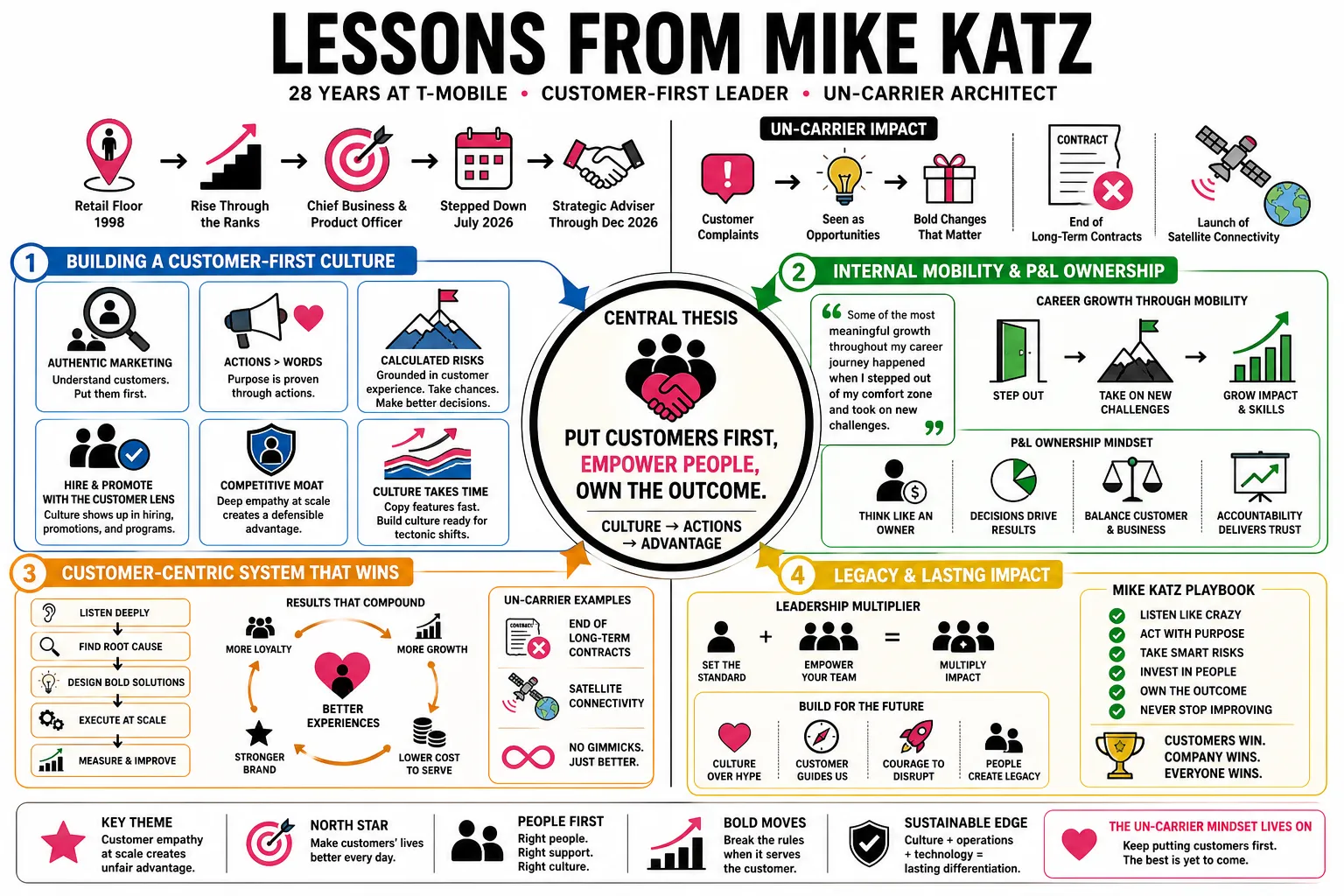
Part 1: Building a Customer-First Culture
- On authentic marketing: "Authentic marketing starts and ends with understanding your customers and then putting them first in everything you do." — Source: WSJ CMO Network
- On acting with purpose: "Actions speak louder than words when claiming to be a purpose-driven company." — Source: WSJ CMO Network
- On taking calculated risks: "When you are well-grounded in something—in T-Mobile’s case, our focus on the customer experience—and take chances and risks in that spirit, you probably aren’t going to make a bad decision." — Source: WSJ CMO Network
- On hiring and promotion: A customer-centric culture should directly influence daily operational choices like hiring, promotions, and program management. — Reference: The Speed of Culture Podcast
- On competitive moats: Establishing a deep operational and cultural commitment to customer empathy serves as a defensible advantage in an industry normally hindered by commoditization. — Reference: Speed of Culture Podcast
- On organizational change: Matching competitor pricing and features is easy, but it takes time to build a culture ready and willing to embrace tectonic shifts in customer service. — Reference: Salesforce
Part 2: Internal Mobility and P&L Ownership
- On career development: "Some of the most meaningful growth throughout my career journey happened when I stepped out of my comfort zone and took on bigger challenges." — Source: WSJ CMO Network
- On internal mobility: Starting in an entry-level retail role and saying yes to new opportunities allows an employee to progressively build expertise across sales, strategy, and executive marketing. — Reference: WSJ CMO Network
- On cross-functional insight: Working within a corporate strategy division provides a rare opportunity to look across an entire company matrix and understand how the complete business model functions. — Reference: Business Insider
- On P&L ownership: Managing a distinct sub-brand provides critical general management experience, forcing a leader to balance absolute profit and loss responsibility alongside brand positioning. — Reference: The Speed of Culture Podcast
- On repositioning a brand: Running a prepaid business teaches foundational lessons in customer segmentation and reveals exactly how consumers make purchase decisions when a product needs a reboot. — Reference: Business Insider
Part 3: Organizational Design and Operating Focus
- On flat organizational structures: Approaching business challenges in a non-hierarchical manner allows leadership teams to better utilize the diverse skills and experiences of everyone at the table. — Reference: WSJ CMO Network
- On marketing-led organizational design: In a company where marketing drives the central strategy, a chief marketing officer's role must naturally expand beyond advertising to encompass IT and supply chain operations alongside wholesale products. — Reference: The Speed of Culture Podcast
- On operating focus: When resources tighten or the cost of acquiring customers rises, leaders must rethink internal working models to focus strictly on the highest-impact priorities. — Reference: Business Insider
- On anticipating change: Success in future periods requires different capabilities, so leaders must constantly look around corners to stay ahead of the innovation curve. — Reference: Business Insider
- On unifying the customer experience: Putting marketing, strategy, product, brand, communications, enterprise technology, data, and AI under one mandate helps connect what customers are promised with how every interaction is actually delivered. — Reference: T-Mobile Executives
Part 4: Frontline Experience and Corporate Loyalty
- On the value of frontline roles: Spending time working directly with customers on a retail floor provides the necessary empathy and practical background for successfully leading a customer-obsessed company later on. — Reference: The Speed of Culture Podcast
- On corporate loyalty: Staying at a single company for decades can feel like working for several different organizations if the business undergoes major acquisitions and structural transformations. — Reference: The Speed of Culture Podcast
- On employee retention: The unique culture of a company and the quality of the people you interact with daily are often the primary reasons for remaining with an employer long-term. — Reference: The Speed of Culture Podcast
- On setting a vision: A leader's primary role is to align teams around a clear vision so they can focus entirely on identifying and breaking down customer pain points. — Reference: WSJ CMO Network
Part 5: Strategy, Execution, and Portfolio Expansion
- On market disruption: Meaningful differentiation comes from challenging entrenched industry practices and converting widely felt customer frustrations into a competitive advantage. — Reference: T-Mobile Executives
- On changing industry norms: Removing long-term contracts and international roaming fees showed that customer-centric strategy becomes powerful when it changes the operating model, not merely the advertising. — Reference: Speed of Culture Podcast
- On crisis-driven reinvention: When T-Mobile's proposed acquisition by AT&T collapsed and the company was losing customers, the failed deal created the urgency to rebuild around a clear, universal pain point. — Reference: Business Insider
- On reinventing customer care: Replacing robotic phone menus with dedicated teams of human experts is a competitive game changer that rivals cannot easily replicate. — Reference: Salesforce
- On portfolio expansion: Sustained corporate growth requires looking past traditional telecom offerings and successfully expanding the business into adjacent markets like high-speed broadband and advertising. — Reference: T-Mobile Executives
- On building a service ecosystem: Programs such as T-Mobile Tuesdays, Magenta Status, and T-Life turn a utility relationship into a recurring customer experience that can deepen loyalty between major purchase moments. — Reference: T-Mobile Executives
- On emerging growth segments: Expanding beyond core wireless involves capturing new opportunities in digital businesses and physical AI. — Reference: T-Mobile Newsroom
Part 6: Expanding Market Reach and B2B Growth
- On targeted outreach: Since national campaigns often fail to address the specific needs of varied communities, shifting toward localized marketing helps brands cut through mass-market noise. — Reference: Speed of Culture Podcast
- On enterprise services: Successfully moving into the B2B sector requires a company to provide reliable networks alongside dedicated account management and customized enterprise solutions. — Reference: Speed of Culture Podcast
- On sustainable growth: Implementing a dual strategy that focuses on local consumer markets while expanding enterprise services safeguards growth against normal consumer market fluctuations. — Reference: Speed of Culture Podcast
- On business partnerships: Focusing on underserved enterprise segments can triple a brand's customer base and result in lasting contracts with government agencies and Fortune 500 corporations. — Reference: T-Mobile Executives
- On connecting customer data: Giving sales and retail teams a shared CRM view reduces repeated questions, saves customers time, and makes a large organization feel more coordinated. — Reference: Salesforce
Part 7: Redefining Broadband and 5G Experiences
- On the digital divide: "connectivity is such an essential part of our lives and those that don’t have it are really left out of vital parts of our community." — Source: T-Mobile Newsroom
- On leveraging 5G: Realizing that 5G download speeds could greatly exceed 4G allowed mobile carriers to reconfigure their infrastructure and deliver a legitimate alternative to traditional wired home internet. — Reference: Speed of Culture Podcast
- On scaling solutions: The shift to remote learning during the pandemic proved that mobile networks can rapidly provide scalable internet connections to thousands of unconnected students in a single school district. — Reference: T-Mobile Newsroom
- On rural access: Deploying reliable wireless home internet in rural areas and small towns delivers vital connectivity choices to people who previously had zero high-speed options. — Reference: WSJ CMO Network
- On the Internet of Things: High-capacity wireless networks will soon enable entirely new ecosystems of connected objects, such as self-driving cars that communicate with one another in real time. — Reference: T-Mobile Newsroom
- On immersive technology: Moving forward, widespread 5G access will be required to successfully scale augmented reality and other low-latency entertainment platforms. — Reference: Speed of Culture Podcast
- On household network demand: Streaming, gaming, security devices, and other connected products turn the home into a high-capacity network environment rather than a collection of isolated devices. — Reference: T-Mobile Newsroom
- On digital environments: As commerce and social interaction move into more immersive digital spaces, network latency and capacity become part of the product experience rather than invisible infrastructure. — Reference: T-Mobile Newsroom
- On platform transitions: The rise of ride-sharing and food-delivery businesses after 4G illustrates how a new network generation can create business models that were difficult to predict when the infrastructure first arrived. — Reference: Salesforce
Part 8: Live-Event Product Proof and Satellite Connectivity
- On live-event product proof: High-attendance spectacles like a city-wide Formula 1 race serve as rigorous testing grounds and highly visible playgrounds for proving network speed and reliability. — Reference: Business Insider
- On active marketing: Choosing to actively market network capabilities at high-profile sporting events rather than remaining an invisible infrastructure provider amplifies brand reach. — Reference: Speed of Culture Podcast
- On everyday satellite connectivity: "We believed the real value of satellite wasn’t just emergency access — it was everyday access" — Source: T-Mobile Newsroom
- On automatic integration: Seamless satellite connectivity allows everyday smartphones to automatically send and receive messages off the grid without the user knowing they left traditional coverage. — Reference: T-Mobile Newsroom
- On eliminating dead zones: Combining low-earth orbit satellites with a cellular network creates a safety net capable of keeping remote workers and families in contact across previously unreachable terrain. — Reference: T-Mobile Newsroom
- On disaster response: In moments where traditional cell towers go offline due to storms or wildfires, satellite integration provides an essential lifeline for emergency response teams. — Reference: T-Mobile Newsroom
Part 9: Personal Values and Community
- On defining community: "For me, community means a sense of belonging, understanding and alignment." — Source: WSJ CMO Network
- On work-life balance: While career success is rewarding, investing time and presence into family activities and vacations remains the highest personal priority. — Reference: T-Mobile Newsroom
- On remote productivity: The connectivity provided by modern mobile technology grants executives the freedom to step away from the office while still maintaining productive oversight. — Reference: T-Mobile Newsroom
- On institutional partnerships: Strong collaborations between corporations and universities begin with a shared orientation toward improving the daily experiences of students and surrounding communities. — Reference: Colorado State University
- On inclusive workplaces: Encouraging employees to bring their true selves to work helps the broader team serve consumers more effectively through unique talents and varied perspectives. — Reference: WSJ CMO Network