April Dunford is a globally recognized positioning consultant who has worked with more than 200 technology companies to help customers understand the value of complex products. She is the author of Obviously Awesome: How to Nail Product Positioning so Customers Get It, Buy It, Love It and Sales Pitch, practical guides for marketers, entrepreneurs, and business leaders.
Core Principles of Positioning
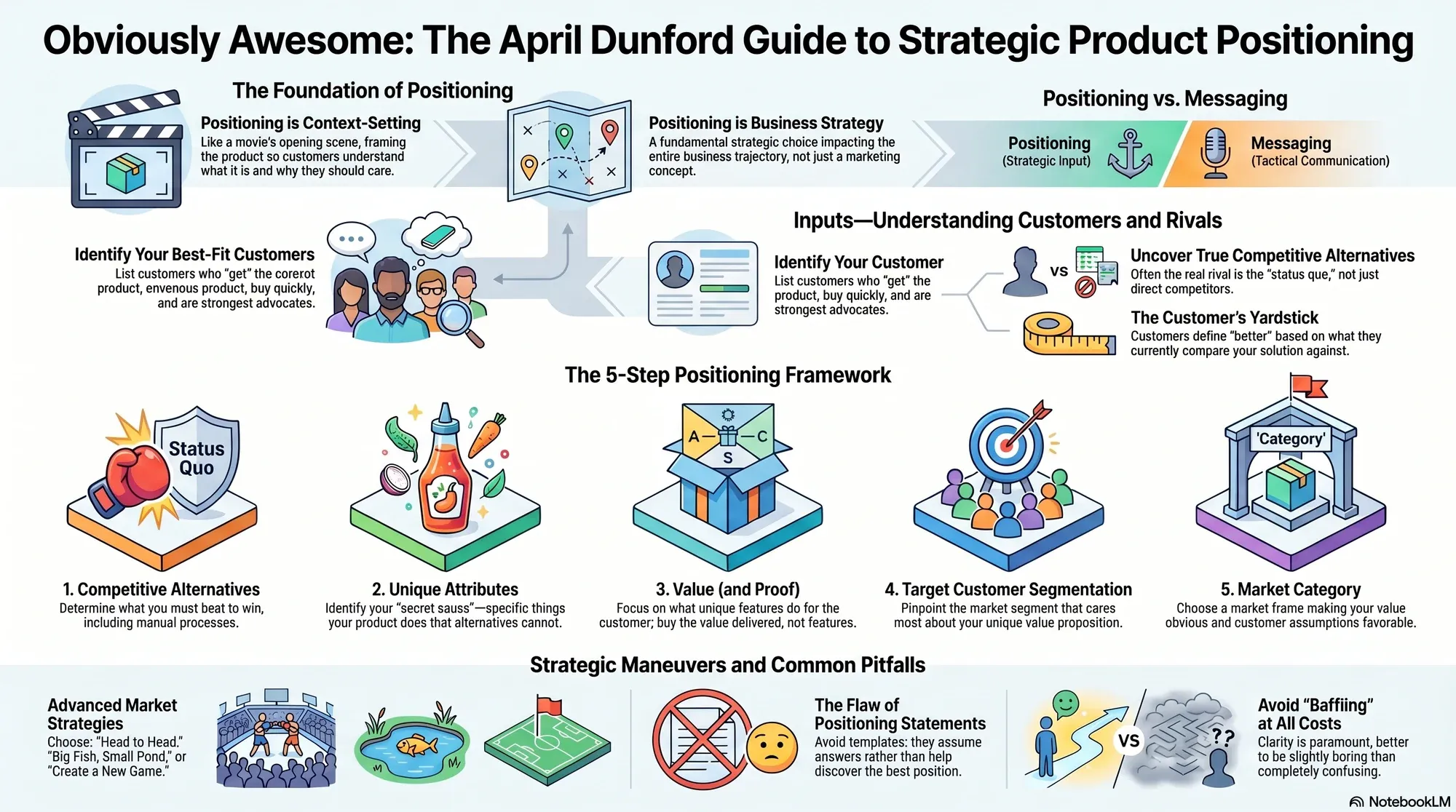
- Positioning as Context-Setting: "Positioning is like context-setting for products. It's a bit like the opening scene of a movie." [1] This initial framing answers the big questions for the customer: What is it? Who is it for? And why should I care?. [1][2]
- The Goal of Positioning: "Positioning defines how your product is the best in the world at delivering some value that a well-defined set of companies care a lot about." [3]
- Positioning is a Business Strategy: "While most people think of positioning as a marketing concept, a shift in positioning feels more like a shift in business strategy." [4] It underpins your entire business approach and can be the difference between success and failure. [4]
- Deliberate vs. Default Positioning: "We generally fail to consider other—potentially better—ways to position our products because we simply aren't positioning them deliberately." [5] Many companies fall into the trap of accepting a default positioning rather than making a conscious, strategic choice. [5]
- Positioning and Messaging are Different: "Positioning is an input to messaging... The positioning template should not be a way of documenting your value proposition or approved messaging." [6][7] Positioning comes first, defining the market and value, while messaging is the consistent communication of that position. [6]
- On A market point of view: Give buyers a clear view of where the market is heading and how to navigate toward it; uncertainty makes this part of the sales and positioning job, not optional thought leadership. — Positioning in the Age of AI
Understanding Your Customer and Competitors
- Focus on Your Best-Fit Customers: "The first step in the positioning exercise is to make a short list of your best customers." [8] These are the customers who "get" your product, buy it quickly, and become advocates. [8][9]
- The Litmus Test for Happy Customers: "Think about your best customers. Everything about doing business with them is different. They understood your product immediately and couldn't wait to get their hands on it." [10]
- Understanding True Competitive Alternatives: "You need to understand who your real competitors are in the minds of customers." [11] To do this, ask the crucial question: "What would our best customers do if we didn't exist?". [9][11]
- Competitors Aren't Just Direct Rivals: The alternative to your product isn't always another company; it can be "using a pen and paper," "hiring someone," or doing nothing at all. [11] In B2B, you often lose deals to the status quo, like spreadsheets or interns. [3]
- The Customer's Perspective is Key: "It's important to really understand what customers compare your solution with, because that's the yardstick they use to define 'better.'" [5]
- On Real versus future competitors: Position against the alternatives prospects actually put on their shortlist now, while using the roadmap to prepare for credible future threats. — Positioning in the Age of AI
The 5 Components of Effective Positioning
Dunford breaks down positioning into five interconnected components. [2][12]
- Competitive Alternatives: What your customers would use if your product didn't exist. [2]
- Unique Attributes: "Your unique attributes are your secret sauce, the things you can do that the alternatives can't." [11]
- Value (and Proof): Customers don't buy features; they buy the value those features deliver. [7][11]
- Target Customer Segmentation: Identifying the customers who care deeply about your unique value. [2]
- Market Category: The frame of reference that makes your value obvious to your target customers. [2]
Crafting Your Positioning
- Start with Competitive Alternatives: The first step is to understand what you have to beat to win a deal. [3]
- From Features to Value: "Customers don't care about your unique features, they care what those features can do for them." [7]
- Find Who Cares—A Lot: Once you understand your unique value, you must determine which segment of the market cares most about that value. [8]
- Choosing Your Market Category Wisely: "If you choose your category wisely, all the assumptions are working for you." [5][13] It tells customers who your competitors are and what features to expect. [13]
- Market Frame of Reference is Crucial: "The frame of reference that a potential customer chooses can make or break a business." [10]
- On Distinguishing a point of view from product vision: A market point of view should explain what good solutions will look like and inform roadmap choices, while avoiding the trap of selling an unfinished future instead of today’s product. — In the Age of AI, You Need a Point of View
Common Positioning Pitfalls
- The Flaw of Positioning Statements: The traditional "fill-in-the-blanks" positioning statement is dangerous because it assumes you already know the answers and doesn't help you discover the best positioning. [1][14]
- Sticking to Your Original Idea: A common trap is being stuck on the initial idea of what the product is or who the market is, even after the product and market have evolved. [15]
- Ignoring Market Shifts: "Sometimes a product that was well positioned in a market suddenly becomes poorly positioned, not because the product itself has changed, but because markets around the product have shifted." [11]
- Positioning Against Competitors Customers Don't Know: "You will weaken your positioning by trying to position against competitors your customers never even consider." [2]
- Confusing Boring with Baffling: "It's always better to be a little boring than completely baffling." [16] Clarity is paramount.
- On Adapting positioning during technology shifts: When technology, buyer priorities, and competition all change at once, revisit positioning because differentiated claims may no longer hold. — Positioning in the Age of AI
Advanced Positioning Strategies
- Head to Head: Positioning to win in an existing market. [8]
- Big Fish, Small Pond: Positioning to win a subsegment of an existing market. [8]
- Create a New Game: Positioning to win a market you create. This requires educating the market on the problem first. [8][13]
- Layering on a Trend (Carefully): "A trend helps customers see your product as an urgent or strategic...purchase." [8] However, don't force-fit your product into a trend. [9]
- Marketing Jiu-Jitsu: "The art of transforming competitor strengths into weaknesses." [17]
- On Grounding a point of view in strengths: A credible future narrative should arise from the capabilities a company can genuinely deliver better than other vendors, rather than from generic market prediction. — In the Age of AI, You Need a Point of View
- On Linking future promise to present value: During major technology transitions, discuss the future honestly, but connect it to what a customer can buy and benefit from today. — Positioning in the Age of AI
Quotes on Sales and Growth
- The Impact of Weak Positioning on Sales: If you have long sales cycles or low conversion rates, you likely have a positioning problem. [4]
- Win Analysis is Crucial: "Every deal you win you should treat that like the little miracle that it is. And find out why the miracle occurred." [18]
- The "No Decision" Loss: Losing to "no decision" means you lost to the status quo. Your positioning must effectively argue against doing nothing. [3]
- Economic Shifts and Value Propositions: In a good economy, "make money" pitches often outperform "save money" pitches. In a downturn, the reverse can be true as companies focus on survival. [18]
- Positioning and Pricing Power: "Clear positioning helps prospects understand that you are a leader in your market segment and that you offer considerable value, making it easier for you to charge a premium." [13]
- On Treating price objections as risk signals: When a buyer says the price is too high, diagnose whether the real barrier is commitment risk; reduce that risk with a phased engagement instead of reflexively discounting. — Conquête: April Dunford on the Positioning Mistakes That Kill B2B Deals
Actionable Learnings and Advice
- Keep Positioning Loose Initially: "When a product is first released in a market, you should keep your positioning loose until you start to see patterns in who loves your stuff and why." [19]
- Form a Positioning Team: Involve people from across the company to get a holistic view. [8]
- Let Go of Your Baggage: The team needs to align on vocabulary and be open to abandoning old assumptions about the product's position. [4]
- Capture and Share Your Positioning: Create a messaging document that translates your positioning into a narrative that can be used by sales and marketing. [7][9]
- Positioning is Not a One-Time Event: "Great positioning rarely comes by default. If you want to succeed, you have to determine the best way to position your product. Deliberate, try, fail, test and try again." [16]
- On Turning positioning into a sales conversation: Once the company has defined its competitive context, differentiated capabilities, value, and best-fit customer, turn that work into a first-call story that gives buyers a reason to progress. — Data Faces: The death of SaaS is a myth
Inspirational and Foundational Quotes
- "You know your product is awesome—but does anybody else?" [12]
- "If people don't get what you're selling, they won't buy." [14]
- "Strategy is about making choices, trade-offs; it's about deliberately choosing to be different." [13]
- "Great positioning makes our strengths obvious." [7]
- "You cannot be everything to everyone. If you decide to go north, you cannot also go south." [11]
- "A world-class musician playing on a street corner will be ignored and not make much money." [15] Context is everything.
- "The future isn't a place we are going to go, it's a place we get to create." (quoting Nancy Duarte) [11]
- "Your customers are already telling you exactly how to position your product —you just need to follow their lead." [6]
- "The biggest mistake you can make is to think your offering could only be positioned in one market." [20]
- "If you see a disconnect between how your happy customers think about your product and how prospects see it, you likely have a positioning problem." [13]
Learn more:
- An Introduction to Positioning - April Dunford
- A Quickstart Guide to Positioning - April Dunford
- How to nail your product positioning | April Dunford (Obviously Awesome) - YouTube
- Book Summary - Obviously Awesome (April Dunford) - Readingraphics
- Quotes by April Dunford (Author of Obviously Awesome) - Goodreads
- Product Positioning That Works—with April Dunford, Global Positioning Expert - How to Web
- A Product Positioning Exercise - April Dunford
- How We Used April Dunford's 10-Step Method to Overhaul Positioning at Userlist
- Book summary: Obviously Awesome by April Dunford | by Bart Krawczyk - Medium
- [Summary] How To Nail Product Positioning by April Dunford — 3 Takeaways, 2 Quotes, 1 Question. - Matthew Sison
- OBVIOUSLY AWESOME: HOW TO NAIL PRODUCT POSITIONING SO CUSTOMERS GET IT, BUY IT, LOVE IT by April Dunford
- How to find your positioning (the April Dunford way) - LBk Consulting
- [Quotes] Obviously Awesome: How to Nail Product Positioning so Customers Get It, Buy It, Love It by April Dunford - Therese's Little Corner
- Obviously Awesome by April Dunford [Actionable Summary] - Durmonski.com
- Notes on Obviously Awesome by April Dunford - Max Mednik
- Obviously Awesome Quotes by April Dunford - Goodreads
- Positioning With April Dunford
- Meet the Queen of Product Positioning aka April Dunford (An Exclusive Interview) - YouTube
- 5 Questions with April Dunford (author and product positioning expert) - Part 2 - How to Web
- Obviously Awesome: a product positioning exercise | by April Dunford | HackerNoon.com