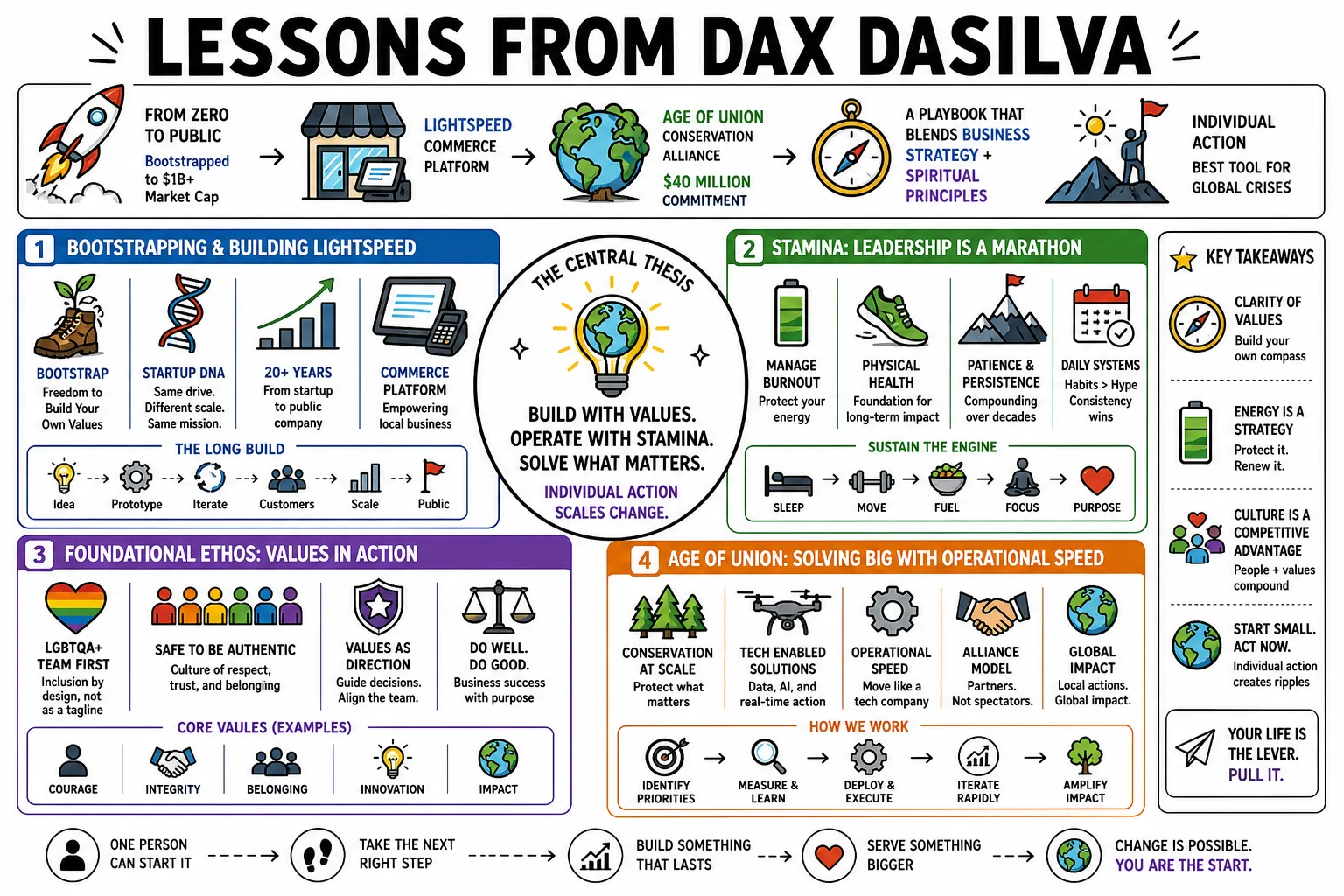
Lessons from Dax Dasilva
Dax Dasilva built the commerce platform Lightspeed from a bootstrapped startup into a public company while maintaining an openly LGBTQ+ leadership culture. He later committed $40 million to launch Age of Union, a conservation alliance that tackles environmental issues with the operational speed of a tech firm. His resulting playbook blends hard business strategy with spiritual principles, arguing that individual action is still the best tool for solving global crises.
Part 1: Bootstrapping and Building Lightspeed
- On Bootstrapping: "When you bootstrap, you have more time to really know what you stand for—to really build a set of values and a way of operating that's uniquely your own." — Source: [BetaKit]
- On the Startup DNA: The drive required to build a tech company from zero against impossible odds is the exact same DNA required to tackle monumental environmental challenges. — Source: [Mission Critical]
- On Stamina: Building a company over two decades requires managing burnout and prioritizing physical health to maintain the stamina necessary for long-term leadership. — Source: [The Startup CEO Show]
- On Foundational Ethos: "In the early days of Lightspeed... the team was entirely LGBTQA+ for the first few months and diversified naturally as we grew. The openness, acceptance, creativity, and showmanship of our community cemented our company's ethos from these early influences." — Source: [Glory Media]
- On Patience: Taking the time to grow without venture capital initially allows a business to establish its core identity before external pressures force rapid scale. — Source: [BetaKit]
- On Early Belief: "When you, as a leader, believe in something and show passion for something, that's contagious." — Source: [BetaKit]
- On Building Solutions: "A diversity in cultural or social communities brings different perspectives to the table, allowing for the creation of richer, more powerful solutions to complex problems." — Source: [Glory Media]
- On Company Culture: "I often say that Lightspeed is a company that's infused with culture just as much as code." — Source: [Glory Media]
- On Defining Values: Early constraints force founders to be explicit about what their company stands for, embedding those values deeply into the organization's foundation. — Source: [BetaKit]
Part 2: The Evolution of the CEO
- On Reinvention: "I learned at Lightspeed that you reinvent your job title every year as CEO. Just when you're getting comfortable, you have to step out of your comfort zone into something that's often completely foreign." — Source: [Substack]
- On Resilience: "You kind of end up having to be a philosopher to survive the ups and downs of growing a business." — Source: [BetaKit]
- On Comfort Zones: Growth only happens when you step outside your comfort zone, whether you are navigating the boardroom or trekking through the Amazon rainforest. — Source: [Mission Critical]
- On Listening First: True leadership isn't about being the loudest person in the room; it is about hearing others to gain buy-in and genuine followership. — Source: [YouTube: Dax Dasilva]
- On Creating Leaders: The ultimate goal of a leader is to foster leadership at every level of the organization, empowering employees to take ownership and act as the CEO of their own domains. — Source: [Medium]
- On Non-Traditional Leadership: "I never saw myself as having the Type-A characteristics of traditional leaders. I chose instead to leverage my position by valorizing diverse perspectives. This has allowed me to find my own methods of leadership, elevated by the voices of others." — Source: [Glory Media]
- On Taking Risks: "If you don't take risks in being a leader for D&I, then who will? The world needs people willing to stand up for important topics, especially in times of a leadership vacuum." — Source: [Glory Media]
- On Reverse Mentorship: Leaders must be willing to learn from younger generations, like Gen Z and Millennials, to truly understand modern worldviews and adapt their organizational structures. — Source: [Delve Podcast]
- On Authenticity: A leader must strive to be "one authentic person" across all their different roles—whether as a tech executive, an activist, or an author. — Source: [Mission Critical]
Part 3: Fostering Culture and Diversity
- On Celebrating Differences: "When you celebrate differences and diversity... the return you get from your employees in terms of motivation and morale is ten-fold." — Source: [Glory Media]
- On Diversity as an Advantage: Diversity is not a vanity metric; it is a core competitive advantage that brings the variety of perspectives necessary for global success. — Source: [Glory Media]
- On Broadening Leadership: "We need to broaden our narrow notions of leadership to embrace its many styles and faces... Leadership diversity means more creativity, ingenuity, and ability in our world." — Source: [Glory Media]
- On Difference as a Teacher: "Difference can be a teacher rather than a source of fear or division." — Source: [Glory Media]
- On Equal Opportunity: "Lightspeed was started by members of the LGBTQ+ community—including myself. I think knowing they're going to be given equal opportunity is partly why we've been able to attract the talent we have." — Source: [Dialogue]
- On Leading by Example: "We have the duty to show the example... an environment where LGBTQA+ people can be empowered and contribute fully to the success of our tech companies." — Source: [Glory Media]
- On Breaking Hierarchies: Real equality and diversity require moving beyond traditional top-down hierarchies to foster open, multi-directional communication. — Source: [Delve Podcast]
- On Inclusive Workplaces: Organizations must proactively create environments where employees feel safe and encouraged to bring their authentic selves to work every day. — Source: [The Startup CEO Show]
- On Nurturing Diverse Interests: "If you have lots of different diverse interests, nurture and water those because although they may not seem highly relevant today, they make you a broader person and enrich your life as you go on." — Source: [Forbes]
- On Bridging Divides: "In the future, we must be better prepared to use critical voices to build new bridges in the face of division." — Source: [McGill]
Part 4: The Concept of the Conduit and Spirituality
- On Being an Instrument: "Spirituality lets you connect into something that takes the pressure off your shoulders and helps you see yourself as an instrument." — Source: [Forbes]
- On Relieving the Ego: "You can strive to be the best conduit as opposed to feeling completely burdened with work." — Source: [Forbes]
- On Anxiety: "If you don't have that [spiritual foundation], you start thinking that everything that goes right – or wrong – is because of you. I think that is why people are wracked with anxiety nowadays." — Source: [Forbes]
- On the Journey: "Spiritual exploration embraces and celebrates humanity's journey. It teaches us that our journey can be at once remembered and renewed by this generation." — Source: [Whizzcart]
- On Reclaiming Traditions: "Spiritual and mystical traditions show us how, as a people, we have reached for that which seemed beyond all understanding. We can learn from traditions that, in today's world, can be reclaimed with modern application." — Source: [Whizzcart]
- On Daily Intention: "I find the idea of mitzvah such an inspiration for how you bring in an action, it's the light of intention. It's your day today, it's your hour by hour, and it gives meaning and purpose to you all day long." — Source: [AppDirect]
- On Consciousness: "Once you're conscious of something, once you're thoughtful, then everything changes. We do so many things without reflecting or thinking about why we are doing them." — Source: [WUL Magazine]
- On Disconnecting: Observing practices like the Sabbath is essential for disconnecting from technology, reconnecting with people, and maintaining long-term mental health. — Source: [Forbes]
- On Purpose-Driven Work: A spiritual toolkit allows leaders to connect to a higher purpose, shifting their perspective from personal ambition to viewing their work as a broader service. — Source: [Forbes]
Part 5: The Philosophy of "Age of Union"
- On the Meaning of Union: "Unseparation is a united front across all people, cultures, and living things." — Source: [Goodreads]
- On the Four Pillars: Effective change requires integrating four foundational pillars: Leadership, Culture, Spirituality, and Nature. — Source: [Medium]
- On Personal and Global Goals: "To these personal goals, we must add an attentive focus upon the greater good." — Source: [McGill]
- On Opening the Heart: "It takes courage to open one's heart, but when we do, we open a space that can be filled with the strength to be leaders in our own destined capacity, to connect with one another." — Source: [McGill]
- On the Urgency of Now: "The time for change is now and our choices are the catalyst." — Source: [Medium]
- On Scaling Impact: "If I can scale Age of Union the same way I scaled Lightspeed, the future of our planet will have a very different outcome." — Source: [Goodreads]
- On Individual Gifts: "As individuals, we are each uniquely gifted and driven to fulfill our personal life goals." — Source: [McGill]
- On Shared Values: "Create more leaders within your organization — Surround yourself with those who share the same values as you and then open doors for them to also fulfill leadership positions." — Source: [Medium]
- On Reframing Crisis: "Every crisis is an opportunity." — Source: [McGill]
- On Reaching the Tipping Point: The Age of Union is about moving past awareness into an era where coordinated, intentional acts create a tipping point for planetary survival. — Source: [Age of Union]
Part 6: Environmental Activism and Action
- On the Real Threat: "The greatest threat to our planet isn't a lack of awareness. It's a lack of union. We are all interconnected. Every species, every ecosystem, every person. The Earth needs every one of us to act." — Source: [Age of Union]
- On Action vs. Awareness: "We're past the point of needing to raise awareness: We're at the stage where we need to see action." — Source: [Canadian Business]
- On Protecting What You Love: "You protect what you love... We live in these urban environments where we're more disconnected from nature, but if we learn to be out in nature and love nature, then we would rally for nature." — Source: [Forbes]
- On Small Acts Creating Hope: "There cannot be hope without you actually starting in small acts, but then graduating to bigger acts because those are the things that give all of us hope and inspire all of us to do more." — Source: [YouTube: Dax Dasilva]
- On the Danger of Despair: "The worst outcome would be for people to stop believing that we're out of time and that there's nothing left to do. We need to demonstrate that action is possible, and that we can have wins on the environment." — Source: [Mongabay]
- On the Next Decade: "The next decade is crucial – we must change the narrative on our environment to one that is hopeful... all acts, both big and small, when acted on together, can change the trajectory of our planet for the better." — Source: [PR Newswire]
- On Nature's ROI: "There is no better investment because nature will always exceed our expectations... when we partner with nature and we invest to repair things that are destroyed or protect things that are still intact." — Source: [YouTube: Dax Dasilva]
- On Interconnected Solutions: "Climate and nature are directly connected and solutions for climate are solutions for nature." — Source: [Earth.org]
- On Generational Impact: "Environmental work does not just make the world a better place for today, but for future generations. Protecting precious ecosystems will help fight climate change and save species... so that your children and your children's children have a healthy planet." — Source: [Medium]
- On the Catalyst Moment: "It was the drive to Clayoquot Sound that changed my perspective forever on our potential impact on the environment. I saw the destructive capacity of humans and what a lack of care for nature can result in. I swore that one day, when I had the resources and the right experience, I would come back." — Source: [Butler Nature]
Part 7: Art as a Vehicle for Change
- On Art's Unique Power: "It's a way to be immersed in everything that we're doing at Age of Union and use art to break through in a way that only art can. It's a reset for nature." — Source: [Forbes]
- On the Silent Activist: "Art is a silent activist." — Source: [WUL Magazine]
- On the Artist's Duty: "Your art gives people a window into a new perspective, and you have an opportunity to create social change and be the leader, the voice, the changemaker through your art." — Source: [WUL Magazine]
- On the Spiritual Nature of Art: "I think sometimes the view of what artists do is limited to a creative exercise. If artists understand... that art is a spiritual exercise, and it's an act of change-making... That's something inspiring." — Source: [WUL Magazine]
- On Combining Tech and Art: "We want to bring the best of both worlds – how art reaches people's hearts and how tech can help us scale the movement to reach more people." — Source: [Forbes]
- On Nature Documentaries: "The actual love that people have for nature content have become a real tool in the toolkit for conservationists... It's a real way to get people to care enough about these topics to engage and act." — Source: [Mongabay]
- On Breaking Through Noise: Visual and immersive art provides the emotional resonance needed to reawaken empathy for the planet, cutting through data fatigue and doom-scrolling. — Source: [Forbes]
- On Bridging the Urban-Nature Divide: Art installations and films are crucial for helping urban populations viscerally feel a connection to distant ecosystems they may never visit. — Source: [Mutek]
- On Cultivating Empathy: Immersive storytelling is not just entertainment; it is a vital mechanism for fostering the empathy required to drive real environmental policy shifts. — Source: [Mongabay]
Part 8: Growth, Scale, and the Future
- On Profitable Growth: Moving beyond growth at all costs requires a deliberate pivot toward sustainable models that prioritize profitability and operational efficiency. — Source: [Lightspeed]
- On Scaling Technology: "Scaling goes beyond technology—it's about how businesses adopt and apply it... Success isn't just about reacting to change; it's about leading it." — Source: [Canadian Innovators]
- On Focus: Sustainable corporate growth often requires turning away from continuous massive acquisitions to focus on integrating core products and strengthening "crown jewel" markets. — Source: [CBC]
- On Business Realities: While hyper-growth is exciting, a mature company must eventually prove its longevity by balancing that expansion with positive free cash flow and EBITDA. — Source: [BetaKit]
- On the Purpose of Tech: AI and automation should be leveraged to handle back-office complexities, giving entrepreneurs their time back to focus on the craft they originally loved. — Source: [YouTube: Dax Dasilva]
- On Changing Course: A CEO must have the humility and decisiveness to implement difficult operational changes—such as reducing footprints and right-sizing teams—when market realities demand a shift in strategy. — Source: [CBC]
- On Conservation as a Startup: Treating a non-profit like a "conservation startup" means applying the rigorous scaling, agility, and impact measurement typical of high-growth tech firms. — Source: [Mongabay]
- On Refusing Business as Usual: "Business as usual is no longer an option." Whether in tech scaling or environmental protection, entrenched models must be disrupted to survive. — Source: [Goodreads]
- On the Decade of Turnaround: "We can make this the decade of actions, the turnaround." The tools we use to scale businesses must now be applied with equal urgency to scale planetary solutions. — Source: [Canadian Business]