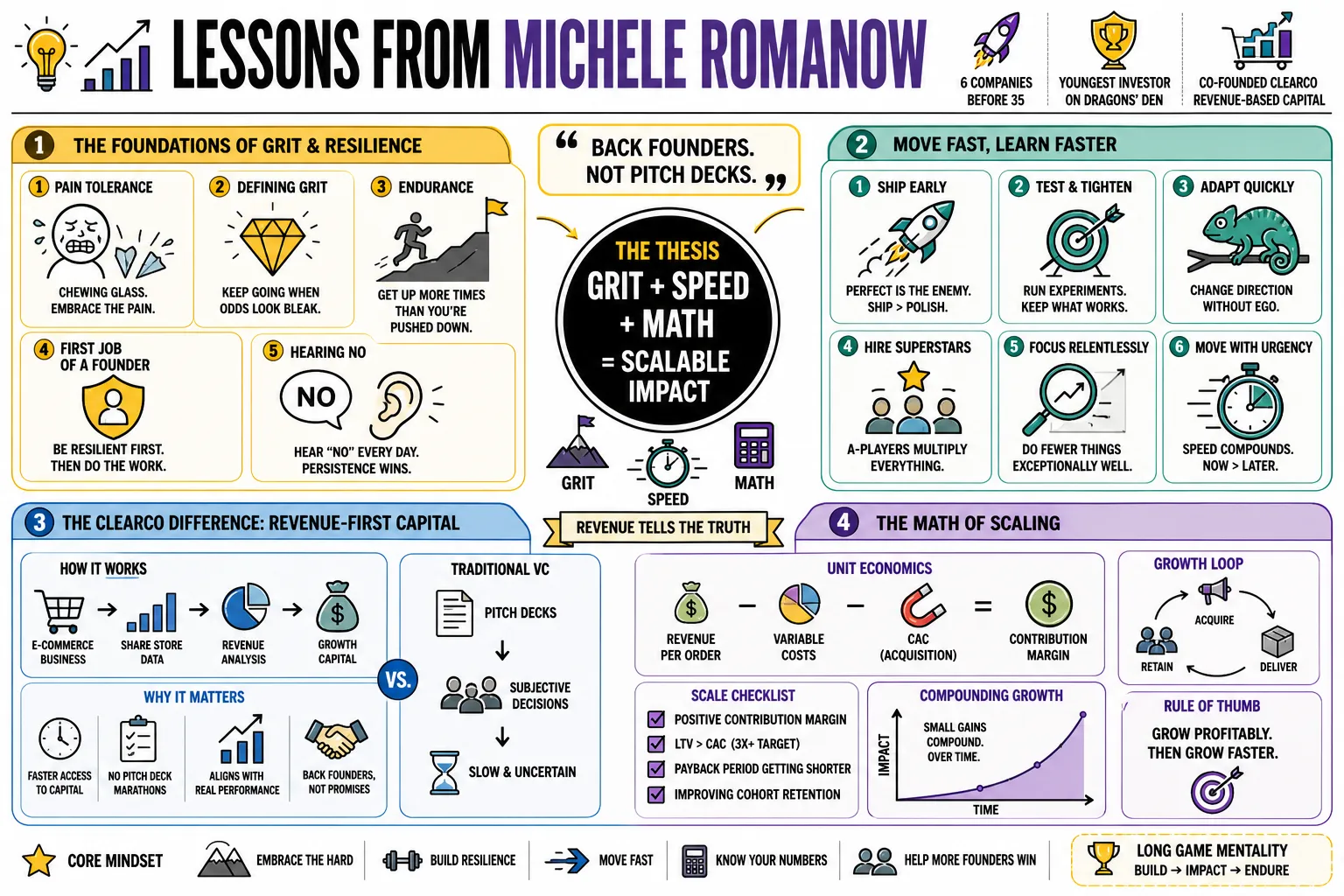
Lessons from Michele Romanow
Michele Romanow built six companies before turning 35 and became the youngest investor on CBC's Dragons' Den. She is best known for co-founding Clearco, which funded e-commerce founders based on their revenue data rather than traditional venture capital pitches. This profile gathers her most direct advice on surviving early failures, moving quickly, and the exact math required to scale a business.
Part 1: The Foundations of Grit & Resilience
- On Pain Tolerance: "There is a level of masochism and just plain pain tolerance—like chewing glass—that is involved in building a company." — Source: Nuvo Magazine
- On Defining Grit: "There’s this trait, and the only way to describe it is 'grit.' Does this person really have what it takes to keep doing this, even when the odds just seem so bleak?" — Source: Speakers.ca
- On Endurance: "It’s just about whether you are going to get up more times than you’re being pushed down." — Source: Speakers.ca
- On the First Job of a Founder: "An entrepreneur's first job is to be resilient, then the real work can begin." — Source: Speakers.ca
- On Hearing No: Being an entrepreneur means hearing "no" every day, and success comes from the capacity to endure an enormous amount of failure without being knocked out. — Source: Web Summit
- On the High-Impact Sport: Entrepreneurship is a high-impact sport where things will blow up every week; the key is to remain calm and treat stress as a motivator. — Source: RBC Direct Investing
- On Doing the Hard Things: "Successful people do what unsuccessful people aren’t willing to do." — Source: Maclean's
- On the 80% Failure Rate: 80% of her own ideas fail, and the 20% that work are found only by pushing through those failures. — Source: Elle Canada
- On Emotional Stamina: You must build the stamina to survive constant rejection, treating each "no" as a data point rather than a personal defeat. — Source: Kara Goldin Show
Part 2: The Action-First Mindset
- On Execution vs. Ideas: "Successful business is built by 95% execution and 5% great ideas." — Source: Medium
- On the MBA Fallacy: "Entrepreneurs don't need an MBA; they need a GSD — a 'Get Sh*t Done' Degree." — Source: Medium
- On Speed to Market: "If you’ve launched and you’re not embarrassed about your first product, you haven’t launched fast enough." — Source: Medium
- On the Planning Trap: "Moving from planning into execution is so important—it is something I still have to force myself to do today." — Source: Medium
- On the 70% Factor: In the startup world, launching a "good enough" product quickly is better than a perfect one late; if you're 70% sure, move. — Source: Speakers.ca
- On the Illusion of Productivity: Planning is often a "crutch" that makes people feel productive without actually building anything of value. — Source: Web Summit
- On the Real World vs. Plans: Your original plan will likely be 90% wrong once it hits the real world; the only way to figure out a business is by actually building it. — Source: Web Summit
- On Taking the Plunge: Starting a business is like jumping into a cold swimming pool—you will never feel ready, but you only figure out how to swim once you are in it. — Source: Women of Influence
- On the Value of Speed: "Being an entrepreneur is not about being perfect. It's about executing at triple the speed of anyone else." — Source: Side Hustle Lab
- On Reversible Decisions: Make reversible decisions instantly, and only slow down for the few decisions that are truly permanent one-way doors. — Source: Newswire
Part 3: Lessons from Early Failures
- On Normalizing Failure: "For every one successful business I’ve started, I’ve had five that have been complete failures. There’s nothing wrong with that." — Source: Speakers.ca
- On Unseen Struggles: "Businesses are complete chaos and almost fail a hundred times before they’re successful. You just talk about your greatest hits." — Source: Nuvo Magazine
- On the Gruelling Reality: Starting Evandale Caviar was incredibly demanding; it meant hauling sturgeon and having hands deep in fish processing. — Source: CBC
- On Scrappy Learning: When her team didn't know how to process sturgeon, they figured it out by watching Russian YouTube videos. — Source: Medium
- On the Illusion of the Business Plan: "The lesson here is just because we had a business plan, nothing in reality happened that way. We learned that through execution and perseverance." — Source: Medium
- On Macro-Economic Timing: Even a strong thesis—like supplying caviar to chefs—can fail if macro-economic timing, such as the 2008 recession, turns against you. — Source: Scribd
- On Failing Early: Getting your first few businesses out of the way early in your working life creates the time, room, and capital for a true success later. — Source: Forbes
- On Bureaucracy: Launching The Tea Room at Queen's University taught her how to navigate strict institutional bureaucracy while still a student. — Source: Queen's University
- On Projects vs. Businesses: Call early ideas "projects" rather than "businesses" to reduce the fear of failure and prevent the venture from feeling "too big to fail." — Source: Careers and Education
Part 4: Iteration, Pivoting, & Finding the "Unfair Right"
- On Iteration: "Innovation comes from iteration. It comes from trying a lot of things." — Source: Nuvo Magazine
- On Failure as a Byproduct: "Failure is a byproduct of success. You have to be trying enough things." — Source: [YouTube: Michele Romanow]
- On Zero-Budget Marketing: With Buytopia, they lacked marketing funds, so they used sidewalk chalk to write the daily deal outside major Toronto office buildings. — Source: Canadian Business
- On Launching Imperfectly: Buytopia's first website was essentially a JPEG image with a working "Buy" button, yet it made $10,000 in sales on the first day. — Source: Speakers.ca
- On Growth via Acquisition: In a crowded market, acquiring competitors—like Buytopia buying out ten rivals—is a highly effective way to scale quickly. — Source: Speakers.ca
- On the Unfair Right to Win: Always look for a business’s unique advantage; for SnapSaves, it was the specific receipt data that CPG companies desperately needed. — Source: Built to Sell
- On the Fifth Iteration: SnapSaves was the fifth or sixth iteration in the coupon space, proving that success rarely comes from the first version of an idea. — Source: Financial Post
- On Knowing Your Worth: When negotiating the sale of SnapSaves to Groupon, she pushed back hard until they doubled their original offer. — Source: All American Speakers
- On Finding the Right Mechanic: They had to continually refine their grocery app model until they landed on the simple "snap a receipt" mechanic that finally resonated with users. — Source: Speakers.ca
Part 5: Rethinking Capital & Removing Bias
- On Democratizing Capital: Traditional venture capital is heavily biased and inefficient for e-commerce, operating on historical patterns rather than current performance. — Source: Women of Influence
- On Removing Bias via AI: By using AI to evaluate business health based on data rather than a founder's background, capital allocation becomes significantly fairer. — Source: Forbes
- On Funding Women: Data-driven models like Clearco's have proven capable of funding up to 25 times more women than the traditional VC industry average. — Source: Forbes India
- On Expensive Equity: Founders often make the mistake of giving away expensive equity to pay for predictable expenses like Facebook ads or inventory. — Source: Nuvo Magazine
- On Revenue-Based Financing: Revenue share models allow founders to secure capital for growth without sacrificing equity or providing personal guarantees. — Source: Women of Influence
- On Objective Metrics: The algorithm ignores pedigree, asking instead, "Does this dollar spent on ads return three dollars in revenue?" — Source: Forbes
- On the Blind Investment: Connecting data sources directly to an AI removes the months of networking and schmoozing typically required to secure funding. — Source: Women of Influence
- On the 20-Minute Term Sheet: Automating due diligence means term sheets can be generated in minutes, matching the speed at which modern founders operate. — Source: Forbes
- On Geographic Bias: Clearco proved that talent is everywhere but capital is not, by funding companies across all 50 states and bypassing the usual VC hubs. — Source: Forbes
- On Solving Personal Pain Points: Disruption often comes from entering an industry as a customer; Clearco was built to solve the exact funding pains she faced in her earlier e-commerce companies. — Source: Shawn Kanungo
Part 6: Pitching & Investment
- On Knowing Your Numbers: Founders must know their customer acquisition cost (CAC), lifetime value (LTV), and margins inside out before stepping into a pitch. — Source: [YouTube: Michele Romanow]
- On the Human Element: A pitch should be deeply personal because investors aren't just backing a spreadsheet; they are betting on the human behind it. — Source: [YouTube: Michele Romanow]
- On Win-Win Models: The strongest business models naturally benefit all parties involved, creating aligned incentives across the ecosystem. — Source: [YouTube: Michele Romanow]
- On the Class Clown Trait: People who fundamentally questioned the rules in grade school often have the exact temperament needed to challenge industry norms at 21. — Source: AppDirect
- On Approaching the Pitch: Prepare to hear 99 "nos" for every one "yes" when fundraising, and do not let the rejection slow your momentum. — Source: Elle Canada
- On the Outsider Advantage: Entrepreneurs entering from completely outside an industry often possess a competitive advantage because they aren't bound by legacy thinking. — Source: Kara Goldin Show
- On Storytelling: The real currency of entrepreneurship and pitching is the ability to craft a compelling, legible narrative around your data. — Source: Libsyn
- On Adaptability over Products: Because markets and products will inevitably shift, the true investment is in a founder’s proven ability to adapt. — Source: Shawn Kanungo
- On Recognizing Smoke: Having built multiple companies from scratch, she can instantly spot when a founder is obscuring weak unit economics with vanity metrics. — Source: Nuvo Magazine
Part 7: Productivity, Focus, & Decision-Making
- On the Rule of Three: Avoid long to-do lists; use a small sticky note every morning to define the three most important needle-moving tasks of the day. — Source: Newswire
- On Eating the Frog: Always tackle the hardest, most complex task first thing in the morning when your willpower is at its highest. — Source: Newswire
- On the Two-Minute Rule: If an email or administrative task takes less than two minutes, handle it immediately so it doesn't linger as mental background noise. — Source: Newswire
- On Strategy Legibility: Your core business strategy should be simple and clear enough to fit entirely on a single Post-it note. — Source: Speakers.ca
- On the Pomodoro Sprint: Use 25-minute segments of intense, deep focus with the phone face down to manage time across multiple ventures. — Source: Newswire
- On the Fun List: Keep a running list of low-energy tasks (like ordering supplies or sending notes) to execute during "dead time" in transit. — Source: Newswire
- On Low-Tech Focus: Use pen and paper for note-taking in meetings to remain fully present and avoid the constant distraction of screens. — Source: Speakers.ca
- On Engineering the Mind: An engineering background teaches you "how to learn" and how to systematically deconstruct complex operational problems. — Source: [YouTube: Michele Romanow]
- On Fluidity with Numbers: Developing quick mental math skills for margins and conversion rates is essential for rapid, real-time decision-making. — Source: Careers and Education
- On Unlearning Perfectionism: You have to actively force yourself to sacrifice polish for speed, trusting that the market's feedback loop is superior to isolated planning. — Source: [YouTube: Michele Romanow]
Part 8: The Reality of the Entrepreneurial Lifestyle
- On True Job Satisfaction: "What produces a dream job is having control: Control over the people and the colleagues you work with... Control over the types of problems you take on." — Source: Speakers.ca
- On Building Your Own Path: "I think if you’re not happy in a job, you should go build your own job... no one’s going to tell me not to." — Source: Speakers.ca
- On the Exhilaration of Creation: "There is nothing that beats the exhilaration of building something from nothing." — Source: Nuvo Magazine
- On Ignoring Bias: "If you go through this world looking for things that are red, you will find things that are red... You just need to believe in yourself and not notice this stuff." — Source: Speakers.ca
- On Boundaries: In the early days, she worked 12-hour days for 20 years, ignoring boundaries simply because she wanted to win. — Source: Speakers.ca
- On Starting Young: The best time to launch a business is before acquiring major life responsibilities like a mortgage, when the absolute cost of failure is lowest. — Source: Speakers.ca
- On Sprinting vs. Resting: The entrepreneurial lifecycle isn't a steady 9-to-5; it requires intense 20-hour "sprints" to close deals, followed by deliberate periods of rest and recovery. — Source: [YouTube: Michele Romanow]
- On Team Selection: Choose your co-founders carefully, as these are the people you will spend 12 grueling hours a day with during the hardest parts of your life. — Source: Careers and Education
- On the Internal Education: Implementing "Founder School" for employees ensures that everyone in the company understands the visceral mechanics and struggles of building a business. — Source: Women of Influence